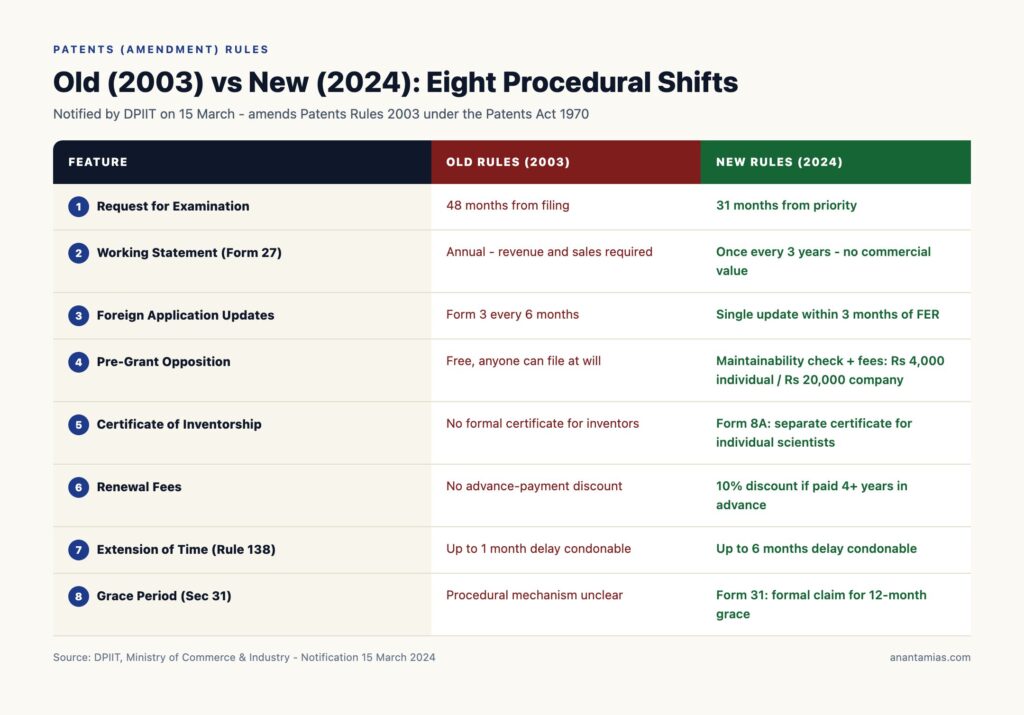
The Patents (Amendment) Rules, 2024, notified by the Department for Promotion of Industry and Internal Trade (DPIIT) on March 15, 2024, are the most significant overhaul of India’s patent procedural framework since the Patents Rules, 2003 came into force two decades earlier. The amendment does not change the Patents Act, 1970 itself; the substantive law on what is patentable, what counts as inventive step, and what constitutes “evergreening” under Section 3(d) remains untouched. What changes is the plumbing: timelines, forms, fees, and who gets recognised on the certificate.
The case for the amendment was straightforward. Indian patent applications had quadrupled since 2014, but the time from filing to first examination was among the longest in the major patent jurisdictions, the Working Statement (Form 27) was a paperwork ritual that produced little useful data, and the pre-grant opposition system had become a tactical delay weapon for competitors. DPIIT’s brief was to compress timelines, reduce compliance friction for the Form-27 universe, give individual scientists their own certificate, and put a price tag on frivolous oppositions.
For an aspirant, the rules sit at the intersection of GS-III (science and technology, intellectual property, indigenous innovation), GS-II (governance, ease of doing business), and prelims (legislation in news, government schemes). They also link to the Indian National IPR Policy of 2016, the Trade-Related Aspects of Intellectual Property Rights (TRIPS) Agreement, the Mission Karmayogi-style productivity push within DPIIT, and the broader Atmanirbhar Bharat agenda. This guide rebuilds the topic for full coverage.
Quick Facts
- Notification date: March 15, 2024
- Issued by: Department for Promotion of Industry and Internal Trade (DPIIT), Ministry of Commerce and Industry
- Statute amended: Patents Rules, 2003 (under the Patents Act, 1970)
- Headline change: Request for Examination (RFE) timeline reduced from 48 months to 31 months from the date of priority
- Working Statement: Frequency reduced from annual to once every 3 financial years
- New form: Form 8A (Certificate of Inventorship), Form 31 (grace period claim)
- Pre-grant opposition: Now requires fees (Rs 4,000 individuals, Rs 20,000 companies)
- Renewal fees: 10% discount if paid in advance for 4+ years
- Extension of time (Rule 138): Controller can condone delay of up to 6 months
- GS paper relevance: Prelims (Government Schemes, Polity), GS-II (Governance, Statutes), GS-III (Science and Technology, Indigenisation)
What the Patents (Amendment) Rules, 2024 Are
The 2024 Rules are a procedural amendment notified under the rule-making power conferred by the Patents Act, 1970. They modify the Patents Rules, 2003, which set out the forms, timelines, and fees applicable to filing and prosecuting Indian patents. The amendment came into effect on the date of notification and applies to applications already in the system as well as fresh filings, with transitional savings for steps already taken under the old framework.
The rules pursue four explicit goals: (a) compress examination and grant timelines so Indian patents are not commercially stale by the time they issue; (b) shrink the compliance load for patentees and applicants, particularly startups, MSMEs, and educational institutions; (c) give individual inventors statutory recognition independent of the corporate applicant; and (d) bring procedural clarity to pre-grant opposition, which had been weaponised in pharma and electronics filings.
Background and Historical Context
India’s modern patent regime begins with the Patents Act, 1970, which replaced the colonial-era Indian Patents and Designs Act, 1911. The 1970 Act, drafted under the influence of the Justice Ayyangar Committee Report, was deliberately patient-favouring: process patents only for food, chemicals, and pharmaceuticals; a 7-year term for those process patents; and Section 3 exclusions designed to prevent monopolisation of essential medicines. This regime made India the “pharmacy of the developing world” through the 1980s and 1990s.
The TRIPS Agreement of 1995, signed as part of the Uruguay Round of GATT negotiations that created the WTO, required India to introduce product patents in pharmaceuticals and to grant a uniform 20-year term. India phased compliance through three amendments to the Patents Act in 1999, 2002, and 2005. The 2005 amendment introduced product patents for pharmaceuticals, food, and chemicals; it also added Section 3(d), which prevents patents on new forms of known substances unless they show enhanced efficacy. Section 3(d) survived a constitutional challenge in the Supreme Court’s Novartis v. Union of India judgement of 2013 (the Glivec case), establishing India’s anti-evergreening shield.
The Patents Rules, 2003 set out the procedural framework: forms, fees, timelines for filing, examination, opposition, and renewal. Over twenty years, the rules accumulated friction. Examiner backlogs lengthened, the Form-27 working statement requirement was honoured in the breach, and a series of high-profile pre-grant oppositions (against Gilead, Bayer, and others) raised concerns about both genuine and tactical uses of the system.
The National IPR Policy of 2016, drafted under the chairmanship of Justice Prabha Sridevan, set seven objectives including IPR awareness, generation, legal framework, administration, commercialisation, enforcement, and human capital. The 2024 Rules implement Objective 3 (legal and legislative framework) and Objective 4 (administration and management) by procedurally tightening what the 2003 Rules had set out.
Detailed Analysis: Eight Key Changes
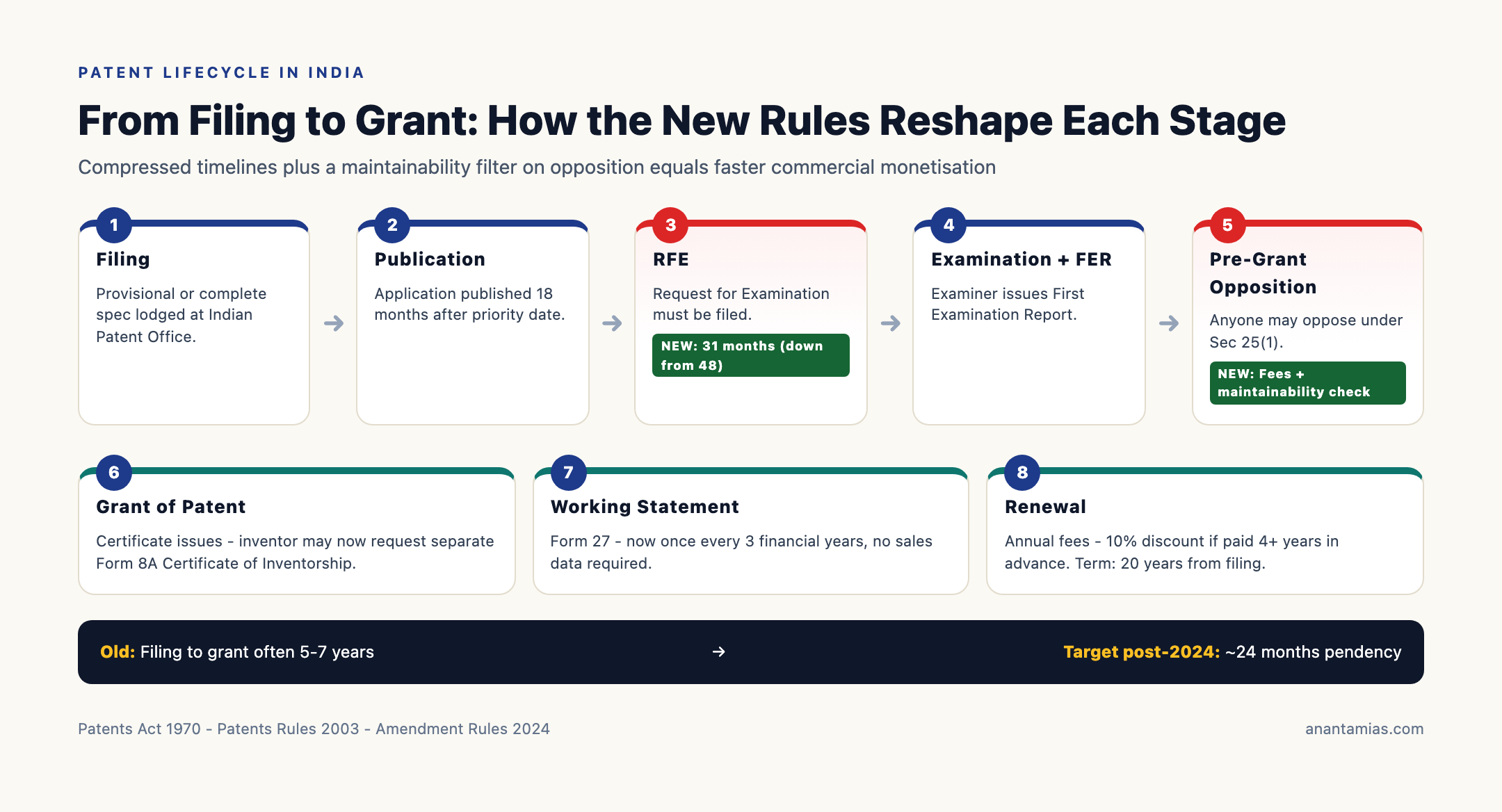
1. Request for Examination (RFE) Timeline Compressed
Old: 48 months from the date of priority (or filing, if earlier). New: 31 months from the date of priority.
This is the most consequential change for applicants. RFE is the formal step that triggers substantive examination. Compressing it by 17 months means examiners must begin work earlier, which in turn pulls forward the grant date. Combined with administrative push to fill examiner vacancies in the Indian Patent Office, the goal is to bring India’s average pendency closer to the 18 to 24 months seen in the US Patent and Trademark Office and the European Patent Office.
2. Working Statement (Form 27) Streamlined
Old: Annual filing; required commercial value, sales data, licensee details. New: Once every three financial years; commercial value and sales data no longer required.
Form 27 had become a paperwork ritual. Many applicants either skipped it or filed boilerplate that shed no light on whether the patent was worked in India. The new rule reduces filing frequency by two-thirds and limits required disclosure to whether the patent is being worked or not, with reasons if not. The trade-off is that public-interest researchers and competition lawyers lose detailed sales data; supporters argue the data was unreliable anyway.
3. Foreign Application Updates
Old: Applicants had to file Form 3 every six months disclosing foreign filings on corresponding inventions. Failure was a frequent ground for revocation under Section 64. New: Single Form 3 update required within three months of the First Examination Report (FER); the 6-month rolling obligation is removed.
This is a significant relief for multinational applicants who file in dozens of jurisdictions. The earlier rule produced over-filing and missed deadlines without commensurate examination value. The new approach delivers the foreign-filing landscape to the examiner at the point it is most useful (during examination) rather than as a continuous reporting burden.
4. Pre-Grant Opposition Reformed
Old: Pre-grant opposition under Section 25(1) was free of cost. Anyone could file at any point before grant; the Controller had to consider every opposition. New: A maintainability check is introduced before notice goes to the applicant; fees are now levied (Rs 4,000 for individuals, Rs 20,000 for companies); the Controller decides on prima facie validity first.
This change is the most contested. Civil society groups argue pre-grant opposition is a vital public-interest tool, especially in pharmaceutical patenting, and that fees raise the bar for affected patient groups, generic manufacturers, and academic experts. Industry argues that vexatious oppositions, often filed by shell entities to delay grant, gamed the system and that fees plus a maintainability filter restore balance. The rule also tightens timelines: the Controller must decide on the maintainability question quickly, and the applicant gets a clearer procedural map.
5. Certificate of Inventorship (Rule 70A)
Old: The patent certificate listed only the applicant (typically the company). The actual scientists and engineers behind the invention had no statutory document recognising their contribution. New: Inventors can apply for a separate Certificate of Inventorship using Form 8A. The certificate names the individual(s) and is independent of the assignment of patent rights to the employer.
This is symbolically and substantively important. Inventors at corporate or institutional R&D arms now have a portable record of their contribution that they can cite in CV, performance review, and award nomination contexts. The IISc, the IITs, the CSIR network, and DRDO have lobbied for this for over a decade.
6. Grace Period Operationalised (Form 31)
Old: Section 31 of the Patents Act provided a 12-month grace period for inventions disclosed at government-notified exhibitions or read before learned societies. The procedural mechanism for claiming this benefit was unclear. New: Form 31 is introduced as the formal claim mechanism. The applicant can file Form 31 at the time of patent application, specifying the prior disclosure event and date.
This matters disproportionately for academic inventors and Indian Institute scientists, who frequently publish or present before filing for a patent and then lose patentability because of self-disclosure.
7. Renewal Fee Discount and Extension Power
Renewal: A 10% discount is offered on renewal fees if paid in advance for four years or more, encouraging applicants to keep patents active.
Extension of Time (Rule 138): The Controller’s power to condone delay is expanded from up to one month to up to six months, on a request and payment of prescribed fees. This cushions inadvertent missed deadlines that previously caused fatal abandonment.
8. Divisional Application Clarity
The new rules clarify the scope of divisional applications under Section 16, including the ability to file divisionals based on subject matter disclosed in the provisional or complete specification, in line with the Delhi High Court ruling in Syngenta Ltd. v. Controller of Patents.
Why It Matters: Who Gains and Who Loses
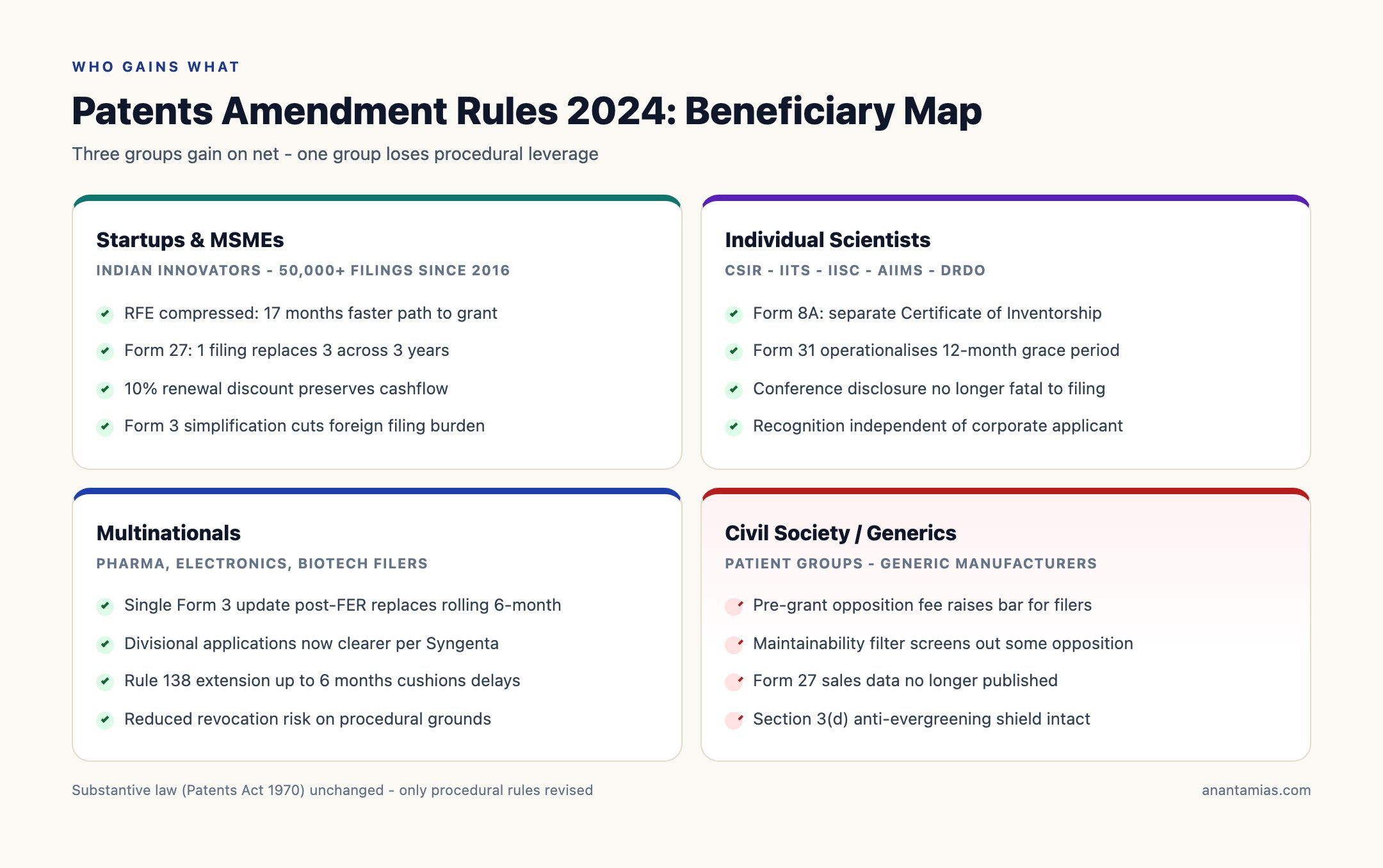
Startups and MSMEs gain from compressed timelines, lighter Form-27 burden, simpler foreign-filing reporting, and the renewal discount. Indian startup IPR filings have grown faster than the corporate average; faster grant means faster monetisation through licensing or collateralised debt.
Individual scientists and academics gain disproportionately from the Certificate of Inventorship and the operationalised grace period. The CSIR network, IITs, AIIMS, and IISc filed approximately 25% of all Indian-origin patents over the last decade; their researchers now have statutory recognition.
Multinational corporations gain from the simpler Form 3 regime and the divisional clarity. The cost of running a globally synchronous patent portfolio in India falls.
Generic pharmaceutical manufacturers and patient groups face a more contested landscape in pre-grant opposition because fees and maintainability filters raise procedural friction. The substantive law (Section 3(d)) is unchanged, but the tactical use of pre-grant opposition is curtailed.
Public-interest researchers lose detailed Form 27 sales data, which was sometimes used to assess whether patented drugs were affordably available in India.
Comparative: Indian Procedural Reform vs Major Patent Offices
| Parameter | India (post-2024) | USPTO | EPO | China (CNIPA) |
|---|---|---|---|---|
| RFE timeline | 31 months | Implicit at filing | 6 months from search report | Implicit at filing |
| Average pendency | Targeted ~24 months | ~22 months | ~24 months | ~18 months |
| Working statement | Triennial | None | None | None |
| Pre-grant opposition fees | Yes | Pre-grant unavailable; only post-grant | Pre-grant unavailable | Yes |
| Inventor certificate | Yes (Form 8A) | Inventors named on patent | Inventors named on patent | Yes |
| Grace period | 12 months (Sec 31) | 12 months | None (limited) | 6 months (limited) |
India’s reformed regime is now more procedurally aligned with major jurisdictions on examination timelines, while retaining distinctive features (Section 3(d), Working Statement, pre-grant opposition) that reflect its public-health and access-to-medicines policy choices.
Challenges and Risks
- Examiner capacity: Compressed timelines are meaningful only if the Indian Patent Office has the examiner strength to deliver. DPIIT must keep recruiting and retaining technical examiners across pharma, biotech, electronics, and AI.
- Quality versus speed: Faster grant must not come at the cost of grant quality; weak patents invite costly litigation and undermine the regime’s credibility.
- Pre-grant opposition equity: The fee structure must not deter genuine opponents; civil society groups have demanded fee waivers for affected patient groups and academic experts.
- Form 27 transparency loss: The reduced reporting may make it harder to evaluate whether patented essential medicines are being worked in India.
- Awareness gap: Many Indian universities and startups remain under-aware of procedural rights such as the Certificate of Inventorship. A sustained awareness campaign by IP Office and CIPAM is essential.
- TRIPS compliance: Future amendments must continue to balance domestic objectives with India’s TRIPS obligations and ongoing scrutiny by trading partners.
Prelims Pointers
- The Patents (Amendment) Rules, 2024 were notified on March 15, 2024 by DPIIT.
- The Rules amend the Patents Rules, 2003 under the Patents Act, 1970.
- Request for Examination must be filed within 31 months of priority (down from 48).
- Form 27 (Working Statement) is now filed once every 3 financial years.
- New forms introduced: Form 8A (Certificate of Inventorship), Form 31 (grace period claim).
- Pre-grant opposition fees: Rs 4,000 (individuals), Rs 20,000 (companies).
- Section 3(d) of the Patents Act prevents evergreening; upheld in Novartis v. Union of India (2013).
- The National IPR Policy, 2016 has 7 objectives; the 2024 Rules implement Objectives 3 and 4.
- CIPAM (Cell for IPR Promotion and Management) sits under DPIIT.
- The TRIPS Agreement came into force on January 1, 1995 under the WTO.
- India’s patent term is 20 years from the date of filing.
Mains Practice Questions
- GS-III: Discuss the salient features of the Patents (Amendment) Rules, 2024. How do these rules balance the objectives of ease of doing business with public-interest concerns embedded in the Patents Act, 1970? (250 words)
- GS-III: “The Certificate of Inventorship is a long-overdue recognition of individual scientific contribution in India.” Examine the rationale, scope, and implications of this provision. (150 words)
- GS-III: Critically evaluate the changes to pre-grant opposition under the Patents (Amendment) Rules, 2024. Have they tilted the balance in favour of applicants at the cost of public-health safeguards? (250 words)
- GS-III: Trace the evolution of India’s patent law from the Patents Act, 1970 to the Patents (Amendment) Rules, 2024. Highlight how each major reform balanced TRIPS obligations with domestic priorities. (250 words)
Way Forward
Procedural reform must be matched by capacity reform. The Indian Patent Office should publish quarterly disposal statistics, examiner-to-application ratios, and median pendency by technology field, mirroring the transparency of the USPTO and EPO dashboards. The grant of every patent should be cross-referenced with the Working Statement so that India can credibly answer questions about whether granted patents are commercially active.
The Section 3(d) bar on evergreening must be administratively reinforced. DPIIT should publish an updated examination manual that compiles post-Novartis case law on enhanced efficacy, clearly distinguishing patentable improvements from frivolous secondary patents. Similarly, the Compulsory Licensing framework under Section 84 should be reviewed; it has been used only once in Indian history (the 2012 Bayer Nexavar case), and its dormancy raises legitimate questions.
The next round of reform should consider digital filing improvements (mandatory machine-readable specifications, AI-assisted prior art search) and stronger linkage with the Traditional Knowledge Digital Library to prevent biopiracy patents. The Intellectual Property Appellate Board (IPAB), abolished in 2021, has not been adequately replaced by the High Courts handling appeals; this gap will widen as filings rise and merits reconsideration.
Patent reform is, ultimately, an industrial policy question. India’s patent regime is the legal scaffolding under which Atmanirbhar Bharat must produce world-class pharmaceuticals, semiconductors, biotech, and quantum-grade hardware. The Patents (Amendment) Rules, 2024 are a strong step in modernising that scaffolding. The next steps will determine whether the building it supports rises to global stature.
Frequently Asked Questions
What are the Patents (Amendment) Rules, 2024 and when did they come into force?
The Patents (Amendment) Rules, 2024 were notified by the Department for Promotion of Industry and Internal Trade (DPIIT) on March 15, 2024. They are a procedural amendment to the Patents Rules, 2003 made under the rule-making power of the Patents Act, 1970, and they came into effect on the date of notification.
How does the new Request for Examination timeline change patent prosecution?
The Request for Examination (RFE) must now be filed within 31 months of the date of priority, down from the earlier 48 months. This compresses the period before substantive examination begins by 17 months and accelerates the overall path from filing to grant.
What is the new approach to Form 27 (Working Statement)?
Form 27 is now filed once every three financial years instead of annually, and the requirement to disclose commercial value and sales data is removed. Patentees only need to confirm whether the patent is being worked in India, with reasons if not.
What is the Certificate of Inventorship and who can apply?
The Certificate of Inventorship, introduced under Rule 70A and claimed via Form 8A, is a separate statutory certificate naming the individual scientist or engineer behind a patented invention. It is independent of the assignment of patent rights to the employer and is available to any inventor named on a granted Indian patent.
Are pre-grant oppositions still available after the 2024 amendment?
Yes. Pre-grant opposition under Section 25(1) of the Patents Act remains available, but the procedural framework has changed. The Controller now performs a maintainability check before notifying the applicant, and fees of Rs 4,000 (individuals) or Rs 20,000 (companies) are levied. The substantive grounds for opposition are unchanged.
Does the amendment alter Section 3(d) of the Patents Act?
No. Section 3(d), which prevents patenting of new forms of known substances unless they show enhanced therapeutic efficacy, is part of the Patents Act, 1970, not the Patents Rules. The 2024 amendment is procedural and does not touch Section 3(d) or any other substantive provision of the Act.
How does Form 31 help academic inventors?
Form 31 operationalises the 12-month grace period under Section 31 of the Patents Act. It allows an applicant to formally claim that prior public disclosure (at a government-notified exhibition or before a learned society) does not destroy patentability, which is particularly valuable for academic researchers who present at conferences before filing.
What is the renewal fee discount in the new Rules?
A 10% discount is available on renewal fees if the applicant pays in advance for four or more years. This incentivises long-term maintenance of patents and reduces administrative burden on the Patent Office.
How do the new Rules affect multinational corporations filing in India?
Multinationals benefit primarily from the simpler Form 3 regime: foreign filing details are now reported once within three months of the First Examination Report, replacing the earlier rolling 6-month update. The risk of revocation for missed Form 3 deadlines, a common ground in the past, is significantly reduced.
How do the 2024 Rules connect to the National IPR Policy of 2016?
The 2016 National IPR Policy set out seven objectives for India’s IP regime, including legal framework reform and administrative efficiency. The 2024 Rules implement Objectives 3 (legal and legislative framework) and 4 (administration and management) by procedurally tightening the Patents Rules, 2003, and reflect a decade of practitioner feedback gathered through DPIIT’s stakeholder consultations.
Tell Google you want more of this.
Add Anantam IAS as a preferred sourceOne tap, and this site shows up more often in your own Top Stories, AI Overviews and AI Mode. Remove it any time.