Quad Countries — India, US, Japan, Australia — Origins, Summits & UPSC IR Guide
Complete guide to the Quad (Quadrilateral Security Dialogue) covering member countries, origins, revival, key initiatives, strategic significance, and China factor for UPSC.
The Quad (Quadrilateral Security Dialogue) — comprising India, the United States, Japan, and Australia — has emerged as one of the most important strategic groupings in the Indo-Pacific region. From an informal consultation mechanism in 2007 to a leaders-level summit forum, the Quad’s evolution reflects shifting geopolitical dynamics and is one of the most frequently tested International Relations topics in UPSC.
What Is the Quad?
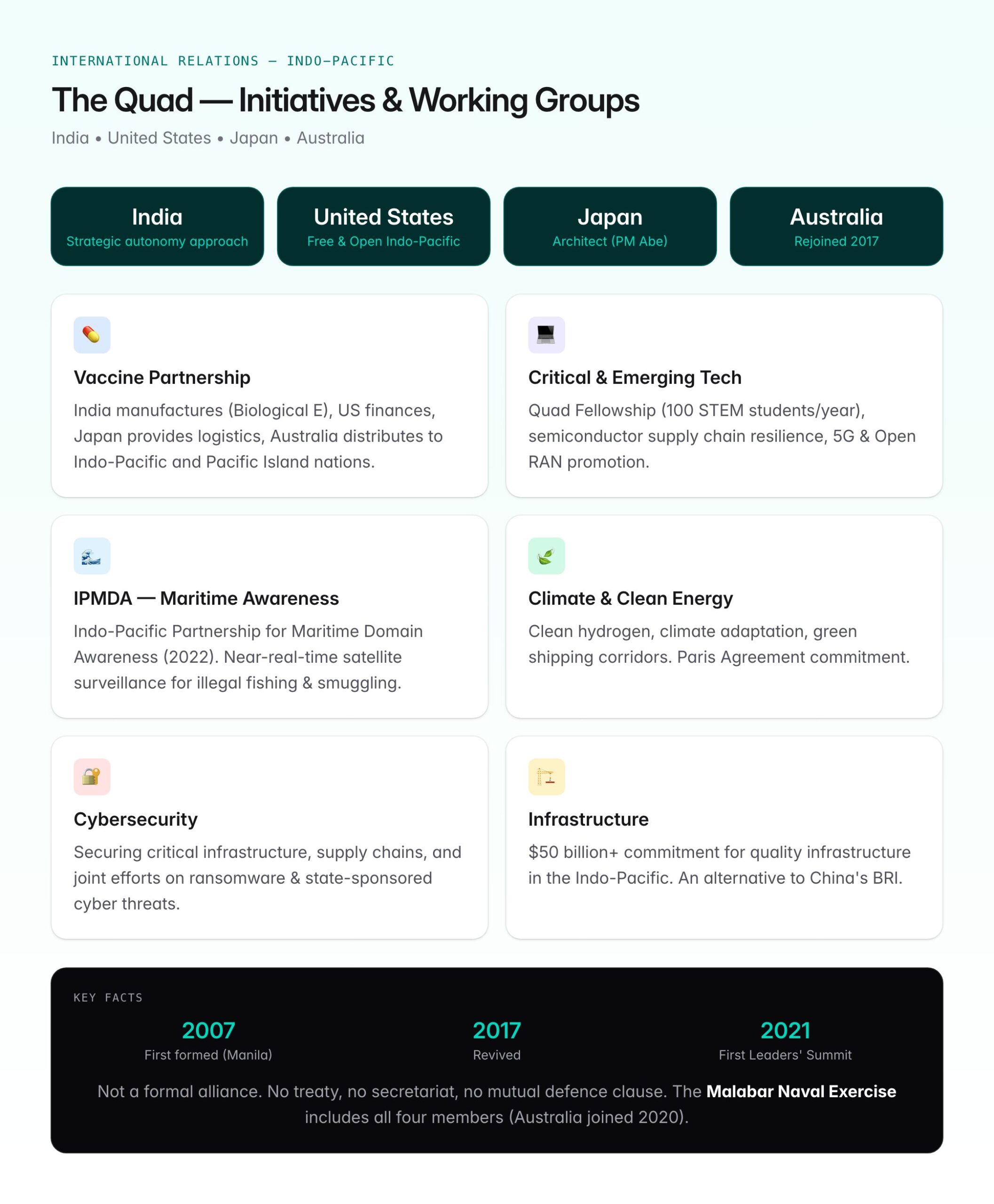
The Quad is an informal strategic dialogue between four democracies — India, the United States of America, Japan, and Australia. It is not a formal alliance, not a military pact, and has no treaty or secretariat. Instead, it functions as a platform for consultations on regional and global issues, with a shared commitment to a free, open, inclusive, and rules-based Indo-Pacific.
Key distinction: Unlike NATO, the Quad does not have a mutual defence clause. India has consistently maintained that the Quad is "not directed against any country" — a diplomatic formulation used to address China's concerns.
Origins — The 2004 Tsunami and 2007 Formation
The conceptual roots of the Quad trace back to Japanese Prime Minister Shinzo Abe’s vision of an “Arc of Freedom and Prosperity” and the concept of the “Confluence of the Two Seas” (the Pacific and Indian Oceans), articulated in his 2007 address to the Indian Parliament.
| Year | Event |
|---|---|
| 2004 | After the Indian Ocean tsunami, India, US, Japan, and Australia coordinated relief operations — an informal precursor |
| 2007 | First Quad meeting held on the sidelines of the ASEAN Regional Forum in Manila; initiated by PM Shinzo Abe |
| 2008 | Quad collapsed after Australia withdrew under PM Kevin Rudd, reportedly due to pressure from China |
| 2017 | Quad revived on the sidelines of the ASEAN Summit in Manila; all four countries recommitted |
| 2020 | Quad foreign ministers met in Tokyo; elevated to ministerial level |
| 2021 | First Quad Leaders' Summit (virtual, March); first in-person summit at the White House (September) |
| 2022 | Quad Leaders' Summit in Tokyo (May); PM Modi hosted the summit virtually in 2023 |
| 2023 | Hiroshima Quad Leaders' Summit on the sidelines of the G7 |
| 2024 | Quad Leaders' Summit in Wilmington, Delaware (hosted by President Biden) |
Why Was the Quad Revived in 2017?
The 2017 revival was driven by several converging factors:
- China's assertiveness: Militarisation of the South China Sea, the Belt and Road Initiative (BRI), and coercive economic practices.
- Doklam standoff (2017): The India-China military standoff at Doklam in Bhutan underscored the need for strategic coordination.
- Free and Open Indo-Pacific (FOIP): The US, Japan, India, and Australia converged on the concept of the Indo-Pacific as a single strategic theatre.
- Abe's persistent advocacy: Japan's PM Abe was the most consistent champion of the Quad framework.
- India's strategic shift: India moved from non-alignment hesitancy to active multi-alignment, embracing issue-based partnerships.
Quad Initiatives and Working Groups
Since the leaders-level elevation in 2021, the Quad has launched several concrete initiatives:
Vaccine Initiative
The Quad Vaccine Partnership was launched in 2021 to manufacture and distribute COVID-19 vaccines in the Indo-Pacific. India (Biological E), with US financing, Japanese logistics, and Australian distribution networks, aimed to deliver vaccines to Southeast Asian and Pacific Island nations.
Critical and Emerging Technologies
- Quad Fellowship Programme: Funds 100 students annually from Quad countries for STEM graduate studies in the US.
- Semiconductor supply chain resilience: Coordination on reducing dependence on single-source chip manufacturing.
- 5G and Open RAN: Promoting open and secure telecommunications infrastructure.
Maritime Domain Awareness (MDA)
The Indo-Pacific Partnership for Maritime Domain Awareness (IPMDA) was launched in 2022 to provide near-real-time surveillance of the maritime domain using commercial satellite data. This helps partner countries in the Indo-Pacific detect illegal fishing, smuggling, and other maritime threats.
Climate and Clean Energy
- Quad Climate Working Group focused on clean hydrogen, climate adaptation, and green shipping corridors.
- Commitment to the Paris Agreement targets.
Cybersecurity
- Cooperation on securing critical infrastructure and supply chains.
- Joint efforts on ransomware and state-sponsored cyber threats.
Infrastructure
- Quad Infrastructure Coordination Group: Aims to provide alternatives to China's BRI by supporting quality infrastructure in the Indo-Pacific.
- Commitment to financing over $50 billion in infrastructure and investment in the Indo-Pacific.
Health Security
- Cooperation on pandemic preparedness beyond COVID-19.
- Strengthening health supply chains in the Indo-Pacific.
The China Factor
While Quad members officially state that the grouping is "not directed against any country," the strategic context is inseparable from China's rise:
- China describes the Quad as an "Asian NATO" and views it as a containment strategy.
- India maintains strategic autonomy — it participates in the Quad but also engages with China bilaterally and through BRICS and the SCO.
- The Quad's emphasis on freedom of navigation, rules-based order, and territorial integrity implicitly addresses Chinese actions in the South China Sea, East China Sea, and along the India-China border.
- The Galwan Valley clash (2020) between India and China further pushed India towards deeper Quad engagement.
India's Position in the Quad
India's participation in the Quad is notable because it represents a departure from traditional non-alignment:
- India frames the Quad as a platform for positive cooperation (vaccines, climate, technology) rather than a military alliance.
- India has declined to join any formal alliance or mutual defence commitment.
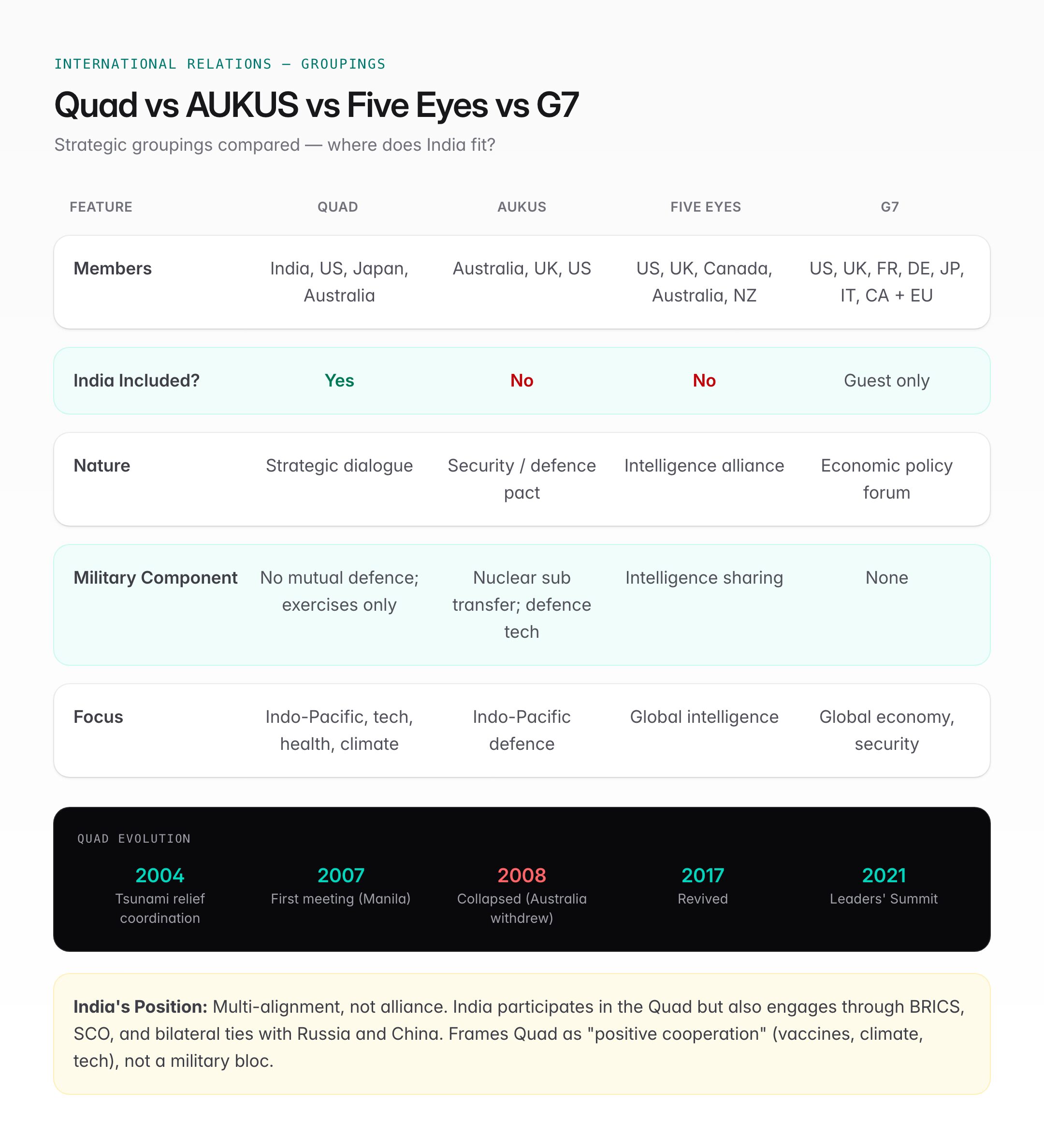
- India's participation is consistent with its multi-alignment approach — engaging simultaneously with the Quad, BRICS, SCO, and bilateral partnerships with Russia and China.
- India hosts the Malabar Naval Exercise with all Quad members — this exercise, which began as a bilateral India-US exercise in 1992, was expanded to include Japan (2015) and Australia (2020).
Quad vs Other Groupings
| Feature | Quad | AUKUS | Five Eyes | G7 |
|---|---|---|---|---|
| Members | India, US, Japan, Australia | Australia, UK, US | US, UK, Canada, Australia, NZ | 7 advanced economies + EU |
| India included? | Yes | No | No | No (guest) |
| Nature | Strategic dialogue | Security/defence pact | Intelligence alliance | Economic policy forum |
| Military component | No mutual defence; exercises only | Nuclear submarine transfer; defence tech | Intelligence sharing | None |
| Focus | Indo-Pacific, technology, health, climate | Indo-Pacific defence | Global intelligence | Global economy, security |
Criticism and Challenges
- Lack of institutionalisation: No treaty, no secretariat, no binding commitments — raising questions about durability.
- Divergent interests: India's strategic autonomy, Australia's economic dependence on China, and differing views on Russia (India's continued engagement with Moscow).
- Implementation gap: Many Quad initiatives are announced at summits but lack follow-through and funding.
- Perception management: Balancing the cooperative framing with the reality that the Quad is a response to China.
UPSC Relevance
GS Paper Mapping:
- Prelims: Quad member countries, year of formation, key initiatives (IPMDA, vaccine partnership, fellowship), Malabar Exercise.
- GS Paper II (Mains): India's foreign policy — bilateral and multilateral groupings, India-US/Japan/Australia relations, Indo-Pacific strategy.
- Essay: Multilateralism, strategic partnerships, India's role in the Indo-Pacific.
Key Prelims Facts:
- The Quad comprises India, the United States, Japan, and Australia.
- It was first formed in 2007, collapsed in 2008, and revived in 2017.
- The first Quad Leaders' Summit was held in March 2021 (virtual).
- The Quad has no treaty, secretariat, or mutual defence commitment.
- IPMDA (Indo-Pacific Partnership for Maritime Domain Awareness) was launched at the 2022 Tokyo summit.
- The Malabar Naval Exercise includes all four Quad members (Australia joined in 2020).
- The Quad Fellowship funds 100 STEM students annually from Quad nations.
- Japan's PM Shinzo Abe was the original architect of the Quad concept.
- India frames the Quad as a platform for positive cooperation, not a military alliance.
- The Quad's vision centres on a "free, open, inclusive, and rules-based Indo-Pacific."