Quantum Dots Explained: Nobel Prize 2023, Size-Tuned Colour, and Why Nanoscale Semiconductors Matter
A complete UPSC GS-III explainer on quantum dots and the 2023 Nobel Prize in Chemistry. Covers nanoscale semiconductor physics, quantum confinement, size-tuned colour, QLED displays, bio-imaging, solar cells, and India's stake in the quantum-materials race.
In October 2023, the Royal Swedish Academy of Sciences awarded the Nobel Prize in Chemistry to three researchers whose work changed what colour means in physics. Moungi Bawendi at MIT, Louis Brus at Columbia University, and Alexei Ekimov, a Soviet-born researcher who later worked at Nanocrystals Technology in New York, were honoured for the discovery and synthesis of quantum dots. The prize recognised something quietly remarkable. In quantum dots, the colour of a material is not determined by what the material is made of. It is determined by how big the particle is.
A quantum dot is a semiconductor crystal so small that the rules of quantum mechanics dominate over the rules of bulk materials. Typically one to ten nanometres across, it contains a few hundred to a few thousand atoms. Make it slightly bigger and it emits red light. Make it slightly smaller and it emits blue. The same material, the same chemistry, just a different size. This is quantum confinement, and it is the central idea that the 2023 Nobel Prize honoured.
For UPSC purposes, the topic sits at the intersection of nanotechnology, the National Quantum Mission, display and energy industries, and the broader race for quantum materials. The Nobel Prize is a hook, but the technology behind it is now embedded in everyday products and in next-generation research. This article walks through what quantum dots are, why size matters, what they are used for, and where India sits in the global quantum-materials story.
Quick Facts on Quantum Dots
A quantum dot is a nanoscale semiconductor particle, typically two to ten nanometres in diameter, in which electrons are confined in all three spatial dimensions. The confinement makes the energy levels of the electrons discrete, like those of an atom, even though the particle is made of bulk semiconductor material like cadmium selenide or indium phosphide.
The defining property is size-dependent optical behaviour. A smaller dot has more widely spaced energy levels, absorbs and emits higher-energy light, and appears blue. A larger dot has narrower spacing, lower-energy light, and appears red. The transition is continuous. By controlling synthesis to within a fraction of a nanometre, manufacturers produce dots that emit any colour across the visible spectrum from a single chemistry.
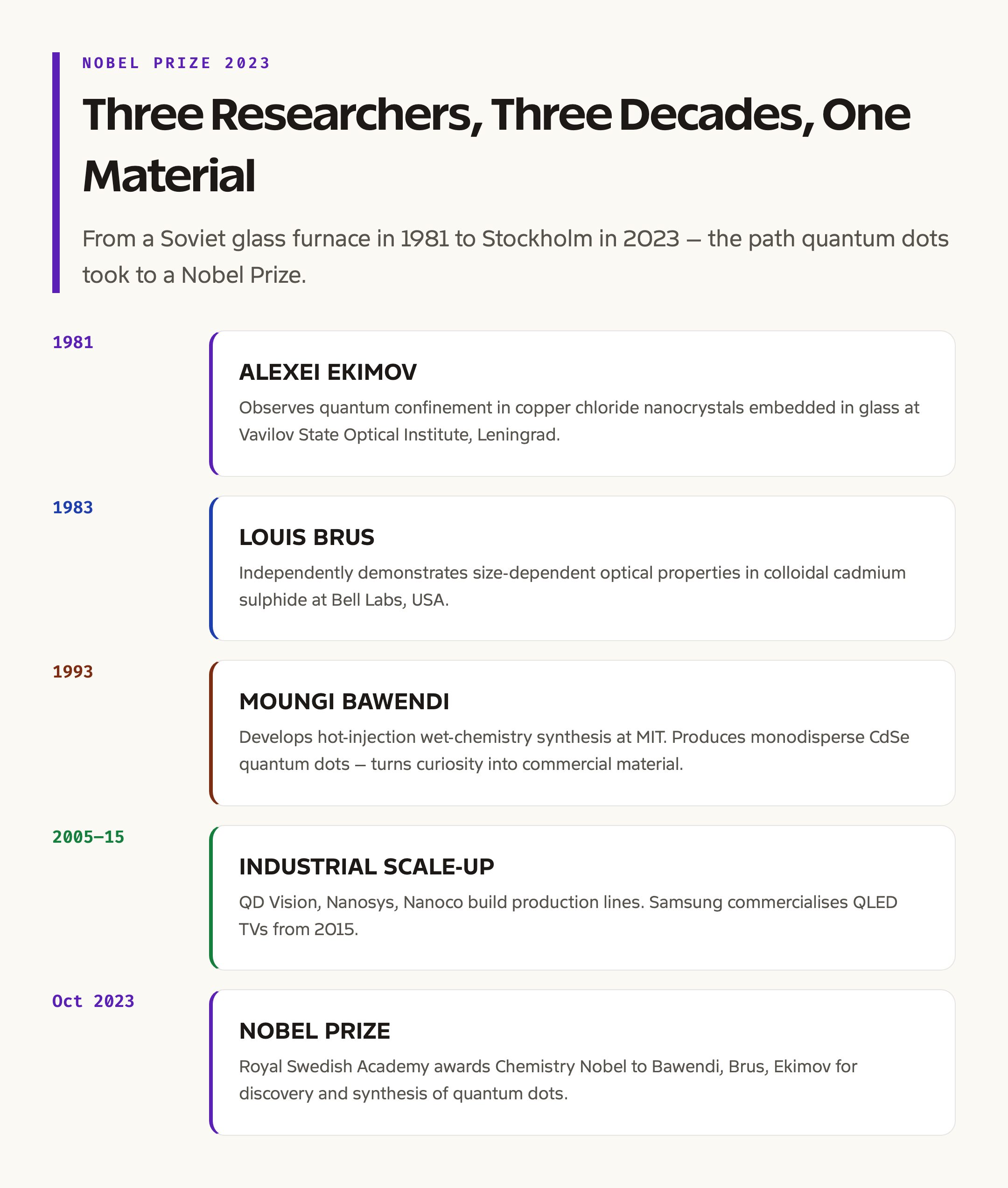
The 2023 Nobel Prize in Chemistry was awarded to three scientists. Alexei Ekimov first observed quantum confinement effects in glass-embedded copper chloride nanocrystals in 1981. Louis Brus independently discovered the same effects in colloidal suspensions in 1983. Moungi Bawendi developed in 1993 the wet-chemistry synthesis that produces uniform, high-quality quantum dots in large quantities. That synthesis turned quantum dots from a laboratory curiosity into an industrial material.
What a Quantum Dot Actually Is
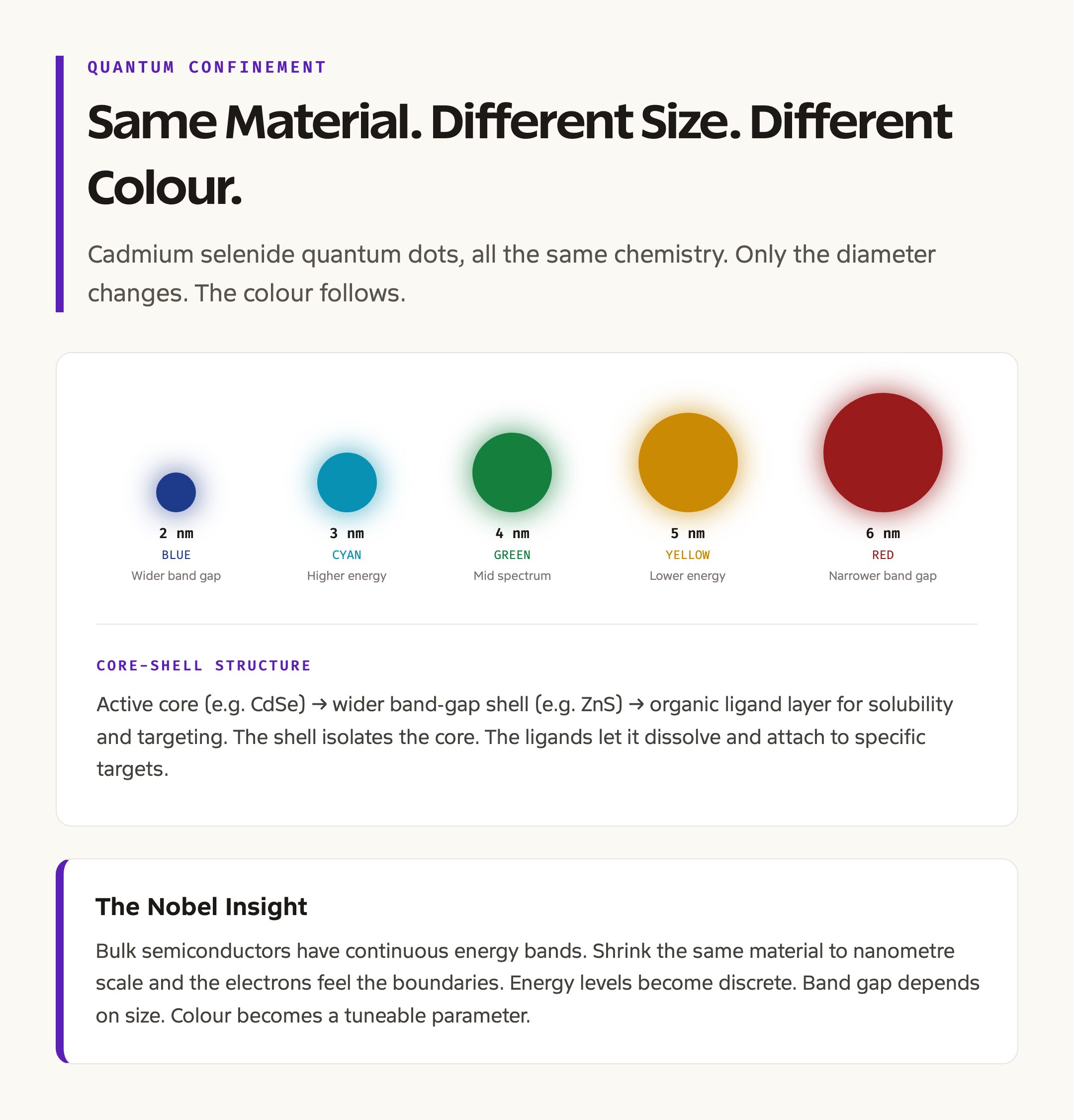
Bulk semiconductors have continuous energy bands. Electrons sit in the valence band. When excited, they jump across a band gap into the conduction band. The size of the band gap determines what colour of light the material can absorb and emit. For bulk cadmium selenide, the band gap corresponds to a fixed orange colour. The material itself defines the colour.
Shrink the same material to nanometre scale and something different happens. The electrons start to feel the boundaries of the particle. Quantum mechanics requires that confined particles have discrete energy levels rather than continuous bands. Smaller boxes have more widely spaced levels. The particle starts to behave like a giant artificial atom whose properties depend not just on its chemistry but on its dimensions.
The practical consequence is that the band gap, and therefore the colour, becomes a tuneable parameter. A two-nanometre cadmium selenide dot has a wider effective band gap than a five-nanometre dot. The two-nanometre dot emits blue light. The five-nanometre dot emits red. By controlling the diameter of the dot during synthesis, you choose the colour. This is what quantum confinement means in practice.
A typical quantum dot has three structural layers. The core is the active semiconductor crystal. The shell is a wider-band-gap semiconductor that confines electrons in the core and prevents them from interacting with the environment. The ligand layer is a coating of organic molecules that keeps the dots from clumping together and lets them be dissolved in solvents or attached to specific targets in biological systems.
Background and Historical Context
The story has three turning points, each tied to one of the 2023 Nobel laureates.
Alexei Ekimov, working in Leningrad in the early 1980s, observed something puzzling in glasses doped with copper chloride. The colour of the glass depended on how the glass had been heat-treated. Microscopy revealed that the heat treatment was forming nanoscale copper chloride crystallites of different sizes. Ekimov recognised that he was seeing the consequences of quantum confinement in a real material. He published in 1981 in a Soviet journal.
Louis Brus, working at Bell Labs in the United States in the early 1980s, was studying chemical reactions on the surface of small semiconductor particles in liquid suspension. He noticed that the absorption spectrum of cadmium sulphide particles depended on the particle size. He published in 1983 a theoretical and experimental description of size-dependent optical properties in colloidal semiconductor nanocrystals. The two researchers had independently arrived at the same insight from different directions.
The third turning point came a decade later. In 1993, Moungi Bawendi at MIT developed a hot-injection synthesis method that produced cadmium selenide quantum dots of nearly uniform size and very high optical quality. The method involved injecting precursor chemicals into a hot organic solvent containing surfactant molecules. The resulting dots were monodisperse, meaning all the particles in a batch were essentially the same size. Monodispersity is what made quantum dots commercially viable, because a batch of dots with mixed sizes produces a smeared-out emission spectrum and dull colours, while a uniform batch produces a pure, vivid colour.
The two decades after 1993 saw industrial scale-up. Companies like QD Vision, Nanosys, and Nanoco built production lines. Samsung Electronics commercialised QLED televisions starting in 2015. The Nobel Prize in 2023 marked the maturation of quantum dots from science to embedded industrial technology.
Key Features of Quantum Dot Behaviour
Five features matter.
The first is size-tuned emission. Within a single chemistry, a single synthesis line can produce dots emitting across the visible spectrum, simply by adjusting growth time and temperature. This is impossible with conventional dyes, where each colour requires a different molecule with different chemistry.
The second is narrow emission bandwidth. Good-quality quantum dots emit in a narrow wavelength range, twenty to forty nanometres wide. That produces saturated, vivid colours that conventional phosphors cannot match.
The third is broad absorption. Quantum dots absorb light efficiently across a wide range of wavelengths, including ultraviolet and blue. They emit narrowly. That makes them ideal as colour converters, where short-wavelength light is absorbed and re-emitted at a target wavelength.
The fourth is photostability. Good quantum dots resist photo-bleaching far better than organic dyes. In bio-imaging applications, that means they keep emitting light after hours of microscope illumination, where dyes fade in minutes.
The fifth is solution processability. Quantum dots dissolve in organic solvents, can be printed onto surfaces, and can be incorporated into polymer films. That makes them compatible with low-cost manufacturing methods like ink-jet printing and roll-to-roll coating.
Why Quantum Dots Matter
Quantum dots matter because they sit at the intersection of three large industries.
In displays, quantum dots produce more saturated colours than conventional phosphor-based LCDs. Samsung QLED, Sony Triluminos, and several other display lines use quantum dots as colour converters in front of a blue LED backlight. The result is wider colour gamut, deeper reds and greens, and visibly better picture quality. Display is the largest commercial application by volume.
In medicine, quantum dots are used as fluorescent labels in research microscopy and increasingly in surgical guidance. Tumour tissue is tagged with quantum-dot-conjugated antibodies that bind specifically to cancer-cell surface markers. Under ultraviolet or blue illumination, the tagged tumour glows. Surgeons can see margins that are invisible to the naked eye. The Indian biomedical research community has published extensively on quantum-dot-based imaging probes, with groups at the National Centre for Biological Sciences, IISc, and several IITs active in the field.
In energy, quantum dots are being developed for next-generation solar cells. The size-tuned absorption means a layered cell can be designed where different layers absorb different parts of the solar spectrum, increasing total efficiency. Quantum-dot solar cells have demonstrated efficiencies above eighteen percent in laboratory settings, with theoretical maximums considerably higher.
In quantum information science, single quantum dots can act as single-photon sources, which are fundamental components of quantum communication systems. This connects directly to the National Quantum Mission, under which India is building national capability in quantum computing, communication, sensing, and materials.
Detailed Comparison: Quantum Dot, Conventional Dye, OLED Phosphor
The three classes of light-emitting material differ in important ways.
| Feature | Quantum Dot | Organic Dye | OLED Phosphor |
|---|---|---|---|
| Colour control | Particle size | Molecular structure | Molecular structure |
| Emission bandwidth | 20 to 40 nm | 50 to 100 nm | 30 to 60 nm |
| Photostability | Very high | Poor to moderate | Moderate |
| Brightness | High | Moderate | High |
| Manufacturing | Solution synthesis | Synthetic chemistry | Vacuum deposition |
| Cost | Falling | Low | Moderate |
The comparison clarifies why displays moved to quantum dots. The narrow emission and high stability deliver the colour performance that high-end consumer electronics demand, at a manufacturing cost that has dropped substantially as production has scaled.
Common Misconceptions
A frequent misunderstanding is that quantum dot colour is set by the chemistry. It is not, at least not in the way most people assume. The chemistry sets the available range of colours, but within that range the size sets the actual colour. A two-nanometre cadmium selenide dot is blue. A six-nanometre cadmium selenide dot is red. Same material. Different size. This is the central insight that the Nobel Prize honoured.
A second misconception is that quantum dots are necessarily toxic. The first commercial quantum dots used cadmium, which is genuinely toxic. Modern alternatives, especially indium phosphide and silver indium sulphide quantum dots, are much less hazardous. Display industry leaders have largely transitioned to cadmium-free dots.
A third misconception is that quantum dots are quantum computers. They are not. Quantum dots are quantum-mechanical objects, but a display is not a quantum computer. Quantum dots can be used as building blocks of quantum information systems, particularly as single-photon sources, but the dots in your television are not doing quantum computing.
India’s Stake in the Quantum-Materials Race
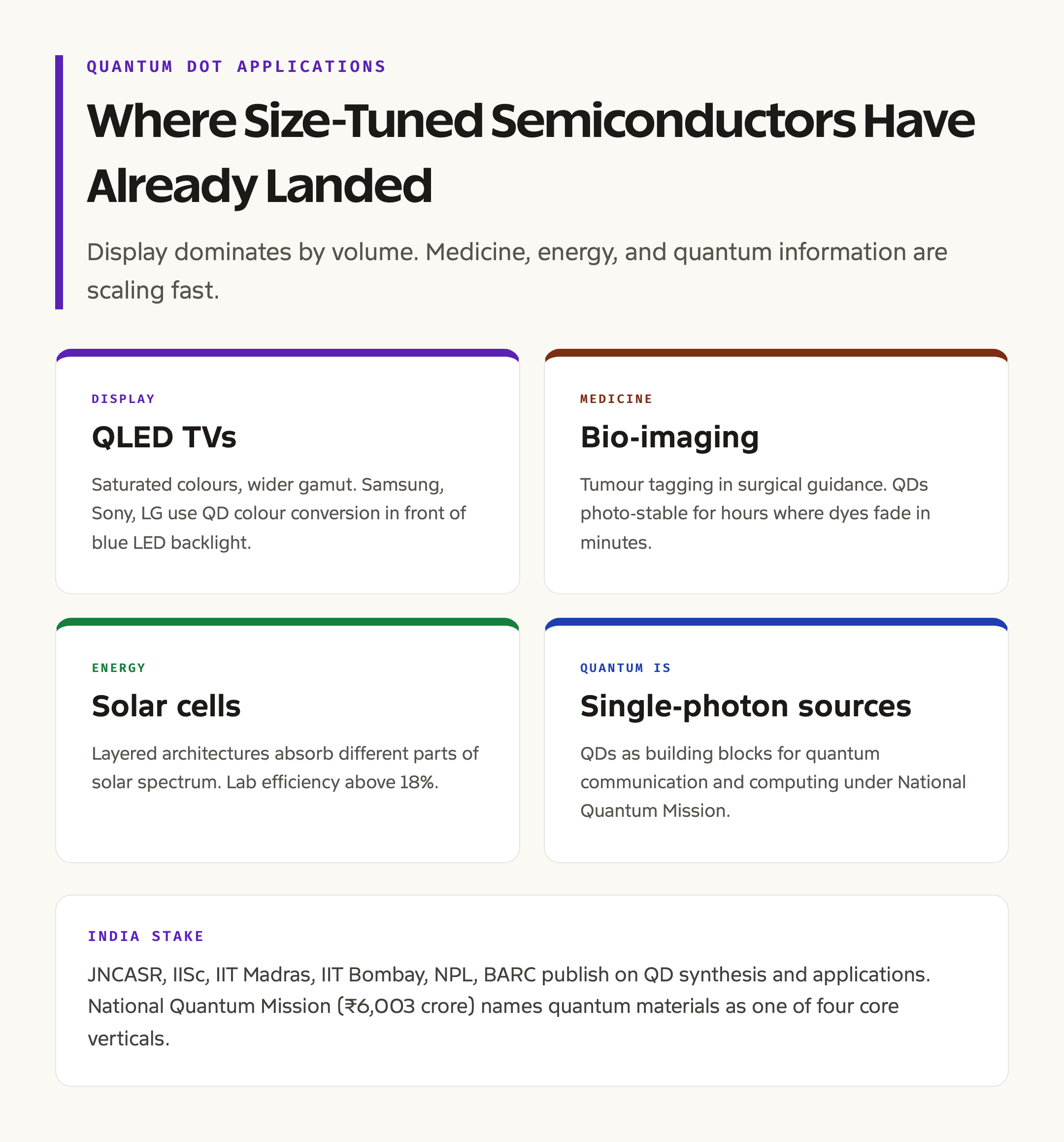
India’s quantum-materials capability is concentrated in research institutions. JNCASR Bangalore, IISc, IIT Madras, IIT Bombay, IIT Kanpur, the National Physical Laboratory, and the Bhabha Atomic Research Centre have all published actively on quantum dot synthesis, characterisation, and applications.
The National Quantum Mission, approved in 2023 with a budget of approximately six thousand crore rupees, includes quantum materials as one of its four mission verticals alongside computing, communication, and sensing. Quantum dots feature in the mission roadmap as building blocks for single-photon sources, quantum sensors, and tunable light emitters.
Industrial deployment in India is at an early stage. Some Indian display assemblers integrate imported quantum-dot films into local production. There is no large-scale indigenous quantum-dot synthesis capacity yet, although several startups and CSIR labs have demonstrated pilot production of cadmium-free dots.
Challenges in the Quantum Dot Ecosystem
Toxicity is the first persistent challenge. Cadmium-based dots are being phased out in regulated markets but remain in some consumer products. Indium-based and silver-based replacements are improving but not yet matching cadmium dots on every performance metric.
Cost and yield is the second. Producing monodisperse quantum dots requires precise control of synthesis conditions. Yields in commercial production are improving but still represent a meaningful share of finished-product cost.
Stability under operating conditions is the third. Quantum dots in solar cells degrade under prolonged illumination. Quantum dots in high-brightness displays degrade under sustained excitation. Engineering durable encapsulation is an active research problem.
Indigenous manufacturing is the fourth, specifically for India. Building national capability in quantum-dot synthesis at industrial scale is necessary if India intends to participate in display, energy, and quantum information industries as a manufacturer rather than only as a consumer.
Way Forward
Three directions look most promising. First, deeper coupling between the National Quantum Mission and quantum-materials research, with explicit funding for industrial-scale quantum-dot synthesis. Second, biomedical applications focused on Indian disease priorities, especially in cancer surgery and infectious disease diagnostics. Third, energy applications integrating quantum dots into emerging solar cell architectures alongside the existing perovskite and silicon ecosystems.
For UPSC, the takeaway is that the 2023 Nobel Prize is not just a science story. It marks the maturation of a technology that is now embedded in displays, medicine, and energy, and that is becoming central to quantum information systems. India’s stake in this depends on whether the laboratory capability translates into manufacturing capacity over the next decade.
Frequently Asked Questions
What is a quantum dot in simple terms?
A quantum dot is a tiny semiconductor crystal, two to ten nanometres across, in which electrons are confined in all three dimensions. The confinement makes the particle behave like an artificial atom whose colour depends on its size rather than only on its chemistry.
Who won the 2023 Nobel Prize in Chemistry and for what?
Moungi Bawendi, Louis Brus, and Alexei Ekimov won the 2023 Nobel Prize in Chemistry for the discovery and synthesis of quantum dots. Ekimov first observed quantum confinement in glass in 1981, Brus did so in colloidal suspensions in 1983, and Bawendi developed the wet-chemistry synthesis in 1993 that made monodisperse quantum dots commercially viable.
Why does a quantum dot’s colour depend on its size?
Because of quantum confinement. When a semiconductor is shrunk to nanometre scale, the energy levels of its electrons become discrete and depend on the particle dimensions. Smaller dots have wider effective band gaps and emit higher-energy, blue-shifted light. Larger dots have narrower band gaps and emit lower-energy, red-shifted light.
What are quantum dots used for?
Quantum dots are used in QLED television displays, fluorescent labels for biological imaging and surgical guidance, next-generation solar cells, single-photon sources for quantum communication, and a growing range of sensing and lighting applications.
Where does India stand on quantum dot research?
India has strong academic capability in quantum-dot synthesis and characterisation at JNCASR, IISc, several IITs, the National Physical Laboratory, and BARC. Industrial-scale indigenous synthesis is at an early stage. The National Quantum Mission includes quantum materials as a core vertical, supporting the next phase of work.