The National Quantum Mission, approved by the Union Cabinet on April 19, 2023, is India’s eight-year, 6003.65-crore-rupee bet on a technology that most Indians have never knowingly used. Unlike the Digital India push of the 2010s, where the productivity gains were visible inside a year, NQM’s payoff is structural: a quantum computer that cracks problems classical machines cannot, an atomic clock that anchors a sovereign GPS-grade navigation backbone, a communication channel that no eavesdropper can read. The country joined a club of seven, behind the United States, China, Finland, Austria, France, and Canada, and the timeline that follows is unforgiving.
The mission is administered by the Department of Science and Technology under the Ministry of Science and Technology, with Mission Governing Board oversight and a Mission Technology Research Council that screens project calls. Four Thematic Hubs (T-Hubs) carry out the technical work in a hub-and-spoke arrangement, each anchored at a premier institute and federated with multiple academic and industry partners. The model deliberately avoids a single national lab, which is how earlier Indian science missions concentrated risk, and instead spreads it across institutions that already have the talent and instrumentation to ramp.
For an aspirant, NQM matters in three ways. It is the easiest GS-III peg for prelims and mains questions on emerging technology, science policy, and strategic autonomy. It links upstream to research bodies (DST, MeitY, ISRO, DRDO) and downstream to applications students already know (cryptography, healthcare, drug discovery, defence sensors, GPS). And it tests the boundary between current affairs and core science: a candidate who can explain superposition, entanglement, and post-quantum cryptography in a single coherent answer will outscore one who simply names the four hubs.
Quick Facts
- Approval date: April 19, 2023, by the Union Cabinet
- Outlay: Rs 6,003.65 crore over 8 years (2023-24 to 2030-31)
- Nodal ministry: Department of Science and Technology (DST)
- Implementing structure: Mission Governing Board plus 4 Thematic Hubs (T-Hubs)
- Position globally: 7th country with a dedicated national quantum mission
- Headline target: 50 to 1000 physical qubits within 8 years
- Communication target: Quantum Key Distribution (QKD) across 2000 km within India
- Sensing target: Indigenous atomic clocks and high-sensitivity magnetometers
- GS paper relevance: Prelims (Sci-Tech, Government Schemes), GS-III (Science and Technology, Indigenisation)
What the National Quantum Mission Is
NQM is a centrally sponsored mission whose purpose is to seed, nurture, and scale up scientific and industrial research and development in quantum technologies, and to convert that R&D into a domestic quantum ecosystem. The legal hook is the standard mission-mode framework used by DST: an inter-ministerial governing board, a technology council, and ring-fenced funding lines for hub operations, fellowships, startups, and infrastructure procurement.
The four verticals the mission funds are not arbitrary. They mirror the four areas where quantum mechanics produces a directly exploitable advantage over classical physics: computation (where superposition collapses brute-force search), communication (where measurement-disturbance makes interception detectable), sensing (where coherent quantum states detect signals classical instruments cannot), and materials (where engineered low-defect substrates make the first three possible). Drop any one vertical and the others stall, which is why the mission funds them in parallel rather than sequence.
Background and Historical Context
India’s quantum work predates the mission by more than a decade. The Quantum Information and Computing (QuIC) lab at the Raman Research Institute, the quantum optics groups at IISc and TIFR, and the cryptography work at ISI Kolkata produced internationally cited results long before policy caught up. What was missing was scale: small grants, fragmented teams, no clear path from a postdoctoral demonstration to a production-grade chip or a deployable QKD link.
The first formal push came in 2018, when DST launched the Quantum-Enabled Science and Technology (QuEST) programme with a roughly 80-crore-rupee corpus. QuEST funded eight thematic projects and exposed the gap between bench-scale demonstrations and a working national capability. By 2020, the Union Budget announced a National Mission on Quantum Technologies and Applications with an indicative 8000-crore-rupee outlay, but actual approval slid by three years as the design moved from a single nodal lab to the hub-and-spoke model that was eventually approved in 2023.
Internationally, the same window saw the United States pass the National Quantum Initiative Act (2018), the European Union launch the Quantum Flagship programme (2018, 1 billion euro over ten years), China commission the Micius satellite for space-based QKD (2016) and the Hefei National Laboratory for Physical Sciences at the Microscale, and the United Kingdom run the National Quantum Technologies Programme since 2014. India arriving in 2023 was late but not fatally so, because the technology itself had not yet crossed the commercial inflection point that would have shut latecomers out.
The Four Thematic Hubs (T-Hubs)
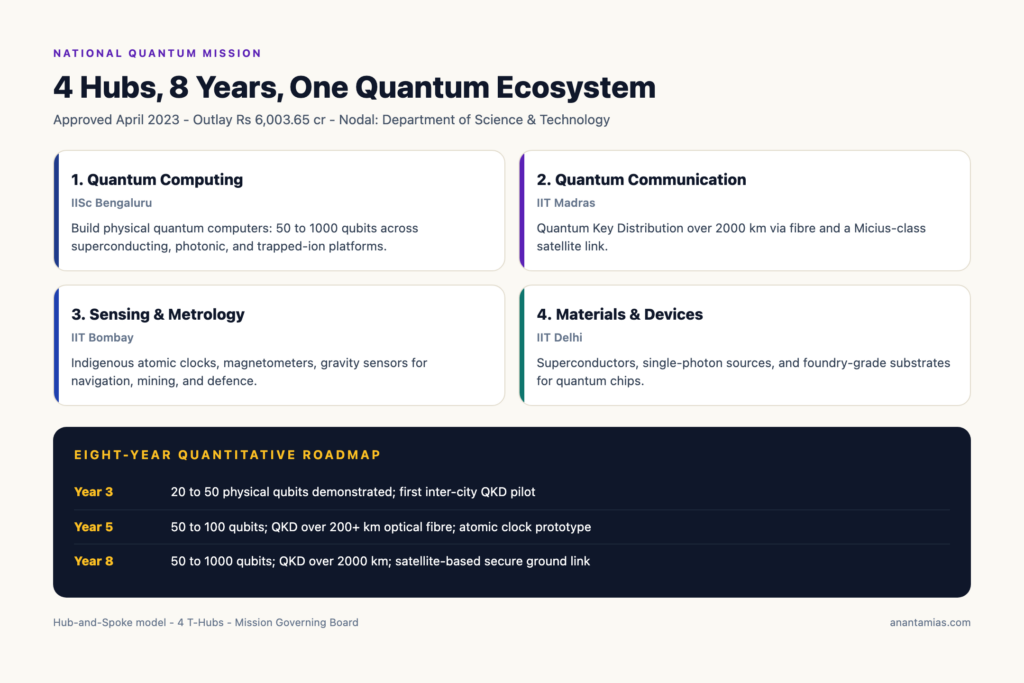
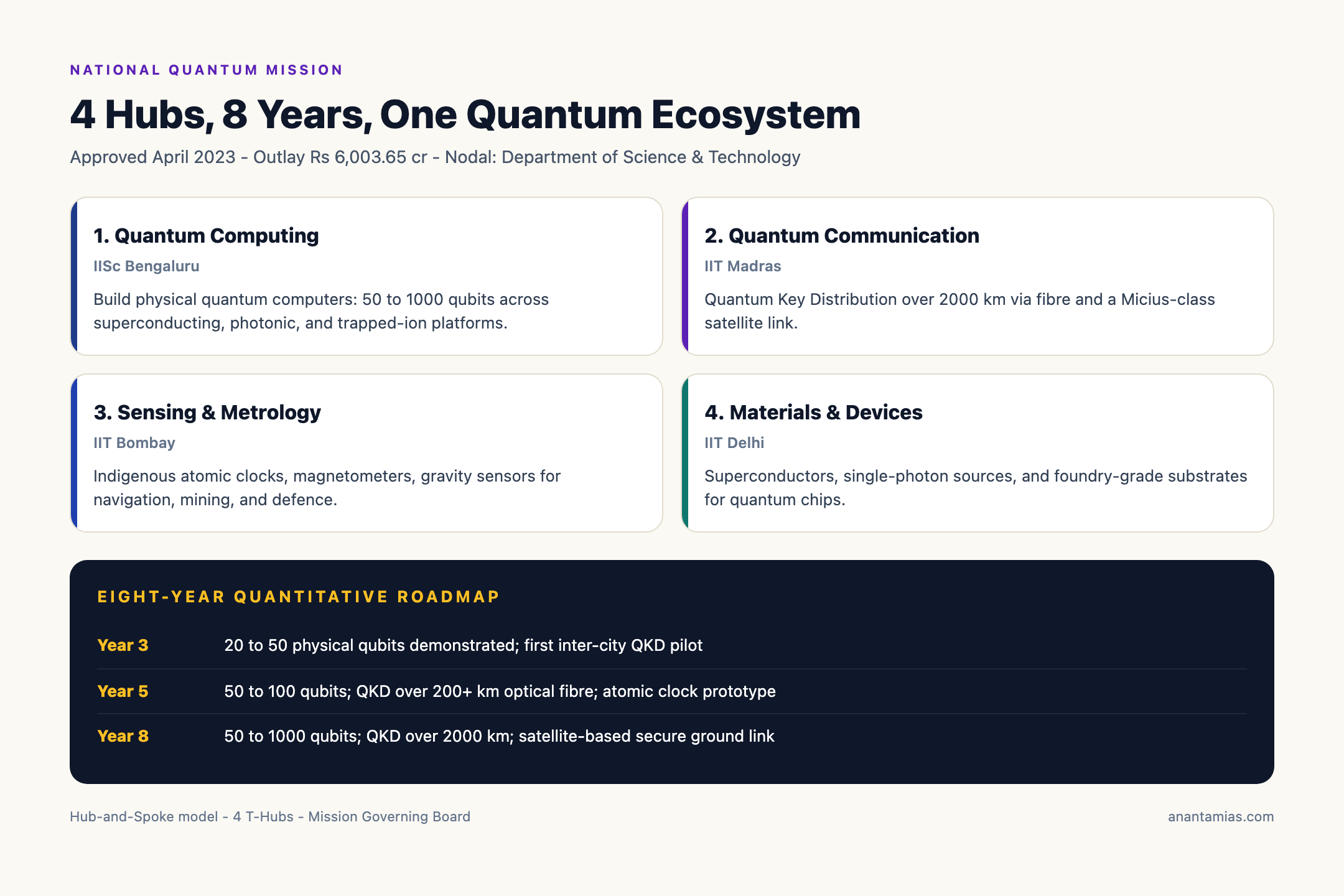
NQM funds four T-Hubs, each anchored at a premier institute and chaired by a hub director who reports to the Mission Governing Board. Each hub federates spokes at other institutions and industry partners.
| Hub | Lead Institute | Domain Focus | Headline Deliverable |
|---|---|---|---|
| Quantum Computing | IISc Bengaluru | Building physical quantum computers | 50 to 1000 qubit machines |
| Quantum Communication | IIT Madras | QKD, quantum internet | 2000 km secure ground links |
| Quantum Sensing and Metrology | IIT Bombay | Atomic clocks, gravity sensors, magnetometers | GPS-grade indigenous timing |
| Quantum Materials and Devices | IIT Delhi | Superconductors, single-photon sources, substrates | Indigenous foundry-grade materials |
The hubs are deliberately complementary. The Computing hub at IISc cannot deliver a working machine without low-defect superconducting qubits from the Materials hub at IIT Delhi. The Communication hub at IIT Madras needs single-photon sources and detectors from the same materials pipeline. The Sensing hub at IIT Bombay shares atomic-physics infrastructure with the Communication hub. Funding all four simultaneously is what distinguishes a mission from a portfolio of grants.
Eight-Year Quantitative Targets
NQM is unusually specific for an Indian science mission. The targets are not aspirational; they are deliverables tied to milestone-based release of funds.
- Quantum computing: Intermediate-scale machines with 50 to 1000 physical qubits over 8 years. Phased: 20 to 50 qubits by year 3, 50 to 100 qubits by year 5, 50 to 1000 qubits by year 8. Platforms include superconducting qubits, photonic qubits, and trapped-ion or neutral-atom systems.
- Satellite-based QKD: Secure quantum communication between ground stations over 2000 km within India, leveraging ISRO launch capability for a Micius-class satellite payload.
- Inter-city QKD over fibre: Trusted-node and eventually repeater-based key distribution across 2000 km of optical fibre, integrated with existing telecom backbones.
- Long-distance entanglement: Multi-node quantum networks within and across cities, working towards a national quantum internet testbed.
- Atomic clocks: Indigenous atomic clocks for timing precision good enough to anchor navigation, financial timestamping, and defence applications.
- Magnetometers and gravimeters: High-sensitivity quantum sensors for medical imaging, mineral exploration, and submarine detection.
Key Quantum Concepts Every Aspirant Must Know
Bit versus Qubit
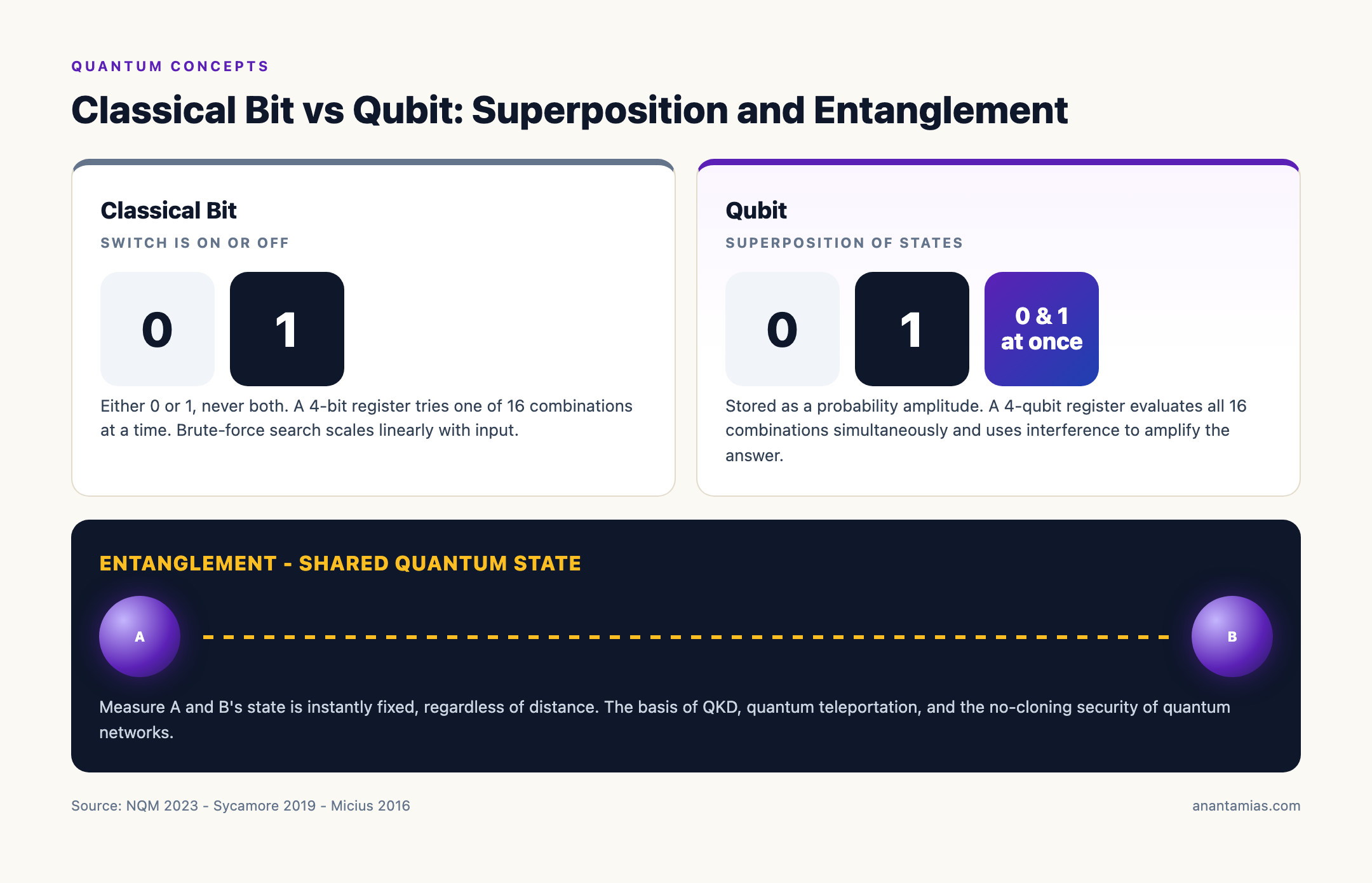
A classical bit is a binary switch: it stores either 0 or 1. A qubit, the unit of quantum information, can store 0, 1, or a superposition of both, and only collapses to a definite value when measured. This is not a gimmick; it is the property that lets a quantum computer evaluate exponentially many candidate solutions in parallel.
Superposition
Superposition is the principle that a quantum system can exist in a linear combination of its basis states until observation forces a collapse. A classical computer trying to crack a 4-digit PIN tests one combination at a time. A quantum computer with enough qubits explores all 10,000 combinations simultaneously and uses interference to amplify the correct answer.
Entanglement
Entanglement is the phenomenon where two or more particles share a single quantum state, such that the measurement of one instantaneously fixes the state of the other, regardless of distance. Einstein called it “spooky action at a distance.” Entanglement is the resource that makes quantum teleportation, dense coding, and entanglement-based QKD work.
Decoherence
Decoherence is the loss of quantum information to the environment. Stray heat, vibration, and electromagnetic noise force a qubit to behave classically. Every quantum platform spends most of its engineering budget fighting decoherence, which is why dilution refrigerators, ultra-high vacuum chambers, and laser-cooled atom traps are standard equipment.
Quantum Communication: How QKD Actually Works
Quantum Key Distribution does not encrypt the message; it distributes the encryption key in a way that any interception is detectable. The most cited protocol, BB84, encodes key bits in the polarisation states of single photons. If a hacker tries to measure the photons in transit, the no-cloning theorem and Heisenberg uncertainty force a measurable disturbance. The legitimate parties detect the disturbance through error-rate checks, discard the compromised key, and try again. The security rests on physics, not on the computational hardness of factoring large integers, which is why QKD is considered future-proof against quantum computers.
NQM’s 2000-km target is ambitious because photon loss in optical fibre is exponential. Without quantum repeaters (which India is also developing), trusted-node architectures bridge the gap by chaining shorter QKD links. China’s Micius satellite, launched in 2016, demonstrated intercontinental QKD over 7600 km using satellite-relay; ISRO’s launch infrastructure makes a similar Indian payload feasible.
Quantum Computing Platforms
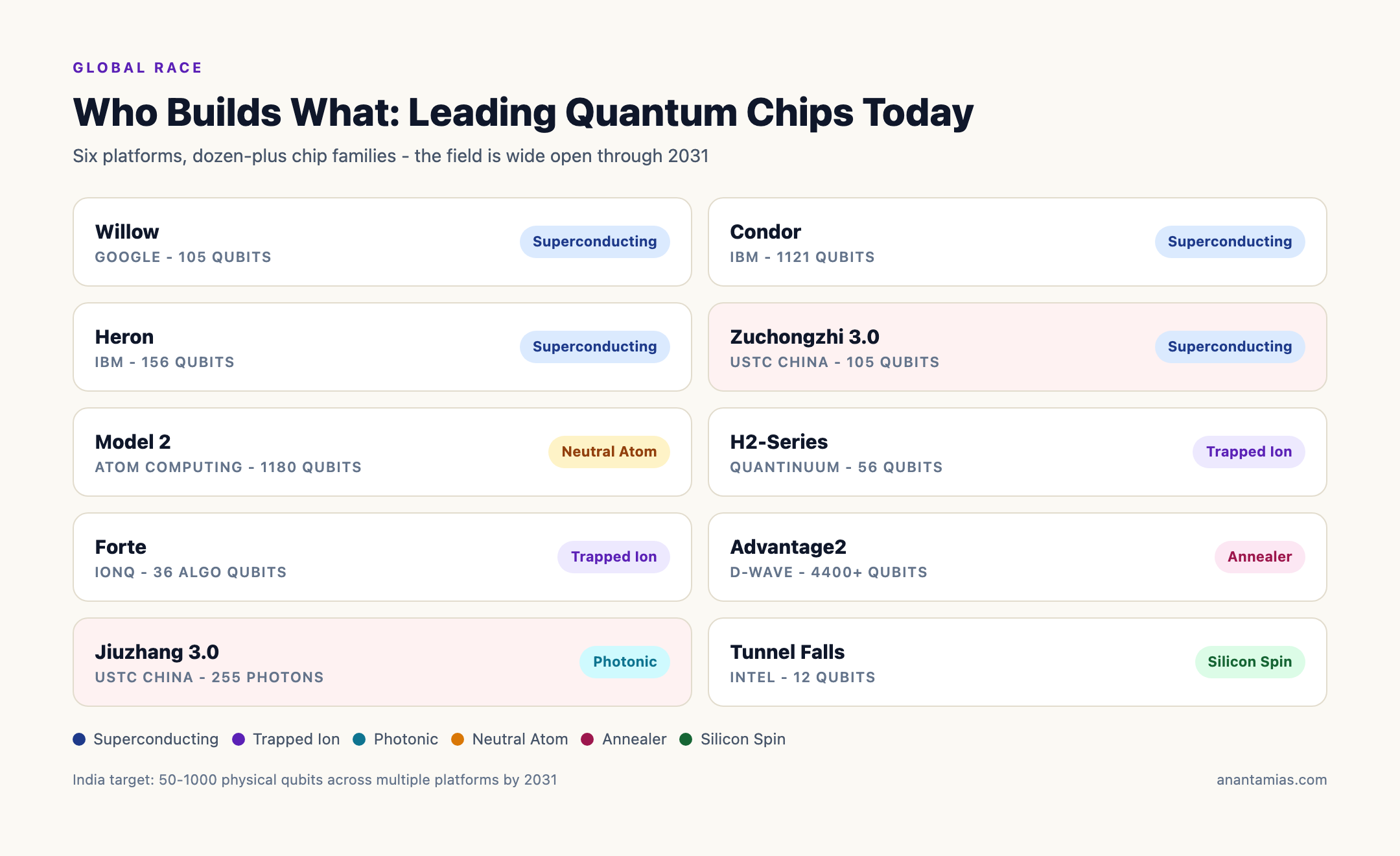
There is no consensus on which physical implementation will win. NQM funds multiple platforms because each has distinct strengths.
| Platform | Principle | Leading Players | Strength | Weakness |
|---|---|---|---|---|
| Superconducting | Cooper pairs in Josephson junctions at near-absolute-zero | Google, IBM, Rigetti | Fast gates, mature fabrication | Requires dilution refrigerator |
| Trapped Ion | Atoms held by electromagnetic fields, manipulated by lasers | IonQ, Quantinuum | Long coherence, high fidelity | Slower gate speeds |
| Photonic | Single photons in optical circuits | PsiQuantum, Xanadu | Room-temperature, networkable | Probabilistic gates |
| Neutral Atom | Laser-cooled atoms in optical tweezer arrays | Atom Computing, QuEra | Highly scalable | Newer, less mature stack |
| Silicon Spin | Electron spins in silicon quantum dots | Intel, SiQure | Compatible with CMOS | Few qubits demonstrated |
Notable chips of the current generation include Google’s Willow, IBM’s Condor and Heron, Atom Computing’s 1180-qubit Model 2, Quantinuum’s H2 trapped-ion system, IonQ’s Forte, D-Wave’s Advantage2 annealer, and China’s superconducting Zuchongzhi 3.0 and photonic Jiuzhang 3.0.
Why It Matters: Strategic and Economic Stakes
The strategic argument is straightforward. Once a sufficiently large fault-tolerant quantum computer exists (the threshold is debated but commonly cited at several thousand logical qubits), today’s RSA and elliptic-curve cryptography breaks. Every encrypted government, banking, and defence record harvested today can be decrypted tomorrow. The “harvest now, decrypt later” threat is why post-quantum cryptography (PQC) standards from NIST, India’s own PQC migration roadmap, and QKD deployment cannot wait.
The economic argument is about complementary capabilities. A country that builds quantum sensors can replace imported atomic clocks, GPS-disciplined oscillators, and MRI magnetometers with sovereign supply. A country that builds quantum chips builds the materials science, cleanroom expertise, and cryogenic engineering that spill over to classical semiconductor manufacturing. The Semicon India programme and NQM are explicitly designed to share infrastructure.
The scientific argument is the most under-appreciated. Quantum systems simulate molecular and material behaviour that classical supercomputers cannot, which accelerates drug discovery, battery chemistry, fertiliser design, and high-temperature superconductor research. India’s pharmaceutical and energy sectors stand to gain disproportionately if domestic quantum compute is available at academic-friendly cost.
Comparative: India versus the Global Race
The United States leads in venture-backed quantum startups (IBM, Google, IonQ, PsiQuantum) and federal coordination (the National Quantum Initiative). China leads in space-based QKD (Micius), ground QKD networks (Beijing-Shanghai backbone), and superconducting qubit counts (Zuchongzhi). The European Union leads in foundational research and the Quantum Flagship’s coordination across 27 member states. The United Kingdom leads in cold-atom and ion-trap research. Canada and Australia punch above their weight in photonics and silicon spin qubits respectively.
India’s comparative advantage is not in cutting-edge fabrication (yet), but in two areas: a deep mathematics and theoretical physics talent pool, and a software and systems integration ecosystem that has historically converted others’ hardware into deployable systems. NQM’s bet is that talent plus disciplined mission execution can close the hardware gap within a decade.
Challenges and Risks
- Talent depth: India produces strong PhDs in quantum information theory but few in cryogenic engineering, RF microwave control, and laser metrology. The mission funds fellowships, but talent maturation takes longer than the 8-year window.
- Equipment imports: Dilution refrigerators, ultra-stable lasers, single-photon detectors, and lithography tools are largely imported. Export controls under regimes like the Wassenaar Arrangement can throttle delivery.
- Industry pull: Indian industry has limited absorption capacity for quantum hardware. Without anchor procurement (defence, banking, ISRO), startups will lack a domestic market and emigrate.
- Coordination overhead: Four hubs across four cities, each federating spokes, creates governance load. Past Indian missions have stumbled on inter-institutional friction.
- Standardisation lag: PQC standards, QKD interoperability, and quantum-safe network protocols are being set internationally. India must participate in standard-setting bodies (ITU-T, ISO, IETF) to avoid being a rule-taker.
- Decoherence physics: All quantum platforms remain noisy. Fault-tolerant computation requires error-correction overheads of 1000-to-1 physical-to-logical qubits, which pushes the truly useful machine well beyond the 1000-qubit headline target.
Prelims Pointers
- NQM was approved on April 19, 2023, with an outlay of Rs 6,003.65 crore over 8 years (2023-24 to 2030-31).
- India is the 7th country in the world with a dedicated national quantum mission.
- The Department of Science and Technology (DST) is the nodal ministry.
- The mission has 4 Thematic Hubs: Computing (IISc Bengaluru), Communication (IIT Madras), Sensing and Metrology (IIT Bombay), Materials and Devices (IIT Delhi).
- Headline computing target: 50 to 1000 physical qubits in 8 years.
- Headline communication target: QKD over 2000 km within India.
- QKD security is based on the no-cloning theorem and the Heisenberg uncertainty principle, not on computational hardness.
- Quantum supremacy was first claimed by Google’s Sycamore in 2019.
- China’s Micius is the world’s first quantum communication satellite (2016).
- Post-Quantum Cryptography (PQC) runs on classical computers but uses lattice-based, hash-based, or code-based algorithms resistant to quantum attack.
Mains Practice Questions
- GS-III: “Quantum technology is the next general-purpose technology after artificial intelligence.” Examine the objectives, structure, and feasibility of India’s National Quantum Mission. (250 words)
- GS-III: Discuss how the National Quantum Mission addresses both economic and strategic dimensions of national security. What are the major implementation challenges? (250 words)
- GS-III: Differentiate between Quantum Key Distribution (QKD) and Post-Quantum Cryptography (PQC). Why does India need to invest in both simultaneously? (150 words)
- GS-III: Critically analyse the hub-and-spoke model adopted by the National Quantum Mission. Compare it with mission-mode programmes such as the National Mission on Interdisciplinary Cyber-Physical Systems and the Semicon India programme. (250 words)
Way Forward
The mission’s success will be judged on five tests. First, whether at least one Indian-built quantum computer crosses 100 logical qubits with fidelity sufficient for industry-relevant problems. Second, whether QKD over 2000 km is demonstrated end-to-end with civilian and defence users on the network. Third, whether atomic clocks indigenously built reach the precision needed to anchor a sovereign timing infrastructure. Fourth, whether the four hubs spawn at least 50 venture-backed startups with global customers, not just government contracts. Fifth, whether India contributes to international standard-setting in PQC, QKD, and quantum networking, rather than waiting for standards to arrive.
Adjacent reforms must move in parallel. The Semicon India programme should ring-fence cleanroom capacity for quantum-grade fabrication. The Department of Telecommunications must publish QKD interoperability and trusted-node guidelines. CERT-In’s PQC migration roadmap, drafted in 2024, needs binding timelines for critical infrastructure. ISRO’s quantum payload programme should align launch slots with the mission’s communication targets. And procurement rules must be amended so that defence and banking can buy domestic quantum products without falling foul of cost-comparison clauses written for classical hardware.
If even three of those five tests are passed by 2031, NQM will have done what the Atomic Energy Programme of the 1950s and the Space Programme of the 1970s did in their generations: convert a science-policy gamble into a sovereign capability the country can no longer be denied.
Frequently Asked Questions
What is the National Quantum Mission and when was it approved?
The National Quantum Mission (NQM) is an 8-year, Rs 6,003.65-crore mission approved by the Union Cabinet on April 19, 2023, to seed and scale India’s quantum computing, communication, sensing, and materials capabilities. It runs from 2023-24 to 2030-31 under the Department of Science and Technology.
Which ministry runs the NQM and what is its governance structure?
The Department of Science and Technology (DST), under the Ministry of Science and Technology, is the nodal agency. Governance flows through a Mission Governing Board, a Mission Technology Research Council, and four Thematic Hubs anchored at IISc Bengaluru, IIT Madras, IIT Bombay, and IIT Delhi.
What are the four Thematic Hubs of the NQM?
The hubs cover Quantum Computing (IISc Bengaluru), Quantum Communication (IIT Madras), Quantum Sensing and Metrology (IIT Bombay), and Quantum Materials and Devices (IIT Delhi). Each hub federates spokes across multiple academic and industry partners using a hub-and-spoke model.
What is the difference between a bit and a qubit?
A classical bit stores either 0 or 1. A qubit, the unit of quantum information, can store 0, 1, or a superposition of both states until measured, which lets quantum computers explore many candidate solutions in parallel. Combined with entanglement, qubits enable algorithms that are exponentially faster than their classical counterparts for specific problems.
What is Quantum Key Distribution (QKD) and why is it secure?
QKD is a method of distributing cryptographic keys using single photons whose quantum states cannot be measured without disturbance. The security rests on the no-cloning theorem and the Heisenberg uncertainty principle, so any interception is detectable. NQM targets QKD over 2000 km via fibre and satellite links.
What is quantum supremacy and has India achieved it?
Quantum supremacy is the milestone where a quantum computer solves a problem no classical supercomputer can solve in reasonable time. Google’s Sycamore processor first claimed it in 2019. India has not yet claimed quantum supremacy; NQM’s targets are aimed at intermediate-scale (50 to 1000 qubit) machines that approach but do not necessarily cross the supremacy threshold.
How does India compare with the United States and China in quantum technology?
The United States leads in venture-backed startups and chip design (IBM, Google, IonQ). China leads in satellite-based QKD (Micius) and high-qubit superconducting chips (Zuchongzhi 3.0). India is a late entrant with strong theoretical talent; NQM is the policy instrument to close the hardware gap by 2031.
What is Post-Quantum Cryptography and how is it different from QKD?
Post-Quantum Cryptography (PQC) refers to mathematical algorithms that run on classical computers but are designed to resist attack by future quantum computers. QKD, by contrast, uses physical photons to share keys with information-theoretic security. PQC protects existing infrastructure cheaply; QKD protects the highest-value links physically. Most experts recommend deploying both.
Which Indian institutions have a long history in quantum research?
The Raman Research Institute, Tata Institute of Fundamental Research, Indian Statistical Institute, Indian Institute of Science, IITs at Madras, Bombay, Delhi, and Kanpur, the Harish-Chandra Research Institute, and ISRO’s space applications units have all produced cited quantum research, much of it under DST’s earlier QuEST programme launched in 2018.
How does NQM connect to other government programmes?
NQM links to the Semicon India programme (shared cleanroom and materials capacity), CERT-In’s PQC migration roadmap (cybersecurity), ISRO’s launch services (satellite QKD), DRDO’s quantum sensing for defence, and the National Mission on Interdisciplinary Cyber-Physical Systems for talent and institutional spillovers.
Tell Google you want more of this.
Add Anantam IAS as a preferred sourceOne tap, and this site shows up more often in your own Top Stories, AI Overviews and AI Mode. Remove it any time.