Ram Prasad Bismil: Biography, Kakori Conspiracy and Revolutionary Legacy
Ram Prasad Bismil: biography, Mainpuri and Kakori conspiracies, HRA, poetry as Bismil and Ram, and UPSC pointers on the revolutionary martyr.
Introduction
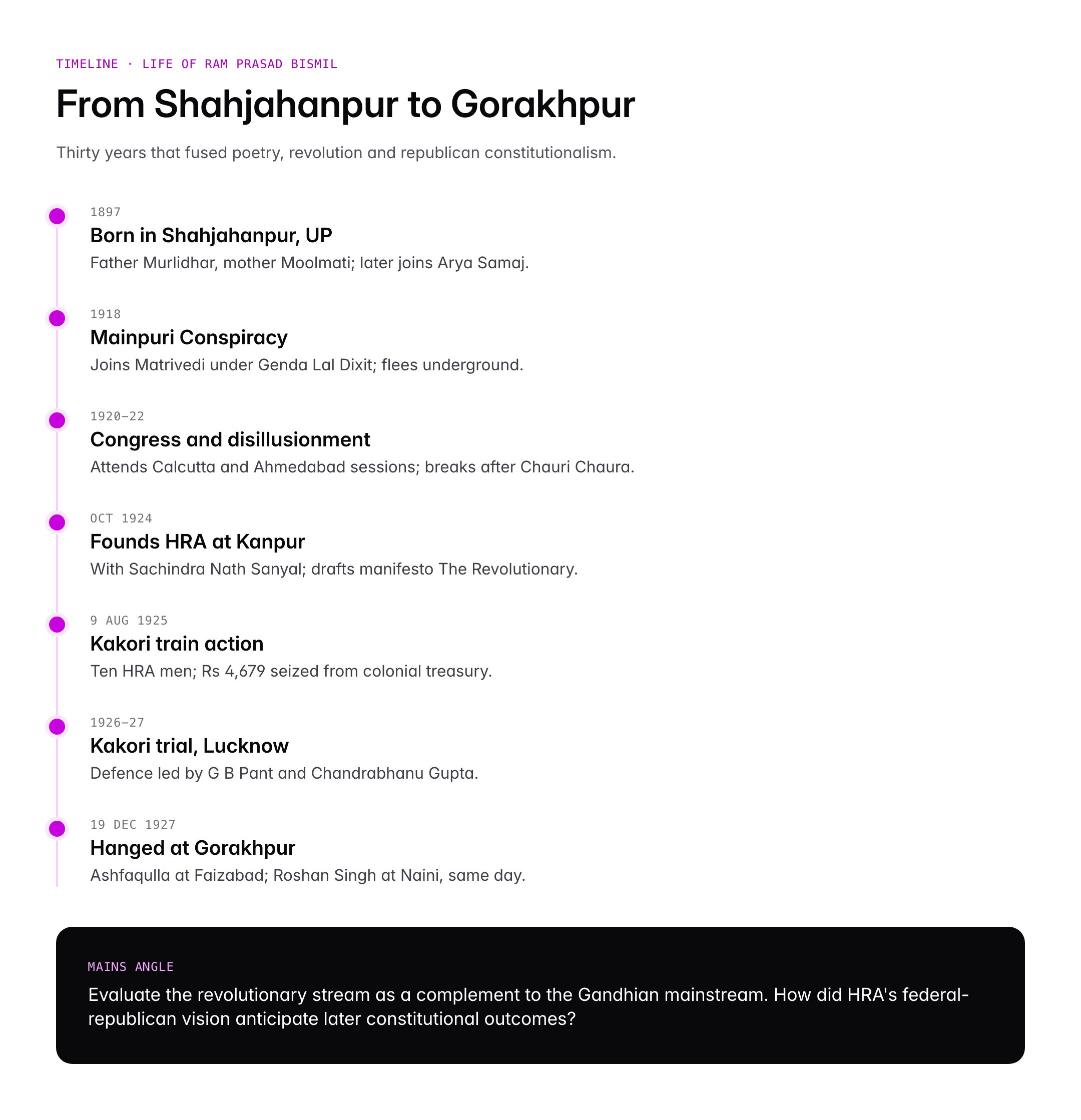
Ram Prasad Bismil was hanged on the morning of 19 December 1927 at Gorakhpur jail, wearing a copy of the Gita and reciting a verse. He was thirty years old. By the time he walked to the gallows he had already written four volumes of poetry, translated the Bolshevik programme from Bengali into Hindi, co-founded the Hindustan Republican Association, and staged the Kakori train action that seized the colonial treasury’s own money to buy weapons. For aspirants of the UPSC Civil Services Examination, Bismil is an essential node in the revolutionary stream of the Indian freedom movement, the intellectual bridge between the Gadar Party generation and the later Hindustan Socialist Republican Association of Bhagat Singh and Chandra Shekhar Azad.
His life raises the kind of questions that Mains examiners love. How did revolutionaries reconcile militant nationalism with literary and spiritual sensibilities? Why did the Congress leadership keep a cautious distance from armed action while still mourning its martyrs? How did a single train robbery at Kakori, yielding only 4,679 rupees, become a larger-than-life symbol of anti-colonial resistance?
Quick Facts at a Glance
| Item | Details |
|---|---|
| Born | 11 June 1897, Shahjahanpur, United Provinces |
| Died (hanged) | 19 December 1927, Gorakhpur jail |
| Parents | Murlidhar and Moolmati |
| Pen names | Bismil, Ram, Agyat |
| Mother tongue | Hindi (Braj, Khari Boli) |
| Organisations | Matrivedi, HRA, Arya Samaj |
| Famous poem | “Sarfaroshi ki Tamanna” (though authored by Bismil Azimabadi) |
| Key action | Kakori train robbery, 9 August 1925 |
| Trial | Kakori Conspiracy Case, 1925-27 |
| Co-accused | Ashfaqulla Khan, Roshan Singh, Rajendra Lahiri |
| Executed same wave | 17 Dec (Lahiri, Gonda), 19 Dec (Bismil, Ashfaqulla, Roshan Singh) |
Background and Historical Context
The late nineteenth and early twentieth century in the United Provinces produced a dense network of revolutionary thinkers. The Arya Samaj, founded by Swami Dayanand Saraswati in 1875, shaped the moral universe of many young men from middle-caste and Kayastha households. The partition of Bengal in 1905, the Swadeshi movement, the rise of the Anushilan Samiti and Yugantar, and the Gadar Party’s plans for a 1915 mutiny all formed the backdrop to Bismil’s adolescence.
The defining catalyst was the Mainpuri Conspiracy of 1918, led by Genda Lal Dixit through a secret society called Matrivedi. Young Ram Prasad Bismil, then barely twenty-one, was an active participant and published a pamphlet titled Deshvasiyon ke Naam Sandesh, an open letter to fellow countrymen. When the plot was uncovered, Bismil escaped into the Yamuna ravines, living underground and writing feverishly. He was formally acquitted only after the government issued a general amnesty in 1920 at the start of the Non-Cooperation movement.
Bismil joined the Indian National Congress and attended the 1920 Calcutta session and the 1922 Ahmedabad session, where he pushed for sharper language against the Raj. After the Chauri Chaura incident of February 1922 and Gandhi’s suspension of non-cooperation, a disillusioned cohort of young activists, including Bismil, Sachindra Nath Sanyal, Jogesh Chandra Chatterjee and Ashfaqulla Khan, decided that a revolutionary organisation capable of armed action was necessary. They founded the Hindustan Republican Association in October 1924 at a meeting in Kanpur. Its manifesto, The Revolutionary, announced the goal of a federal republic of the United States of India based on universal suffrage.
Key Features: Biography and Thought
Early Life and Education
Born on 11 June 1897 in Shahjahanpur to a Tomar Rajput family of modest means, Bismil studied at an Urdu-medium primary school and then at an Arya Samaj mission. He failed his matriculation multiple times, not from want of intellect but from political distraction. He was drawn early to Swami Dayanand and to the martyr Bhai Parmanand, whose death sentence in the Lahore Conspiracy Case of 1915 profoundly shaped him.
Name and Pen-names
The young poet adopted the pseudonym Bismil, an Urdu word meaning “the wounded one”, an image of the sacrificial victim at the altar. He also wrote in Hindi under the pen name Ram, and in some anonymous pieces as Agyat, “the unknown”. His collected poetry, Krantikari Jeevan and Man ki Lahar, mix Vedantic metaphors with revolutionary urgency.
Literary Output
Bismil was a prolific translator. He rendered Bhagavad Gita Rahasya by Tilak into simple Hindi, translated Niralamba Upanishad, and produced Hindi versions of revolutionary texts including Catherine of Russia and The Bolshevik Programme. The widely recited ghazal “Sarfaroshi ki Tamanna” is usually attached to Bismil’s memory, though its actual author was Bismil Azimabadi (1901-1978) of Patna. Bismil of Shahjahanpur popularised it on his way to the gallows.
Mainpuri and the Making of a Revolutionary
The Mainpuri Conspiracy (1918) involved robbery of government treasuries to fund the import of arms. Bismil authored pamphlets, helped draft a constitution for Matrivedi, and evaded arrest by fleeing to the Yamuna ravines. During these fugitive years he mastered guerrilla tactics, learned horse-riding, and worked as a worker at a silk factory to stay under cover.
Hindustan Republican Association
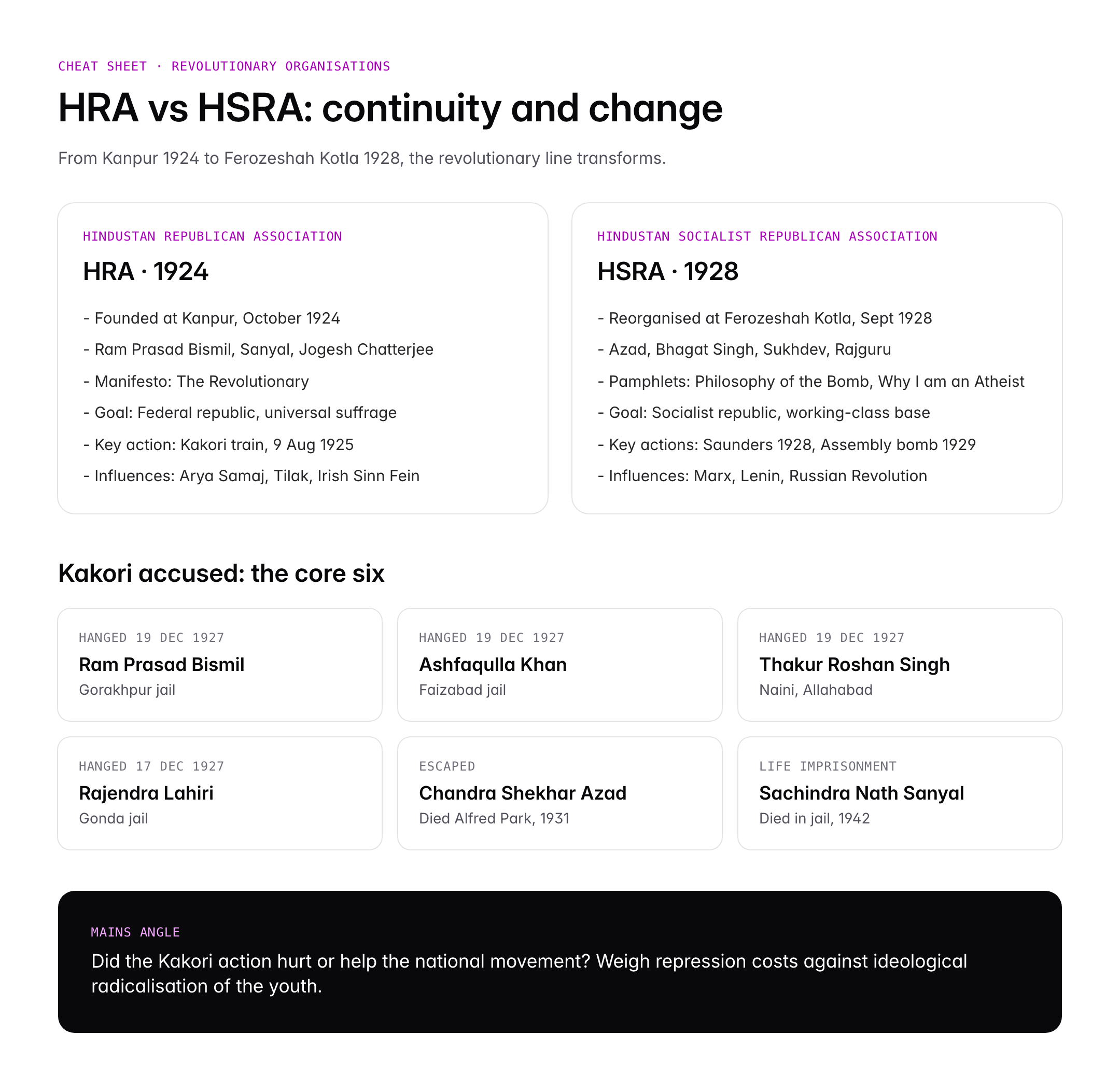
Founded in October 1924 and formally announced at Kanpur, the HRA brought together Bengal, the United Provinces and the Punjab under a single republican framework. Its manifesto The Revolutionary, drafted by Bismil and Sanyal, demanded universal adult suffrage, abolition of all exploitation, and a federal republican government. This manifesto would be carried forward, with a socialist turn, into the 1928 Hindustan Socialist Republican Association by Bhagat Singh, Azad and others at the Ferozeshah Kotla meeting in Delhi.
Significance for UPSC and General Knowledge
- Bismil represents the revolutionary stream of the freedom movement, a compulsory topic under Modern Indian History for GS1 and the History optional.
- The Kakori Conspiracy Case is the most cited revolutionary trial of the 1920s, alongside the Lahore Conspiracy Case.
- He exemplifies the poet-warrior archetype, often contrasted in Mains essays with Gandhian non-violence.
- The drafting of The Revolutionary manifesto is an important intellectual bridge between cultural nationalism and socialist republicanism.
- HRA’s transformation into HSRA in 1928 is a favourite Prelims current-affairs hook whenever anniversaries fall.
- Bismil’s Hindi-Urdu bilingual output makes him a useful case study in composite culture and the linguistic plurality of the freedom movement.
Detailed Analysis: Kakori, Trial and Martyrdom
On 9 August 1925 ten HRA members stopped the 8 Down train running from Shahjahanpur to Lucknow near Kakori in present-day Uttar Pradesh. The group included Bismil as the action leader, Ashfaqulla Khan, Rajendra Lahiri, Chandrashekhar Azad, Thakur Roshan Singh, Sachindra Bakshi, Keshab Chakravarty, Manmathnath Gupta, Mukundi Lal and Murari Sharma. They looted the government’s own treasury cash of 4,601 rupees intended for the imperial exchequer, not private passengers. One passenger, Ahmed Ali, was accidentally killed. The figure later commonly cited in court was 4,679 rupees.
The colonial administration responded with exceptional energy. Over forty suspects were arrested, although Azad evaded capture until his death at Allahabad’s Alfred Park in 1931. The Kakori Conspiracy Case trial began in May 1926 at Lucknow before Justice A Hamilton. The defence was coordinated by Govind Ballabh Pant, Jagat Narayan Mulla, Mohan Lal Saksena and Chandrabhanu Gupta. Despite a nationwide “Save Kakori Accused” campaign led by figures such as Madan Mohan Malaviya and Jawaharlal Nehru, the sentences were upheld.
On 17 December 1927, Rajendra Lahiri was hanged at Gonda jail, two days ahead of schedule. On the morning of 19 December 1927, Bismil was hanged at Gorakhpur, Ashfaqulla Khan at Faizabad and Thakur Roshan Singh at Naini jail in Allahabad. Bismil reportedly recited the line “Malik teri raza rahe aur tu hi tu rahe, baqi na main rahun na meri aarzoo rahe”. His autobiography, Nij Jeevan Ki Ek Chhata, smuggled out of prison page by page, remains one of the clearest first-person documents of the Indian revolutionary movement.
Comparative Perspective
| Figure | Years | Organisation | Key Action | Fate |
|---|---|---|---|---|
| Ram Prasad Bismil | 1897-1927 | HRA | Kakori 1925 | Hanged, Gorakhpur |
| Ashfaqulla Khan | 1900-1927 | HRA | Kakori 1925 | Hanged, Faizabad |
| Chandra Shekhar Azad | 1906-1931 | HRA/HSRA | Kakori, Saunders | Shot self, Alfred Park |
| Bhagat Singh | 1907-1931 | HSRA | Saunders 1928, Assembly bomb 1929 | Hanged, Lahore |
| Sachindra Nath Sanyal | 1893-1942 | HRA | Founding ideologue | Died in jail |
| Khudiram Bose | 1889-1908 | Anushilan | Muzaffarpur bomb | Hanged, youngest martyr |
The comparison is instructive. Bismil’s generation, between 1918 and 1927, professionalised revolutionary organisation around a written manifesto, a newspaper, a federated structure across provinces, and a clear republican goal. The next generation, led by Bhagat Singh, added socialism and international internationalism, influenced by Marx, the Russian Revolution and the Irish Republican movement. Both groups, however, shared Bismil’s emphasis on propaganda through the spectacular action.
Controversies and Debates
The first controversy is the authorship of “Sarfaroshi ki Tamanna”. Popular culture and many textbooks continue to attribute the ghazal to Bismil of Shahjahanpur, but textual scholarship places it with Bismil Azimabadi of Patna, who first published it around 1921. The Shahjahanpur Bismil did recite and popularise it, which is why the confusion persists.
The second debate concerns whether revolutionary violence was effective. Gandhians argue that actions like Kakori invited severe repression and hardened moderate opinion against nationalist aspirations. Revolutionary sympathisers respond that violence forced the colonial state to confront the scale of disaffection and radicalised a generation. The Karachi Congress Resolution of 1931, which condemned political violence but also praised the “bravery and sacrifice” of Bhagat Singh and comrades, captured the uneasy equilibrium.
The third controversy is about Hindu-Muslim optics. Bismil was an Arya Samajist; Ashfaqulla Khan was a devout Muslim from a Pathan family. Their comradeship is cited as proof of inclusive nationalism. Critics argue that later attempts to recast Bismil narrowly within a single religious tradition distort the historical record, which clearly shows a composite revolutionary culture.
Prelims Pointers
- Ram Prasad Bismil was born on 11 June 1897 in Shahjahanpur.
- He was hanged on 19 December 1927 at Gorakhpur jail.
- His pen names included Bismil, Ram and Agyat.
- He participated in the Mainpuri Conspiracy of 1918 led by Genda Lal Dixit.
- He co-founded the Hindustan Republican Association at Kanpur in October 1924.
- The manifesto The Revolutionary was drafted by Bismil and Sachindra Nath Sanyal.
- The Kakori train action took place on 9 August 1925 near Kakori in UP.
- Co-accused hanged in December 1927: Ashfaqulla Khan, Rajendra Lahiri and Roshan Singh.
- Chandra Shekhar Azad escaped arrest and later died at Alfred Park, Allahabad in 1931.
- “Sarfaroshi ki Tamanna” was written by Bismil Azimabadi of Patna.
- HRA was reorganised as HSRA at Ferozeshah Kotla in 1928.
- Bismil’s autobiography is titled Nij Jeevan Ki Ek Chhata.
Mains Practice Questions
Q1. “The Hindustan Republican Association represented an important ideological transition between early revolutionary nationalism and later socialist republicanism.” Discuss with reference to Ram Prasad Bismil. (250 words, GS1)
- Trace HRA’s 1924 founding, its manifesto The Revolutionary, and the Kakori action.
- Link Bismil’s articulation of universal suffrage and a federal republic to ideas later advanced by HSRA after 1928.
- Conclude on continuity of republican goal even as socialist vocabulary was added.
Q2. Examine the role of revolutionaries like Ram Prasad Bismil and Ashfaqulla Khan in shaping composite nationalism during the freedom struggle. (250 words, GS1)
- Outline their shared vision across Hindu-Muslim lines and cultural backgrounds.
- Discuss HRA’s inclusive membership and parallel efforts in Bengal and Punjab.
- Reflect on the contrast with later communal framings and the enduring value of their example.
Conclusion
Ram Prasad Bismil compressed into thirty years a life that most movements spread across generations. He was a poet, translator, pamphleteer, conspirator, organiser and finally a martyr. The Mainpuri and Kakori actions mark the assertive edge of the revolutionary stream, while the HRA manifesto reveals a disciplined constitutional imagination that anticipated the federal republic India eventually became in 1950.
For the UPSC aspirant, Bismil rewards close reading rather than flashcard recall. The dates and co-accused matter for Prelims, but the deeper Mains value lies in understanding how a Hindi-Urdu poet from a Kayastha town in the United Provinces fused Arya Samaji ethics, Bolshevik political economy, Tilak’s Gita and the insurgent Irish model into a coherent project. Few figures carry as much of the freedom struggle’s intellectual weight in so little calendar time.
Frequently Asked Questions
Who was Ram Prasad Bismil?
Ram Prasad Bismil (1897-1927) was an Indian revolutionary, Hindi-Urdu poet and co-founder of the Hindustan Republican Association. Born in Shahjahanpur, he led the Kakori train action of 9 August 1925 and was hanged at Gorakhpur jail on 19 December 1927 along with Ashfaqulla Khan and Thakur Roshan Singh after the Kakori Conspiracy Case.
Why is Ram Prasad Bismil important for UPSC?
Bismil is a core figure in the revolutionary stream of the Indian freedom movement, which appears in GS1 Modern History and the History optional. Questions cover the Mainpuri Conspiracy, the HRA manifesto, the Kakori Conspiracy Case and the bridge to HSRA. His composite Hindu-Muslim comradeship with Ashfaqulla Khan is also used for essay questions on inclusive nationalism.
What was the Kakori Conspiracy Case?
The Kakori Conspiracy Case was the 1925-27 trial of HRA members who looted a British treasury train at Kakori in UP on 9 August 1925. Forty suspects were arrested; Bismil, Ashfaqulla Khan, Rajendra Lahiri and Roshan Singh were sentenced to death. Defence was led by Govind Ballabh Pant, Chandrabhanu Gupta and Mohan Lal Saksena.
How is Ram Prasad Bismil related to the HSRA and Bhagat Singh?
Bismil co-founded the Hindustan Republican Association in 1924 with Sachindra Nath Sanyal. After Bismil’s execution in 1927, Chandra Shekhar Azad reorganised the group in 1928 at Ferozeshah Kotla as the Hindustan Socialist Republican Association, adding Bhagat Singh and others and a socialist orientation to the original republican programme.
Did Ram Prasad Bismil write Sarfaroshi ki Tamanna?
No. The ghazal Sarfaroshi ki Tamanna was written by Bismil Azimabadi of Patna around 1921. Ram Prasad Bismil of Shahjahanpur recited and popularised it, especially on his way to the gallows, which led to the widespread misattribution. Academic sources including the Sahitya Akademi confirm Bismil Azimabadi as the author.
What was the Mainpuri Conspiracy?
The Mainpuri Conspiracy of 1918 was a plan by the Matrivedi secret society led by Pandit Genda Lal Dixit to loot government treasuries to fund weapons purchases. Young Ram Prasad Bismil participated, authored the pamphlet Deshvasiyon ke Naam Sandesh and fled into the Yamuna ravines when the plot was discovered. He was later acquitted under the 1920 amnesty.
What were the main beliefs of the Hindustan Republican Association?
The HRA was founded in October 1924 at Kanpur. Its manifesto The Revolutionary, drafted by Bismil and Sanyal, called for a federal republic of the United States of India based on universal adult suffrage, abolition of exploitation and public ownership of key industries. It combined Arya Samaj ethics, Tilak’s political economy and republican constitutional ideas.
Where was Ram Prasad Bismil hanged?
Ram Prasad Bismil was hanged at Gorakhpur district jail in the United Provinces on the morning of 19 December 1927. His co-accused Ashfaqulla Khan was hanged the same day at Faizabad and Thakur Roshan Singh at Naini jail in Allahabad. Rajendra Lahiri had been hanged two days earlier on 17 December at Gonda jail.