Srinivasa Ramanujan (UPSC Science & Tech)
UPSC guide to Srinivasa Ramanujan: early life, partnership with Hardy, key contributions, mock theta functions, modern applications, legacy and UPSC relevance.
Srinivasa Ramanujan (1887-1920) was an Indian mathematician whose intuition for numbers remains, more than a century after his death, an unsolved question in the philosophy of science. With no formal training in pure mathematics, working initially in a colonial port-trust office, he produced 3,900+ original results — many of which mainstream mathematicians could not follow at the time but which have since spawned entire research fields. His collaboration with British mathematician G H Hardy at Cambridge was one of the most extraordinary in scientific history. He died at 32, of tuberculosis exacerbated by malnutrition during his Cambridge years.
The 2015 Hollywood biopic "The Man Who Knew Infinity" brought his story to a global audience. India celebrates National Mathematics Day on 22 December each year — his birth anniversary. 2012, the 125th anniversary of his birth, was declared the National Year of Mathematics.
For UPSC, Ramanujan is a flagship GS III — Science & Technology topic alongside GS I — Personalities and Essay material. His mathematics is also unexpectedly relevant to modern signal processing and theoretical physics.
Early life
Srinivasa Ramanujan Aiyangar was born on 22 December 1887 in Erode, Tamil Nadu, in a Tamil Brahmin Iyengar family of modest means. His father worked as a clerk in a sari shop in Kumbakonam, where the family soon settled and where Ramanujan grew up. His mother, Komalatammal, was a devout woman who sang at the local temple.
The boy showed mathematical genius astonishingly early. By the age of 11 he had exhausted the mathematical knowledge of two college students who lodged with the family. At 13 he was working through advanced trigonometry from S L Loney's textbook unaided. At 14 he won merit certificates and academic awards from Town High School, Kumbakonam. He could complete an entire mathematics examination in half the allotted time.
The decisive moment came in 1903 when, aged 16, Ramanujan obtained a copy of G S Carr's A Synopsis of Elementary Results in Pure and Applied Mathematics. Carr's book was a terse list of about 5,000 theorems without proofs. Ramanujan worked through every theorem, deriving proofs and going on to discover his own results. Mathematics now consumed him absolutely.
In 1904 he won a scholarship to Government Arts College, Kumbakonam, but failed his college English literature paper because he ignored every subject other than mathematics. He lost his scholarship. A second attempt at Pachaiyappa's College, Madras, ended the same way.
For the next several years he lived in extreme poverty, doing tutoring work and filling notebook after notebook with original mathematics. These "lost notebooks" would later astound generations of mathematicians.
The Madras years and the Hardy correspondence
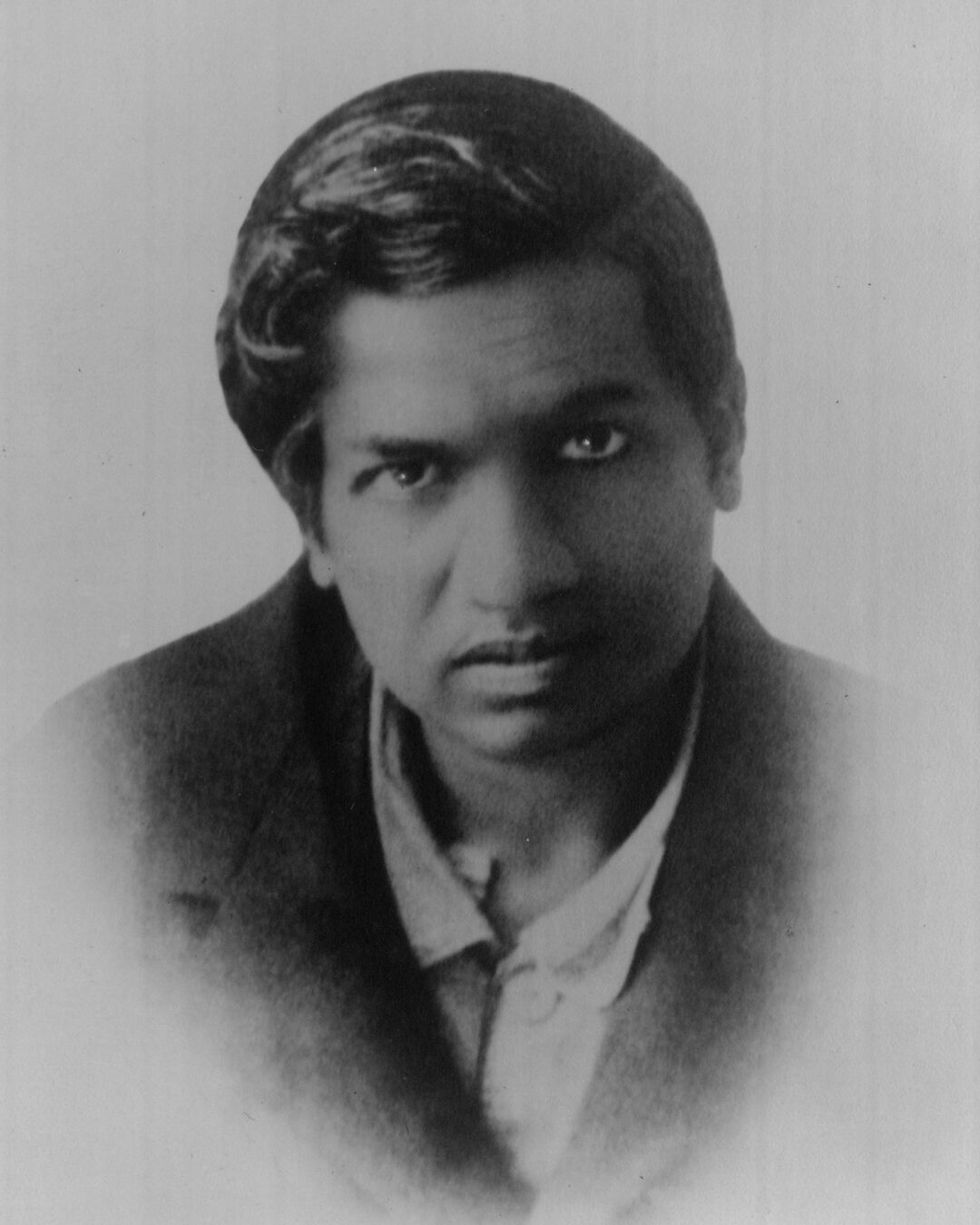
In 1910, with the help of mathematician R Ramachandra Rao (Collector of Nellore), Ramanujan secured a small stipend. By 1912 he had a clerical post at the Madras Port Trust earning Rs 25 a month. The chairman, Sir Francis Spring, and chief accountant, S Narayana Iyer, recognised his genius and encouraged him to write to British mathematicians.
In January 1913, Ramanujan posted a 10-page letter to Godfrey Harold Hardy, the foremost number theorist at Cambridge. The letter contained roughly 120 theorems with no proofs, including infinite series for π. Hardy initially thought it was a hoax. After examining it with his colleague John Edensor Littlewood, he concluded:
"They must be true, because if they were not true, no one would have the imagination to invent them."
Hardy invited Ramanujan to Cambridge. After overcoming caste-based objections to overseas travel — initially refused because crossing the seas was considered ritually impure for orthodox Brahmins — Ramanujan sailed for England in March 1914.
The Cambridge years
For the next five years, the Hardy-Ramanujan partnership produced some of the most original mathematics of the 20th century. Their joint work on the partition function — the number of ways an integer can be written as a sum of positive integers — introduced the circle method, now a cornerstone of analytic number theory.
Highlights of his Cambridge work:
- Elected Fellow of the Royal Society in 1918 — at age 30, one of the youngest ever — and the second Indian to receive this honour after Ardaseer Cursetjee.
- Elected Fellow of Trinity College, Cambridge in 1918 — the first Indian to be so honoured.
- Awarded a B.A. by Research by Cambridge in 1916.
War-time food shortages, vegetarian dietary constraints, the cold English climate and the pressure of work eroded his health. Diagnosed with tuberculosis, he returned to India in March 1919 and died at Kumbakonam on 26 April 1920, aged just 32.
In his final year, even on his deathbed, he produced mock theta functions — a class of functions that lay almost forgotten until late 20th-century mathematicians and string theorists rediscovered their importance.
Major contributions

Partitions of integers
The partition function p(n) counts the number of ways an integer n can be written as a sum of positive integers, regardless of order. For example:
- p(1) = 1 — just 1.
- p(2) = 2 — 1+1, 2.
- p(3) = 3 — 1+1+1, 2+1, 3.
- p(4) = 5 — 1+1+1+1, 2+1+1, 2+2, 3+1, 4.
- p(5) = 7.
For larger n, p(n) explodes — p(100) = 190,569,292; p(200) = 3,972,999,029,388. Computing p(n) directly becomes intractable. Hardy and Ramanujan in 1918 produced an asymptotic formula approximating p(n), refined later by Hans Rademacher into an exact convergent series. The technique they invented — the Hardy-Ramanujan-Littlewood circle method — remains a workhorse of modern analytic number theory.
Ramanujan's tau function and modular forms
Ramanujan studied the coefficients of the modular discriminant function, today known as the Ramanujan tau function τ(n). He conjectured remarkable congruence and multiplicative properties. Many of these were proved decades later by Pierre Deligne, work that earned him the Fields Medal in 1978.
Mock theta functions
In his last letter to Hardy in 1920, Ramanujan introduced mock theta functions — 17 such functions of unusual transformation behaviour. For 80 years they remained mysterious. In 2002, Sander Zwegers showed they fit into the framework of harmonic Maass forms, sparking an entire new field. Ken Ono and others have shown mock theta functions arise in the quantum entropy of black holes in string theory — a direct line from Ramanujan's deathbed to 21st-century theoretical physics.
Highly composite numbers and continued fractions
Ramanujan's first paper at Cambridge (1915) was on highly composite numbers — integers with more divisors than any smaller integer. He developed remarkable identities for continued fractions, including the famous Rogers-Ramanujan identities and elegant continued-fraction expansions for ratios involving π and e.
Infinite series for π
Ramanujan derived series that converge to π extraordinarily fast. One of his identities adds about 8 correct decimal digits per term — and is the basis of modern algorithms used to compute π to trillions of digits. The 1989 record-setting Chudnovsky algorithm is a direct descendant of Ramanujan's work.
Ramanujan primes, Ramanujan-Hardy number, magic squares
The number 1729 — popularly the "taxi-cab number" or Hardy-Ramanujan number — became famous from a sickbed conversation. Hardy mentioned that 1729 seemed dull. Ramanujan replied instantly that 1729 was the smallest number expressible as the sum of two positive cubes in two different ways: 1729 = 1³ + 12³ = 9³ + 10³.
Modern applications
Ramanujan's mathematics, often considered too abstract for use, is now found across:
| Field | Application |
|---|---|
| Signal processing | Periodic patterns in DNA, protein sequences and audio analysed using Ramanujan sums |
| Cryptography and number theory | Modular forms underlie modern algorithms for primality and factoring |
| String theory and quantum gravity | Mock theta functions appear in computing quantum entropy of black holes |
| Statistical mechanics | Partition function analogues describe particle systems |
| Crystallography | Ramanujan series in counting lattice sums |
| Computer algorithms | π-computation, randomness testing |
| Bioinformatics | Identifying repeating patterns in genome data |
The most surprising connection is to black hole physics. The number of microstates of a class of black holes in string theory — and hence their entropy — is given by the partition function and modular forms that descend directly from Ramanujan's identities and mock theta functions.
The notebooks
Ramanujan's mathematical legacy lives in three notebooks (the "Frayed Notebooks") and a "Lost Notebook" rediscovered by George Andrews in 1976 in the Trinity College library archives. Together these contain over 3,900 results, many still being investigated. Mathematician Bruce C Berndt spent over four decades editing them; the multi-volume edition is one of the great projects of 20th-century mathematics.
Legacy in Indian mathematics and beyond
- National Mathematics Day is celebrated every 22 December in India.
- 2012 declared the National Year of Mathematics on the 125th anniversary of his birth.
- SASTRA Ramanujan Prize, established in 2005, awarded annually to mathematicians under 32 working in Ramanujan's areas.
- Ramanujan Mathematical Society publishes leading research journals.
- Ramanujan Institute for Advanced Study in Mathematics at the University of Madras carries his name.
- Hardy-Ramanujan Journal continues research in his areas.
- His mathematical biography by Robert Kanigel and the resulting Hollywood film The Man Who Knew Infinity (2015) introduced him to mass audiences.
- Postage stamps issued by India in 1962 (75th birth anniversary) and 2011.
- Ramanujan IT City, Ramanujan Award for Young Scientists (ICTP), various scholarships and chairs at Indian and international universities.
His life is also a powerful argument for democratising scientific opportunity — that genius can come from anywhere, that institutional rigidity often misses talent, and that the cost of ignoring it is borne by the whole of human knowledge.
UPSC relevance
GS Paper III — Science & Technology
- Indian contributions to mathematics; modern applications of Ramanujan's work in signal processing and theoretical physics.
- Role of basic research and how seemingly abstract mathematics finds applications decades later.
GS Paper I — Indian society and personalities
- Colonial-era barriers to scientific careers; the role of mentors (Ramachandra Rao, Sir Francis Spring, G H Hardy).
- Caste, religion and orthodoxy as obstacles (sea-crossing taboo) and how they were overcome.
Essay
- "The lone genius and the institution" — Ramanujan as a question to modern science policy.
- "Beauty in mathematics" — the aesthetic case for basic research.
- "Mentorship across borders" — Hardy-Ramanujan as a model.
Prelims pointers
- Srinivasa Ramanujan — born 22 December 1887 at Erode, Tamil Nadu; died 26 April 1920.
- National Mathematics Day — 22 December.
- 2012 — National Year of Mathematics.
- Cambridge collaborator — G H Hardy, Trinity College, Cambridge.
- Elected FRS (Fellow of the Royal Society) — 1918, age 30.
- Elected Fellow of Trinity College — 1918, the first Indian.
- Lost Notebook rediscovered in 1976 by George Andrews.
- Hardy-Ramanujan number / Taxicab number — 1729 = 1³ + 12³ = 9³ + 10³.
- Partition function p(n) — counts ways to write n as a sum of positive integers.
- Mock theta functions — introduced in his last letter (1920); now connected to black hole entropy in string theory.
- Ramanujan tau function — properties proved by Pierre Deligne, Fields Medal 1978.
- Madras Port Trust — where he worked as a clerk before going to Cambridge.
- SASTRA Ramanujan Prize — annual award to mathematicians under 32.
- The Man Who Knew Infinity (2015) — biopic; book by Robert Kanigel.
For UPSC, Ramanujan is more than an inspirational story. He is a window into the colonial-era constraints on Indian science, the role of mentorship, and the way basic, abstract research finds applications decades later in fields no one anticipated. The aspirant who treats him as a case study in scientific policy — not just biography — will write answers that go beyond rote.