A black hole is the universe’s most extreme gravitational object: a region of spacetime so warped that nothing crossing its boundary can return, not even a photon traveling at the universal speed limit. The phrase sounds dramatic, but the physics is surprisingly clean. Pack enough mass into a small enough volume and the escape velocity at its surface exceeds the speed of light. Once that threshold is crossed, what was a star becomes a one-way door cut into the fabric of space and time.
For UPSC aspirants, black holes sit at a peculiar intersection. They appear in prelims under sci-tech and current affairs whenever a major astrophysical discovery breaks (the Event Horizon Telescope image of M87 in 2019, the Sagittarius A* image in 2022, the discovery of Gaia-BH3 in 2024). They also appear in mains as a way of testing whether a candidate can convert abstract physics into a clear, public-facing explanation. The topic rewards conceptual clarity over rote facts. A candidate who can sketch the anatomy, name three types, and explain Hawking radiation in their own words will outperform one who has memorized a table without grasp of the geometry.
This guide treats black holes the way an examiner expects you to treat them: as a single coherent concept with anatomy, taxonomy, and a small set of named phenomena that show up repeatedly. We will cover what a black hole is, how astronomers actually detect something they cannot see, the four families recognized today, and the half-dozen ideas (event horizon, accretion disk, Hawking radiation, gravitational lensing, spaghettification, photon sphere) that turn up most often in answer sheets.
Quick Facts on Black Holes
- Definition: A region of spacetime where gravity is strong enough that the escape velocity exceeds the speed of light.
- Theoretical basis: Einstein’s General Theory of Relativity (1915); first solution by Karl Schwarzschild in 1916.
- First image: M87* by the Event Horizon Telescope, released April 10, 2019.
- Milky Way’s black hole: Sagittarius A (Sgr A), 4.1 million solar masses, 26,000 light years away.
- Closest known: Gaia-BH3, about 1,926 light years away in Aquila, discovered 2024.
- Hawking radiation: Predicted in 1974 by Stephen Hawking; not yet directly observed.
- GS paper relevance: Prelims (Sci-Tech), GS-III (Science and Technology, Awareness in Space).
What a Black Hole Actually Is
A black hole is not a hole in the everyday sense. There is no opening, no tunnel, no surface to stand on. It is a region in which the curvature of spacetime, produced by an extraordinary concentration of mass-energy, becomes so steep that all paths through that region lead inward. Light, which normally travels in straight lines, finds itself with no straight line that escapes. The region is therefore dark, and its boundary is the event horizon.
Two ways of thinking about this help most aspirants. The Newtonian picture says that escape velocity, the speed needed to break free of a body’s gravity, depends on the mass and radius of that body. Compress Earth to the size of a peanut and its escape velocity exceeds the speed of light; that compressed Earth would be a black hole. The Einsteinian picture, which is the one professional astronomers use, says that mass tells spacetime how to curve, and curvature tells matter and light how to move. Past a critical curvature, all worldlines turn inward.
Astronomers cannot see a black hole directly, since by definition no light leaves it. They infer its presence by what it does to surrounding matter and light. Gas falling toward it heats up and radiates X-rays. Stars near it accelerate to enormous speeds in apparently empty orbits. Light from sources behind it bends and forms rings. The Event Horizon Telescope, which combined data from radio observatories on multiple continents, did not photograph a black hole; it photographed the silhouette an event horizon casts against the glowing disk that surrounds it.
Background and Historical Context
The idea that a star could be heavy enough to trap its own light is older than relativity. In 1783, the English clergyman John Michell speculated about “dark stars” whose escape velocity would exceed the speed of light. Pierre-Simon Laplace published a similar conjecture in 1796. Both ideas were curiosities; nobody had a working theory of gravity strong enough to make the speculation rigorous.
Karl Schwarzschild changed that in 1916. While serving on the Russian front during World War I, Schwarzschild solved Einstein’s field equations for a non-rotating spherical mass and discovered that any mass compressed within a critical radius (now called the Schwarzschild radius) would be hidden behind a one-way boundary. Einstein himself disliked the result. Through the 1930s, Robert Oppenheimer, Hartland Snyder, and others showed that a sufficiently massive collapsing star would produce exactly this configuration. The name “black hole” was popularized by John Archibald Wheeler at a 1967 conference.
Observational confirmation lagged the theory by decades. Cygnus X-1, identified in the 1960s as an X-ray source whose companion star showed the orbital wobble of an unseen massive partner, became the first widely accepted stellar-mass candidate. Andrea Ghez and Reinhard Genzel won the 2020 Nobel Prize in Physics for their decades-long tracking of stars looping around the Milky Way’s center, which proved a 4-million-solar-mass dark object lurked there. The 2019 EHT image of M87 and the 2022 image of Sgr A moved black holes from theoretical to photographable, and they are now firmly part of mainstream observational astronomy. India’s space programme has built complementary capability through space-based instruments such as the Aditya-L1 solar observatory and the Euclid mission that India contributes to.
The Anatomy of a Black Hole
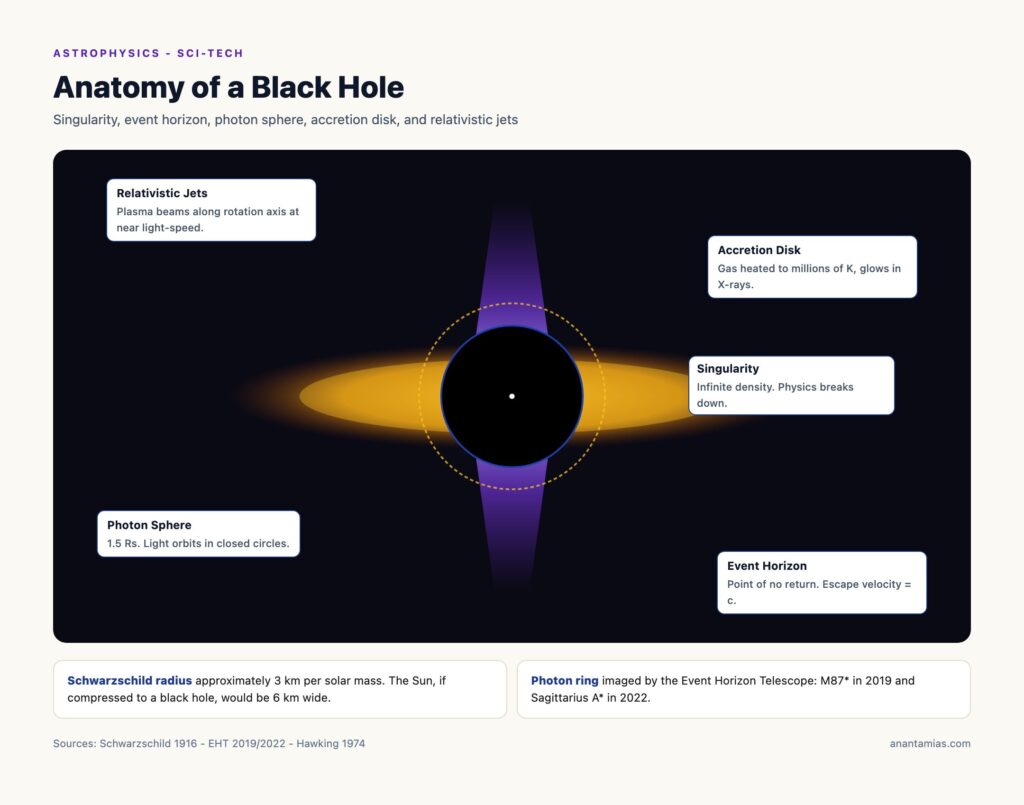
Three structural elements show up in every black-hole diagram and in every UPSC answer worth full marks: the singularity, the event horizon, and the accretion disk. A fourth, the photon sphere, has joined the list since the EHT images appeared in textbooks.
The singularity is the point at the centre. Classical general relativity predicts infinite density and infinite spacetime curvature there, which is physics’ way of saying the equations have broken down. Most physicists assume a complete theory of quantum gravity will replace this point with something finite but bizarre. For exam purposes, treat the singularity as the formal centre where known physics ceases to apply.
The event horizon is the boundary that defines the black hole as a black hole. It is not a physical surface; nothing material lives there. It is the locus at which the escape velocity equals the speed of light, the radius beyond which no signal can ever reach an outside observer. Cross it and your future light cone tilts entirely inward. The Schwarzschild radius for a non-rotating black hole works out to roughly 3 km per solar mass, so the Sun, if compressed to a black hole, would have an event horizon about 6 km across.
The accretion disk is the bright halo of gas and dust spiraling inward. Material from companion stars, interstellar clouds, or whole stars that ventured too close gets caught in orbit, loses angular momentum through friction, and grinds inward over millions of years. Friction within the disk heats the gas to millions of kelvin, hot enough to radiate strongly in X-rays. Almost everything we observe about a black hole is observed via its accretion disk. Some accreting black holes also launch relativistic jets, narrow beams of plasma that punch outward along the rotation axis at speeds approaching that of light.
The photon sphere is a region just outside the event horizon (at 1.5 times the Schwarzschild radius for a non-rotating hole) where gravity bends light into closed circular orbits. This is the bright ring you see in the EHT images: photons skimming the horizon and looping back to your eye after one or more orbits.
Types of Black Holes

Astronomers recognize four families, separated by mass and origin. Three are observationally confirmed; the fourth is a leading hypothesis.
Stellar-mass black holes are the workaday population, formed when a massive star (more than about 20 solar masses) exhausts its nuclear fuel, collapses, and undergoes a supernova or direct collapse. Masses range from roughly 3 to a few tens of solar masses. Cygnus X-1 (about 21 solar masses) and the merging pair detected by LIGO in 2015 (the first gravitational wave detection) belong to this family.
Supermassive black holes (SMBHs) sit at the centre of nearly every large galaxy. Masses run from millions to tens of billions of solar masses. Sagittarius A is a small one at 4.1 million solar masses; M87 is a giant at 6.5 billion. How they grew so big in the early universe is an open research question; current models combine seed black holes from the first stars, runaway mergers in dense clusters, and direct collapse of primordial gas clouds.
Intermediate-mass black holes (IMBHs), ranging from roughly 100 to 100,000 solar masses, fill the gap between the other two. They are difficult to find. Confirmed candidates have come from globular clusters and from the gravitational-wave signal GW190521, which appeared to involve a black hole around 142 solar masses. They may be the missing seeds of supermassive black holes.
Primordial black holes are the speculative family. The hypothesis, first developed by Hawking and Carr in the 1970s, says that density fluctuations in the very early universe could have produced black holes anywhere from sub-atomic to mountain-sized. None have been confirmed, but they remain a candidate for some fraction of dark matter and a target for sensitive gravitational-wave and microlensing surveys.
Why Black Holes Matter for UPSC
Three reasons drive their repeat appearance in the syllabus. First, they are headline science: every major black-hole discovery makes the front page, and prelims has an established habit of asking about whatever was in the news the previous year. Second, they sit at the edge of physics, and the syllabus rewards aspirants who can comfortably discuss objects where general relativity meets quantum mechanics. Third, they connect to topics every aspirant already covers: gravitational waves (LIGO, India’s LIGO-India project), the Event Horizon Telescope, India’s Aditya-L1 (which is solar but introduces space-based observation), and indirectly to cosmology through the cosmic microwave background.
The topic also pulls in questions related to the National Quantum Mission, since black-hole physics sits at the intersection of general relativity and quantum mechanics, the two pillars whose unification remains the open frontier. Black holes also show up as a vehicle for ethics and science-policy questions. Should public money fund “blue-sky” research with no obvious application? The standard answer in any well-written GS-III essay traces a line from blackboard physics (relativity, 1915) to Schwarzschild’s wartime calculation (1916) to GPS satellites (which need general-relativistic corrections to function), to LIGO’s detection of merging black holes (2015), to medical imaging algorithms that share mathematical roots. The lesson is that fundamental physics pays back unpredictably and asymmetrically.
Key Concepts You Must Know
A handful of named phenomena turn up year after year in objective and subjective questions.
Spaghettification, sometimes called the noodle effect, is what happens to anything falling into a black hole feet-first. Gravity pulls the feet harder than the head, and the difference (the tidal force) stretches the falling body into a long thin filament. For stellar-mass holes the effect is fatal long before you reach the horizon; for supermassive holes the gradient is gentler and you would cross the horizon intact, only to be torn apart deeper inside.
Hawking radiation, predicted by Stephen Hawking in 1974, says black holes are not perfectly black. Quantum field theory near the event horizon allows pair production in which one particle falls in and the other escapes, draining the hole’s mass over astronomical timescales. The radiation is fantastically faint for any astrophysical hole (a stellar-mass hole emits at billionths of a kelvin, far below the cosmic microwave background), so it has never been directly observed. Its theoretical importance is enormous because it ties black holes to thermodynamics and creates the information paradox at the heart of modern theoretical physics.
Gravitational lensing describes how a black hole’s curvature bends the path of light passing nearby, magnifying or duplicating the image of a more distant source. The effect was first confirmed during the 1919 solar eclipse for the Sun, predicted in detail for black holes by relativity, and is now routinely used to map dark matter and to find faint distant galaxies.
The photon sphere, mentioned earlier, deserves a second look. At 1.5 Schwarzschild radii, light can orbit the hole. The bright ring in the EHT images is the photon ring’s outer edge, and the dark central region (the “shadow”) is roughly 2.5 times the Schwarzschild radius across, not the horizon itself.
Famous Black Holes and Recent Discoveries
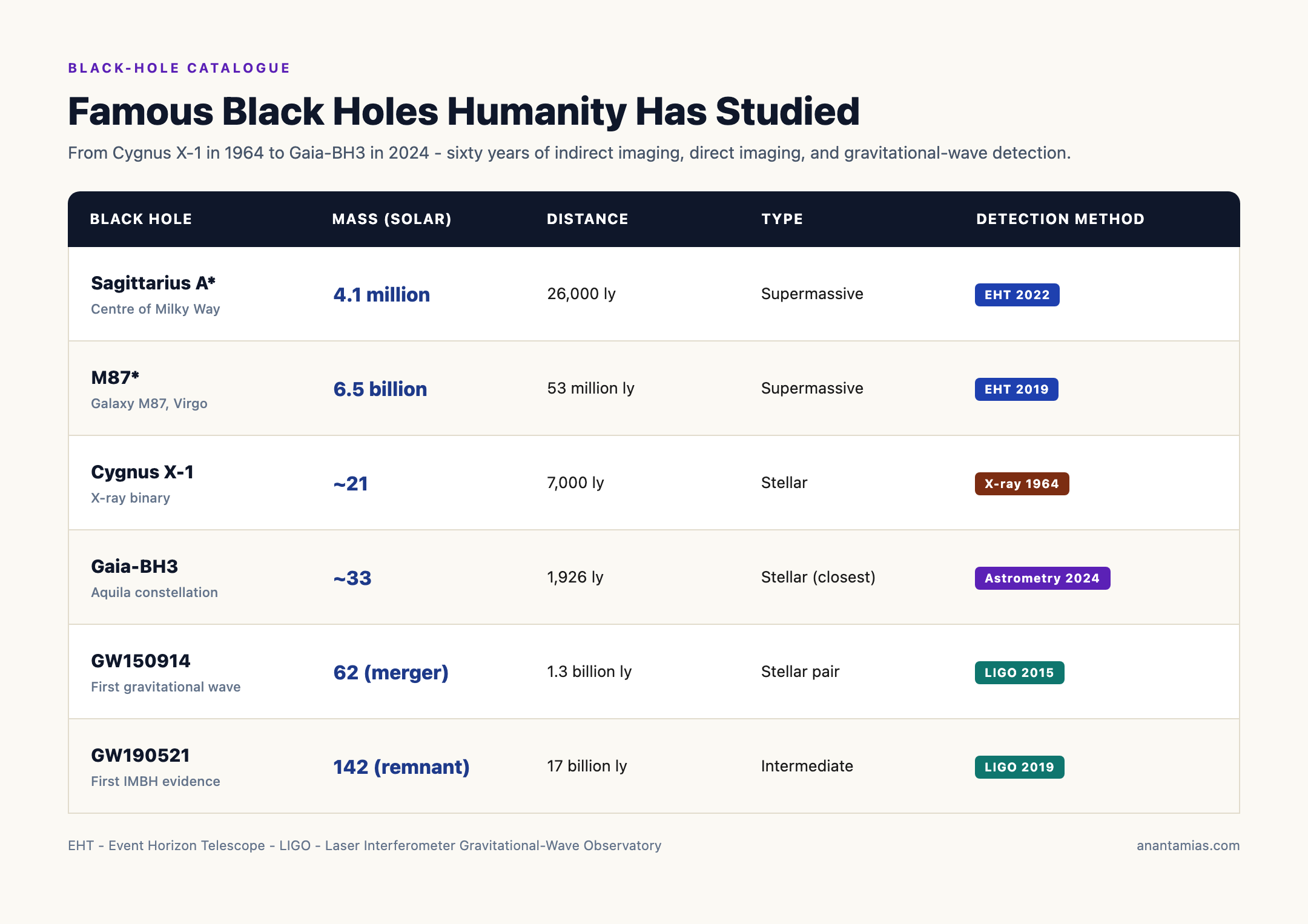
Sagittarius A* lives at the centre of the Milky Way. Its 4.1-million-solar-mass identity was nailed down by tracking the orbits of stars (especially S2) over twenty years, work that earned the 2020 Nobel Prize. The EHT released its silhouette image in May 2022.
M87* is the giant at the centre of the elliptical galaxy Messier 87, 53 million light years away in Virgo. Its 6.5-billion-solar-mass image, released in April 2019, was the first direct picture of any black hole’s neighbourhood and confirmed Einstein’s predictions for the shape and size of the photon ring to within a few percent.
Cygnus X-1 was the first widely accepted stellar-mass candidate. The 21-solar-mass black hole pulls gas from a blue supergiant companion, producing the X-ray signature that gave it away in 1964.
Gaia-BH3, announced in 2024, is the most massive stellar-origin black hole found in the Milky Way (about 33 solar masses) and the closest yet at 1,926 light years. It was found in routine astrometric data from the European Space Agency’s Gaia mission, which tracks stellar positions with extreme precision.
GW190521, detected by LIGO in 2019, was the first gravitational-wave signal whose remnant landed in the intermediate-mass range, providing observational support for the IMBH category.
Detection Techniques
Because black holes are dark, all evidence is indirect. The four standard channels are: dynamical (tracking motions of nearby stars or gas as in the Sgr A* work), accretion-driven (X-ray, radio, and optical emission from the disk and jets, as in active galactic nuclei and X-ray binaries), gravitational-wave (LIGO and Virgo catch the chirp of merging black holes), and event-horizon imaging (the EHT collaboration’s very-long-baseline interferometry across continent-scale arrays). India contributes through LIGO-India (under construction in Maharashtra), AstroSat X-ray observations, and theoretical work at IUCAA, Raman Research Institute, and TIFR. The broader Indian space policy 2023 framework covers how astrophysics observatories now sit alongside commercial and applied space activity in national priorities.
Comparative Snapshot: Black Holes vs Neutron Stars vs White Dwarfs
The end states of dying stars form a sequence by mass. White dwarfs (electron-degeneracy supported, up to 1.44 solar masses, the Chandrasekhar limit) are the fate of low- and intermediate-mass stars including the Sun. Neutron stars (neutron-degeneracy supported, up to roughly 2-3 solar masses, the Tolman-Oppenheimer-Volkoff limit) are the fate of moderately massive stars. Black holes are what is left when the collapse cannot be halted by any known degeneracy pressure, the fate of the most massive stars. The boundaries are blurred by rotation, magnetic fields, and binary interactions, but the mass-ordered sequence is the picture exam questions usually expect.
Challenges in Black Hole Research
Direct observation remains expensive and rare. The EHT requires synchronous millimetre-wave data from observatories on three continents, calibrated to picosecond precision; only two black holes have been imaged so far. Hawking radiation is too faint to detect with any current instrument, leaving its theoretical implications (the information paradox in particular) untested. Primordial black holes have eluded every search to date. And the formation of supermassive black holes in the first billion years of cosmic time is an open puzzle that JWST observations are now actively reshaping.
For India specifically, the gap is in big-instrument participation. AstroSat is small by global standards. LIGO-India, when it goes online later this decade, will close part of the gap. Continued investment in computational astrophysics and in the fellowships that send Indian PhD students to EHT-class collaborations is where most of the country’s black-hole science is being built.
Prelims Pointers
- Schwarzschild radius scales linearly with mass: about 3 km per solar mass.
- M87 image (2019) and Sgr A image (2022) were both produced by the Event Horizon Telescope collaboration.
- LIGO’s 2015 GW150914 detection involved the merger of two stellar-mass black holes; LIGO-India is being built in Hingoli, Maharashtra.
- Hawking radiation is a theoretical prediction, not yet observed.
- Sagittarius A* is at the centre of the Milky Way and weighs about 4.1 million solar masses.
- The 2020 Nobel Prize in Physics went to Roger Penrose, Reinhard Genzel, and Andrea Ghez for black-hole-related work.
Mains Practice Questions
- “Black holes are no longer purely theoretical objects.” Discuss the observational evidence accumulated since 2015 that supports this statement. (250 words, GS-III)
- Explain the concept of Hawking radiation and discuss why its experimental verification remains one of the open problems of modern physics. (150 words, GS-III)
- Examine India’s contribution to gravitational-wave astronomy and to black-hole science, with particular reference to LIGO-India and AstroSat. (250 words, GS-III)
Way Forward
The next decade should produce three things relevant to the syllabus. The Event Horizon Telescope will image more supermassive holes and add time-resolved movies of their inner regions. LIGO-India, when commissioned, will turn the global gravitational-wave network into a four-detector system capable of localizing merger sources to within a few degrees on the sky. And the Square Kilometre Array (with Indian participation through SKA-India) will vastly expand the sample of active galactic nuclei whose central black holes can be characterized. For an aspirant, the lesson is that black holes will keep generating prelims-grade news, and the conceptual scaffolding in this guide will not need to change to absorb each new headline.
Frequently Asked Questions
What is the simplest definition of a black hole for UPSC?
A black hole is a region of spacetime where gravity is so strong that nothing, not even light, can escape once it crosses the boundary called the event horizon. It is the densest known kind of object and forms either when a massive star collapses or, in the case of supermassive ones, through processes that grew them over billions of years.
Who first proposed the existence of black holes?
The modern theory comes from Karl Schwarzschild’s 1916 solution to Einstein’s field equations. The general idea of a body so heavy that light cannot escape goes back to John Michell in 1783. The name u0022black holeu0022 was popularized by John Archibald Wheeler in 1967.
What is Hawking radiation and has it been observed?
Hawking radiation is the faint thermal emission predicted by Stephen Hawking in 1974, arising from quantum effects at the event horizon. It causes black holes to slowly lose mass and eventually evaporate over astronomically long timescales. It has not yet been directly observed, since the predicted emission is far weaker than the cosmic microwave background.
How do astronomers see something that emits no light?
They observe its surroundings. Gas falling into the hole heats up and emits X-rays. Stars orbiting nearby reveal the mass of the unseen object. Light from background sources gets bent by the black hole’s gravity, producing distinctive rings and arcs. The Event Horizon Telescope actually images the bright ring of light around the dark silhouette of the event horizon.
What is the difference between a black hole and a neutron star?
Both form when a massive star collapses, but neutron stars are supported against further collapse by neutron degeneracy pressure and have a physical surface. Black holes form when the collapsing core exceeds about 2-3 solar masses, the limit beyond which no known force can stop the contraction; they have an event horizon but no physical surface.
What is Sagittarius A* and why does it matter to India?
Sagittarius A* is the supermassive black hole at the centre of our galaxy, the Milky Way. It matters because tracking stars orbiting it provided the first ironclad evidence that supermassive black holes are real, work for which Andrea Ghez and Reinhard Genzel won the 2020 Nobel Prize. Indian theorists and observers contribute to its study through institutions like IUCAA, RRI, and TIFR.
What is spaghettification?
Spaghettification is the stretching of any object that falls into a black hole. The gravity at the feet (closer to the centre) is stronger than at the head, so the body gets pulled into a long thin shape. For stellar-mass black holes the effect kills you well before you reach the horizon; for supermassive holes the tidal force at the horizon is gentler, and the stretching becomes lethal only deeper inside.
What is the Event Horizon Telescope?
The Event Horizon Telescope is a global collaboration that links radio observatories on different continents into a single virtual telescope the size of Earth. It uses very-long-baseline interferometry to achieve the angular resolution needed to image the silhouette of a supermassive black hole’s event horizon. It produced the first image of M87 in 2019 and Sagittarius A in 2022.
Are black holes related to dark matter?
Most of dark matter is thought to be a non-baryonic particle yet to be identified, not black holes. Primordial black holes formed in the very early universe remain a small candidate fraction, and gravitational microlensing surveys have ruled out wide mass ranges as the dominant component. The two concepts are linked but distinct.
How does India contribute to black-hole science?
India contributes through theoretical work at IUCAA Pune, Raman Research Institute, ICTS-TIFR, and several IITs; through observational data from AstroSat (the country’s first dedicated space observatory); and through the under-construction LIGO-India gravitational-wave detector in Hingoli, Maharashtra. Indian researchers are members of the EHT and LIGO collaborations.
Tell Google you want more of this.
Add Anantam IAS as a preferred sourceOne tap, and this site shows up more often in your own Top Stories, AI Overviews and AI Mode. Remove it any time.