RBI Annual Report 2025-26: Forex Reserves, Import Cover and the External-Sector Buffer (UPSC Economy)
The RBI's 2025-26 Annual Report puts India's foreign exchange reserves at about $691 billion with roughly 11 months of import cover, a balance sheet worth 26.4% of GDP, and a record surplus transfer of nearly ₹2.87 lakh crore to the government. Here is the full picture — what the reserves are made of, how import cover works as a buffer, and why the economic capital framework matters — explained for UPSC GS3.
As of end-March 2026, India’s foreign exchange reserves stood at about $691.1 billion — roughly eleven months of import cover and covering about 90.3 per cent of total external debt — as reported in the RBI’s Annual Report 2025-26 (approved 23 May 2026). The buffer held even as the RBI sold dollars through the year to steady the rupee.
When the Reserve Bank of India released its Annual Report for 2025-26 in late May, the headline most papers ran with was a number: a record surplus of nearly ₹2.87 lakh crore handed to the central government. But the report’s real story sits a few pages deeper, in the part that rarely makes the front page — the state of India’s external-sector buffer. After a year in which the rupee wobbled and the RBI spent down dollars to steady it, the country’s foreign exchange reserves still stood at around $691 billion at the end of March 2026, enough to pay for roughly eleven months of imports. The buffer held. And how it held is exactly the kind of thing a UPSC answer is supposed to explain.
So this article unpacks the 2025-26 report from the angle examiners care about most — the external sector and the RBI’s own balance sheet. It walks through what the reserves are made of, why import cover is the number that matters, how the RBI’s books grew to a fifth larger in a single year, what the record dividend to the government actually means, and how the economic capital framework decides how much of that surplus the bank keeps versus gives away. Get these few figures and the logic behind them, and you can answer almost any question on India’s external resilience and the central bank’s finances.
What the RBI Annual Report Is and Why It Matters
Start with the document itself, because a lot of aspirants quote it without knowing what it is. The RBI Annual Report is the central bank’s yearly account of its own operations and of the economy it manages, released each May for the financial year that ended the previous March. It carries two things at once. The first is an assessment and outlook — the RBI’s reading of growth, inflation, the external sector, banking and the year ahead. The second, and the part most people skip, is the RBI’s own audited balance sheet: what the central bank owns, what it owes, what it earned and how it shares the leftover with the government. For 2025-26 that report was placed before the public after the RBI’s Central Board approved its accounts on 23 May 2026.
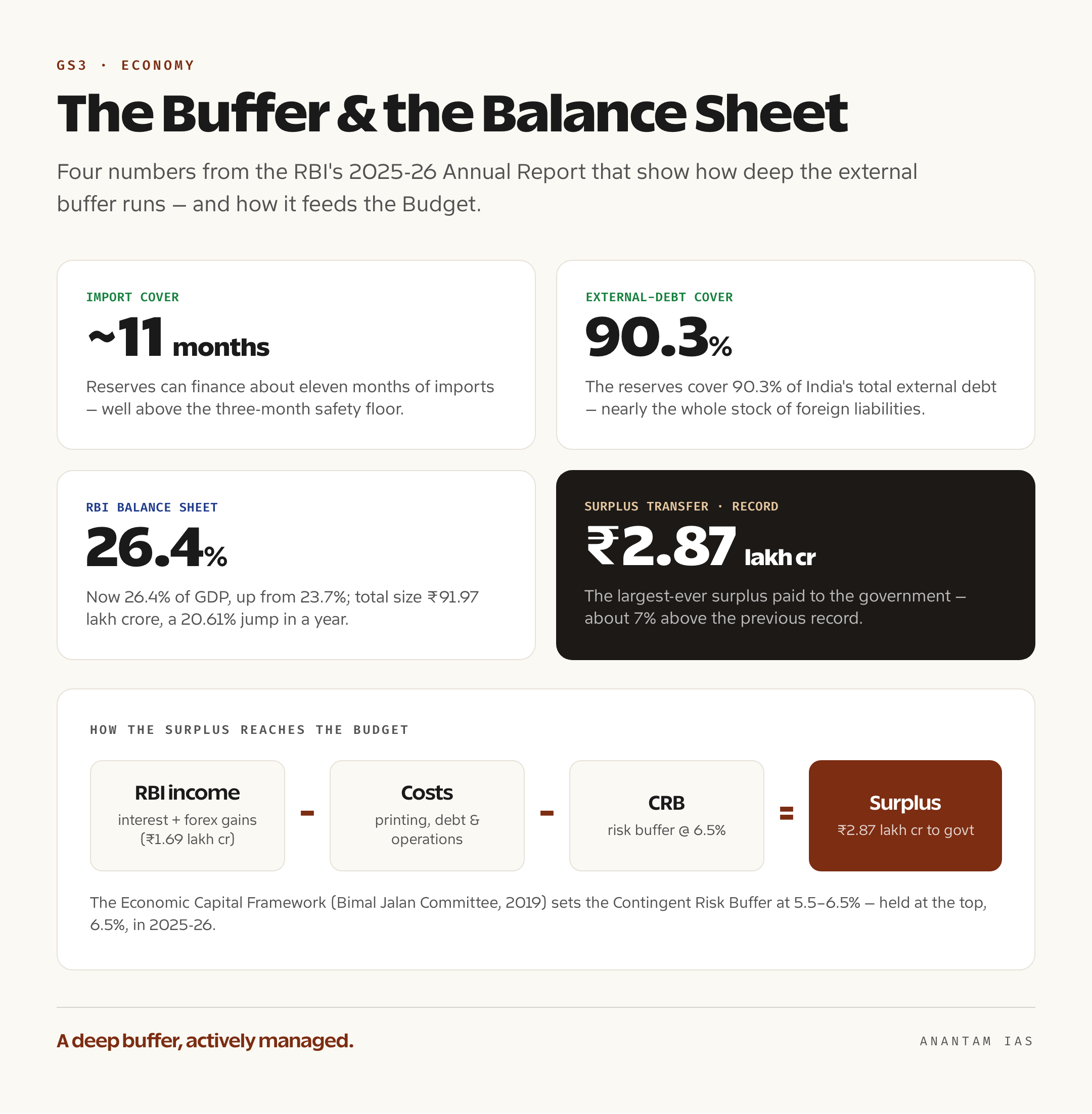
Why does a central bank even have a balance sheet worth reading? Because the RBI is not just a regulator — it is a vast financial institution in its own right. On the asset side it holds the country’s foreign exchange reserves, gold, and government securities. On the liability side sit the currency notes in your wallet (currency in circulation is a liability of the issuing bank), the deposits commercial banks park with it, and its own reserves and capital. When that balance sheet grows or shrinks, it tells you how much money the RBI has pumped into or pulled out of the system, how its reserves have been revalued, and how much cushion it is keeping against risk. For 2025-26 the balance sheet expanded by 20.61 per cent to about ₹91.97 lakh crore, which the RBI pegged at roughly 26.4 per cent of India’s GDP, up from 23.7 per cent a year earlier.
That one-fifth jump in a single year is striking, and it didn’t come mainly from the RBI buying more assets. A big chunk came from revaluation — the rupee value of the reserves and gold the bank already held rose sharply as gold prices climbed and the rupee weakened against the dollar. The RBI’s currency and gold revaluation account, the line that captures these paper gains, swelled from about ₹13.03 lakh crore to ₹21.69 lakh crore over the year. So the books grew partly because the world repriced what was already inside them. Holding that distinction — between fresh money created and old assets revalued — is the kind of nuance that lifts an external-sector answer above the average.
Forex Reserves: The Four Components and What Import Cover Buys You
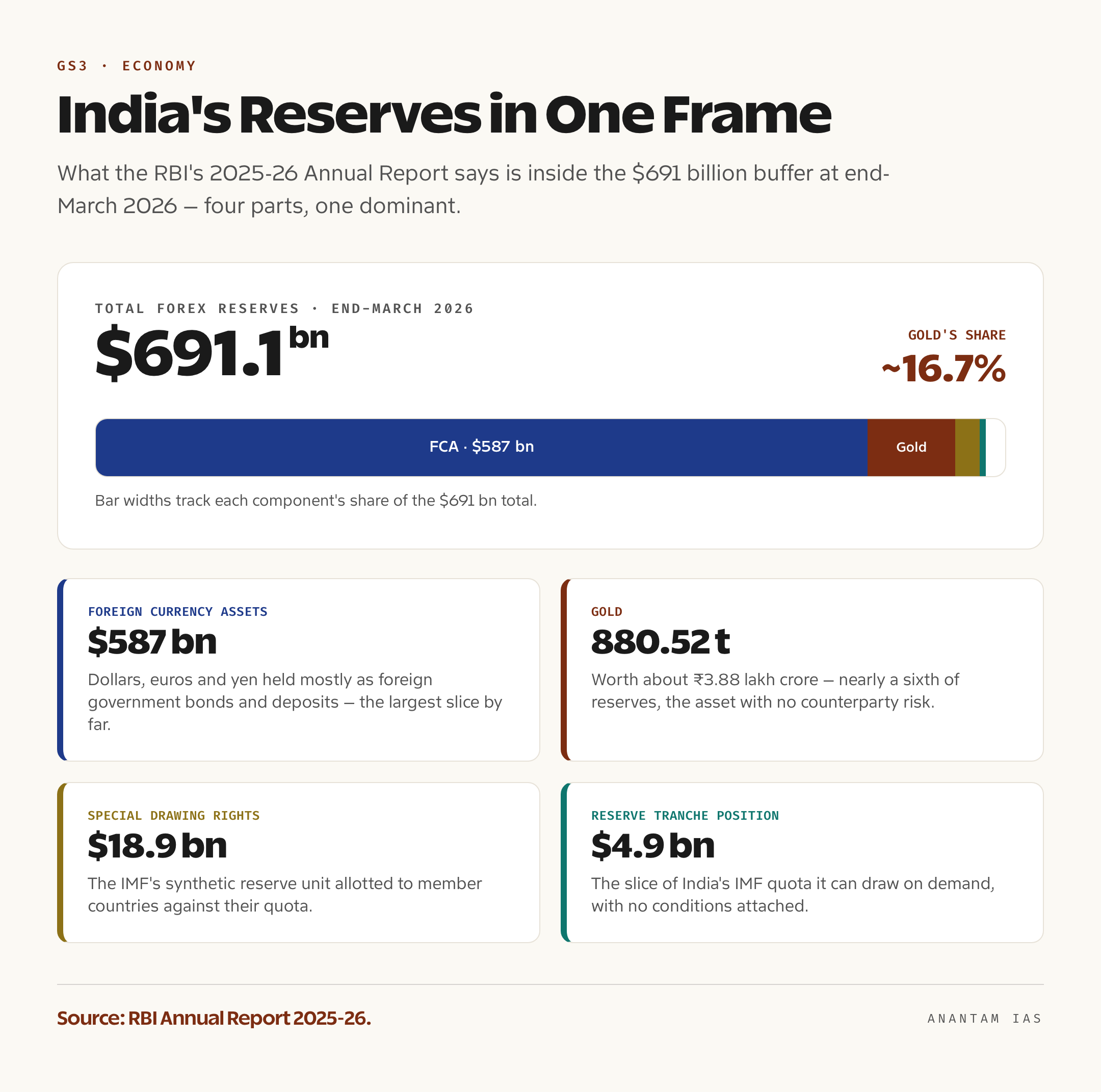
Now the external buffer, which is the heart of the report for GS3. India’s foreign exchange reserves are the stock of external assets the RBI can draw on to meet the country’s foreign payments and to steady the rupee when markets turn rough — the national emergency fund, in plain terms. As of end-March 2026 the report put them at about $691.1 billion, among the largest such buffers in the world, and they come in four parts every aspirant should be able to name in order. The biggest by far is Foreign Currency Assets, or FCA — dollars, euros, yen and other currencies held mostly as foreign government bonds and deposits, which stood at around $587 billion. Then comes gold, at 880.52 tonnes and worth about ₹3.88 lakh crore, now nearly a sixth of the total. Then Special Drawing Rights, or SDRs, the synthetic reserve unit the International Monetary Fund hands its members, at roughly $18.9 billion. And last, the Reserve Tranche Position, the slice of India’s IMF quota it can pull back on demand without conditions, at about $4.9 billion.
The standard health check on this buffer is import cover — how many months of imports the reserves could pay for if every other dollar inflow stopped tomorrow. On the 2025-26 numbers India’s cover is comfortable, in the region of eleven months, well above the three-month line economists treat as the danger floor. Import cover matters because it answers the only question a creditor or a panicked market really asks in a crisis: can this country keep paying for what it needs to buy from abroad? Eleven months says yes, with room to spare. The report added a second reassuring ratio — the reserves cover about 90.3 per cent of India’s total external debt, so the country could repay almost everything it owes the rest of the world from its own kitty if it ever had to.
But the report was honest about the strain, too, and this is where a sharp answer earns marks. The reserves didn’t grow smoothly through the year. On a balance-of-payments basis — stripping out valuation effects — they actually drew down by about $30.8 billion over April to December 2025, because capital inflows fell short of the current account deficit and the RBI sold dollars to defend the rupee. So the headline figure stayed high partly because gold and currency revaluation papered over the dollars that were actually spent. The buffer is large and the external position is sound — external debt is a contained 20.4 per cent of GDP and short-term debt is a manageable slice of reserves — but it is being managed actively, not sitting idle. That is the difference between reserves as a static trophy and reserves as a working shock absorber.
The Record Surplus Transfer and What It Pays For
Here is the number that made news. For 2025-26 the RBI’s Central Board approved a surplus transfer of ₹2,86,588.46 crore — close to ₹2.87 lakh crore — to the central government, the largest such payout in the bank’s history and about 7 per cent above the previous year’s then-record of roughly ₹2.69 lakh crore. People loosely call this the RBI’s “dividend,” and the comparison is fair: like a company paying out profit to its owner, the RBI transfers its leftover income to the government, which owns it. But the mechanics are worth getting right, because examiners test exactly this.
Where does the surplus come from? The RBI earns income from several streams — interest on the domestic government bonds it holds, returns on its foreign currency assets parked abroad, and gains from buying and selling foreign exchange. In 2025-26 those forex operations were especially lucrative: as the bank sold dollars at a weaker rupee than it had bought them, it booked gains of about ₹1.69 lakh crore on exchange-rate transactions, up from ₹1.11 lakh crore the year before. Set against this income are the RBI’s costs — printing currency, managing debt, running the institution — and, crucially, the amount it sets aside as a risk cushion. Whatever is left after costs and provisioning is the surplus that goes to the government under Section 47 of the RBI Act.
And that transfer is no small thing for the Union Budget. Nearly ₹2.87 lakh crore is a large, non-tax revenue line that helps the government hit its fiscal deficit target — pegged at 4.4 per cent of GDP for 2025-26 — without raising taxes or cutting spending. A bumper RBI payout gives the finance minister breathing room; a thin one tightens the squeeze. That is precisely why the rule deciding how much the RBI keeps for itself versus how much it gives away is so politically charged, and it brings us to the framework that governs it.
The Economic Capital Framework: How Much the RBI Keeps
So who decides the split between the RBI’s risk cushion and the government’s cheque? A rulebook called the Economic Capital Framework, or ECF. This is the part candidates most often get vague about, so it’s worth nailing down. Economic capital is simply the buffer a central bank holds against the risks it carries — that its reserves and bonds could lose value, that markets could turn, that it might have to act as lender of last resort in a crisis. The ECF is the formula that says how big that buffer must be, which in turn fixes how much surplus is “free” to be transferred to the government.
The current framework comes from the Bimal Jalan Committee, set up by the RBI in 2018 after the Finance Ministry pushed the bank to align with global practice, and adopted in 2019. Its key device is the Contingent Risk Buffer, or CRB — a slice of the RBI’s balance sheet kept aside specifically for monetary and financial-stability shocks. The committee recommended the CRB be held in a band of 5.5 to 6.5 per cent of the balance sheet, and that the whole framework be reviewed every five years. For 2025-26 the RBI kept the CRB at the top of that band, 6.5 per cent, transferring ₹1,09,379.64 crore into it. Keeping the buffer at the upper limit means the bank is being cautious — setting aside more for risk and, by definition, leaving a little less for the government than the absolute maximum.
Because the Jalan framework was meant to be reviewed every five years, an internal RBI committee has been re-examining the ECF, and this is the live debate to flag in an answer. The tension is structural and clean to state: the government, always hungry for revenue, would prefer a leaner buffer and a fatter transfer, while the RBI guards its independence and financial strength by holding a thicker cushion. Push the buffer too low and you raise the dividend but expose the central bank in the next crisis; hold it too high and you starve the budget of money that arguably belongs to the public. The ECF is where that balance is struck, and any change to it ripples straight into the government’s fiscal arithmetic. That is the conceptual payoff of the whole report — the RBI’s reserves, its balance sheet, its surplus and its risk buffer are one connected system, and the external-sector buffer is the most visible face of it.
For Your Mains Answer
This is a high-value topic for GS Paper 3, which covers the Indian economy, mobilisation of resources, the external sector, the balance of payments and the role of institutions like the RBI. Questions on forex-reserve adequacy, exchange-rate management, central-bank finances, the RBI-government surplus transfer and the economic capital framework can all be answered with this material. It also feeds GS Paper 2 on the autonomy of regulatory institutions and the Essay paper on economic sovereignty and resilience. The skill examiners reward is the same one this article uses: pair a few exact figures with a clear chain of cause and effect, and connect the buffer to the budget.
How to Build the Answer
Open with the buffer, not the balance sheet — define forex reserves and import cover, give the headline figures, then show how the reserves connect to the RBI’s books and the surplus. Move in a logical chain: what the report is, what reserves are made of (the four components), why import cover is the adequacy test (eleven months, above the three-month floor), how the buffer is managed actively (the dollar drawdown to defend the rupee), how the balance sheet grew (revaluation, not just fresh assets), what the surplus transfer pays for (the fiscal deficit), and how the ECF decides the split. Close by judging the trade-off between the RBI’s cushion and the government’s revenue. That arc — define, compose, test, manage, transfer, evaluate — fits almost any reserves-or-RBI-finances question.
Common Mistakes to Avoid
Don’t treat the rising balance sheet as proof the RBI printed lots of money — much of the growth was revaluation of existing reserves and gold. Don’t call the surplus a “profit tax” or confuse it with corporate dividend law; it flows under Section 47 of the RBI Act after risk provisioning. Don’t quote import cover without the danger floor — eleven months means little unless you note three months is the textbook minimum. And don’t describe the ECF as settled; flag that it is under review and that the buffer level is the live fault line between the RBI and the Finance Ministry.
A Compact Answer Spine
RBI Annual Report 2025-26 → forex reserves ≈ $691 bn at end-March 2026, ~11 months import cover, ~90.3% of external debt → four components: FCA ≈ $587 bn + gold (880.52 t, ≈ ₹3.88 lakh cr) + SDRs ≈ $18.9 bn + reserve tranche ≈ $4.9 bn → buffer managed actively: BoP-basis drawdown ≈ $30.8 bn as RBI sold dollars to defend the rupee → balance sheet ₹91.97 lakh cr (26.4% of GDP), up 20.61% mostly on revaluation → record surplus transfer ₹2.87 lakh cr under Section 47 → ECF (Bimal Jalan Committee, 2019): CRB held at 6.5%, under review → verdict: a deep, actively managed buffer; the RBI-government split is the policy tension.
Diagram or Flowchart Idea
Draw a two-panel visual: on the left, a stacked bar or donut of the four reserve components with FCA dominant and gold’s slice highlighted; on the right, a simple flow — RBI income (interest + forex gains) minus costs minus CRB provision (6.5%) equals surplus to government (₹2.87 lakh cr). A clean composition-plus-flow pairing communicates the whole report at a glance and is quick to sketch.
A Balanced-Conclusion Line
A line that lands the marks: “India’s external buffer is deep enough to inspire confidence — eleven months of import cover and reserves nearly matching all external debt — but the real test of the 2025-26 report is institutional: striking the right balance between a central bank strong enough to absorb the next shock and a government in need of the revenue that buffer locks away.”
How to Use Data Without Cramming
You need only five anchors, not the full balance sheet: $691 billion (reserves), 11 months (import cover), ₹91.97 lakh crore / 26.4% of GDP (balance sheet), ₹2.87 lakh crore (surplus transfer), and 6.5% (the CRB). Drop those five into the right sentences and the answer reads as authoritative. Attribute them plainly — “as the RBI’s 2025-26 Annual Report showed” — rather than scattering numbers without a source.
FAQ
What did the RBI Annual Report 2025-26 say about India’s forex reserves? It put India’s foreign exchange reserves at about $691.1 billion at end-March 2026, enough for roughly eleven months of imports and covering around 90.3 per cent of total external debt. The reserves are made up of four parts — foreign currency assets (about $587 billion), gold (880.52 tonnes, worth about ₹3.88 lakh crore), Special Drawing Rights (about $18.9 billion) and the reserve tranche position with the IMF (about $4.9 billion). The buffer stayed large even though the RBI sold dollars through the year to steady the rupee.
How big was the RBI’s surplus transfer to the government this year? The RBI’s Central Board approved a surplus transfer of ₹2,86,588.46 crore — close to ₹2.87 lakh crore — for 2025-26, its largest ever and about 7 per cent above the previous record. The money flows to the government under Section 47 of the RBI Act after the bank meets its costs and sets aside a risk cushion, and it is a major non-tax revenue line that helps the Union Budget hit its deficit target.
What is the economic capital framework, and why does it matter? The economic capital framework, recommended by the Bimal Jalan Committee in 2019, is the rulebook that decides how much of its income the RBI keeps as a risk buffer versus how much it transfers to the government. Its core tool is the Contingent Risk Buffer, held in a band of 5.5 to 6.5 per cent of the balance sheet; for 2025-26 the RBI kept it at 6.5 per cent. The framework is under periodic review, and the level of that buffer is the main tension between the RBI and the Finance Ministry.
What is import cover, and why is eleven months considered good? Import cover is the number of months of imports a country’s forex reserves could finance if all other foreign inflows stopped. Economists treat three months as the bare-minimum safety floor, so India’s roughly eleven months is comfortably strong. It signals to markets and creditors that India can keep paying for essential imports and meet its external obligations even through a sustained shock, which is the whole point of holding reserves.
Practice Questions
Prelims MCQs
- According to the RBI Annual Report 2025-26, India’s foreign exchange reserves consist of which of the following components?
(a) Foreign Currency Assets, gold, SDRs and the Reserve Tranche Position
(b) Foreign Currency Assets, gold and crude oil stocks
(c) Gold, SDRs and commercial bank deposits abroad
(d) Foreign Currency Assets, gold and domestic government bonds
Answer: (a) The four components are Foreign Currency Assets, gold, Special Drawing Rights, and the Reserve Tranche Position with the IMF. - With reference to “import cover” as used in the context of forex reserves, which statement is correct?
(a) It is the customs duty levied on imported goods
(b) It measures how many months of imports the foreign exchange reserves could finance
(c) It is the share of imports settled in rupees
(d) It is the ceiling on gold imports set by the RBI
Answer: (b) Import cover indicates how many months of imports the reserves can pay for; India’s was around eleven months, well above the three-month danger floor. - The surplus that the RBI transfers to the central government each year is governed by which provision?
(a) Section 7 of the RBI Act
(b) Article 280 of the Constitution
(c) Section 47 of the RBI Act
(d) The FRBM Act, 2003
Answer: (c) Under Section 47 of the RBI Act, the RBI transfers its surplus to the government after meeting expenses and provisions; for 2025-26 this was a record of about ₹2.87 lakh crore. - The Contingent Risk Buffer (CRB), retained by the RBI as part of its economic capital framework, was recommended to be held within which band of the balance sheet?
(a) 1.5 to 2.5 per cent
(b) 5.5 to 6.5 per cent
(c) 8 to 10 per cent
(d) 12 to 15 per cent
Answer: (b) The Bimal Jalan Committee recommended a CRB of 5.5 to 6.5 per cent of the balance sheet; for 2025-26 the RBI kept it at the upper end, 6.5 per cent. - The Economic Capital Framework currently followed by the RBI was based on the recommendations of which committee?
(a) The Urjit Patel Committee
(b) The Y.V. Reddy Committee
(c) The Bimal Jalan Committee
(d) The Narasimham Committee
Answer: (c) The Bimal Jalan Committee, constituted in 2018 and adopted in 2019, framed the current Economic Capital Framework and recommended a five-yearly review.
Mains Practice Questions
- Examine the composition of India’s foreign exchange reserves as reported in the RBI’s 2025-26 Annual Report, and discuss why import cover is the most useful single measure of reserve adequacy. (15 marks, 250 words)
- “A large headline reserve figure can mask an actively spent-down buffer.” In light of the RBI’s dollar sales to defend the rupee during 2025-26, critically analyse how forex reserves function as a shock absorber for the external sector. (15 marks, 250 words)
- Explain the Economic Capital Framework of the RBI and the role of the Contingent Risk Buffer. Why has the level of this buffer become a recurring point of tension between the RBI and the central government? (15 marks, 250 words)
- The RBI’s surplus transfer to the government for 2025-26 was its largest ever. Discuss the sources of this surplus and its significance for the Union Budget and fiscal management. (10 marks, 150 words)
- The RBI’s balance sheet expanded to about 26.4 per cent of GDP in 2025-26. Evaluate what this growth reveals about reserve revaluation, monetary expansion and the central bank’s financial strength in a period of external-sector stress. (15 marks, 250 words)