Reaping the Demographic Transition in India: Strategy for the Dividend (UPSC)
India's demographic dividend peaks by 2041. Master the age-structure shift, jobs strategy, skilling, retirement age and 2024-26 policy levers for UPSC GS-III.
India is in the middle of a demographic transition that will define the next two decades of growth. The share of children (0-19) is shrinking, the working-age population (20-59) is expanding, and the share of elderly (60+) is rising. The demographic dividend — the boost to GDP growth that arises when the working-age share grows faster than dependents — is projected to peak around 2041 before age-related dependency rises again. Reaping this dividend requires an integrated socio-economic strategy spanning jobs, skilling, education consolidation, healthcare upgrade, and retirement age reform. This guide sets out the demographic data, the policy levers, and the 2024-26 update that UPSC aspirants must internalise under GS-III (Indian economy, employment, demographic dividend) and GS-II (population and associated issues).
What Is a Demographic Transition
A demographic transition is the long-run move from high birth and high death rates (pre-industrial regime) to low birth and low death rates (post-industrial regime), passing through a transitional phase of falling deaths first and births later. During this transition, the age structure changes dramatically — the dependency ratio falls before rising again as the population ages.
The Five Stages
| Stage | Birth Rate | Death Rate | Population Growth | Indian Status |
|---|---|---|---|---|
| 1. Pre-industrial | High | High | Slow | Pre-1921 |
| 2. Mortality decline | High | Falling | Rapid | 1921-1951 |
| 3. Fertility decline | Falling | Low | Slowing | 1951-2025 |
| 4. Stable | Low | Low | Stable | 2025-2050 (entering) |
| 5. Ageing | Below replacement | Slightly rising | Decline | Post-2050 (projected) |
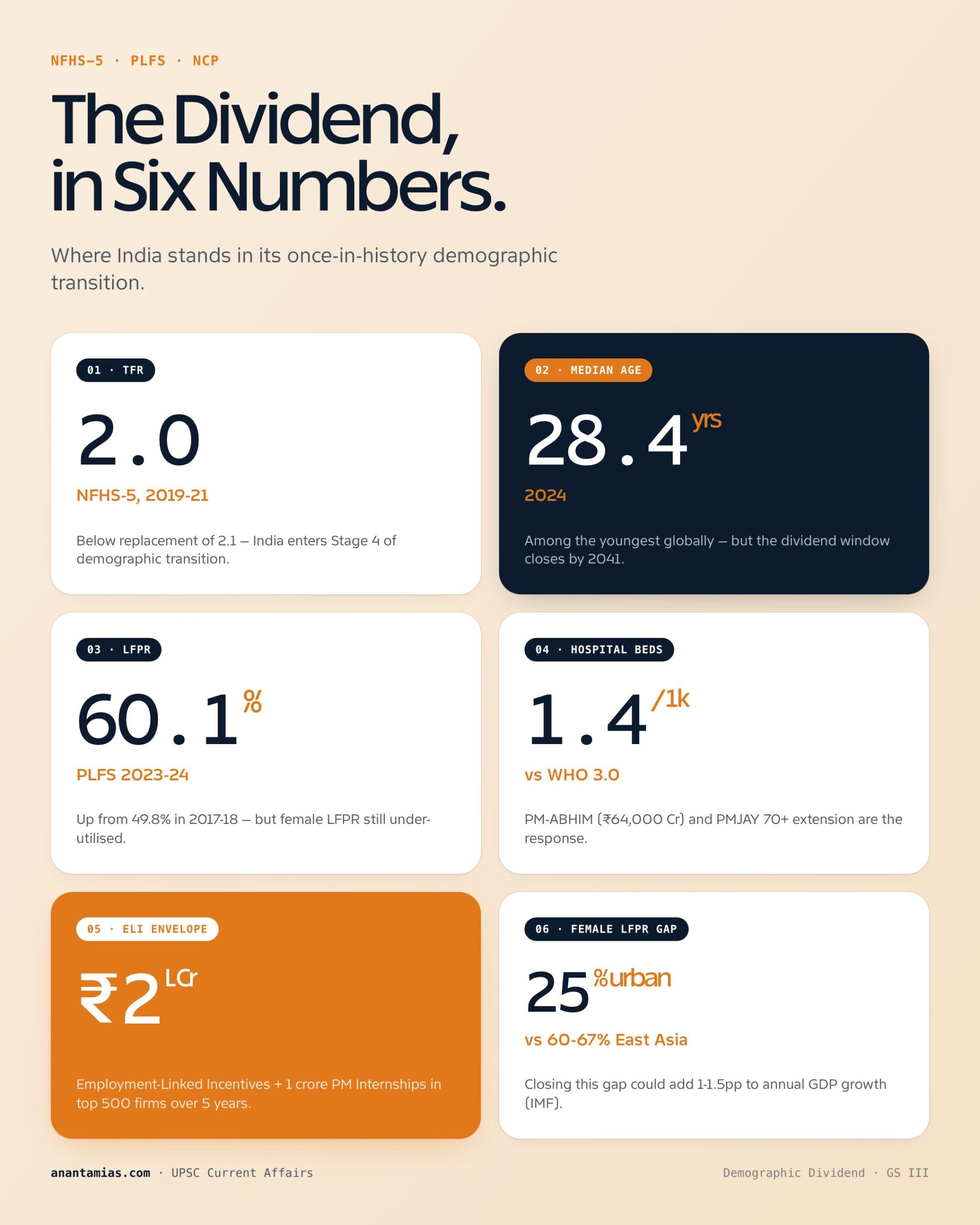
India's Total Fertility Rate (TFR) has fallen below the replacement level of 2.1 to 2.0 (NFHS-5, 2019-21), confirming the entry into Stage 4.
India's Age-Structure Shift: 2011 to 2041
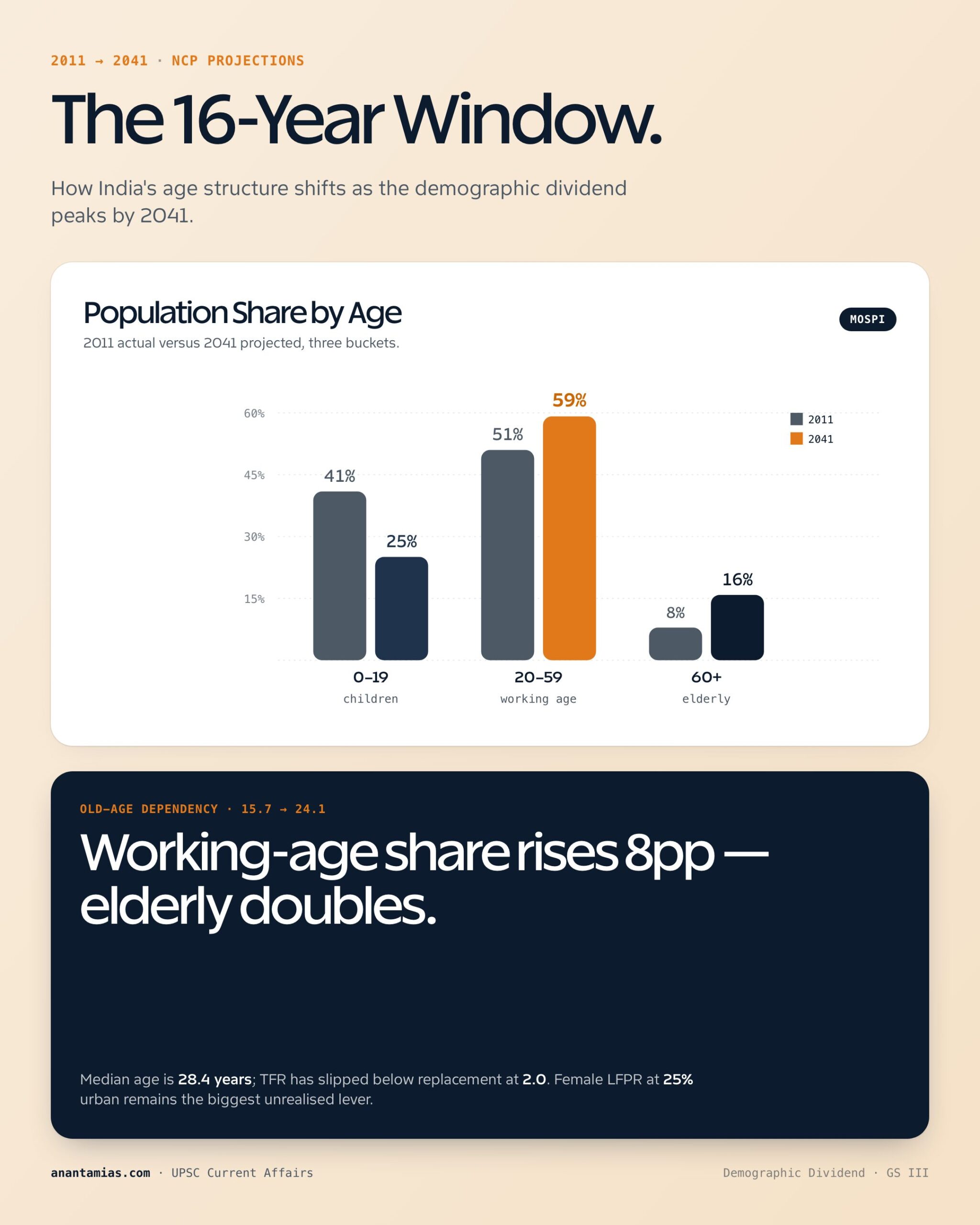
| Population (Age Group) | 2011 | 2041 (Projected) |
|---|---|---|
| 0-19 years | 41 percent | 25 percent |
| 20-59 years (working age) | 51 percent | 59 percent |
| 60+ years (elderly) | 8 percent | 16 percent |
The working-age share rises by 8 percentage points in 30 years, while the elderly share doubles. This is the demographic dividend window — and a demographic countdown.
Why the Dividend Matters
A larger working-age population means:
- More producers per consumer (lower dependency ratio = higher savings, investment, growth).
- Fiscal headroom for capex and human capital.
- A larger labour force to drive manufacturing, services, and exports.
- Higher household savings for housing, education, and old-age support.
China's growth between 1980-2010 was driven substantially by its dividend; South Korea, Japan, Singapore turned theirs into rapid industrialisation. India must do the same — but with the additional challenge of declining LFPR, especially among women.
The Policy Levers
1. Jobs Creation: 360-Degree Approach
Even though 60 percent of India will be working-age by 2041, the Labour Force Participation Rate (LFPR) in 2017-18 was just 49.8 percent, rising to 60.1 percent (PLFS 2023-24, MoSPI 2024) — still below world averages. Female LFPR has risen sharply post-Covid but remains around 41 percent.
A sustainable jobs strategy needs:
- Generating jobs — manufacturing PLI, services exports, construction (PMAY, infrastructure).
- Producing job creators — entrepreneurship via Startup India, MUDRA, Stand-Up India.
- Empowering the labour force — skilling, social security (e-Shram), portability of benefits.
- Female labour absorption — care economy, formal services, MSMEs.
2. Skilling and Reskilling for Industry 4.0
The 21st-century jobs market demands continuous upskilling, especially in AI, semiconductors, EV manufacturing, green tech, and biotech. Policy responses:
- National Education Policy (NEP) 2020 — vocational education from Class 6, 50 percent gross enrolment ratio in higher education by 2035.
- Skill India Mission — PMKVY 4.0 with industry 4.0 modules.
- National Apprenticeship Promotion Scheme (NAPS) scaled in Budget 2025-26.
- PM Internship Scheme (Budget 2024-25) — 1 crore internships in top 500 firms over five years.
3. Consolidation of Schools
With the share of 0-19 falling to 25 percent, India will have fewer school-age children per village. School consolidation — closing or merging tiny single-teacher schools while ensuring access through transportation — can raise quality without reducing reach. The PM-SHRI Scheme (2022) targets 14,500 model schools; Samagra Shiksha continues to fund consolidation pilots.
4. Health System Upgrade
India's hospital beds per 1,000 population stands at around 1.4 (2024 estimates, slowly improving from 0.7), far below the WHO benchmark of 3.0. Levers:
- Ayushman Bharat-PMJAY — health insurance for bottom 40 percent; Budget 2024-25 added the 70+ population.
- Ayushman Bharat — Health and Wellness Centres (Ayushman Aarogya Mandir) — 1.7 lakh PHCs upgraded by 2025.
- PM-ABHIM (PM Ayushman Bharat Health Infrastructure Mission, 2021-26) — Rs 64,000 crore for tertiary care.
- National Digital Health Mission (Ayushman Bharat Digital Mission) — health stack rollout.
- Lifestyle disease focus — Cardiovascular Diseases (CVD), diabetes, cancer screening.
5. Retirement Age Reform
With healthy life expectancy beyond 60 (current life expectancy at birth: 72 years), India must consider raising retirement age to 65 in central, state, and PSU services — as Japan, South Korea, France, and Germany have done. This:
- Postpones pension liabilities.
- Retains experienced workers.
- Slows the elderly dependency ratio rise.
6. Old-Age Income Security
- Atal Pension Yojana (APY) with over 7 crore subscribers.
- PM-SYM for unorganised workers.
- National Pension System (NPS) — National Pension System Trust manages assets over Rs 13 lakh crore as of 2025.
- Unified Pension Scheme (UPS, 2024) for central government employees combining NPS contributions with assured payouts.
Risks: When the Dividend Becomes a Liability
- Jobless growth: If LFPR remains low and quality jobs scarce, the working-age surge becomes a demographic disaster rather than dividend.
- Skill mismatch: Without large-scale reskilling, technology adoption (AI, automation) could displace labour faster than absorption.
- Female participation gap: India's female LFPR remains under-utilised; releasing 30 crore women into the labour force could add 1-1.5 percentage points to GDP growth annually.
- Spatial mismatch: Southern and western states are already ageing (Kerala, TN, Andhra) while northern states (UP, Bihar) still have young populations — internal migration is critical.
- Health expenditure surge: Lifestyle and ageing diseases will push out-of-pocket spending unless insurance deepens.
Recent Developments (2024-26)
Demographic Indicators
- TFR: 2.0 (NFHS-5, 2019-21), expected to fall further as per National Commission on Population (NCP) projections 2021-2036.
- Median age: 28.4 years (2024) — among the youngest globally.
- India became the world's most populous country in 2023, surpassing China — UN World Population Prospects 2024 confirms.
- Old-age dependency ratio projected to rise from 15.7 (2021) to 24.1 (2041).
Policy Interventions in Budget 2024-25 and 2025-26
- Employment-Linked Incentive (ELI) schemes — Rs 2 lakh crore envelope, manufacturing employer subsidy, first-time-employee EPFO support.
- PM Internship Scheme — 1 crore internships, Rs 4,500/month allowance.
- Saksham Anganwadi & Poshan 2.0 — focus on early-childhood nutrition for the next generation.
- Atal Vayo Abhyuday Yojana (AVYAY) restructured for senior citizen welfare.
- Health spending — Ayushman Bharat extended to 70+ irrespective of income (Budget 2024-25).
- Ayushman Bharat-PMJAY outlay: Rs 7,300 crore (2025-26 BE).
NITI Aayog and Reports
- NITI Aayog "Senior Care Reforms in India" report (2024) — recommended scaling up geriatric care, integrating with primary health.
- "India@2047 Vision" — workforce transformation as the central pillar.
- MoSPI India Ageing Report 2023 (jointly with UNFPA) — flagged feminisation of ageing.
India@2047 and Viksit Bharat
The government's Viksit Bharat 2047 roadmap places demographic dividend conversion at the centre — targeting USD 30 trillion economy by 2047 with mid-7 percent annual growth. Achieving it requires the dividend window (2025-2041) to be maximally exploited.
International Comparisons
| Country | Dividend Window | Outcome |
|---|---|---|
| Japan | 1955-1990 | Industrialisation + savings boom; now ageing crisis |
| South Korea | 1970-2005 | Export-led growth; high HDI; ageing |
| China | 1980-2010 | Rapid industrialisation; now demographic decline |
| Brazil | 1990-2025 | Mixed — failed to industrialise fully (middle income trap) |
| India | 2005-2041 | In progress |
The lesson: dividend windows close, and countries that fail to industrialise quickly (Brazil, South Africa) get stuck at middle-income levels.
Way Forward
- Maximise female LFPR: Care infrastructure (crèches, elderly care), safe transport, flexible work, anti-harassment enforcement.
- Manufacturing push: Maintain PLI focus on labour-intensive sectors (textiles, leather, food processing) alongside high-tech (semiconductors, electronics).
- Apprenticeship culture: Scale PM Internship Scheme and NAPS as default for college graduates.
- Lifelong learning: Modular, stackable credentials via National Credit Framework.
- Healthy ageing: Geriatric care under PMJAY, dementia and Alzheimer's programmes, age-friendly cities.
- Retirement age reform: Phased increase to 65, especially for white-collar government roles.
- Internal migration policy: Portable PDS (One Nation One Ration Card), portable EPFO, e-Shram for migrant safety nets.
UPSC Relevance
GS-III Mapping
- Indian economy and issues relating to planning, mobilization of resources.
- Effects of liberalisation on the economy.
- Inclusive growth and issues arising from it.
GS-II Mapping
- Population and associated issues.
- Welfare schemes for vulnerable sections — elderly, youth.
- Issues related to development and management of social sector / services — health, education.
GS-I Mapping
- Population and associated issues, poverty and developmental issues, urbanisation.
Prelims Pointers
- TFR: 2.0 (NFHS-5).
- Demographic dividend peaks for India around 2041.
- Median age: ~28 years (2024).
- NEP 2020 — 50 percent GER in higher education by 2035.
- PM Internship Scheme — Budget 2024-25.
- Unified Pension Scheme (UPS) — 2024 announcement.
Mains Hooks
- "India's demographic dividend window will close by 2041. Examine the policy choices needed to ensure it does not become a demographic disaster." (GS-III)
- "Without dramatic improvements in female labour-force participation, India's demographic dividend will remain only half-realised. Discuss." (GS-III)
- "Compare India's demographic transition with East Asian economies. What lessons can India draw?" (GS-III)
- "Discuss the impact of India's ageing population on healthcare and pension systems." (GS-II)
India's demographic transition is a once-in-history opportunity. The arithmetic is clear — a 16-year window during which more producers than dependents can power growth, savings, and tax revenue. Whether India reaps the dividend depends on jobs, skills, female participation, health, and retirement reforms working in concert. For UPSC, master the age-structure table, the LFPR data, the budget interventions (ELI, internship, PMKVY 4.0, Ayushman Bharat extensions), and the international comparisons — and you will write authoritative answers on India's most consequential macroeconomic story.
State-Level Asymmetry in Demographic Transition
India's demographic clock varies dramatically across states. Southern and western states (Kerala, Tamil Nadu, Andhra Pradesh, Karnataka, Maharashtra) have already crossed below replacement-level fertility and are entering ageing phase. Northern and eastern states (Bihar, Uttar Pradesh, Madhya Pradesh, Jharkhand, Rajasthan) still have young populations and high fertility.
| State | TFR (NFHS-5) | Median Age (approx) | Demographic Stage |
|---|---|---|---|
| Bihar | 3.0 | 22 | Late dividend |
| Uttar Pradesh | 2.4 | 23 | Mid-dividend |
| Madhya Pradesh | 2.0 | 25 | Mid-dividend |
| Maharashtra | 1.7 | 30 | Late-dividend, ageing soon |
| Tamil Nadu | 1.8 | 32 | Ageing |
| Kerala | 1.8 | 33 | Ageing |
| All India | 2.0 | 28 | Mid-dividend |
This internal asymmetry has two implications:
- Internal migration from younger northern states to older southern states is essential — but politically and culturally complex.
- Resource allocation between Centre and states must reflect demographic divergence — older states need health-system surge; younger states need education/skill capital.
- Finance Commission devolution criteria need recalibration to balance these needs.
The Female Labour Force Participation Rate Story
Female LFPR is the single most consequential variable for India's demographic dividend.
- Female LFPR (rural, PLFS 2023-24): ~47 percent (rising sharply post-Covid).
- Female LFPR (urban, PLFS 2023-24): ~25 percent.
- OECD average: ~52 percent.
- East Asian benchmark (China, Vietnam): ~60-67 percent.
Releasing 30 crore women into the labour force at productive jobs would:
- Add 1-1.5 percentage points to annual GDP growth (IMF estimate).
- Shrink demographic risk by widening the dividend window.
- Boost household savings and education investment in the next generation.
Levers: safe transport, crèche access, anti-harassment enforcement, flexible work, female-friendly factory floors (textile, leather, food processing), and care-economy formalisation.
Beyond 2041: Preparing for the Ageing Phase
Even as India reaps the dividend through 2041, planning for the post-2041 ageing phase must begin now:
- Pension architecture: Universal coverage through APY, NPS, UPS.
- Healthy ageing: PMJAY for 70+, geriatric departments in district hospitals.
- Age-friendly cities: Senior-friendly transport, housing, public spaces.
- Long-term care: Insurance products, regulated care homes (NITI Aayog Senior Care report 2024).
- Intergenerational fiscal balance: Sustainability of pension and health expenditures.
The dividend window closes — and the bill arrives. Preparing both sides simultaneously is the only sustainable approach.