Registration and Deregistration of Political Parties (UPSC Polity)
A satirical 'Cockroach Janata Party' got 20 million followers in a week but cannot fight an election, because it isn't registered with the ECI. That gap is the whole syllabus: how parties are registered under Section 29A, recognised, given symbols, and — very rarely — deregistered.
In May 2026 a political party with a cockroach for a mascot picked up more than twenty million followers in a single week — more, briefly, than the official handles of the BJP and the Congress combined. The Cockroach Janata Party (CJP) was founded on 16 May 2026 by Abhijeet Dipke, a former Aam Aadmi Party social-media volunteer, the day after a remark by the Chief Justice of India comparing unemployed youngsters to cockroaches went viral. It is loud, very online, and genuinely popular. And it cannot contest a single election, because it is not registered with the Election Commission of India.
That gap — between a movement of millions and a name that can legally appear on a ballot — is the whole of this topic. A political party in India is not just a group of like-minded people. It’s a legal entity created by an application under one section of one Act, and what it can and cannot do flows from where it sits in a three-tier ladder: registered-but-unrecognised at the bottom, recognised as a State party in the middle, recognised as a National party at the top. Understanding registration, recognition and the much harder question of deregistration is a staple of UPSC GS2, because it sits exactly where elections, party funding, the Model Code of Conduct and electoral reform all meet.
How a Party Gets Registered: Section 29A
The single door into the system is Section 29A of the Representation of the People Act, 1951. Any association or body of individuals that wants to be a “political party” for the purposes of that Act has to apply to the Election Commission within thirty days of its formation. There is no Parliament vote, no licence from a ministry — registration is an administrative act of the ECI, and that is exactly why the CJP, for all its followers, is still on the outside until its papers are filed and cleared.
The application is not a formality. The party has to submit a copy of its memorandum or constitution, and that document must contain a specific, non-negotiable clause: that the party bears true faith and allegiance to the Constitution of India, and to the principles of socialism, secularism and democracy, and that it will uphold the sovereignty, unity and integrity of India. This is the only place in Indian law where a party is forced, in writing, to swear by secularism and socialism — words that don’t bind ordinary citizens but do bind anyone who wants the privileges of a registered party. The ECI also asks the applicant to publish the proposed name in national and local newspapers so that objections can be filed, and it can call for any further particulars it wants before it registers the party.
Once registered, a party unlocks a real bundle of benefits, which is why thousands of them exist. Donations it receives are exempt from income tax under Section 13A of the Income Tax Act, 1961, provided it keeps proper books, gets them audited and discloses contributions above the threshold. It becomes eligible for a common symbol so its candidates across the country fight under one mark rather than as scattered independents. It can field up to twenty “star campaigners” whose travel and campaign spending is not charged to any individual candidate’s expenditure ceiling. And it is treated as a “political party” for a host of other legal purposes. None of this requires the party to ever win, or even contest, anything — and that, as we’ll see, is the design flaw at the centre of the whole debate.
Registered, Recognised, National: The Three Tiers
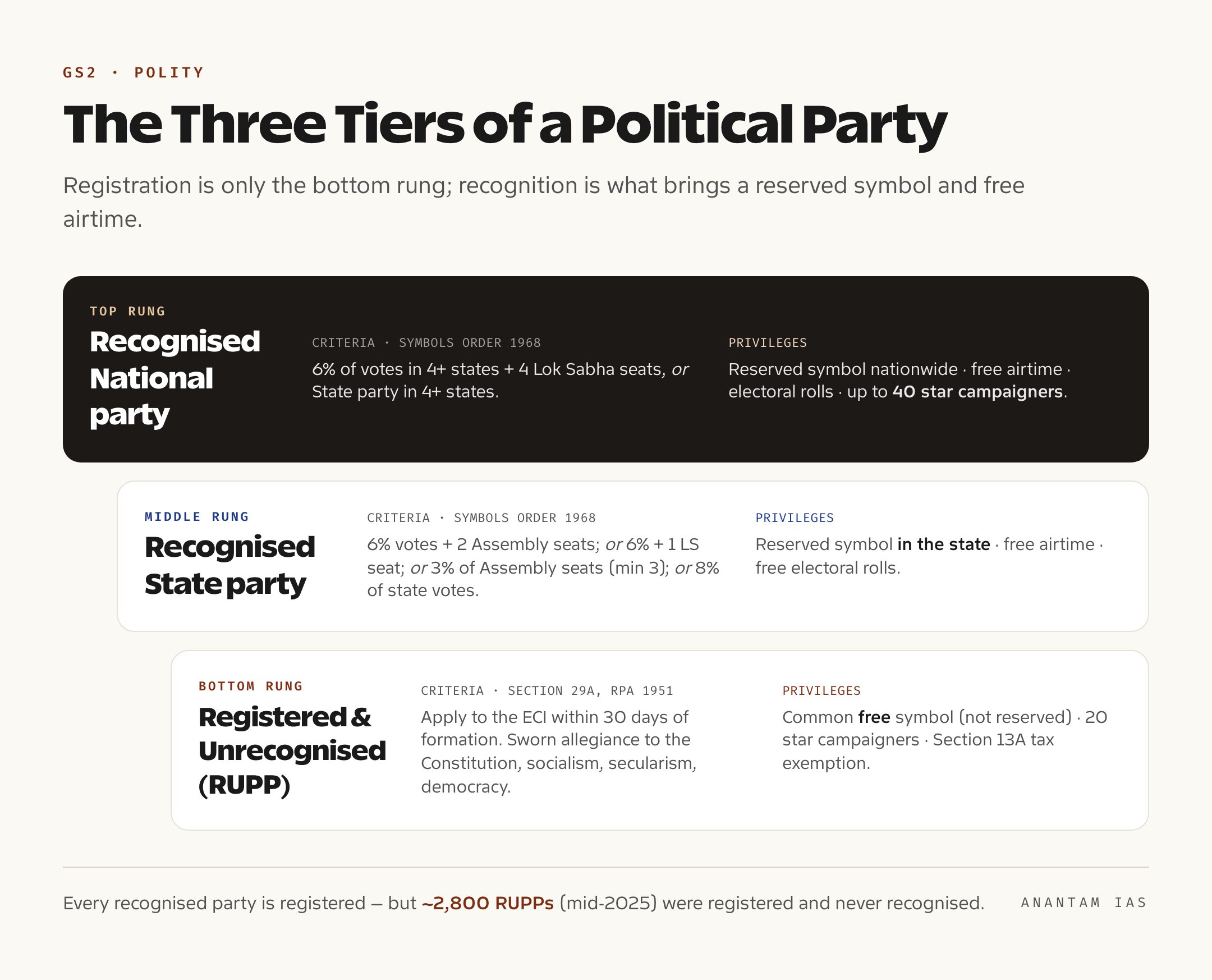
Here is the distinction that trips up most candidates, so hold it carefully. Registration and recognition are two different things. Every recognised party is registered, but the vast majority of registered parties are not recognised. A party that is registered under Section 29A but hasn’t met the performance bar is called a Registered Unrecognised Political Party — an RUPP — and as of mid-2025 India had roughly 2,800 of them before the ECI began trimming the list.
Recognition is governed not by the RPA but by the Election Symbols (Reservation and Allotment) Order, 1968 — usually just “the Symbols Order” — which the ECI issues under its own powers. To be recognised as a State party, a party broadly has to clear one of a set of vote-and-seat thresholds in that state: secure at least six per cent of valid votes in an Assembly election and win two seats; or six per cent in a Lok Sabha election from the state plus one seat; or win three per cent of Assembly seats (minimum three); or eight per cent of the total valid votes in the state. To be recognised as a National party, the party essentially has to be a serious presence in several states at once — for example, securing six per cent of votes in four or more states and winning at least four Lok Sabha seats, or being recognised as a State party in four or more states. The numbers are worth knowing, but the principle behind them is the simple thing to remember: recognition tracks real, demonstrated electoral support, not paperwork.
Why does the ladder matter? Because recognition is where the genuinely valuable privileges live. A recognised party — State or National — gets a reserved symbol, one that no one else can use within its area, so a voter sees the same hand, lotus, broom or elephant election after election. It gets free broadcast time on Doordarshan and All India Radio during general elections. It gets free copies of the electoral rolls. A National party may field up to forty star campaigners against an RUPP’s twenty. An unrecognised party, by contrast, has to pick from a pool of “free” symbols afresh at each election and gets none of the broadcast or roll privileges. This is precisely why a novelty outfit like the CJP, even once it registers, would not simply be handed a cockroach: reserved symbols go only to recognised parties, and registered-unrecognised parties choose from the ECI’s list of common free symbols. The mascot can rule Instagram; the ballot is a different jurisdiction.
Why the ECI Can’t Just Deregister Parties
Now the hard part, and the most heavily examined. Getting registered is comparatively easy and, crucially, almost permanent — because the law gives the Election Commission very little power to undo it. The RPA simply does not contain a general provision letting the ECI deregister a party for going inactive, skipping elections, never holding internal elections or failing to file its returns. The Commission has the key to the front door but, by design, not to the back.
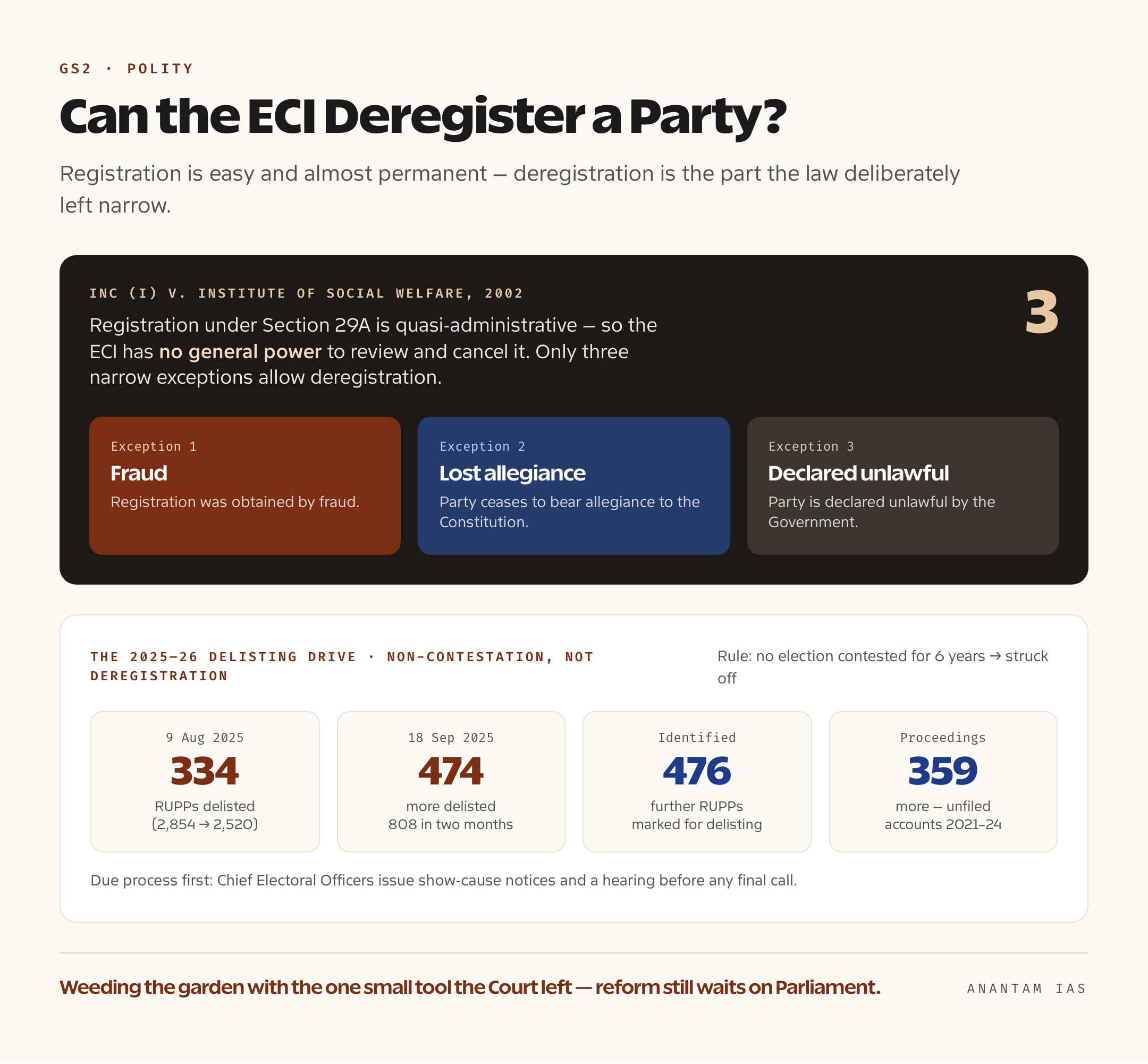
This was settled by the Supreme Court in Indian National Congress (I) v. Institute of Social Welfare (2002). The Court held that since registering a party is a quasi-administrative function under Section 29A, the ECI has no implied power to review and cancel that registration. It carved out only three narrow exceptions where deregistration is possible: where registration was obtained by fraud; where the party itself tells the Commission, or otherwise ceases, that it no longer adheres to its sworn allegiance to the Constitution; and where the party is declared unlawful by the Government or otherwise by law. Outside those three windows, a registered party stays registered, however dormant it becomes. So the bar isn’t bureaucratic caution — it’s a constitutional reading that only Parliament, by amending the law, can change.
That ruling created the policy headache the country is still living with. Because the ECI can register but barely deregister, the rolls fill up with parties that exist on paper and nowhere else. The worry is not abstract. A registered party that never faces voters still enjoys the income-tax exemption on its donations, which makes a defunct “party” an attractive shell — a way to route money and claim deductions under Sections 80GGB and 80GGC while the entity faces no electoral scrutiny at all. After the Supreme Court struck down the Electoral Bonds Scheme as unconstitutional on 15 February 2024 for violating the voter’s right to information, the funding spotlight only sharpened, and the question of who these thousands of paper parties really are became harder to wave away.
The 2025-26 Delisting Drive Against Dormant Parties
So the ECI did the one thing the 2002 judgment arguably still lets it do: instead of “deregistering” parties on contested legal grounds, it began delisting parties that had failed to meet a basic condition of being on the register at all — actually contesting elections. The guidelines say a registered party that does not contest any election continuously for six years can be taken off the list, and from 2025 the Commission used exactly that lever.
The numbers tell the story. On 9 August 2025 the ECI delisted 334 RUPPs that had not contested a single election since 2019, bringing the count of registered parties down from 2,854 to 2,520. On 18 September 2025 it delisted another 474, so that within roughly two months 808 dormant parties had been struck off. Alongside that, the Commission identified a further 476 RUPPs for delisting and opened proceedings against 359 more that had failed to file their audited annual accounts for three straight years (2021-22 to 2023-24) or their mandatory election-expenditure reports despite contesting polls. To protect genuine but irregular parties, the drive runs through due process: the Chief Electoral Officers of the states issue show-cause notices and give each party a hearing before any final call.
But notice what this drive is — and isn’t. It is a clean-up of the register on the narrow ground of non-contestation, not a new power to deregister parties for being shells or for laundering money. The deeper reforms have been recommended for years and still wait on Parliament. The Law Commission’s 255th Report (2015) suggested allowing deregistration of a party that fails to contest for ten consecutive years, mandating inner-party democracy and tightening financial transparency; the ECI’s own electoral-reform proposals have repeatedly asked for an explicit, graduated power to deregister. Until the RPA is amended, the Commission is essentially weeding the garden with the one small tool the Court left it, while the structural overgrowth — thousands of registered-unrecognised parties with tax benefits and no accountability — keeps growing back.
For Your Mains Answer
This topic is built for GS Paper 2, under “salient features of the Representation of People’s Act,” “the structure and functioning of the Election Commission,” and “issues and reforms in the electoral system.” It also lends itself to questions on transparency in political funding and inner-party democracy. The examiner is usually testing one thing: do you understand that the law makes registration easy and deregistration hard, and can you argue what should be done about it?
How to Build the Answer
Open by separating the three ideas the question always blurs — registration (Section 29A, the ECI, the easy door), recognition (the Symbols Order, vote-and-seat thresholds, the privileges), and deregistration (the 2002 ruling, the three exceptions). Then move to the problem these create together: the proliferation of dormant RUPPs and the funding risks. Close with the live reform debate and the ECI’s 2025-26 delisting drive as evidence that the system is being stretched to its limit. That structure — what the law is, what it produces, what should change — works for almost any phrasing.
Common Mistakes to Avoid
Don’t confuse registration with recognition; it’s the single most common error and an informed examiner will catch it. Don’t say the ECI “can deregister parties” without the heavy qualification from the 2002 case. Don’t treat the 2025 delisting drive as a deregistration power — it’s a delisting for non-contestation, a narrower thing. And don’t list reforms without naming a source, like the Law Commission’s 255th Report, which signals you’ve actually read.
A Compact Answer Spine
Registration under Section 29A (apply within 30 days, sworn allegiance to the Constitution, secularism, socialism; benefits — Section 13A tax exemption, common symbol, 20 star campaigners) → recognition under the Symbols Order 1968 (vote-and-seat thresholds; reserved symbol, free airtime, electoral rolls) → deregistration (INC v Institute of Social Welfare, 2002 — only fraud, lost allegiance, unlawful declaration) → the RUPP problem (shell parties, funding misuse post-electoral-bonds) → the 2025-26 delisting drive and pending reforms (Law Commission 255th Report).
Diagram or Flowchart Idea
Draw a three-rung ladder: bottom rung “Registered-Unrecognised (RUPP) — free symbol, 20 star campaigners, tax exemption,” middle rung “Recognised State party — reserved symbol in state, free airtime, electoral rolls,” top rung “Recognised National party — reserved symbol nationwide, 40 star campaigners.” A side arrow marked “deregistration?” points back down with the note “ECI power very limited — INC v ISW, 2002.” A clean ladder like this earns marks fast.
A Balanced-Conclusion Line
A registration regime that is easy to enter and almost impossible to exit will always collect dead weight; the answer is not to make registration harder for genuine new movements, but to give the Election Commission a calibrated, due-process power to remove parties that are demonstrably defunct.
How to Use Data Without Cramming
You need only three anchors: roughly 2,800 registered parties before 2025; 808 RUPPs delisted across August-September 2025 (from 2,854 down to 2,520); and the date the Electoral Bonds Scheme was struck down, 15 February 2024. Drop those three and the answer reads as current without becoming a data dump.
FAQ
Is the Cockroach Janata Party a registered political party? No. As of mid-2026 the CJP, founded on 16 May 2026, is a viral online movement, not a party registered with the Election Commission. Until it applies under Section 29A of the Representation of the People Act, 1951 and the ECI clears it, it cannot field candidates, get a common symbol or claim any of the legal privileges of a registered party — however many followers it has.
What is the difference between a registered and a recognised political party? Registration is the entry-level legal status granted by the ECI under Section 29A; a registered party that hasn’t met the performance bar is a Registered Unrecognised Political Party (RUPP). Recognition, under the Election Symbols Order, 1968, is earned by clearing vote-share and seat thresholds, and it brings the valuable privileges — a reserved symbol, free broadcast time and free electoral rolls. Every recognised party is registered, but most registered parties are not recognised.
Can the Election Commission deregister a political party? Only in very limited circumstances. In Indian National Congress (I) v. Institute of Social Welfare (2002), the Supreme Court held the ECI has no general power to deregister a party. The three exceptions are: registration obtained by fraud, the party ceasing to bear allegiance to the Constitution, and the party being declared unlawful by the Government. For everything else — inactivity, no internal elections, unfiled returns — the law gives the Commission no deregistration power, which is why reformers want the RPA amended.
Why is the ECI delisting hundreds of parties in 2025-26? Because thousands of registered parties exist only on paper, raising fears they are used as shells to misuse tax exemptions on donations. Using the rule that a party not contesting any election for six years can be taken off the list, the ECI delisted 334 RUPPs on 9 August 2025 and 474 more on 18 September 2025 — 808 in all — with show-cause notices and hearings first. It is a delisting for non-contestation, not the broader deregistration power that still needs Parliament to legislate.
Practice Questions
Prelims MCQs
- With reference to the registration of political parties in India, consider the following statements: (a) A political party must apply to the Election Commission within 30 days of its formation under Section 29A of the Representation of the People Act, 1951. (b) Its memorandum must declare allegiance to the Constitution, and to socialism, secularism and democracy. (c) Registration entitles a party to a reserved election symbol. Which of the statements given above are correct? Answer: (a) and (b) — Registration brings a common/free symbol, not a reserved one; a reserved symbol requires recognition under the Symbols Order, 1968.
- The criteria for recognition of a political party as a “National” or “State” party are laid down in:
(a) The Representation of the People Act, 1951
(b) The Election Symbols (Reservation and Allotment) Order, 1968
(c) The Constitution of India
(d) The Conduct of Election Rules, 1961.
Answer: (b) — Recognition is governed by the Symbols Order, 1968, issued by the ECI; registration is governed by the RPA, 1951. - The privileges that a recognised political party enjoys but a registered-unrecognised party does not include which of the following? 1. A reserved election symbol.
2. Free broadcast time on Doordarshan and All India Radio.
3. Income-tax exemption on donations under Section 13A. Select the correct answer:
(a) 1 and 2 only
(b) 2 and 3 only
(c) 1 and 3 only
(d) 1, 2 and 3.
Answer: (a) — A reserved symbol and free airtime require recognition; the Section 13A tax exemption is available to any registered party, recognised or not. - In Indian National Congress (I) v. Institute of Social Welfare (2002), the Supreme Court held that the Election Commission can deregister a political party only in certain cases. These do NOT include:
(a) Registration obtained by fraud
(b) The party ceasing to bear allegiance to the Constitution
(c) The party being declared unlawful by the Government
(d) The party failing to contest elections for six years.
Answer: (d) — Non-contestation is a ground for delisting under ECI guidelines, not one of the three deregistration exceptions recognised by the Court. - Consider the following with reference to the ECI’s 2025 delisting drive against Registered Unrecognised Political Parties (RUPPs):
1. Parties were delisted mainly for not contesting any election for six continuous years.
2. The total number of registered parties fell from 2,854 to 2,520 after the first phase.
3. Parties were given show-cause notices and a hearing before delisting. Which are correct?
(a) 1 and 2 only
(b) 2 and 3 only
(c) 1 and 3 only
(d) 1, 2 and 3.
Answer: (d) — All three are correct; 334 RUPPs were delisted on 9 August 2025, bringing the count from 2,854 to 2,520, after due-process notices and hearings.
Mains Practice Questions
- “Indian law makes it easy to register a political party but nearly impossible to deregister one.” Critically examine this statement in the light of Section 29A of the Representation of the People Act, 1951 and the Supreme Court’s ruling in INC v. Institute of Social Welfare (2002). (15 marks, 250 words)
- Distinguish between the registration and the recognition of political parties in India. What are the privileges that recognition confers, and how do they shape electoral competition? (10 marks, 150 words)
- The proliferation of Registered Unrecognised Political Parties (RUPPs) poses risks to the integrity of political funding and the credibility of the electoral register. Discuss, and suggest reforms to address it. (15 marks, 250 words)
- Evaluate the Election Commission of India’s 2025-26 drive to delist dormant political parties. To what extent does it address the underlying problem, and what statutory changes would be needed for a durable solution? (15 marks, 250 words)
- “Internal democracy and financial transparency within political parties are preconditions for a healthy representative democracy.” Examine this in the context of the recommendations of the Law Commission’s 255th Report and the post-electoral-bonds funding landscape. (15 marks, 250 words)