Representation of Women in the Indian Judiciary: Data, Barriers and Reforms (UPSC Indian Society)
Women now make up nearly 38% of the district judiciary but only about 14% of High Court judges and roughly 6% of the Supreme Court. India is yet to have a woman Chief Justice. Here is why the pyramid narrows so sharply, and what could widen it.
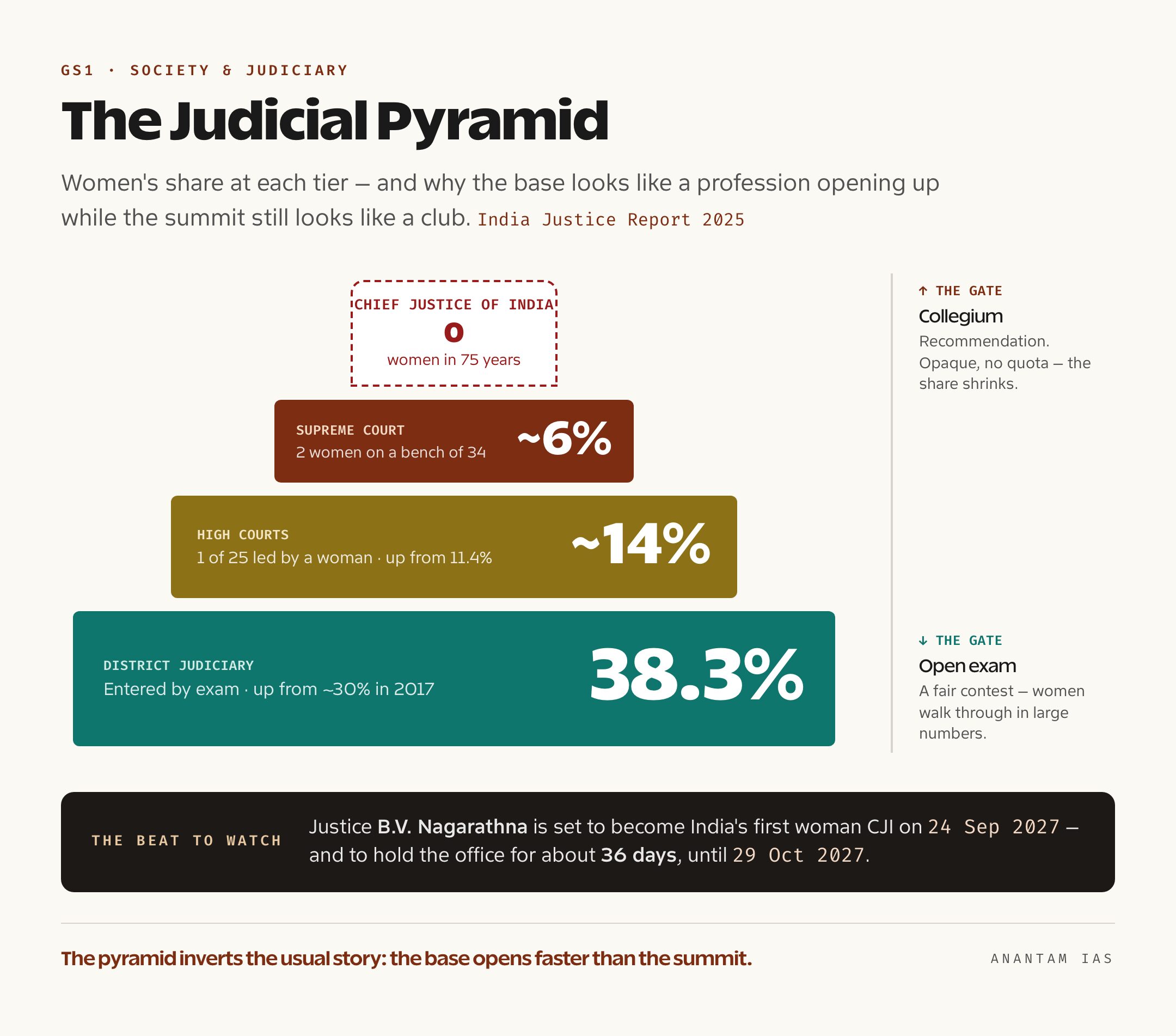
Walk up the levels of India’s judiciary and watch the women thin out. At the bottom, in the district courts that most citizens ever actually see, women now hold close to 38 of every 100 judgeships. Climb to the High Courts and the figure collapses to around 14. Reach the Supreme Court, the apex of the whole structure, and you are down to two women on a bench of thirty-odd. The pyramid does not just narrow at the top, the way every hierarchy does. It changes character. The base looks like a profession opening up to women; the summit still looks like a club they are admitted to one at a time.
That gap is not a side issue for a country that calls equality a basic feature of its Constitution. The judiciary is the institution that decides what equality means in practice — what counts as discrimination, how a maintenance claim is weighed, whether a workplace harassment complaint is believed. Who sits on the bench shapes how those questions are answered. So the under-representation of women in the courts is not a matter of headcount or optics. It is a question about whether the institution that guards everyone’s rights actually resembles the society whose rights it guards.
Reading the Bench: What “Representation” Means Here
Start with the structure, because the numbers only make sense against it. India’s judiciary is a three-tier pyramid. At the base is the district or subordinate judiciary — civil judges and magistrates recruited by each state through a competitive examination, the State Judicial Service. Above that sit the twenty-five High Courts, one for each state or group of states. At the top is the Supreme Court, with a sanctioned strength of thirty-four judges including the Chief Justice of India.
The crucial fact is that these tiers are filled in two completely different ways, and that difference drives almost everything that follows. The district judiciary is entered through an open written exam — the kind of exam that, like the civil services or the bank tests, women have increasingly aced. The higher judiciary is not entered by exam at all. High Court and Supreme Court judges are chosen by the collegium: a small group of the senior-most sitting judges who recommend names to the government, which appoints them. There is no application form, no reserved quota, no published shortlist. Elevation comes either from the bar, where a successful advocate is invited to the bench, or by promotion from the district judiciary. Both routes pass through that closed circle of recommendation.
So when we ask about “representation of women in the judiciary,” we are really asking two questions at once. How many women clear an exam they can compete in fairly? And how many women are picked by a process that no one outside it can see? The answers, as the data shows, are very different.
The Numbers: A Pyramid That Inverts the Story
The most reliable recent snapshot comes from the India Justice Report 2025, the periodic assessment produced by Tata Trusts with a clutch of civil-society partners. Its headline finding on gender is stark and clear. Women make up 38.3% of judges in the district judiciary — up from about 30% in 2017, a genuine and steady climb. But in the High Courts they are only about 14%, nudged up barely a percentage point from 11.4% a few years earlier. And across all twenty-five High Courts, only one is led by a woman Chief Justice.
The Supreme Court tells the bleakest version of the same story. As of 2026 it has two women judges — Justice B.V. Nagarathna and Justice V. Mohana — on a bench of around thirty-four. In its entire seventy-five-year history, the Court has appointed only eleven women out of roughly 280 judges in all, which works out to under 4% of every appointment ever made. The Supreme Court Observer’s tracking puts women at about 6% of the current bench. Whichever way you cut it, the apex of Indian justice has been an overwhelmingly male institution for three-quarters of a century.
There is one milestone on the horizon, and it doubles as a parable. Justice B.V. Nagarathna, elevated in 2021, is in line under the seniority convention to become the first woman Chief Justice of India. She is expected to take the office on 24 September 2027. Her tenure will last about thirty-six days, until she retires on 29 October 2027. So India’s first woman CJI, when she finally arrives after seven decades, will hold the country’s highest judicial office for barely over a month. That single fact captures the whole problem better than any chart: it is not only that women are scarce at the top, but that the seniority system, applied to a bench they entered late and in small numbers, hands them the gavel just as the clock runs out.
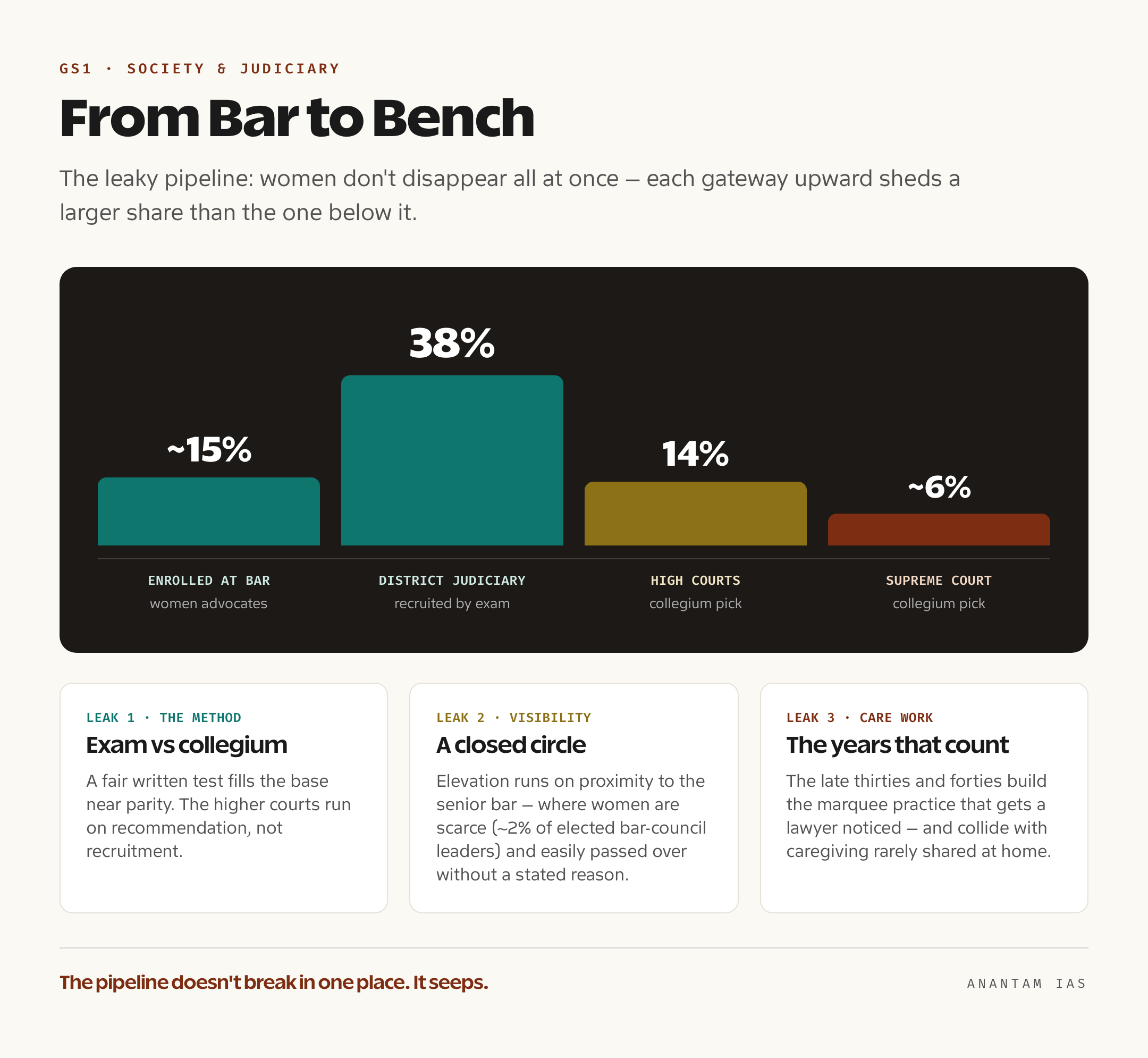
The contrast with the entry point of the profession sharpens the picture. Women are roughly 15% of all advocates enrolled with the Bar Councils of India, and only about 2% of the elected leadership of state bar councils — so few that the Supreme Court has now mandated 30% of bar-council seats for women to break open what one report called the legal “old boys’ club.” A profession that is 15% women at the bar and 38% women at the district bench, yet only 14% women at the High Courts, is a profession that is leaking its talent somewhere on the way up.
Why the Pyramid Narrows: The Leaky Pipeline
The single most useful idea for understanding this data is the “leaky pipeline” — the observation that women do not vanish from the legal profession all at once, but drip out at every gateway upward, so that a base near parity dwindles to a trickle at the top. Trace the leaks and the gap stops being mysterious.
The first leak is the recruitment method itself. The district judiciary recruits by exam, an impersonal test that rewards preparation over connections, and women do well in it. That is exactly why the base is the most balanced tier — and why states that go further, by reserving a share of judicial-service posts for women, have pushed female representation among their judicial officers to between 40% and 50%. Where the gate is a fair contest, women walk through it in large numbers.
The second leak is the collegium. The higher judiciary is not filled by exam but by recommendation, and recommendation runs on visibility and proximity. Senior advocates considered for elevation tend to be those with thriving high-value practices in the constitutional courts; judges promoted from below are picked by the same senior figures. Women are under-represented at the senior bar, less likely to be in the room where names are weighed, and easier to pass over without a published reason. The process is opaque by design — there is no shortlist, no scorecard, no requirement to explain why one name went forward and another did not. Opacity does not have to be malicious to be unequal; a closed network reproduces the people already inside it.
The third leak runs underneath both: the gendered weight of care work. The years when a litigator builds the reputation that gets her noticed — the late thirties and forties — are the same years many women are expected to carry children and ageing parents. Long court hours, unpredictable listings and the slog of building a practice collide with caregiving that is rarely shared equally at home. Some women never enter litigation; many leave it; others stay but cannot build the marquee practice that the bench-from-the-bar route rewards. The pipeline does not break in one place. It seeps.
Where It Falls Short: Barriers Beyond the Numbers
Below the statistics sit conditions that quietly tell women the bench was not built for them. The most concrete is infrastructure. A study by the Supreme Court’s own Centre for Research and Planning found that around a fifth of district court complexes lack separate toilets for women, and dedicated creches and feeding rooms are rarer still. When a workplace assumes its workers will not be women, it signals to women that they are visitors, not residents.
Then there is the absence of any reservation at the top. India reserves seats for Scheduled Castes, Scheduled Tribes and other groups across much of public employment and education, and several states reserve judicial-service posts for women. But there is no reservation, horizontal or otherwise, in the High Courts or the Supreme Court — and given that these are filled by collegium recommendation rather than recruitment, there is no obvious mechanism through which a quota could even operate. The higher judiciary is, by its own logic, a discretion zone.
Bias does the rest, and it does not announce itself. It shows up as a quiet doubt about whether a woman can “handle” a heavy commercial or criminal docket, as the assumption that she will not relocate, as the harassment that women advocates and junior judges still report in court precincts. None of this appears in an appointment file. All of it shapes who gets recommended. And because so few women reach the top, there are few role models to pull the next cohort up — the under-representation feeds itself, a loop in which scarcity at the summit discourages aspiration at the base.
The case for fixing all this is not charity, and it is worth stating plainly. A bench drawn from one narrow slice of society carries that slice’s blind spots into its judgments. Mixed benches have been shown to reason more carefully through cases touching domestic violence, sexual harassment and workplace discrimination, where lived perspective sharpens the law. Diversity also underwrites legitimacy: a court that visibly resembles the people it judges commands more confidence than one that does not. Representation on the bench is, in the end, a question of better judging — not merely fairer hiring.
The Way Forward
There is no single switch to flip, but the reforms cluster into a sensible, balanced package — some about the pipeline, some about the gate, some about the workplace.
- Open the collegium to daylight. The most direct lever at the top is transparency. Publishing the criteria for elevation, recording the diversity of the pool considered, and giving reasons when a name is passed over would not surrender judicial independence — it would simply make the discretion accountable. The Memorandum of Procedure, the document governing appointments, could be revised to require that the share of women in the candidate pool be tracked and reported.
- Strengthen the exam pipeline. Because the district judiciary recruits fairly and already approaches parity, it is the natural feeder for the courts above. States that have reserved judicial-service seats for women, including Assam, Andhra Pradesh, Telangana, Odisha and Rajasthan, now report 40-50% women among their judicial officers. Extending such reservation and then ensuring fair, timely promotion to the High Courts converts a balanced base into a more balanced summit over time.
- Settle the All India Judicial Service debate. President Droupadi Murmu has backed an All India Judicial Service — a national, merit-based examination, on the model of the civil services, to recruit judges and widen the talent pool for women, SCs, STs and OBCs alike. It remains contested: many High Courts and bar bodies fear it would centralise power and erode federalism, and successive governments have shelved it for want of consensus. But a transparent, exam-based national channel is one of the few structural routes that could dilute the collegium’s monopoly on diversity. The debate deserves resolution, not perpetual deferral.
- Build the bench women can actually work on. Separate toilets, creches, feeding rooms, safe transport and privacy across every court complex should be a baseline, not a favour. Gender audits of court establishments and functioning anti-harassment committees, with real teeth, in every bar association would change the texture of daily working life.
- Open the bar, then mentor toward the bench. The Supreme Court’s mandate of 30% women in state bar councils attacks the leadership leak at the source. Pair that with judicial academies that actively mentor and train women advocates and district judges for higher appointments, and the pipeline gets both wider and stronger.
- Collect the data. Most of the above stalls because India does not systematically record the social background of its judges. Mandatory disaggregated data on gender — and caste — at every level would turn diversity from a slogan into something that can be measured, targeted and held to account.
For Your Mains Answer
This topic sits squarely in GS Paper 1 (role of women, women’s organisations, social empowerment) and GS Paper 2 (the judiciary, appointment of judges, mechanisms for protection of vulnerable sections). It also feeds GS Paper 4 on diversity and fairness in public institutions, and makes a strong supporting case study in an Essay on equality or institutions. The examiner is rewarding a candidate who can pair the right numbers with the structural reason behind them — not one who simply asserts that women are under-represented.
How to Build the Answer
Open with the pyramid, not a lament. State the three figures — roughly 38% in the district judiciary, about 14% in the High Courts, around 6% in the Supreme Court — and then make the analytical move that lifts the answer: the base is balanced because it recruits by exam, the top is not because it recruits by collegium. From there, run the leaky-pipeline logic (entry, promotion, care work), then the barriers (infrastructure, no reservation, bias), then a layered reform package. Close by naming the stakes as better judging, not just fairer hiring.
Common Mistakes to Avoid
Don’t present the numbers as a flat list with no explanation — the district-versus-higher contrast is the whole insight, so use it. Don’t claim there is reservation in the higher judiciary; there isn’t, and the reason (collegium discretion, no recruitment gate) is itself examinable. Don’t conflate “more women” with “diversity” alone — anchor it in legitimacy and quality of judging. And don’t reduce reform to “appoint more women”; show you understand transparency, the AIJS debate and infrastructure.
A Compact Answer Spine
Three-tier pyramid → women ~38% district, ~14% HC, ~6% SC (IJR 2025) → cause is the recruitment method: exam (fair, balanced) versus collegium (opaque, discretionary) → leaky pipeline (entry, promotion, care work) → barriers (infrastructure, no reservation, bias, no role models) → why it matters (better reasoning on gender cases, legitimacy) → reforms (collegium transparency, exam pipeline + state reservation, AIJS debate, infrastructure, mentoring, data) → first woman CJI in 2027 for ~36 days as the symbol of how far there is to go.
Diagram or Flowchart Idea
Draw the judicial pyramid in three tiers and write the women’s share inside each — about 38% at the wide base, about 14% in the middle, about 6% at the apex. A single visual that makes the share shrink as the pyramid narrows communicates the inverted story faster than a paragraph and is quick to sketch.
A Balanced-Conclusion Line
“Diversity on the bench is a constitutional necessity, not a courtesy — and the surest route to it is not a quota at the top, where none can easily sit, but a transparent gate and an open pipeline that let the balanced base rise.”
How to Use Data Without Cramming
You need only four anchors: ~38% district / ~14% High Court / ~6% Supreme Court (India Justice Report 2025), and the first woman CJI in September 2027. Drop one number per claim and let the structure carry the argument. Examiners reward a figure that proves a point, not a recital of statistics.
FAQ
How many women judges are there in the Supreme Court of India? As of 2026 the Supreme Court has two women judges — Justice B.V. Nagarathna and Justice V. Mohana — on a sanctioned bench of thirty-four. In its seventy-five-year history the Court has appointed only eleven women out of roughly 280 judges, under 4% of all appointments ever made.
What share of judges are women in the High Courts and district courts? The India Justice Report 2025 puts women at about 14% of High Court judges and 38.3% of the district judiciary. The base is far more balanced than the top because the district judiciary is entered through a competitive exam, while High Court and Supreme Court judges are chosen by the collegium.
Who will be India’s first woman Chief Justice? Justice B.V. Nagarathna is in line to become the first woman Chief Justice of India, expected to take office on 24 September 2027 under the seniority convention. Her tenure will last only about thirty-six days, until she retires on 29 October 2027.
Is there reservation for women in the judiciary? There is no reservation in the High Courts or Supreme Court, which are filled by collegium recommendation rather than recruitment. Several states, however, reserve seats for women in their State Judicial Services — Assam, Andhra Pradesh, Telangana, Odisha and Rajasthan among them — and now report 40-50% women among their judicial officers.
Practice Questions
Prelims MCQs
- According to the India Justice Report 2025, women’s share of judges is highest in which tier of the Indian judiciary?
(a) Supreme Court
(b) High Courts
(c) District/subordinate judiciary
(d) It is equal across all three tiers
Answer: (c) — Women are about 38.3% of the district judiciary, against roughly 14% in High Courts and 6% in the Supreme Court. - The district judiciary is more gender-balanced than the higher judiciary primarily because:
(a) it has a statutory reservation for women in every state
(b) it is entered through a competitive written examination rather than collegium recommendation
(c) it requires fewer years of legal practice
(d) High Courts bar women from applying
Answer: (b) — An impersonal exam rewards preparation over connections, so women clear it in large numbers, while the opaque collegium fills the higher courts. - Who is expected to become the first woman Chief Justice of India, and for how long?
(a) Justice V. Mohana, for about five years
(b) Justice B.V. Nagarathna, for about thirty-six days
(c) Justice B.V. Nagarathna, for about five years
(d) Justice V. Mohana, for about thirty-six days
Answer: (b) — Under the seniority convention Justice Nagarathna is set to take office on 24 September 2027 and retire on 29 October 2027. - Consider the following about appointments to the higher judiciary in India:
1. High Court and Supreme Court judges are appointed by the collegium.
2. There is a horizontal reservation for women in the Supreme Court. Which is/are correct?
(a) 1 only
(b) 2 only
(c) Both 1 and 2
(d) Neither 1 nor 2
Answer: (a) — The collegium recommends names, but there is no reservation, horizontal or otherwise, in the High Courts or Supreme Court. - To break open the legal “old boys’ club,” the Supreme Court has mandated what share of seats for women in state bar councils?
(a) 10%
(b) 20%
(c) 30%
(d) 50%
Answer: (c) — Women are only about 2% of elected bar-council leadership, prompting the 30% mandate.
Mains Practice Questions
- “India’s judiciary is a profession opening up at its base but still a club at its summit.” Examine this statement with reference to women’s representation across the three tiers of the judiciary. (15 marks, 250 words)
- The recruitment method, not merit, explains why women are far better represented in the district judiciary than in the higher courts. Critically analyse. (15 marks, 250 words)
- Discuss the concept of the “leaky pipeline” as it applies to women in the Indian legal profession, and suggest measures to plug the leaks at each stage. (15 marks, 250 words)
- “Diversity on the bench is a constitutional necessity, not a courtesy.” Evaluate the case for gender diversity in the judiciary in terms of quality of judging and institutional legitimacy. (15 marks, 250 words)
- In the absence of any reservation in the higher judiciary, what structural and procedural reforms can widen women’s representation in the High Courts and the Supreme Court? (10 marks, 150 words)