Revised SO₂ Norms for Thermal Power Plants: What India’s 2025 Notification Changes
India's 2025 SO2 norms exempt 75% of thermal capacity (Category C) and shift Category B to case-by-case. Why MoEFCC relaxed rules, FGD timeline, and UPSC analysis.
In July 2025, the Ministry of Environment, Forest and Climate Change (MoEFCC) issued a notification that quietly rewrote one of India’s most ambitious clean-air policies. The 2015 sulphur dioxide (SO₂) standard for thermal power plants, which originally required every coal-fired unit in the country to install Flue Gas Desulphurisation (FGD) equipment by 2017, has now been replaced with a three-tier categorisation. Category A plants near the National Capital Region or million-plus cities still have to install FGD. Category B plants near critically polluted areas will be assessed case by case. Category C plants, which account for roughly 75 to 80 percent of India’s thermal fleet, have been exempted altogether.
The decision has provoked sharp debate. Industry associations and the Coal Ministry argue that India’s ambient SO₂ levels are already within safe limits, that FGD adds 30 to 90 paise per unit to electricity costs, and that scarce capital is better spent on PM2.5 control where the actual public health gap lies. Environmental groups counter that SO₂ is a precursor to fine particulate matter through sulphate formation, that the World Health Organization tightened its guidelines in 2021, and that exempting most of India’s coal capacity sets a precedent the developing world will follow at a time when the State of India Environment 2026 report flags worsening air quality across the Indo-Gangetic plain.
This article unpacks what the revised norms say, why MoEFCC moved, and what the change means for India’s energy transition, public health, and UPSC GS-III answers.
Quick Facts
- Original norm: December 2015, all coal-fired thermal plants required to meet SO₂ limits by December 2017
- Revised norm: July 2025 notification by MoEFCC creates three categories
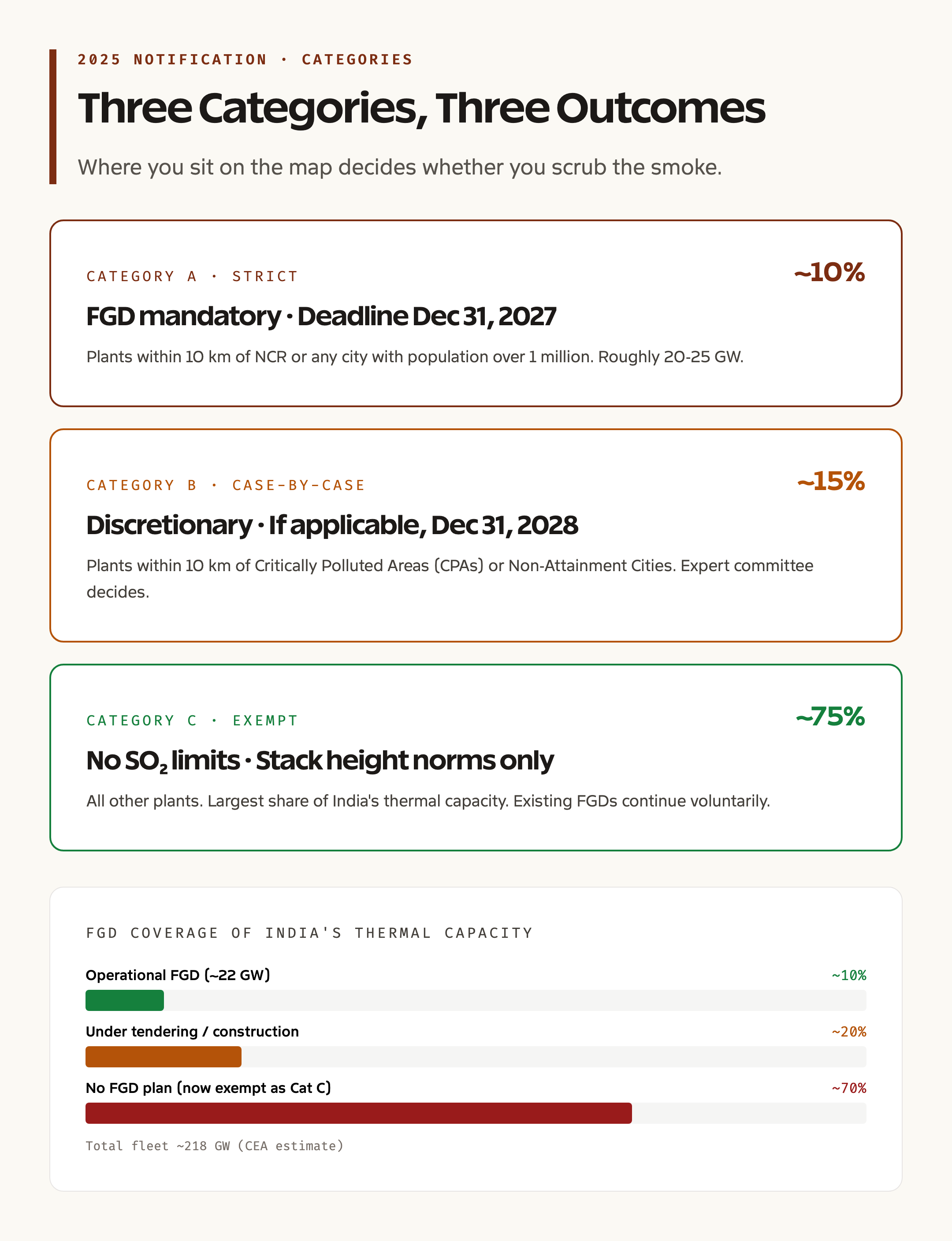
- Category A: Plants within 10 km of NCR or million-plus cities; FGD deadline December 31, 2027
- Category B: Plants within 10 km of Critically Polluted Areas (CPAs) or Non-Attainment Cities; case-by-case decision; if applicable, deadline December 31, 2028
- Category C: All other plants (around 75 to 80 percent of capacity); exempted from SO₂ limits, only stack height norms apply
- Equipment in question: Flue Gas Desulphurisation (FGD) systems, typically wet limestone or seawater scrubbing
- Why the relaxation: MoEFCC argues India’s ambient SO₂ levels are largely within safe limits unlike PM2.5 and PM10
- Cost implication: FGD adds 30 to 90 paise per unit to power tariffs
- CPCB position: Critically Polluted Areas are listed by CPCB based on a Comprehensive Environmental Pollution Index score above 70
What the Revised Norms Actually Say
The 2025 notification splits India’s thermal fleet into three tiers based on location rather than uniform technology mandate. The shift is from “every plant must install FGD” to “FGD only where local airshed pressure justifies it.”
Category A plants are those within 10 kilometres of the National Capital Region boundary or any city with a population over one million. These plants are required to install FGD by December 31, 2027. The deadline has already been extended from the original 2024 target.
Category B plants are those within 10 kilometres of Critically Polluted Areas notified by the CPCB or within 10 kilometres of Non-Attainment Cities under the National Clean Air Programme. For Category B, the central government will decide applicability of FGD on a case-by-case basis, drawing on expert recommendations and local airshed data. If FGD is mandated, the deadline is December 31, 2028.
Category C plants, which include all coal-fired units that fall outside the Category A and B definitions, are exempted from the new SO₂ emission limits. They continue to comply only with stack height norms, which control the dispersion of pollutants but not their absolute volume. Category C accounts for the bulk of India’s roughly 218 GW of installed coal capacity.
The notification keeps PM and NOx norms intact and only modifies the SO₂ track. Existing FGD installations at Category C plants are not penalised but become voluntary rather than mandatory.
Background and Historical Context
India’s thermal emission story moved in fits and starts.
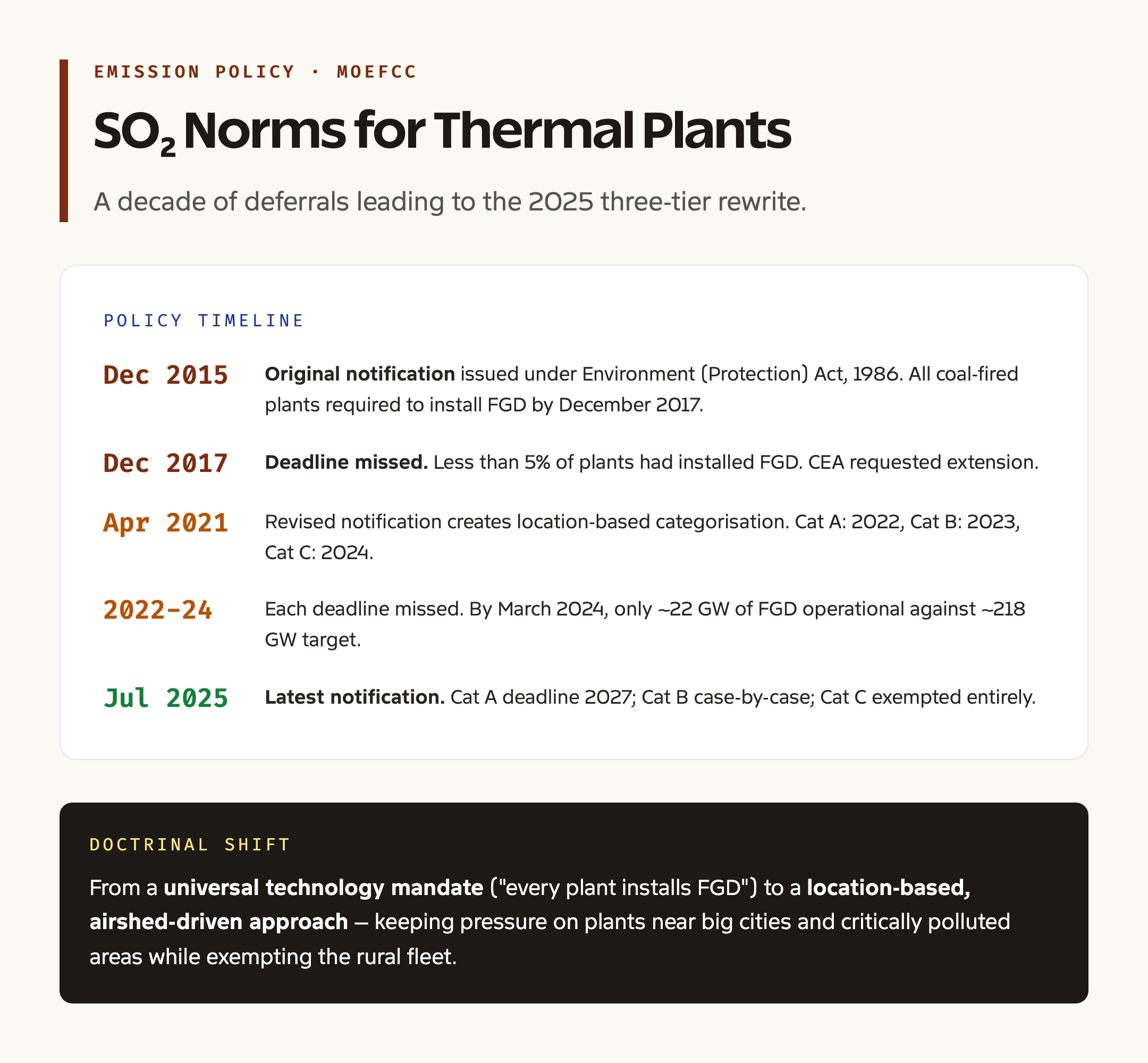
December 2015: MoEFCC issued the original notification under the Environment (Protection) Act, 1986 setting tight limits on PM, SO₂, and NOx from thermal power plants. Compliance deadline was December 2017.
2017: The deadline came and went. Less than 5 percent of plants had installed FGD. CEA, the Central Electricity Authority, requested an extension.
2017 to 2021: Phase-wise extensions issued. The Central Pollution Control Board threatened legal action against non-compliant plants.
April 2021: A revised notification grouped plants by location for the first time, giving Category A plants until 2022, Category B until 2023, and Category C until 2024.
2022, 2023, 2024: Each deadline was missed. By March 2024 only about 22 GW of FGD capacity was operational against a target of over 200 GW.
July 2025: The latest notification effectively concedes that universal FGD is no longer the policy goal. Only Category A is held to a hard deadline. Category B becomes discretionary. Category C is exempted entirely.
The shift reflects three forces. First, a chronic supply shortage of FGD equipment and certified vendors, with most orders concentrated among Chinese, Japanese, and a handful of Indian suppliers. Second, the cost of FGD on tariffs and on Discoms which are already in financial stress. Third, fresh modelling commissioned by NITI Aayog and IIT Delhi suggesting that India’s ambient SO₂ levels are largely within National Ambient Air Quality Standards while PM2.5 remains the main public health concern, in contrast to the Indo-Gangetic air pollution hotspots.
Key Provisions of the 2025 Notification
The July 2025 notification has six operational provisions worth knowing for both Prelims and Mains.
- Three-tier categorisation based on location and proximity to dense population centres or polluted airsheds
- Category A deadline extended from earlier dates to December 31, 2027
- Category B made discretionary; applicability decided by an expert committee under MoEFCC
- Category C exempted from absolute SO₂ limits
- Stack height norms retained for all categories as a baseline dispersion requirement
- No penalty rollback for non-compliance before the new notification, but enforcement effectively lapses
Importantly, the notification leaves PM and NOx limits unchanged. So Category C plants still need electrostatic precipitators (ESPs) for particulate control and selective catalytic reduction (SCR) for NOx, even though they no longer need scrubbers for SO₂.
The notification draws its statutory authority from Section 6 and Section 25 of the Environment (Protection) Act, 1986 read with the Environment (Protection) Rules, 1986. State Pollution Control Boards remain responsible for monitoring, but the SO₂ enforcement window has narrowed to Category A plants alone.
Why It Matters
Health: SO₂ is a precursor to secondary sulphate aerosols, which form fine particulate matter (PM2.5) in the atmosphere. Even if ambient SO₂ readings appear low, the indirect contribution to PM2.5 is non-trivial and disproportionately affects poor and working-class neighbourhoods downwind of plants.
Energy transition: India’s net-zero by 2070 commitment depends on a steady decline in thermal emissions even as new capacity is added in the short run. Exempting the bulk of thermal capacity from SO₂ norms creates a credibility gap with international climate partners.
Investment signals: Developers who already invested in FGD lose any competitive advantage. Banks and rating agencies factor environmental compliance into project valuations.
Public health economics: Several studies including those from the Indian Institute of Public Health estimate that strict SO₂ controls would prevent 30,000 to 50,000 premature deaths a year. The opposite case argues those models double-count benefits already captured by PM controls.
International precedent: China, the only country with a larger coal fleet than India, mandated FGD on virtually all units by the late 2010s. India relaxing its standard while China tightens runs against the global decarbonisation trajectory and may complicate trade-linked carbon discussions.
Detailed Analysis
How FGD Works
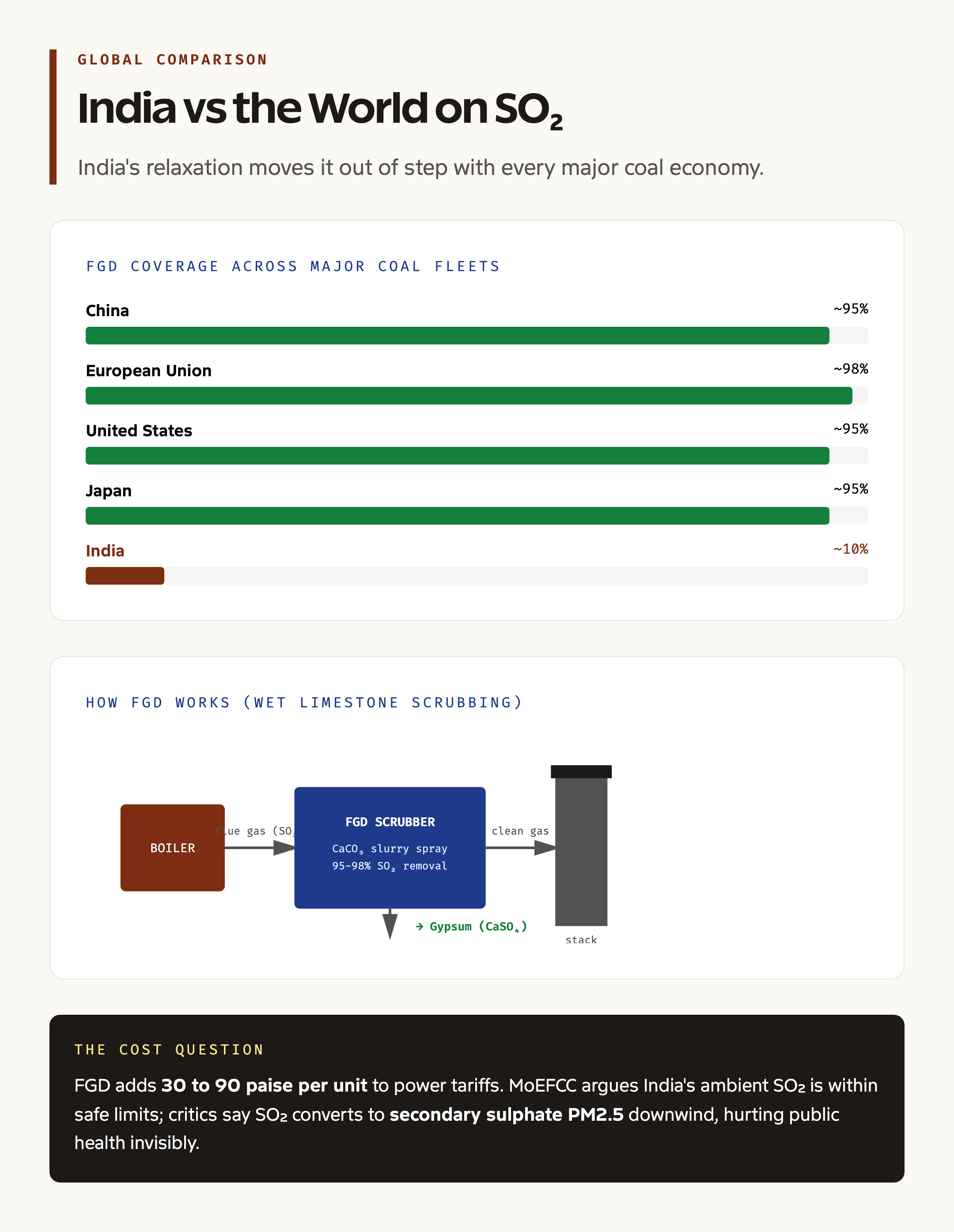
Flue Gas Desulphurisation removes SO₂ from the exhaust gas stream of a coal-fired boiler before it reaches the chimney. The most common method in India, wet limestone scrubbing, sprays a slurry of crushed limestone (calcium carbonate) into the flue gas. The SO₂ reacts with the limestone to form gypsum (calcium sulphate), which is collected and either used in cement or landfilled. Wet FGD typically removes 95 to 98 percent of SO₂.
Other methods include seawater FGD (used at coastal plants where seawater alkalinity neutralises SO₂), dry sorbent injection (lower efficiency, lower cost), and circulating fluidised bed scrubbing. Each has different capital and operating costs.
The technology details and policy logic of FGD are covered in greater depth in our flue gas desulphurisation (FGD) primer, including FGD’s interaction with water consumption, ash management, and lime-stone supply chains.
Why MoEFCC Justified the Relaxation
MoEFCC’s notification cites three lines of evidence.
- Ambient SO₂ readings across CPCB monitoring stations show most cities are well below the 50 µg/m³ annual NAAQS limit
- Modelling by IIT Delhi and CSIR-NEERI suggests SO₂ contribution to ambient PM2.5 is smaller than primary PM emissions and traffic-related pollutants
- The cost of FGD adds 30 to 90 paise per unit to electricity tariffs, hitting Discoms and end-consumers
The counter-arguments are equally strong. Critics point out that India has only 800 to 900 SO₂ monitors for the entire country, that secondary sulphate formation is well documented in the Indo-Gangetic plain, and that WHO tightened its SO₂ guideline in 2021 from 20 to 40 µg/m³ over 24 hours, which India’s NAAQS does not yet reflect.
Sectoral Implications
| Stakeholder | Impact of 2025 Norms |
|---|---|
| NTPC and central PSUs | Capex relief for Category C plants; Category A still on FGD timeline |
| State gencos | Major financial relief; some have already cancelled FGD tenders |
| IPPs (private generators) | Mixed; those with PPAs that priced FGD have lower competitive risk |
| Coal sector | Supports continued domestic coal use; reduces marginal compliance pressure |
| Renewable developers | No direct impact, but coal cost competitiveness improves marginally |
| Pollution control boards | Reduced enforcement scope; SPCB focus shifts to PM and water |
| Public health | Likely worsening sulphate-driven PM2.5 in downwind regions |
| End consumers | Tariff stability; some areas may see worse air quality |
Comparative Lens: India’s Standards vs Global Peers
| Country | SO₂ Norm for New Plants | FGD Coverage |
|---|---|---|
| India (2025) | 200-600 mg/Nm³ for Category A; relaxed for B and C | 22 GW of 218 GW (~10 percent) |
| China | 35-100 mg/Nm³ (ultra-low) | Over 95 percent of fleet |
| United States | 160 mg/Nm³ (CSAPR) | Over 95 percent |
| European Union | 130-200 mg/Nm³ (BAT) | Near 100 percent |
| Japan | 100-200 mg/Nm³ | Over 95 percent |
India’s relaxation moves it out of step with every major coal-using economy. Even Indonesia and Vietnam are tightening SO₂ standards under their respective net-zero pathways.
Challenges
Monitoring gaps: SO₂ monitoring stations are concentrated in metros. Many critical airsheds in Jharkhand, Chhattisgarh, and Telangana lack continuous monitoring data, making the “SO₂ levels are fine” argument hard to verify.
Vendor and supply chain shortage: Even Category A plants face equipment lead times of 24 to 36 months. The 2027 deadline is feasible only if orders are placed before the end of 2025.
Discom finances: Many Discoms cannot absorb the tariff impact of FGD without state subsidy. The federal government’s UDAY 2.0 scheme has not adequately addressed this.
Public health attribution: Linking specific SO₂ exposures to specific health outcomes is hard, which weakens the political case for stringent norms.
Climate diplomacy: As the world tightens climate finance toward decarbonising coal, India’s loosening of pollution norms could affect access to climate finance and concessional lending.
Prelims Pointers
- The revised SO₂ norms were notified by MoEFCC in July 2025
- Plants are categorised into A, B, and C based on location
- Category A: within 10 km of NCR or million-plus cities; FGD deadline December 31, 2027
- Category B: within 10 km of CPAs or Non-Attainment Cities; case-by-case basis; if applicable, deadline December 31, 2028
- Category C: all other plants; exempted from SO₂ limits
- Category C accounts for roughly 75 to 80 percent of India’s thermal capacity
- The original norms were issued in December 2015 with a December 2017 compliance date
- FGD stands for Flue Gas Desulphurisation
- Most common Indian FGD type: wet limestone scrubbing, removing 95 to 98 percent of SO₂
- The notification draws authority from the Environment (Protection) Act, 1986
Mains Practice Questions
- The revised SO₂ norms for thermal power plants have been described as a step backward in India’s air quality journey. Critically examine the trade-offs between cost, public health, and energy security in the 2025 notification. (250 words)
- Compare India’s new three-category SO₂ regime with the emission standards of China, the European Union, and the United States. What does this comparison say about India’s energy transition? (150 words)
- Examine the role of Flue Gas Desulphurisation in controlling sulphate-driven PM2.5 formation in the Indo-Gangetic plain. Should ambient SO₂ levels alone determine compliance pressure on coal plants? (250 words)
Way Forward
India’s policy goal cannot be either “control everything” or “exempt most.” A workable middle path has four elements. First, expand the SO₂ monitoring network, particularly in coal-belt districts of Jharkhand, Chhattisgarh, and Odisha, to generate the airshed data on which exemption decisions should rest. Second, mandate FGD for any new coal capacity built after 2025, regardless of category, so that the long-term capacity stock cleans up automatically. Third, link Category C exemption to a measurable airshed quality criterion, so that any plant whose contribution to local PM2.5 sulphate concentration exceeds a threshold is moved into Category B. Fourth, use the savings from relaxed FGD norms to accelerate retirement of plants older than 25 years, redirecting the freed capital to renewables and storage. India can manage SO₂, public health, and tariff stability together only if it stops treating these three as separate problems.
Frequently Asked Questions
What are the revised SO₂ norms for thermal power plants in India?
The 2025 notification by MoEFCC categorises India’s coal-fired thermal plants into three groups. Category A plants near NCR and million-plus cities must install FGD by December 31, 2027. Category B plants near critically polluted areas will be assessed case by case. Category C plants, which make up around 75 to 80 percent of capacity, are exempted from SO₂ limits.
What is FGD and why is it needed?
FGD stands for Flue Gas Desulphurisation. It is an end-of-pipe technology that removes sulphur dioxide from the exhaust gas of a coal-fired boiler before it leaves the chimney. The most common method in India is wet limestone scrubbing, which captures 95 to 98 percent of SO₂.
Why has the government exempted Category C plants from SO₂ norms?
MoEFCC argues that ambient SO₂ levels across most Indian cities are already within National Ambient Air Quality Standards, that the cost of FGD adds 30 to 90 paise per unit to tariffs, and that PM2.5 rather than SO₂ is the main public health concern. Critics argue that SO₂ contributes to PM2.5 through secondary sulphate formation.
What is the 2015 SO₂ notification and what did it require?
The December 2015 MoEFCC notification was the first major emission standard for Indian thermal power plants. It set tight limits on particulate matter, SO₂, mercury, and NOx, with a compliance deadline of December 2017. Less than 5 percent of plants installed FGD by that deadline.
Which Indian thermal plants have already installed FGD?
As of early 2025, only about 22 GW of India’s 218 GW coal capacity had operational FGD. NTPC’s Vindhyachal, Mauda, and a handful of central sector plants lead the way. Most state-sector and private plants are still in the tendering or construction stage.
What is a Critically Polluted Area (CPA)?
A CPA is a location identified by the Central Pollution Control Board where the Comprehensive Environmental Pollution Index score exceeds 70. CPAs face additional environmental scrutiny and were the basis for the Category B definition in the 2025 notification.
How does India’s SO₂ standard compare with China?
China requires ultra-low emissions of 35 to 100 mg/Nm³ for SO₂ from new and most existing coal plants and has installed FGD on over 95 percent of its fleet. India’s revised norms maintain stricter limits only for Category A, leaving the bulk of capacity at far higher emission levels.
What is the link between SO₂ and PM2.5?
Sulphur dioxide reacts with ammonia, nitrogen oxides, and atmospheric moisture to form ammonium sulphate, a major component of fine particulate matter (PM2.5). So even when ambient SO₂ readings look low, downwind regions can suffer significant PM2.5 contributions from upstream coal plants.
Will the new norms increase electricity costs?
For the bulk of Category C plants, the new norms reduce or eliminate FGD investment, keeping tariffs stable. For Category A plants, the FGD investment will continue to add 30 to 90 paise per unit. The overall tariff impact at the system level is likely small but not zero.
Has the Supreme Court ruled on the SO₂ norms?
The Supreme Court has heard several public-interest petitions on thermal emission compliance and has, in earlier orders, pulled up the central government for repeated extensions. The 2025 notification is likely to face legal challenge from environmental NGOs.