Flue Gas Desulphurisation, or FGD, is the technology that scrubs sulphur dioxide out of the smoke leaving a coal-fired power plant before that smoke goes up the chimney. India is consistently ranked as the world’s largest emitter of anthropogenic sulphur dioxide, and the country’s roughly 200 GW of coal-based generation is the dominant source. FGD is therefore the single most important air-quality intervention available for the coal fleet, and it has been at the centre of one of India’s longest-running environmental compliance debates.
For UPSC GS-III, FGD sits at the intersection of energy policy, air pollution in India, and environmental jurisprudence. The 2015 emission norms for thermal plants, the repeated deadline extensions, the National Green Tribunal interventions, and the recent revision of the SO2 standards for non-NCR plants are all exam-relevant, and the underlying technology is straightforward enough to write a clean answer about.
Quick Facts on FGD

FGD is a set of technologies that remove sulphur dioxide from the exhaust flue gases of fossil-fuel power plants, particularly those burning coal. The most common method uses an alkaline reagent, typically limestone or lime, to neutralise the acidic SO2 gas. The Ministry of Environment, Forest and Climate Change first issued binding SO2 emission norms for coal plants in December 2015 with a 2017 compliance deadline.
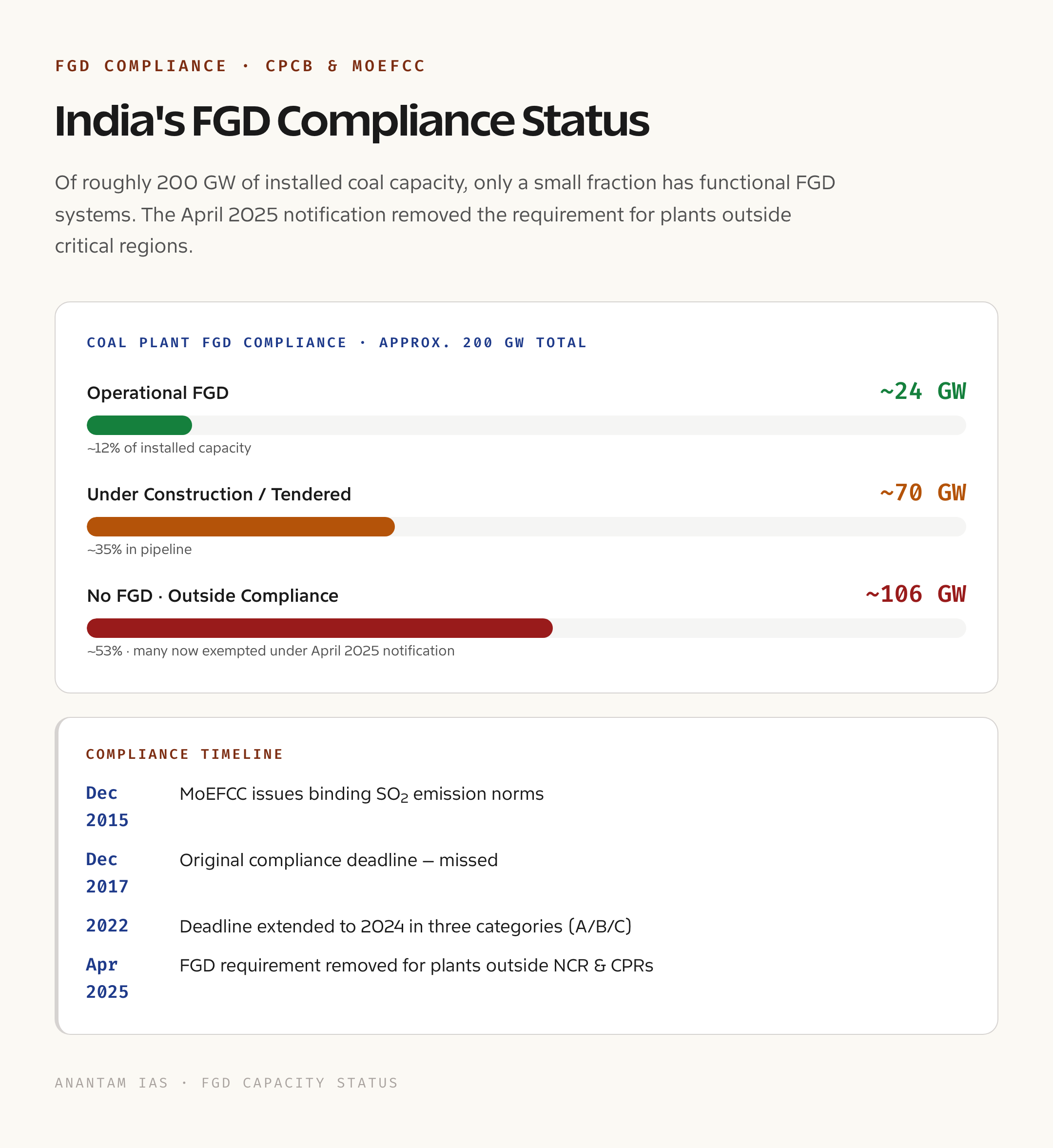
That deadline has been pushed back multiple times. In April 2025, the Centre issued a fresh notification removing the FGD requirement for plants located outside the National Capital Region and other critically polluted regions, while retaining stricter norms for the most polluting locations. Compliance status remains uneven, with only a fraction of installed coal capacity having functional FGD systems.
What Flue Gas Desulphurisation Is
Coal contains sulphur in varying concentrations. Indian coal averages around 0.5 percent sulphur, which is lower than imported coal from many other regions, but the volume of coal burned in India is enormous, which is why total SO2 emissions are still very high. When coal is combusted, the sulphur reacts with oxygen to form sulphur dioxide, a colourless toxic gas with a sharp pungent odour. SO2 leaves the boiler with the rest of the flue gas and travels through pollution control equipment, including electrostatic precipitators that remove particulate matter, before exiting the chimney.
FGD is installed downstream of the precipitators and upstream of the chimney. Its job is to neutralise the SO2 by reacting it with an alkaline reagent. The reagent is typically calcium-based: either limestone, which is calcium carbonate, or lime, which is calcium oxide. The product of the reaction is calcium sulphite, which is then oxidised to gypsum, a marketable industrial by-product.
Background and Historical Context
The link between sulphur dioxide and air pollution has been understood since the late nineteenth century, when industrial cities in Britain experienced acid fog incidents. The 1952 Great Smog of London killed thousands of people in a few days and was the trigger for the United Kingdom’s Clean Air Act of 1956. The United States followed with its Clean Air Act in 1963 and amendments in 1970 and 1990. By the 1980s, large-scale FGD had become standard equipment on new coal plants in OECD countries.
India’s path has been slower. The Air (Prevention and Control of Pollution) Act, 1981, gave the Central Pollution Control Board the legal authority to set emission standards. Particulate emission norms for thermal plants were tightened progressively through the 1990s and 2000s, but binding SO2 emission norms did not arrive until 2015. The December 2015 notification, issued by the Ministry of Environment, Forest and Climate Change, set SO2 limits ranging from 100 to 600 milligrams per normal cubic metre depending on plant size and vintage, and gave coal plants two years to comply.
The 2017 deadline was missed. Successive extensions through 2019, 2022, and 2024 followed, often justified by supply chain bottlenecks for FGD equipment, the limited number of qualified contractors, and the financial stress on power-generating utilities. The Supreme Court and the National Green Tribunal both intervened at different points, and in 2025 the Centre issued a fresh categorisation that effectively narrowed the universe of plants required to install FGD, focusing the requirement on the National Capital Region and a handful of critically polluted clusters.
Key Provisions: The Three Main FGD Technologies
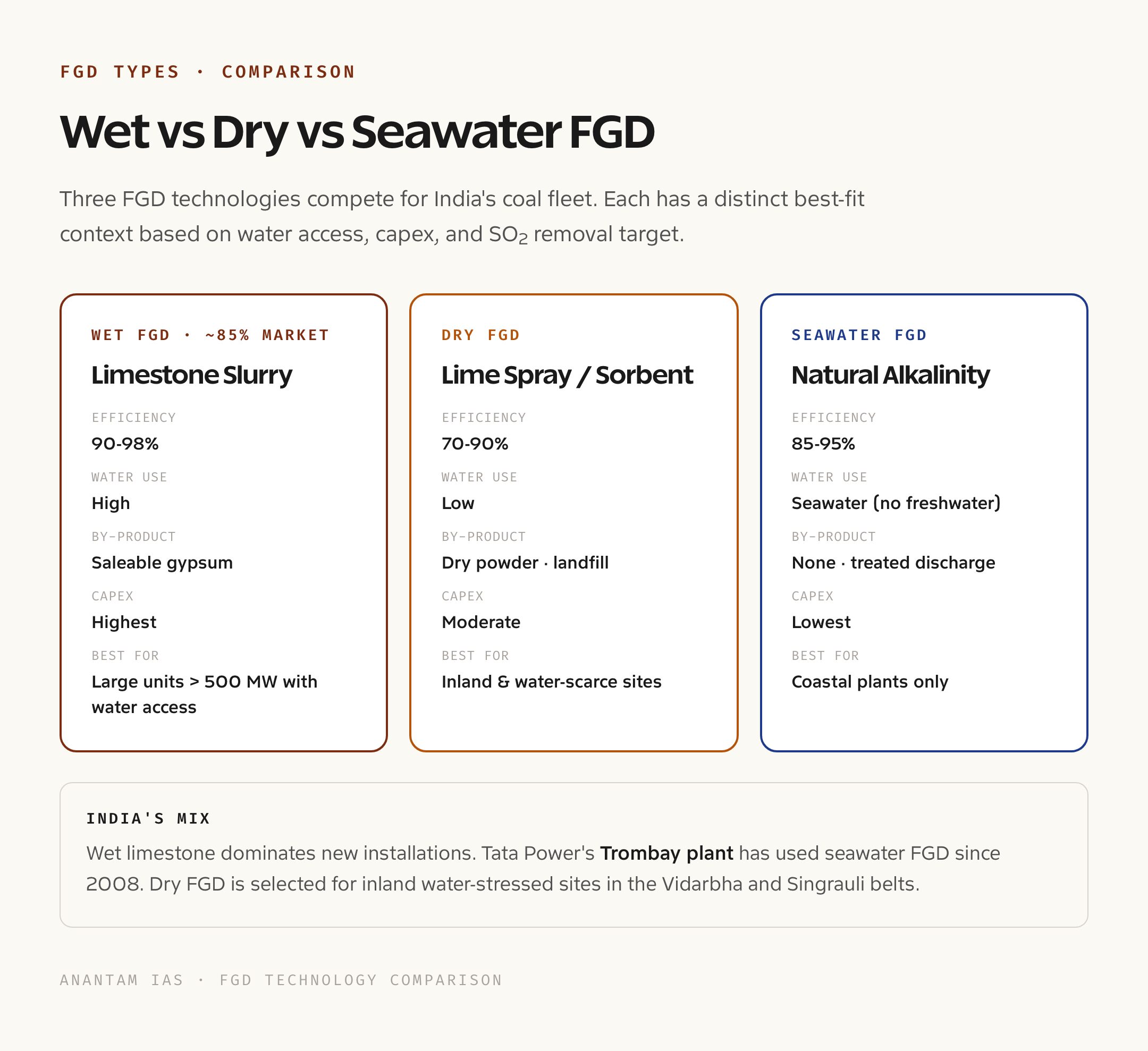
There are three principal FGD technologies in commercial use. Wet FGD is the most common and most efficient. A slurry of limestone and water is sprayed into the flue gas stream inside a large absorber vessel. The SO2 dissolves into the slurry and reacts with the calcium carbonate to form calcium sulphite. The slurry is then forced-oxidised, often by blowing air through it, to convert the calcium sulphite into calcium sulphate dihydrate, better known as gypsum. The gypsum can be sold to cement and plasterboard manufacturers, partially offsetting the operating cost.
The chemistry is straightforward. Limestone reacts with sulphur dioxide and water to form calcium sulphite and carbon dioxide. Calcium sulphite then reacts with oxygen and water to form gypsum. Wet FGD typically achieves 90 to 98 percent SO2 removal, the highest efficiency of any commercial technology, but it consumes significant amounts of water and produces a wet sludge that needs careful management.
Dry and semi-dry FGD use a damp spray or a dry powder of lime rather than a slurry. The reagent reacts with the SO2 and falls out of the flue gas as a dry solid, which is collected in a fabric filter or precipitator downstream. Dry FGD uses about 60 percent less water than wet FGD, which makes it suitable for water-scarce regions, but it has lower efficiency, typically 70 to 90 percent removal, and the by-product is a dry waste rather than marketable gypsum.
Seawater FGD uses the natural alkalinity of seawater to absorb SO2. The flue gas passes through an absorber tower in which seawater is sprayed at high volume. The dissolved SO2 reacts with the bicarbonates and carbonates naturally present in seawater. After treatment, the spent seawater is aerated to oxidise the absorbed sulphur compounds and is then discharged back to the sea. Seawater FGD has the advantage of needing no limestone or lime input and produces no solid by-product, but it can only be used at coastal plants and requires careful management to avoid local marine pollution.
Why FGD Matters
The case for FGD rests on three air-quality outcomes. First, acid rain. SO2 in the atmosphere combines with water and oxygen to form sulphuric acid, which falls as acidic precipitation. Acid rain damages forests, acidifies lakes, and harms aquatic ecosystems. The Eastern Himalayan ecosystems and parts of the biodiversity in India range are vulnerable to long-range transport of SO2 from large industrial clusters.
Second, stone leprosy. Acid rain reacts with the marble and limestone of historical monuments to form gypsum, which then flakes off and turns yellow. The Taj Mahal has been visibly affected by this process, which is why a Taj Trapezium Zone was notified to control SO2 emissions in the area. Several other monuments around large coal-fired clusters face similar threats.
Third, particulate matter and respiratory disease. Once in the atmosphere, SO2 oxidises into sulphate aerosols that are a major component of PM2.5, the fine particulate matter that penetrates deep into lung tissue. Studies estimate that secondary sulphate aerosols contribute roughly 15 to 25 percent of the PM2.5 mass in many Indian cities. SO2 itself is a respiratory irritant that causes bronchoconstriction, asthma attacks, coughing, and shortness of breath, and is linked to elevated mortality in long-term exposure studies.
Detailed Analysis of Compliance and Deadlines
The 2015 SO2 emission norms were a turning point in Indian air quality regulation, but their implementation has been slow. The original December 2015 notification gave a December 2017 deadline. By that date, fewer than 5 percent of the coal fleet had installed FGD. The first extension pushed the deadline to 2022 with a phased compliance schedule based on plant location and pollution severity. The Central Pollution Control Board categorised plants into three buckets: Category A in the National Capital Region with the strictest deadlines, Category B in critically polluted areas, and Category C elsewhere.
By 2024, around 22 to 25 GW of coal capacity, out of roughly 200 GW total, had operational FGD systems. Another 50 to 60 GW had FGD under construction or in tender. The April 2025 notification reduced the FGD requirement for Category C plants, which represent the bulk of the coal fleet, while maintaining stricter standards for Category A and Category B. The notification was justified by the Centre on the grounds that the marginal SO2 reduction from Category C plants was small relative to the cost, particularly given that Indian coal is relatively low in sulphur.
Critics have argued that this dilutes the original 2015 framework and effectively rewards a decade of non-compliance. Supporters have argued that it focuses scarce resources on the highest-impact installations. The National Green Tribunal has continued to monitor compliance and has issued notices to several specific plants for missed deadlines. The broader debate sits inside the larger context of India’s coal mining and thermal power economy.
Comparative View: FGD vs Other SO2 Controls
FGD is not the only way to control SO2 emissions. Three alternative or complementary approaches exist. Coal washing, also called coal beneficiation, removes inorganic sulphur and ash before combustion. It is most effective for coals with high pyritic sulphur content but does not address organic sulphur. India has expanded coal washing capacity in recent years, but the bulk of the domestic coal still goes to plants unwashed.
Fluidised bed combustion technology, particularly circulating fluidised bed combustion, captures SO2 within the boiler itself by feeding limestone alongside the coal. This avoids the need for a separate FGD unit and is well suited to high-ash domestic coals. India has several CFBC units, particularly in captive industrial generation, but it is rarely used for utility-scale plants because it has higher capital cost and slightly lower efficiency than pulverised coal combustion.
Fuel switching to imported low-sulphur coal or to natural gas is the most direct alternative but has macroeconomic costs given import dependence. Co-firing of biomass, mandated for thermal plants under the SAMARTH mission, also reduces SO2 modestly because biomass has lower sulphur content than coal.
Challenges and Criticisms
The FGD rollout has run into several recurring problems. Capital cost is the first. A 500 MW unit typically requires Rs 200 to 300 crore for FGD installation, which translates to a tariff impact of roughly 25 to 35 paise per kilowatt-hour. For state-owned generators in financial stress, finding this capital is genuinely hard. Several utilities have asked for tariff adjustments to recover the investment, which puts the cost on consumers.
Equipment supply is the second. India’s domestic FGD manufacturing base is limited, and several large utilities have had to import key components, particularly absorber towers and slurry pumps. Lead times of two to three years between contract award and commissioning are common.
Water availability is the third. Wet FGD, the highest-efficiency technology, consumes substantial water, and many of India’s coal plants are located in water-stressed regions. The Centre has encouraged dry and seawater FGD where appropriate, but retrofitting existing plants from wet to dry technology is generally not feasible.
Disposal of by-products is the fourth challenge. Wet FGD produces gypsum that can be sold, but only if cement plants in the vicinity are willing buyers. In remote locations, the gypsum can pile up and become a solid waste management problem.
Prelims Pointers on FGD
Flue Gas Desulphurisation removes sulphur dioxide from the exhaust gases of fossil-fuel power plants. The three main technologies are wet, dry or semi-dry, and seawater FGD. Wet FGD uses a limestone slurry, achieves 90 to 98 percent SO2 removal, and produces gypsum as a marketable by-product. Dry FGD uses about 60 percent less water but has lower efficiency. Seawater FGD uses natural alkalinity of seawater and is suitable only for coastal plants.
The first binding SO2 emission norms for coal plants in India were issued in December 2015 by the Ministry of Environment, Forest and Climate Change with effect from 2017. Multiple extensions followed. The April 2025 notification removed the FGD requirement for Category C plants outside critically polluted regions while retaining stricter norms for NCR and Category B clusters. India is consistently ranked as the world’s largest emitter of anthropogenic sulphur dioxide. Sulphur dioxide is a colourless toxic gas with a sharp odour, easily soluble in water, and is a precursor to acid rain and PM2.5 sulphate aerosols.
Mains-Level Questions
A standard mains question on this topic might ask whether India’s revised FGD policy strikes the right balance between air quality protection and energy affordability. A strong answer would walk through the 2015 norms, the deadline extensions, the 2025 Category-based revision, the public health evidence on sulphate aerosols, and the financial constraints on state utilities.
Another framing asks about the linkage between thermal power plant emissions and ambient air quality in Indian cities. Here the answer can connect SO2 emissions, the formation of secondary PM2.5, the role of CPCB monitoring under the Air (Prevention and Control of Pollution) Act, 1981, and the policy gap between source-level FGD compliance and ambient air quality management at the city scale.
Way Forward
A coherent path forward needs to do four things. First, accept that FGD is a long-cycle infrastructure investment and finance it accordingly. Sovereign green bonds, the new Energy Transition Fund mooted in recent budgets, and partial cost pass-through into tariffs are all instruments that can spread the burden. Second, prioritise installations in the highest-impact locations. The Category A and Category B clusters identified by CPCB should have firm deadlines with consequences for non-compliance.
Third, integrate FGD planning with the broader coal phase-down trajectory. India’s coal capacity is projected to peak in the early 2030s and decline thereafter. FGD investment in plants likely to retire by 2035 may not be cost-effective, and the Centre’s 2025 categorisation implicitly recognises this. A formal FGD-or-retirement decision matrix would make the planning more transparent.
Fourth, accelerate domestic FGD manufacturing through procurement aggregation and through targeted Production Linked Incentive support. Building Indian capacity in absorber towers, pumps, and oxidation systems would cut import dependence and reduce installation lead times for the next wave of FGD projects.
Frequently Asked Questions
What is Flue Gas Desulphurisation?
Flue Gas Desulphurisation, or FGD, is a set of technologies used to remove sulphur dioxide from the exhaust gases of fossil-fuel power plants, particularly coal-fired plants. The most common method uses an alkaline reagent like limestone or lime to neutralise the acidic SO2.
What are the main types of FGD?
The three main types are wet FGD, dry or semi-dry FGD, and seawater FGD. Wet FGD uses a limestone slurry and is the most efficient at 90 to 98 percent removal. Dry FGD uses lime powder or damp spray and consumes less water. Seawater FGD uses the natural alkalinity of seawater and is suitable only for coastal plants.
Why is SO2 a concern?
Sulphur dioxide is a respiratory irritant that causes asthma, bronchoconstriction, and other lung problems. It also reacts in the atmosphere to form acid rain, which damages forests, lakes, and historical monuments. Once oxidised into sulphate aerosols, SO2 is a major component of PM2.5 air pollution.
What are India’s SO2 emission norms?
India’s binding SO2 emission norms for coal-fired thermal plants were first issued by the Ministry of Environment, Forest and Climate Change in December 2015. Limits range from 100 to 600 milligrams per normal cubic metre depending on plant size and vintage. The April 2025 notification revised the framework to focus FGD requirements on the National Capital Region and critically polluted clusters.
Why has FGD compliance been slow in India?
Compliance has been slow because of high capital cost, limited domestic FGD manufacturing capacity, long equipment lead times, water availability constraints in many plant locations, and the financial stress on state-owned generating utilities. The 2015 deadline of 2017 has been extended multiple times.
What is stone leprosy?
Stone leprosy is the discolouration and flaking of marble and limestone monuments caused by reaction with acid rain. Sulphur dioxide and other acid gases react with the calcium carbonate in stone to form gypsum, which is softer and yellowish and crumbles away from the surface. The Taj Mahal is the most famous Indian monument affected by this process.
Why is India the largest SO2 emitter in the world?
India has a large coal-fired generation fleet of nearly 200 GW, and FGD installation has been slow. While Indian coal has relatively low sulphur content compared to many imported coals, the sheer volume burned annually translates into very high total SO2 emissions, exceeding even China since China invested heavily in FGD over the 2010s.
What is the difference between wet and dry FGD?
Wet FGD uses a limestone slurry sprayed into the flue gas, achieves 90 to 98 percent SO2 removal, and produces marketable gypsum as a by-product. Dry FGD uses lime powder or damp spray, achieves 70 to 90 percent removal, consumes about 60 percent less water, and produces a dry waste rather than gypsum. Wet is more efficient, dry is more water-friendly.
What is gypsum and why is it useful?
Gypsum is calcium sulphate dihydrate. It is the hardened by-product of wet FGD systems and is used in cement manufacturing as a setting retarder and in plasterboard production. A 500 MW coal plant with wet FGD can produce roughly 100,000 tonnes of gypsum annually, which can offset some of the operating cost of the FGD unit.
Will FGD remain relevant as India transitions away from coal?
FGD remains relevant for the next two to three decades, since coal is projected to remain a significant share of India’s electricity mix into the 2040s. The April 2025 categorisation effectively focuses FGD investment on plants likely to remain in operation for the long term and in the highest-impact air quality clusters, while older plants nearing retirement are being given more flexibility.
Tell Google you want more of this.
Add Anantam IAS as a preferred sourceOne tap, and this site shows up more often in your own Top Stories, AI Overviews and AI Mode. Remove it any time.