Role of E-Technology in Agriculture: Digital Tools, e-NAM, AgriStack UPSC
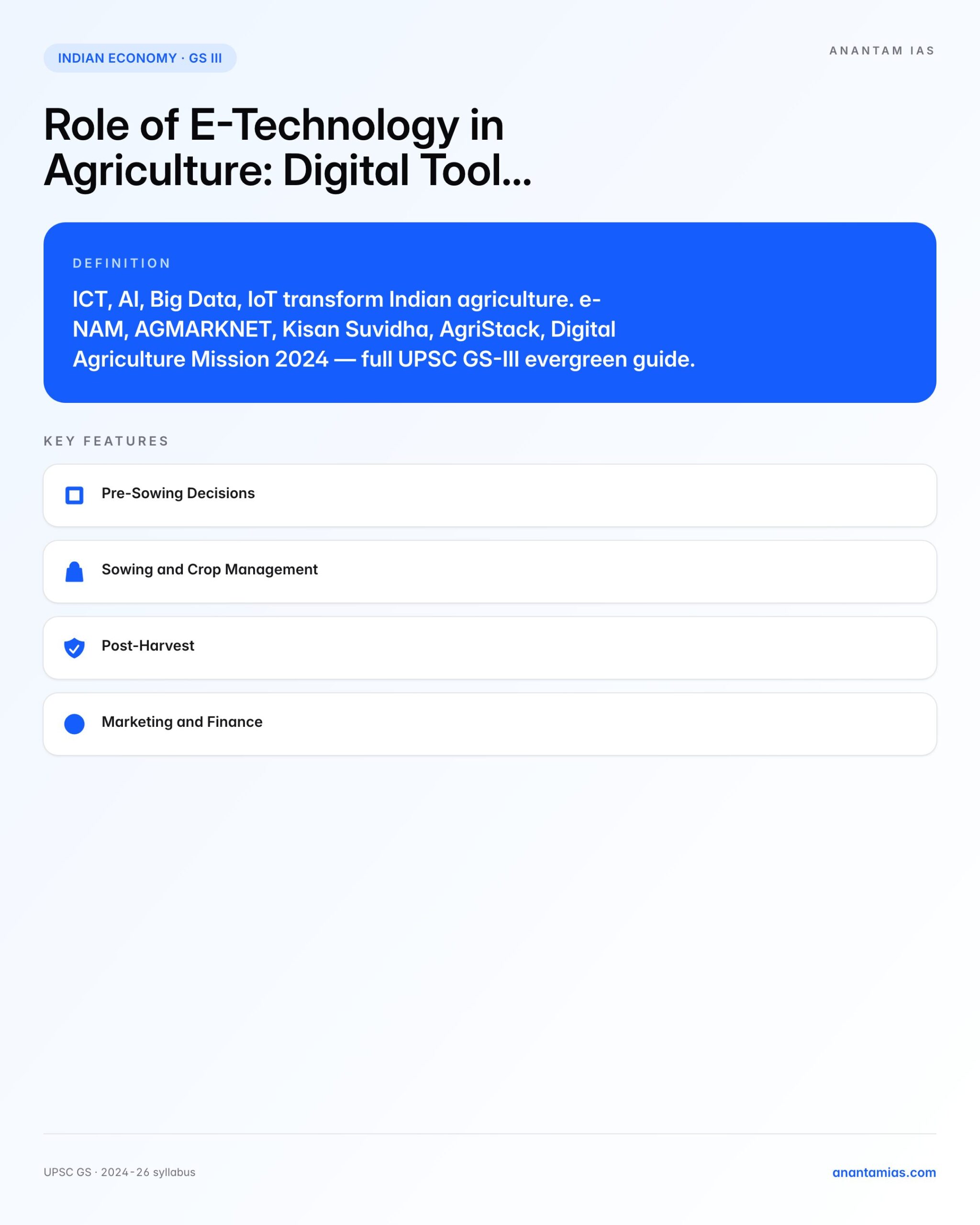
ICT, AI, Big Data, IoT transform Indian agriculture. e-NAM, AGMARKNET, Kisan Suvidha, AgriStack, Digital Agriculture Mission 2024 — full UPSC GS-III evergreen guide.
E-technology — encompassing Information and Communication Technologies (ICT), Artificial Intelligence (AI), Big Data, Internet of Things (IoT), drones, blockchain, satellite imagery, and mobile platforms — is reshaping Indian agriculture from a low-margin, weather-dependent subsistence activity into a data-driven, precision-managed, market-connected enterprise. The Dalwai Committee on Doubling Farmers' Income identified digital technology as the single most important enabler for raising farmer incomes. The Government's flagship architecture for this transition is the Digital Agriculture Mission (2024), anchored by the AgriStack — a unified data platform with Farmer Registry, Crop Sown Registry, and Geo-referenced Land Records.
For UPSC, e-technology in agriculture is a recurring GS-III topic intersecting with doubling farmers' income, technology missions, food security, agricultural marketing, climate-smart agriculture, MSME and rural transformation. Prelims has tested specific platforms (e-NAM, AGMARKNET, ATMA, Kisan Suvidha, mKisan), and the Dalwai recommendation. Mains has asked about how e-technology contributes to doubling farmers' income and the challenges of digital adoption in rural India.
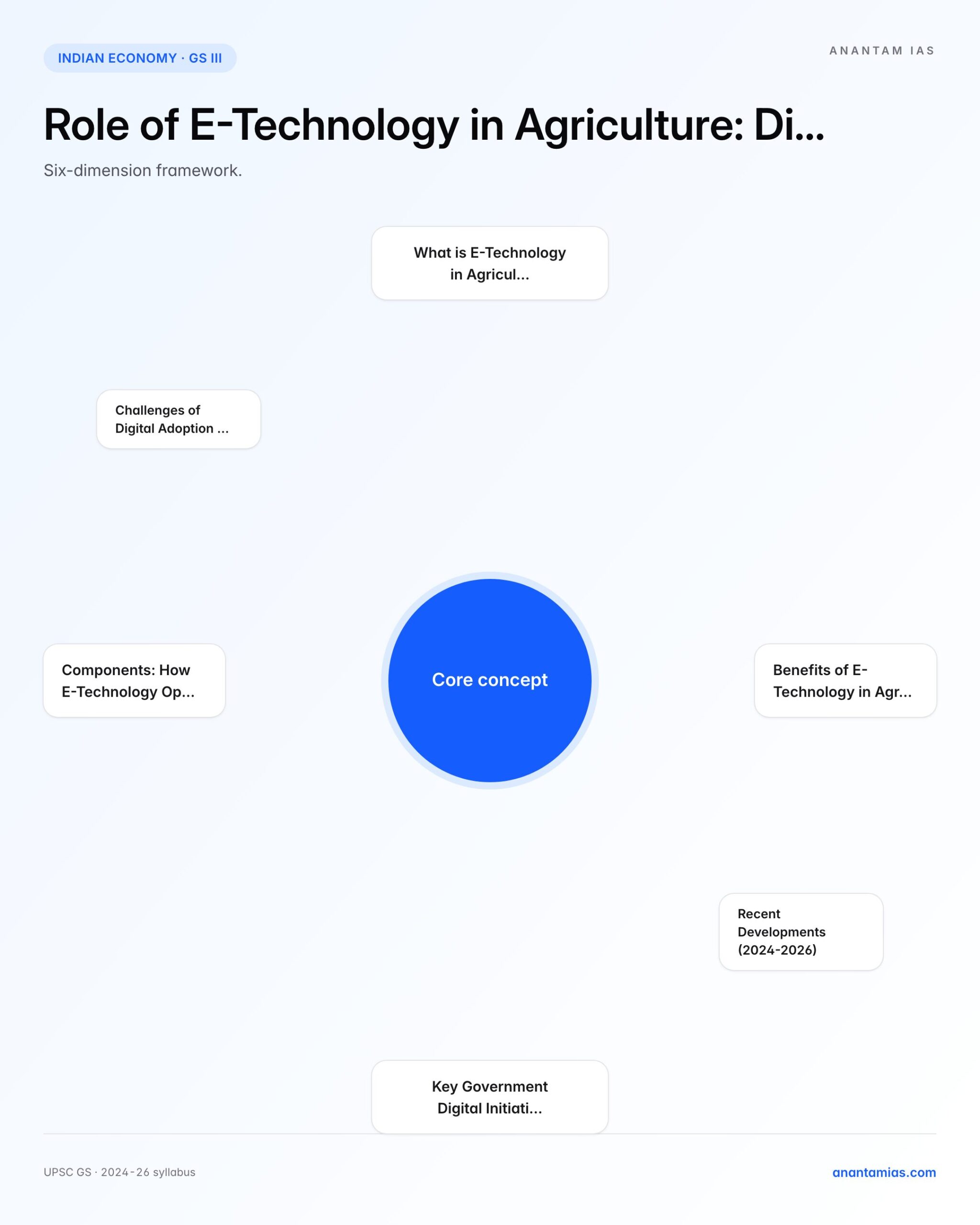
What is E-Technology in Agriculture?
E-technology refers to the systematic integration of digital tools across the agricultural value chain — from pre-sowing decisions to post-harvest sale. The technology stack typically covers:
- Information dissemination — weather alerts, market prices, crop advisories.
- Decision support systems — soil health, irrigation scheduling, pest forecasting.
- Precision farming — drones, GPS-guided machinery, sensor networks.
- AI and Big Data — crop yield prediction, disease detection, satellite-based monitoring.
- IoT — soil moisture sensors, leaf wetness sensors, automated fertigation.
- Blockchain — traceability for organic, GI, and export-oriented produce.
- Mobile apps and call centres — extension services, grievance redressal.
- Digital marketplaces — e-NAM, ONDC for agriculture, agritech platforms.
- Fintech — Kisan Credit Card, crop insurance (PMFBY), digital payments.
Key Government Digital Initiatives
| Platform | Purpose | Year Launched |
|---|---|---|
| AGMARKNET | Online portal for daily market prices across mandis | 2000 |
| ATMA (Agricultural Technology Management Agency) | District-level extension delivery | 2005 |
| Kisan Call Centres (KCC) | Toll-free agricultural advisory in 22 languages | 2004 |
| mKisan SMS Portal | Push-based SMS advisories to registered farmers | 2013 |
| Kisan Suvidha App | Weather, market, advisory in single app | 2016 |
| e-NAM (National Agriculture Market) | Online auction platform for 1,389+ APMC mandis | 2016 |
| PMFBY portal | Crop insurance enrolment, claims | 2016 |
| PM-KISAN portal | DBT income support for farmers | 2019 |
| Soil Health Card portal | Soil-test-based recommendations | 2015 |
| AgriStack | Unified Farmer Registry, Crop Registry, Geo-referenced Land | 2024 |
| Digital Agriculture Mission | Umbrella mission integrating all platforms | 2024 |
| Bharat Krishi Setu | Procurement and price discovery (pilot) | 2025 |
Components: How E-Technology Operates Across the Value Chain
Pre-Sowing Decisions
- Soil Health Card based crop and fertiliser recommendations.
- Weather forecasts through IMD Mausam app and KCC.
- Market price trends for crop selection.
- Seed availability and quality through portals like DBT-Seed.
Sowing and Crop Management
- Precision sowing — GPS-guided seed drills.
- Drone spraying of pesticides under Namo Drone Didi (15,000 women SHGs).
- Sensor-based irrigation — soil moisture monitoring with auto-shut-off.
- AI-based pest forecasting (e.g., Microsoft FarmBeats, Cropin, Fasal).
- Satellite imagery for crop health — Crop Health Monitoring System.
Post-Harvest
- e-NAM auction platform with FPO module, logistics, fintech, warehousing.
- Cold chain management through PMKSY-Sampada infrastructure.
- Quality grading through AI-based vision systems.
Marketing and Finance
- Kisan Credit Card (KCC) — digital enrolment and disbursement.
- PMFBY crop insurance — digital claims and Aadhaar-linked DBT.
- e-NAM payment gateway — direct bank transfer to farmer.
- AgriStack-linked credit scoring — for FPOs and individual farmers.
Information Dissemination
- mKisan — SMS alerts in regional languages.
- Kisan Suvidha app — integrated weather, price, advisory.
- Kisan Drone Didi — drone-based extension.
- AI chatbots (e.g., Krishi Bandhu, Bhashini-powered Krishi GPT) for query resolution.
Benefits of E-Technology in Agriculture
- Reduces input costs through precision dosing of seeds, fertilisers, water, pesticides — savings of 20-40%.
- Enhances productivity — yield gains of 15-30% through advisory-based interventions.
- Higher prices through e-NAM-driven price discovery and direct buyer linkages.
- Reduced post-harvest losses through cold chain monitoring.
- Faster credit access via digital KCC and AgriStack-based scoring.
- Risk mitigation through PMFBY-linked weather data.
- Climate adaptation — early warning systems for droughts, floods, heatwaves.
- Doubling farmers' income — Dalwai Committee identified e-technology as key enabler.
- Empowerment of small/marginal farmers through information access.
- Transparency — DBT eliminates intermediaries in subsidy delivery.
- Export competitiveness — blockchain traceability for organic and GI produce.
- Scaling extension — overcoming the 1:1,000+ extension officer-farmer ratio.
Challenges of Digital Adoption in Indian Agriculture
Fragmented Landholdings
Average operational holding is 1.08 ha; 86% of farmers are small/marginal. This makes:
- Per-hectare cost of technology high.
- Scale economics unfavourable for individual adoption.
- FPO aggregation the workaround — but FPOs themselves cover only ~5% of farmers.
Affordability
- High upfront cost of drones, sensors, IoT systems.
- Smartphone penetration in rural India ~60% but lower in older farmer demographic.
- Apps in regional languages still developing.
Long Gestation Period
Adoption of new technology in agriculture is slow — 5-10 years to reach 50% adoption from launch.
Lack of Enabling Policy
- Subsidy framework for digital tools is sporadic.
- Drone regulations still evolving.
- Data privacy under DPDP Act 2023 needs operational rules for AgriStack.
- Standards for IoT in agriculture lacking.
Poor Skill Sets
- Farmer digital literacy uneven.
- Extension workers under-trained in digital tools.
- Local language content insufficient.
Connectivity
- 4G coverage ~96% but 5G rural rollout still nascent.
- Power supply intermittent in rural areas.
- Smartphone shared in households — gendered access gaps.
Data Privacy and Cybersecurity
- AgriStack data — concerns about misuse, profiling, third-party access.
- Cybersecurity of payment and procurement platforms.
- Farmer consent mechanisms need strengthening.
Limited Last-Mile Extension
- Krishi Vigyan Kendras (KVKs) under-resourced.
- ATMA scheme has reach but variable quality.
- Private agritech extension focused on commercial farmers.
Recent Developments (2024-2026)
| Year | Update |
|---|---|
| 2023 | AgriStack pilot rolled out in 6 states; Farmer Registry launched |
| 2024 | Digital Agriculture Mission approved with Rs 2,817 crore outlay through FY26 |
| 2024 | Namo Drone Didi scaled to 15,000 women SHGs; Rs 1,261 crore outlay |
| Budget 2024-25 | Rs 350 crore for Digital Agriculture Mission |
| 2025 | Farmer Registry crosses 6+ crore farmers; Crop Sown Registry pilot in 11 states |
| 2025 | Kisan Drone Didi training of 10,000 women operators |
| Budget 2025-26 | Rs 700 crore for Digital Agriculture Mission; AgriStack-eNAM-PMFBY integration |
| 2025-26 | Bharat Krishi Setu procurement portal piloted |
| 2025-26 | AI-based pest forecasting rolled out in 100 KVKs |
| 2026 | Krishi GPT chatbot under Bhashini in 22 languages |
Reforms and Way Forward
- Strengthen AgriStack with farmer consent framework and data privacy compliance under DPDP Act.
- Subsidise smartphones and connectivity for small/marginal farmers.
- Mandate regional-language interfaces in all government agriculture portals.
- Scale Krishi Vigyan Kendras (KVKs) as digital extension hubs.
- FPO-led adoption model — provide IoT, drones, AI tools at FPO level for shared use.
- Public-Private Partnerships with agritech startups for last-mile delivery.
- Drone regulations — fast-track approvals for agricultural use.
- Skill development through ASCI, ICAR institutes, agricultural universities.
- Bridge digital divide for women farmers through Namo Drone Didi-style schemes.
- Integration with FPO Mission — 10,000 FPOs as digital adoption nodes.
- Performance-based subsidies — link DBT to verified technology adoption.
- Bharatnet rural connectivity — fibre to every panchayat by FY27.
- Farmer-centric design — voice-enabled apps for low-literacy users.
Government Schemes and Budget Allocations (2025-26)
- Digital Agriculture Mission: Rs 700 crore.
- Namo Drone Didi: Rs 1,261 crore (over 2024-26).
- e-NAM: Rs 350 crore.
- PMFBY: digital crop insurance.
- PM-KISAN: DBT income support.
- Kisan Suvidha App, mKisan, AGMARKNET: continued operation.
- Soil Health Card scheme: state-level support.
- AgriStack: Farmer Registry, Crop Sown Registry, Geo-referenced Land.
- Bhashini: Krishi GPT in 22 languages.
- Agricultural Marketing Information System: market price aggregation.
Mains Answer Hook
A high-scoring GS-III answer should: (a) frame e-technology as the single most important enabler for doubling farmers' income per the Dalwai Committee; (b) describe the platform stack — e-NAM, AGMARKNET, Kisan Suvidha, AgriStack, Digital Agriculture Mission; (c) cite scale — 6+ crore farmers in Farmer Registry, 1,389 mandis on e-NAM, 15,000 SHGs in Namo Drone Didi; (d) flag fragmented landholdings, affordability, skill gaps, data privacy as adoption barriers; (e) propose reforms — FPO aggregation, regional-language interfaces, Bharatnet rural fibre, KVK strengthening.
Use: "E-technology is the operating system of 21st-century Indian agriculture — every input decision, every market sale, every credit line, every climate response will eventually pass through it."
Prelims Pointers
- Dalwai Committee identified e-technology as key enabler for doubling farmers' income.
- Digital Agriculture Mission: launched 2024; outlay Rs 2,817 crore.
- AgriStack: Farmer Registry, Crop Sown Registry, Geo-referenced Land Records.
- e-NAM: launched 2016; 1,389+ mandis.
- AGMARKNET: launched 2000; daily mandi prices.
- Kisan Suvidha App: launched 2016.
- mKisan SMS Portal: 2013.
- Kisan Call Centres: 1551 toll-free; 22 languages.
- Namo Drone Didi: 15,000 women SHGs; Rs 1,261 crore.
- PM-KISAN: DBT Rs 6,000/year.
- PMFBY: crop insurance.
FAQ on E-Technology in Agriculture
What is the role of e-technology in Indian agriculture?
It transforms decision-making across the value chain — pre-sowing planning, crop management, marketing, finance, post-harvest — through ICT, AI, IoT, drones, and digital platforms.
What is AgriStack?
A unified data platform with three core layers — Farmer Registry, Crop Sown Registry, and Geo-referenced Land Records — for delivering targeted services.
What is the Digital Agriculture Mission?
An umbrella mission launched in 2024 with Rs 2,817 crore outlay to integrate AgriStack, e-NAM, PMFBY, drone services, AI-based advisory.
How does e-NAM help farmers?
By enabling online auction across 1,389+ mandis, e-NAM expands market access, improves price discovery, and reduces intermediation.
What is Namo Drone Didi?
A scheme that trains 15,000 women SHGs to operate drones for fertiliser/pesticide spraying — accelerating drone adoption while empowering rural women.
What are the main barriers to digital adoption?
Fragmented landholdings, smartphone affordability, digital literacy gaps, regional-language content scarcity, weak rural connectivity, and data privacy concerns.
E-technology is rewiring Indian agriculture. For UPSC, anchor your answers in e-NAM, AgriStack, Digital Agriculture Mission, Namo Drone Didi, and the Dalwai Committee endorsement. Pair these with the fragmented landholding and affordability challenges for a Mains-grade answer that hits both depth and currency.