R.S. Sharma Ancient History for UPSC: A Reading Guide
Choose between Ancient India and India's Ancient Past, then turn your reading into period comparisons and evidence-based recall.
R.S. Sharma ancient history searches often lead to two books: the old NCERT Ancient India and Oxford’s India’s Ancient Past. Mixing their reading plans makes a simple task confusing. You can spend a session looking for a chapter that belongs to the other title.
I recommend keeping a usable copy you already own and building your notes around themes. If you’re buying your first Sharma book, identify the publisher and exact title first. India’s Ancient Past is a reasonable foundation for learning the sequence of early Indian history; it still needs question practice and focused culture revision.
Identify Your Copy
The two titles are related, but their contents shouldn’t be treated as interchangeable. Sharma explains the relationship in the preface to India’s Ancient Past.
| Book | Identity | What It Means for Your Reading |
|---|---|---|
| Ancient India | R.S. Sharma’s older NCERT textbook; the author’s preface dates its first publication to 1977 | Use the contents of your own copy. An online list labeled “old NCERT” doesn’t establish its completeness or edition. |
| India’s Ancient Past | R.S. Sharma, Oxford University Press | A revised work based partly on the earlier textbook, with additional chapters. Don’t transfer old NCERT page references. |
The Oxford Academic record identifies print ISBN 9780195687859. That record doesn’t establish the ISBN or publication date of every retail reprint. If you choose the Oxford title listed on Amazon, compare its title and publisher with the copy delivered. A changed cover is a poor reason to replace a complete book you can already use.
Sharma’s preface places the coverage through the 7th century CE. Later medieval history needs its own source. For choosing across history books, use the Indian history book guide.
Read by Historical Problem
You should first establish where a period fits, then ask what changed within it. A chronological outline is like the index of a folder: it helps locate evidence, but it doesn’t explain the evidence by itself.
Use this study map with the chapter titles in your copy. These are recommended outputs, not an official chapterwise UPSC weightage.
| Reading Theme | Question to Carry Into the Chapter | Output to Keep |
|---|---|---|
| Sources and geography | What can this source tell us, and where was it produced? | A source, place and limitation card |
| Food production and settlements | What evidence supports a change in livelihood? | A before-and-after comparison with its evidence |
| Harappan society | Which claims come from material remains? | An observation-and-inference sheet |
| Religious ideas and social life | What problem or practice is being discussed? | A term, meaning and context card |
| States and empires | How were power and resources organized? | An administration, economy and society grid |
| Trade and culture | What connects objects, routes and patrons? | A small map with evidence labels |
An unread list of rulers is a weak substitute for this work. You should be able to explain a change with evidence before adding more dates to the page.
Work Through a Sources Question
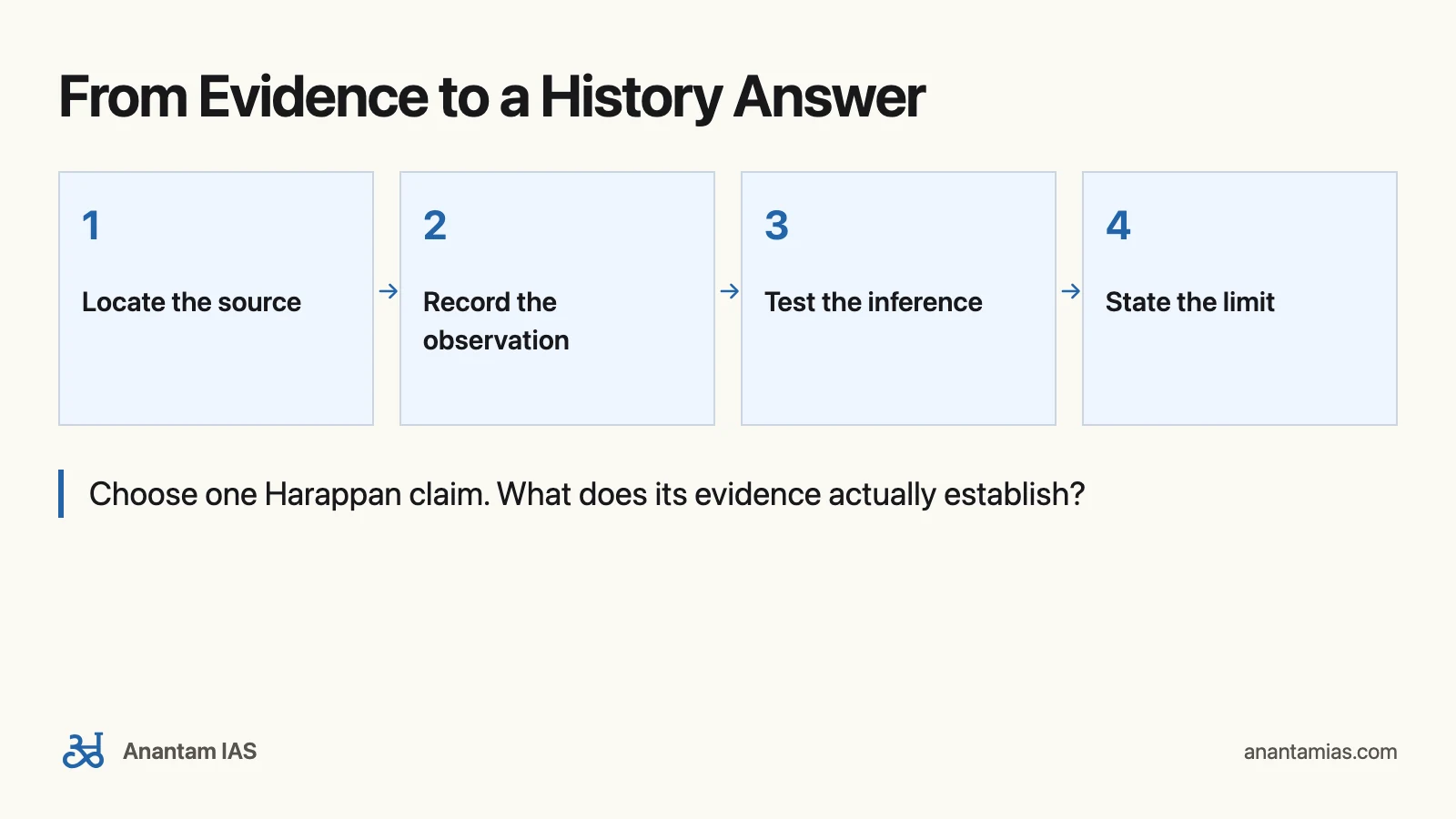
A good history note separates observation, inference and uncertainty. The distinction matters because a confident-looking statement may ask more of a source than it can give.
Consider this original practice question, not a UPSC PYQ: “Harappan drains and seals prove that all Harappan cities had one king. Is that conclusion justified?”
The NCERT discussion of Harappan evidence provides the background: material remains help reconstruct urban life, while the script remains undeciphered. Work through the claim in stages.
| Stage | Reasoning |
|---|---|
| Identify the observation | Drains and seals are kinds of surviving material evidence. Their exact findspot and context matter. |
| Make the narrow inference | Building and maintaining drains required coordination. Seals can help us investigate communication and exchange. |
| Locate the leap | Coordination doesn’t identify a ruler, a succession rule or one political system shared by every city. |
| State the source limit | Undeciphered signs cannot supply a securely read royal name. Similar objects alone cannot prove a single king. |
| Write the answer | The evidence supports questions about organized urban life, but it doesn’t by itself establish one king across all Harappan cities. |
Now create the revision card:
- Theme: Harappan urban life.
- Evidence: Drains and seals, with archaeological context.
- Supported conclusion: Coordination can be investigated through material remains.
- Unsafe conclusion: One king is proved merely by the presence of similar objects.
- Recall prompt: What extra evidence would be needed to identify political authority?
If you initially accepted the stronger claim, the correction is useful. You found the exact point where the evidence stopped supporting it. Apply the same check to inscriptions and literary texts: who produced the source, what does it say and what remains uncertain?
Build a Flexible Reading Routine
A 30-day structure should organize your work without forcing every chapter into the same-sized slot. A dense sources discussion may need more time than a familiar narrative.
| Days | Main Work | Evidence of Progress |
|---|---|---|
| 1 to 5 | Identify the copy; read sources, geography and early settlements | Explain what each source type can and cannot establish |
| 6 to 12 | Work through Harappan themes and the next chronological transitions | Complete period-and-source comparisons from memory |
| 13 to 20 | Study religious developments, states and economic change | Explain a term and connect it to its period |
| 21 to 25 | Finish remaining themes and revisit confusing links | Repair the comparison sheets rather than rewrite chapters |
| 26 to 30 | Attempt questions and return to the relevant passages | Keep a short error log with the corrected reasoning |
For a 45-minute session, I suggest 25 minutes of reading, 10 of closed-book recall and 10 of checking. That’s a starting schedule, not a tested completion guarantee. With 20 minutes available, read a smaller section and retain the recall step.
Use the ancient history Prelims PYQ collection to identify what you can actually answer. Mark an error as a missing fact, confused chronology or unsupported inference. Each needs a different repair.
Decide What to Add
Sharma can give your preparation a chronological base. You should add material for a defined gap, especially culture details, later periods or questions you repeatedly miss.
- Keep your current copy if it is complete and your notes match its contents.
- Buy a foundation text if you lack an organized early-history narrative.
- Delay a second broad textbook if your first book is unread or unrevised.
- Add targeted evidence when a specific topic needs a map, a visual example or a fuller explanation.
For your next session, choose one claim from the sources chapter and write what supports it. A page you can explain is a better starting point than another book waiting to be opened.
Frequently Asked Questions
Are Ancient India and India’s Ancient Past the same book?
They are related works by R.S. Sharma. In his Oxford preface, Sharma explains that India’s Ancient Past draws on the earlier NCERT book and includes substantial revisions and additional chapters. Use the contents of your actual copy.
Should I replace my old NCERT copy?
A complete, readable copy can remain useful. Replace it for an identified content or condition problem, rather than a different cover. Check title, publisher and contents before following another edition’s references.
Is India’s Ancient Past enough for all ancient-history preparation?
It can provide a chronological foundation, but preparation also requires question practice and work on specific gaps, including culture details. Its coverage through the seventh century CE does not supply the whole medieval period.
How should I make notes from R.S. Sharma?
Keep short period-and-source comparisons. For each claim, identify its evidence and what the evidence cannot establish. Test the sheet with the book closed before adding more detail.
Can I finish it in 30 days?
The suggested 30-day routine is an adjustable structure, not a guarantee. Your copy, current knowledge and available time determine the pace. Retain recall and correction even when you reduce the reading passage.
Does the Harappan exercise use a real UPSC question?
No. It is an original teaching exercise about the limits of inference. Use the separate published PYQ collection for actual past questions.