Disclosure: this guide contains Amazon affiliate links. As an Amazon Associate, Anantam IAS earns from qualifying purchases — at no extra cost to you.
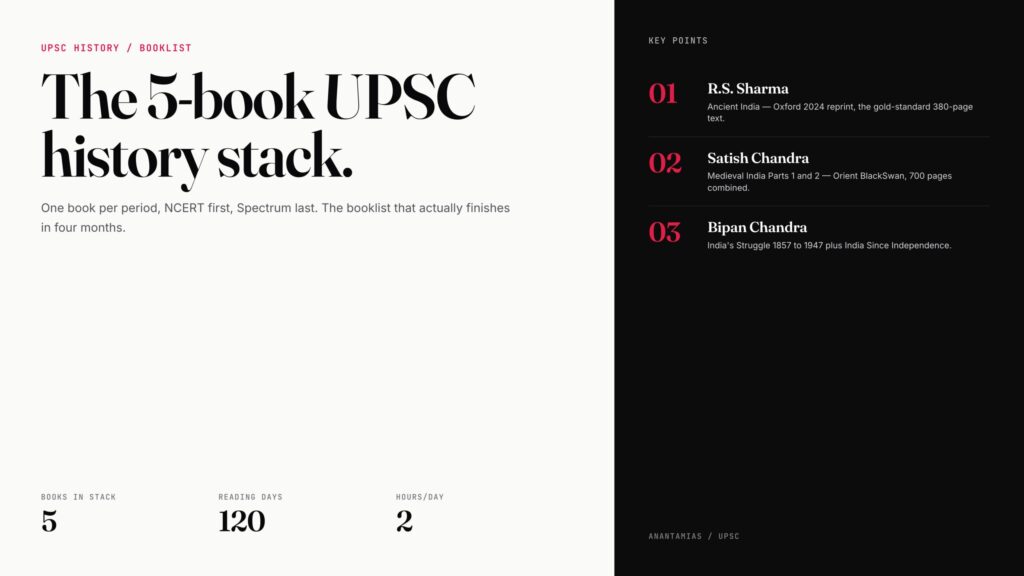
Picking the wrong indian history book for UPSC costs you four months. I’ve watched aspirants finish Bipan Chandra’s India’s Struggle for Independence in May, panic in August because they haven’t touched ancient or medieval, and end up cramming Spectrum two weeks before Prelims… which is exactly when the syllabus stops being absorbable. The booklist problem isn’t that good books don’t exist. It’s that there are too many, half are recycled in coaching pamphlets, and nobody tells you the right reading order. Here’s the stack I’d hand to a serious aspirant in 2026 — five books, one per period, plus NCERTs as the backbone.
What is the best book for Indian history for UPSC?
The best book for Indian history for UPSC is not one book — it’s a layered stack: NCERT Class 6–12 Old and New (foundation), R.S. Sharma’s Ancient India (NCERT-rebrand for ancient depth), Satish Chandra’s Medieval India (Parts 1–2), Bipan Chandra’s India’s Struggle for Independence and India Since Independence for modern, and Spectrum’s A Brief History of Modern India (Rajiv Ahir) for revision and Prelims-style facts. Read NCERT first, standard book second, Spectrum third for revision.
- NCERT Old (1980s–2000s) — Ancient India by R.S. Sharma, Medieval India by Satish Chandra, Modern India by Bipan Chandra. These were rewritten in 2002 (Themes in Indian History I, II, III — the New NCERTs). For UPSC, read both.
- NCERT New (Themes in Indian History) — Class 12, three volumes — Themes I (Ancient), Themes II (Medieval), Themes III (Modern). Better written, more analytical, stronger source-criticism approach.
- Spectrum’s A Brief History of Modern India by Rajiv Ahir, 2025 edition (currently in print) — the single most-cited revision book in UPSC coaching circles.
- Bipan Chandra (lead author) — India’s Struggle for Independence (1857–1947) + India Since Independence (1947–1990s) — Penguin, both still widely available in 2026 reprints.
- Tamil Nadu State Board History textbooks (Class 11 and 12) — public-domain PDFs, used as a quiet weapon by toppers for ancient and medieval factual depth.
Honestly, that list above settles 80% of the booklist debate. The remaining 20% is reading order. Let’s get into it.
NCERT Old vs New — which one wins?
Both. Don’t overthink this.
Old NCERT is fact-dense. R.S. Sharma’s Ancient India gives you everything — Indus Valley town planning, Vedic literature stratification, Mahajanapadas, the Mauryan Empire, post-Mauryan transitions, Gupta administration. Satish Chandra’s Medieval India (Old NCERT, single volume) is the cleanest narrative of the Delhi Sultanate and the Mughal Empire you’ll find. Bipan Chandra’s Modern India (Old NCERT) covers 1707 to 1947 in 350 readable pages.
New NCERT (Themes in Indian History, Classes 11–12) is interpretive. It teaches you how historians read sources — coins, inscriptions, foreign accounts, archaeological strata. UPSC Mains GS-1 increasingly asks “discuss the evidence” and “evaluate the sources” type questions. New NCERT trains that muscle.
Practical reading order:
- Old NCERT first (3–4 weeks total — Sharma, Satish Chandra, Bipan).
- New NCERT next (Themes I/II/III, 2–3 weeks).
- Then standard books per period.
Look, I know the temptation is to skip Old NCERT because they’re “outdated.” They’re not. They’re foundational. The 2002 rewrite removed political bias from some passages but kept the factual scaffolding… and the factual scaffolding is what Prelims tests.
Bipan Chandra vs Spectrum — the modern history showdown
This is the question every aspirant asks. Here’s the honest answer.
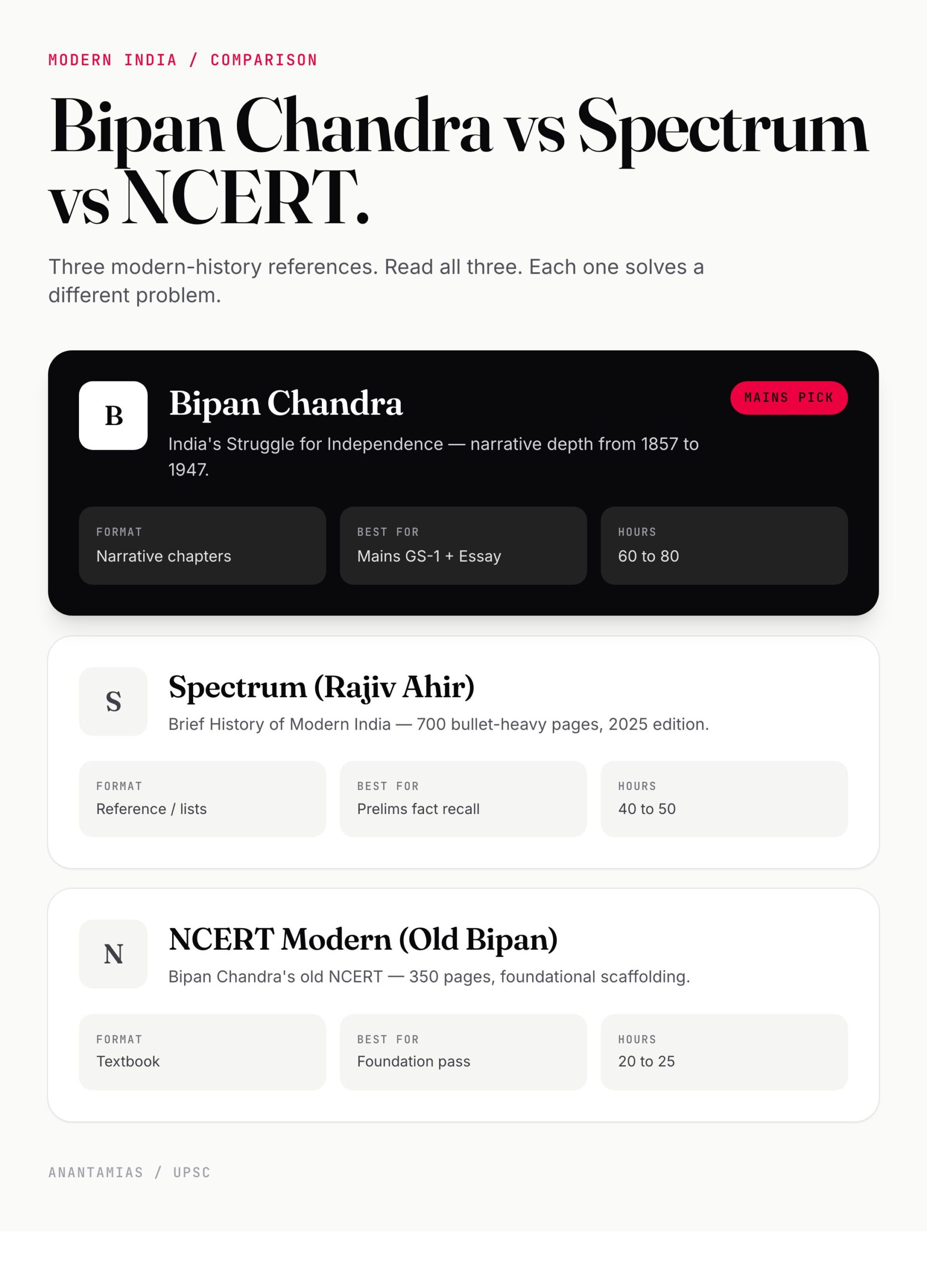
Bipan Chandra’s India’s Struggle for Independence (1988, latest reprint 2024) is a narrative. It tells you why the 1857 revolt happened, why Moderates split from Extremists, why the Khilafat-Non-Cooperation merger collapsed in 1922, why Gandhi suspended the movement after Chauri Chaura. It’s 600 pages. You can’t memorize it. You absorb it.
Spectrum’s A Brief History of Modern India (Rajiv Ahir, 2025 edition) is a reference. It lists. Every viceroy, every act, every session of Congress with year and president, every revolutionary movement with leader and outcome. 700 pages but designed to be flipped, not read cover-to-cover.
| Dimension | Bipan Chandra | Spectrum (Rajiv Ahir) |
|---|---|---|
| Format | Narrative chapters | Bullet-heavy reference |
| Best for | Mains GS-1 + Essay | Prelims fact recall |
| Time to read | 60–80 hours | 40–50 hours |
| Revision-friendly | Low | Very high |
| Coverage | 1707–1947 (Bipan) + 1947–1990s (India Since Independence) | 1707–1947 + brief post-independence |
| Bias | Marxist-nationalist lean | Neutral, exam-oriented |
| Edition | Penguin reprint, widely available 2026 | 2025 edition currently in market |
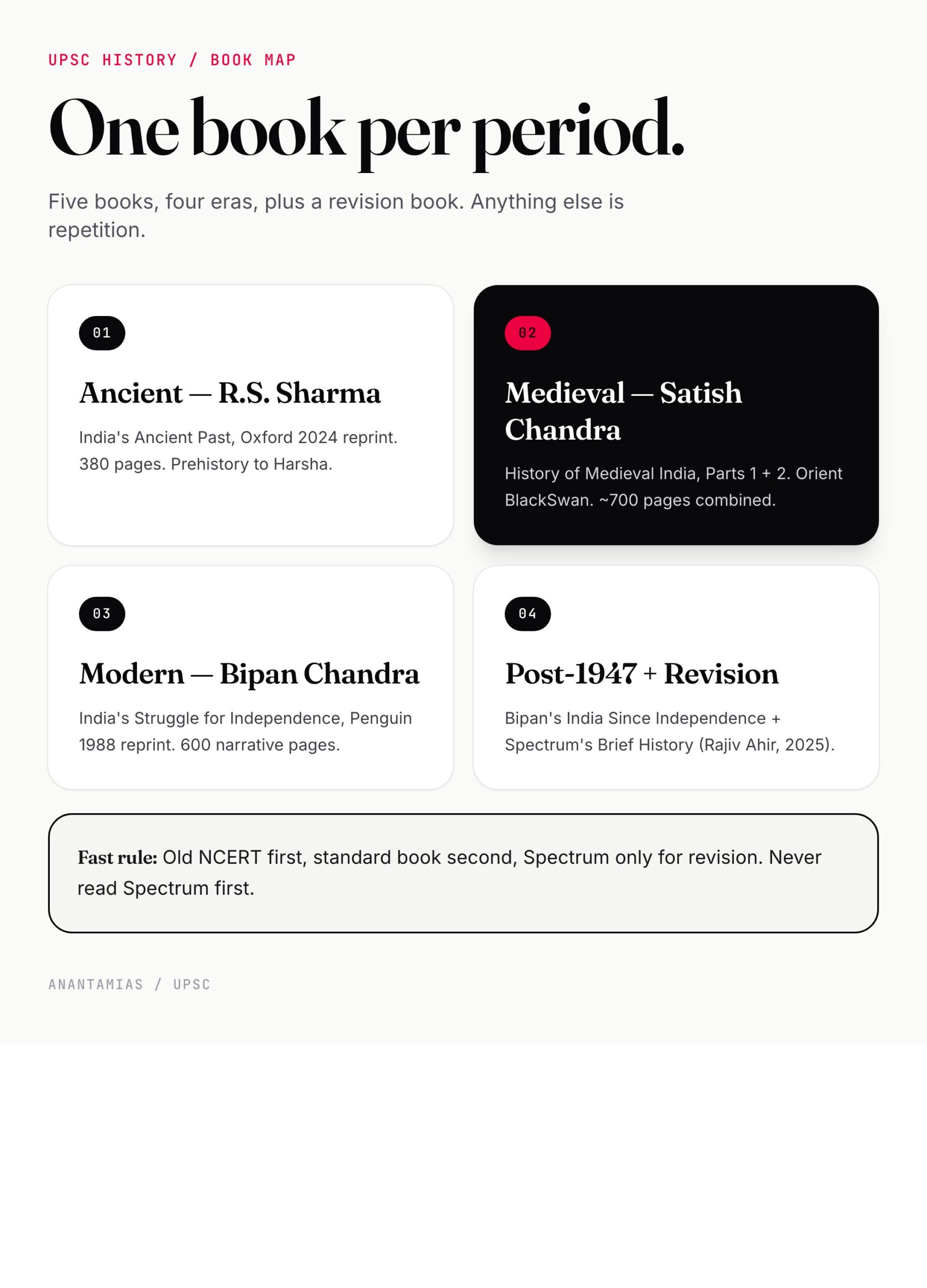
The honest recommendation: read both. Bipan first for understanding. Spectrum second for revision. NCERT (Old Bipan + New Themes III) somewhere in between as the bridge. Skip none of them.
R.S. Sharma for Ancient India — still the gold standard?
Yes. Mostly.
R.S. Sharma’s India’s Ancient Past (Oxford University Press, 2005, reprinted through 2024) is the standard ancient India text for UPSC. It covers prehistory, Indus Valley civilization, Vedic age, Mahajanapadas, Magadha rise, Mauryas, Sungas-Satavahanas-Kushanas, Guptas, Harsha, early medieval — about 380 pages.
What’s dated: Sharma’s interpretation of Aryan migration, his dating of Indus decline (~1900 BCE), and his framing of the Mauryan economy (heavy state-control reading). Recent archaeology — including the 2024 Sinauli chariot dating which pushed copper-age chariot evidence in India to ~2000 BCE, and ongoing DNA studies on Rakhigarhi skeletons — has nuanced some of his conclusions.
What still works: his chapter structure, his timeline, his summary of Ashokan edicts, his Gupta administration breakdown. For Prelims and Mains GS-1, Sharma + a current-affairs PDF on recent ASI findings is enough.
Alternative if you want a fresher take: Upinder Singh’s A History of Ancient and Early Medieval India: From the Stone Age to the 12th Century (Pearson, 2008) — heavier (700+ pages), more archaeological, more current on Sinauli, Rakhigarhi, Keeladi. Slow read. For dedicated history optional aspirants only.
Satish Chandra for Medieval India — which edition?
There are two distinct Satish Chandra books. Don’t confuse them.
- Satish Chandra — Medieval India (NCERT Old, single volume, 1990s) — short, exam-oriented, covers ~1000–1750 CE. Out of print officially but PDFs everywhere. Good for first-pass.
- Satish Chandra — History of Medieval India (Orient BlackSwan, two parts: Part 1 — 800–1700, Part 2 — Mughals + 18th century, current 2024 reprint) — the standard medieval book for UPSC. ~700 pages combined.
The Orient BlackSwan two-volume set is what most toppers cite. It covers the Delhi Sultanate (Slave, Khilji, Tughlaq, Sayyid, Lodi), the Mughals from Babur to Aurangzeb, Vijayanagara and the Bahmanis, and the Bhakti and Sufi movements. Part 2 ends with the rise of the regional powers — Marathas, Sikhs, Jats — and the early 18th-century crisis.
Counter-recommendation that nobody talks about: the Tamil Nadu State Board Class 11 History of India (free PDF, syllabus-aligned to NCERT) covers the same period in 200 pages with cleaner tables. For revision, it’s faster than Satish Chandra. Use Satish Chandra for depth, TN Board for speed.
The Tamil Nadu Board trick
Here’s the counter-popular advice. Most coaching tells you “buy Spectrum, buy Bipan Chandra, buy R.S. Sharma.” Nobody tells you the TN Board History textbooks (Class 6, 7, 11, 12) are free PDFs, written in simpler English than NCERT, and cover the entire UPSC ancient and medieval syllabus with cleaner timelines.
Why? Tamil Nadu’s state syllabus has historically prioritized ancient Indian history (Sangam, Cholas, Pallavas, Pandyas) at depth no NCERT matches. The Class 11 book covers prehistory through the 18th century. The Class 12 book covers modern India and post-independence.
If you’re starting from zero and English isn’t your first language, TN Board → NCERT → standard book is a faster path than NCERT → standard book. I’ve seen aspirants cut 3 weeks off their history prep this way.
What about Romila Thapar, Irfan Habib, and the academic giants?
Read them after you clear Mains. For Prelims and Mains, they’re overkill.
- Romila Thapar — Early India: From the Origins to AD 1300 (Penguin, 2002) — brilliant, but 600 pages and interpretation-heavy. For optional History students.
- Irfan Habib — Medieval India: The Study of a Civilization (NBT, 2008) — dense, Marxist framing of agrarian relations. Optional only.
- Sumit Sarkar — Modern India 1885–1947 (Macmillan, 1983) — alternative to Bipan Chandra, more critical of Congress nationalism. Good if you’ve finished Bipan and want a second view.
For GS aspirants? Skip these. You’re optimizing for the exam, not a PhD.
The 120-day reading schedule that actually works
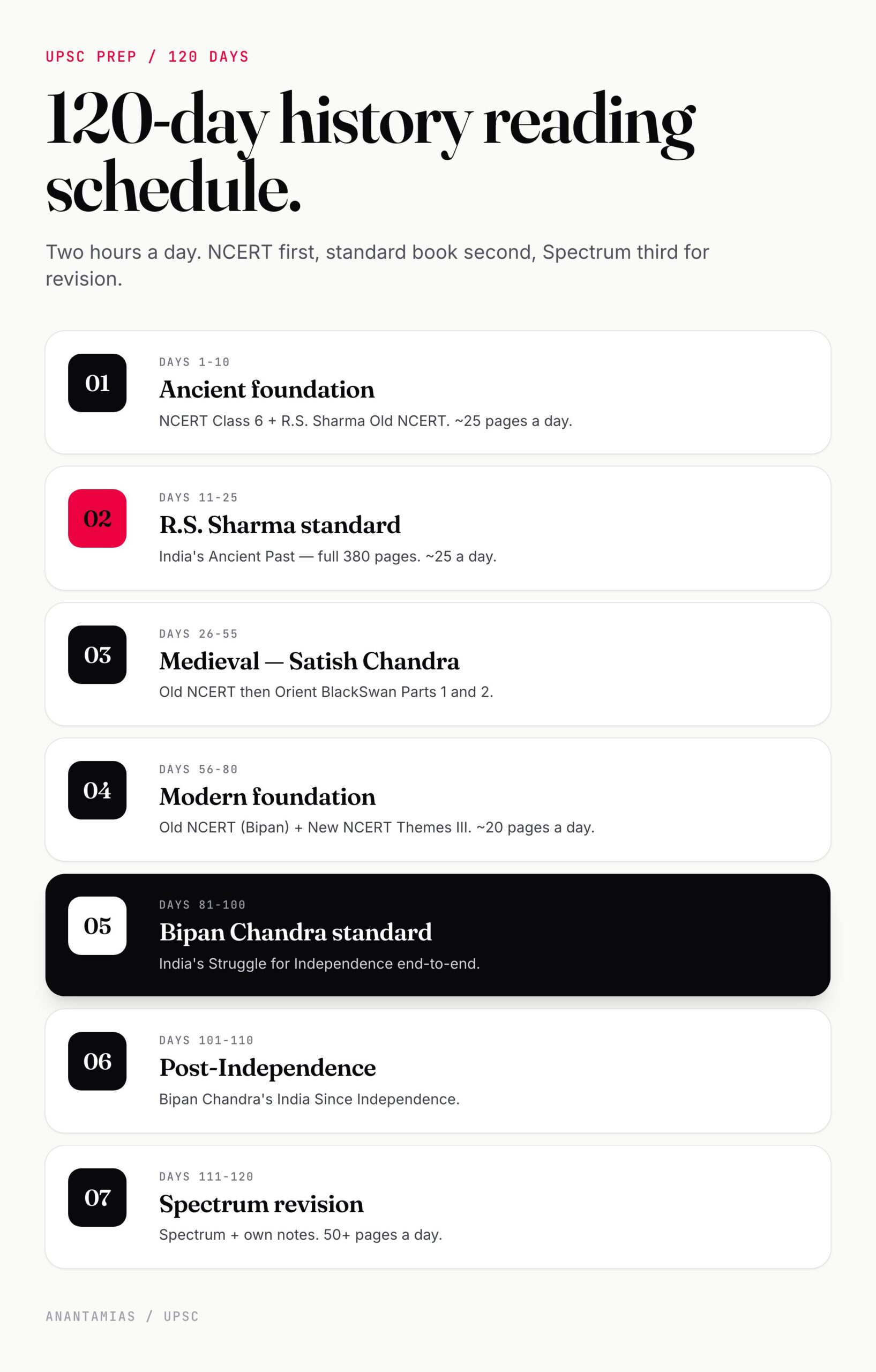
If you’re starting fresh and have 4 months before Prelims, here’s the schedule. Adjust for your pace.
| Days | Period | Books | Pages/day |
|---|---|---|---|
| 1–10 | Ancient (Foundation) | NCERT Class 6 + R.S. Sharma Old NCERT | 25–30 |
| 11–25 | Ancient (Standard) | R.S. Sharma — India’s Ancient Past | 25 |
| 26–40 | Medieval (Foundation + Standard) | NCERT Old (Satish Chandra) + Orient BlackSwan Part 1 | 25 |
| 41–55 | Medieval (Mughals) | Satish Chandra Part 2 | 25 |
| 56–80 | Modern (Foundation) | NCERT Old (Bipan) + New NCERT Themes III | 20 |
| 81–100 | Modern (Standard) | Bipan Chandra — India’s Struggle for Independence | 30 |
| 101–110 | Post-Independence | Bipan Chandra — India Since Independence | 35 |
| 111–120 | Revision | Spectrum + own notes | 50+ |
This is doable at 2 hours/day. It’s not doable at 30 minutes/day — that’s the uncomfortable truth.
Common booklist mistakes I keep seeing
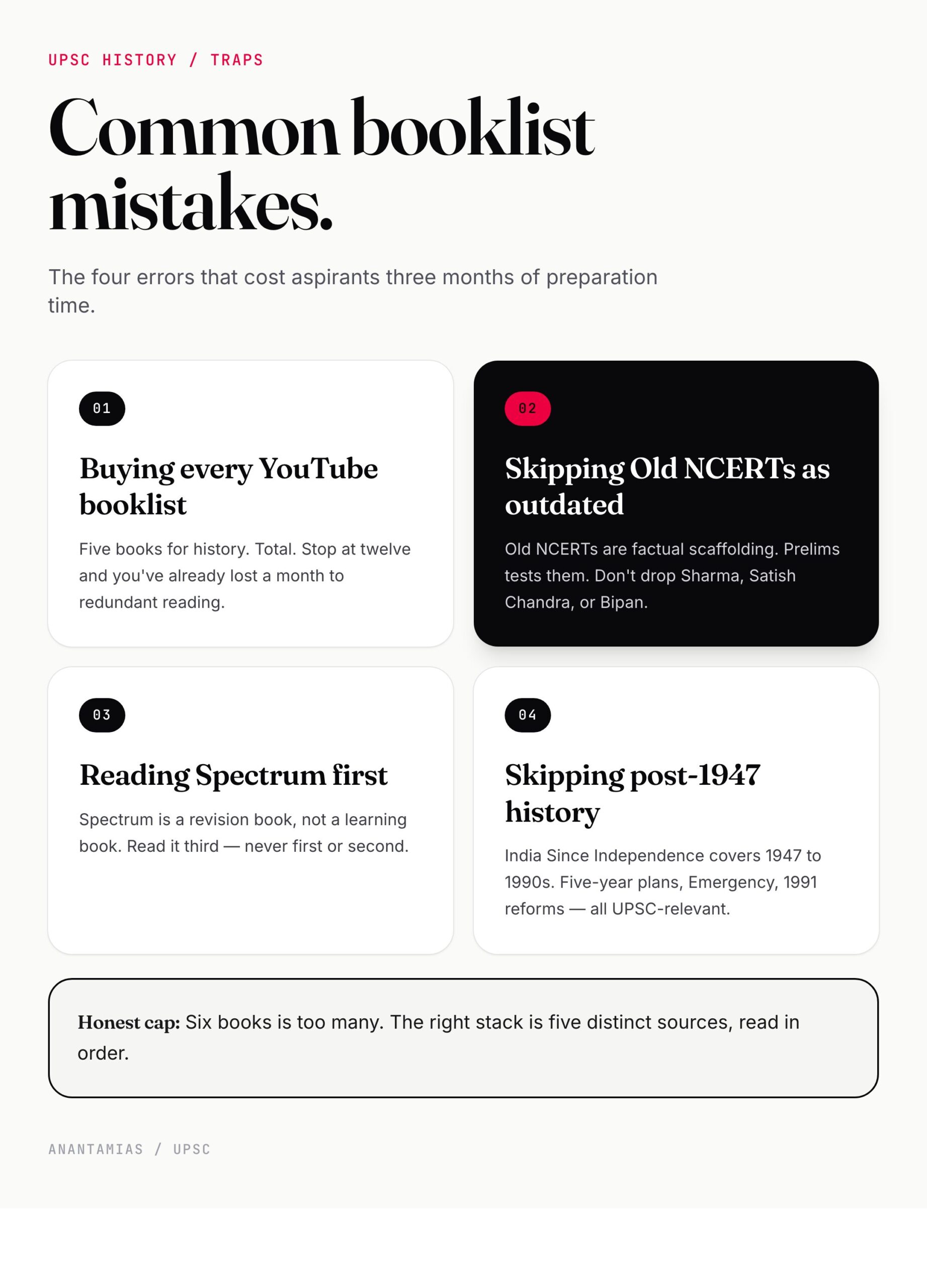
- Buying every book mentioned in every YouTube booklist. Five books for history. Total. Don’t buy 12.
- Skipping Old NCERTs because someone called them “outdated.” They’re not. They’re the factual scaffolding for modern history and ancient.
- Reading Spectrum first. Spectrum is a revision book, not a learning book. You’ll memorize lists you don’t understand.
- Skipping post-1947 history. India Since Independence (Bipan) covers 1947 to ~1990s. Five-Year Plans, integration of states, language reorganization, Emergency, post-1991 reforms — all UPSC-relevant. Don’t skip it.
- Ignoring the NCERT books for UPSC reading list. NCERTs aren’t “school books.” For history, they ARE the syllabus.
- Buying expensive coaching booklets instead of NCERT. Coaching booklets are summarized NCERT + Spectrum with worse editing.
How to revise this in 30 minutes a week
Once you’ve read the stack once, here’s the revision rhythm:
- Monday — Ancient (10 min): Indus Valley sites table, Vedic literature stratification, Mahajanapadas list, Mauryan-Gupta administration comparison.
- Wednesday — Medieval (10 min): Delhi Sultanate dynasties + dates, Mughal succession, Vijayanagara timeline, Bhakti-Sufi key figures.
- Friday — Modern (10 min): Congress sessions table, viceroys list, acts and their effects (1773 Regulating Act → 1947 Indian Independence Act), revolutionary movements.
That’s 30 minutes a week. Sustained, this beats marathon revision sessions before the exam.
For lists and tables, NCERT textbooks at the back of each chapter give you exam-ready summaries. Use them as the revision document, not the chapter body.
Frequently Asked Questions
: Is Spectrum enough for UPSC modern history?
For Prelims, almost. For Mains GS-1, no. Spectrum gives you facts; Mains needs analysis. Pair Spectrum with Bipan Chandra. If you can only read one, read Bipan Chandra and use Spectrum for revision.
: Which is better — Old NCERT or New NCERT for history?
Read both. Old NCERTs (Sharma, Satish Chandra, Bipan Chandra) are fact-dense. New NCERTs (Themes in Indian History) teach source analysis. UPSC tests both.
: Do I need to read Romila Thapar or Irfan Habib?
Not for GS. Only if you’re taking History optional. For Prelims and Mains GS-1, R.S. Sharma + Satish Chandra + Bipan Chandra is sufficient.
Are Tamil Nadu Board books really useful for UPSC?
Yes — for ancient and medieval India especially. Class 11 covers prehistory to 18th century in 200 pages. Class 12 covers modern. Both are free PDFs from the TN Textbook Corporation site.
How many history books are too many?
More than 6 is too many. The ideal stack: NCERT (Old + New), R.S. Sharma, Satish Chandra (2 parts counts as one), Bipan Chandra (2 books), Spectrum. That’s 5 distinct sources. Anything beyond is repetition.
When should I start history prep?
Day 1. History takes 4 months to internalize. Start with NCERT Class 6 alongside whatever else you’re reading. Don’t wait for “after Polity is done.”
Q4: What about India After Gandhi by Ramachandra Guha? Excellent book, but 900 pages and not strictly UPSC-aligned. India Since Independence by Bipan Chandra is shorter and exam-focused. Read Guha after you clear Mains.
Tell Google you want more of this.
Add Anantam IAS as a preferred sourceOne tap, and this site shows up more often in your own Top Stories, AI Overviews and AI Mode. Remove it any time.