Sengol: History, Symbolism and Installation in New Parliament Building
Sengol is the Chola-era sceptre of righteous rule installed in the New Parliament Building in 2023. Explore its history, symbolism and UPSC relevance.
Introduction
The Sengol is a ceremonial sceptre rooted in the Chola tradition of South India, where it symbolised the sacred transfer of authority to a righteous ruler. The word itself derives from the Tamil senkol, meaning the staff of justice or righteousness, and its presentation to a king served as a public pledge that he would rule with dharma. After decades in near obscurity inside a museum in Prayagraj, the Sengol returned to national attention on 28 May 2023, when Prime Minister Narendra Modi installed it near the Speaker’s chair in the newly inaugurated Parliament Building.
For UPSC aspirants, the Sengol sits at the intersection of Art and Culture, Modern History, and Polity. It offers Prelims-friendly facts on Chola governance and Tamil symbolism, while Mains answers can engage with debates on constitutional continuity, political symbolism and the 1947 transfer of power narrative. This article consolidates the known history of the Sengol, its iconography, the documentary trail of its 1947 use, and its reinstallation in the Lok Sabha chamber.
Quick Facts at a Glance
| Attribute | Detail |
|---|---|
| Meaning of Sengol | From Tamil senkol: righteous rule or sceptre of justice |
| Origin tradition | Chola dynasty, South India |
| Length | Approximately 5 feet (around 1.5 metres) |
| Material | Silver with gold coating |
| Crowning figure | Nandi, the sacred bull, symbol of justice |
| Commissioned by | Thiruvaduthurai Adheenam (Tamil Saivite mutt) |
| Crafted by | Vummidi Bangaru Chetty, Madras, 1947 |
| 1947 presentation | Received by Jawaharlal Nehru on 14 August 1947 |
| Held at | Allahabad Museum, Prayagraj (1947 to 2023) |
| Reinstalled on | 28 May 2023, New Parliament Building, New Delhi |
| Current location | Near the Speaker’s chair, Lok Sabha chamber |
Background and Historical Context
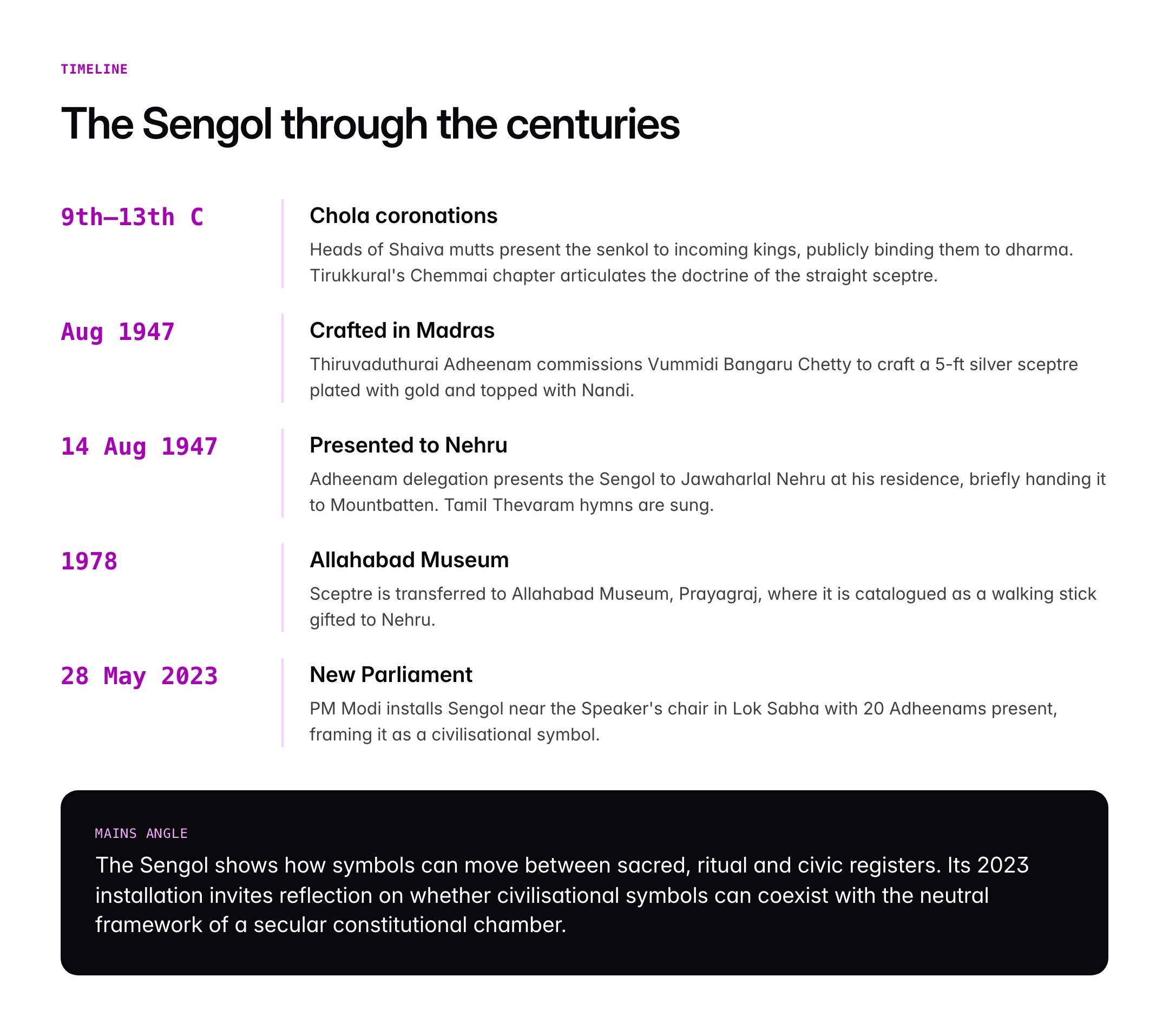
The idea of a royal sceptre as a visible covenant of just rule is common across ancient civilisations, but in the Tamil tradition the senkol carried a particularly ethical charge. Chola inscriptions and Sangam literature repeatedly describe the king as the holder of the senkol, and deviations from dharma are framed as the sceptre being bent or broken. Thiruvalluvar’s Tirukkural devotes an entire chapter, Chemmai, to the upright sceptre, declaring that the land where the sceptre stands straight will see timely rains and abundant harvests. In the Chola age (ninth to thirteenth centuries CE), the coronation ritual at the royal mutt included the presentation of a senkol by the rajguru to the incoming king, binding him publicly to the pursuit of justice.
The modern Sengol traces its origin to August 1947 and to a conversation, as recounted by the Thiruvaduthurai Adheenam and later by C. Rajagopalachari. When Lord Mountbatten asked Jawaharlal Nehru for a suitable ritual to mark the transfer of power, Rajaji is reported to have suggested the Chola coronation practice, where a sceptre was handed over by a holy man to signify the conferment of authority. The Thiruvaduthurai Adheenam in Tamil Nadu commissioned a five-foot silver sceptre plated with gold, topped with a Nandi, and dispatched a delegation to Delhi. The Sengol was first blessed by the Adheenam, handed briefly to Mountbatten and then reverently received by Nehru at his residence on the night of 14 August 1947.
After the ceremony the Sengol was preserved in the Anand Bhavan family collection and later transferred to the Allahabad Museum in Prayagraj, where it was catalogued as a walking stick gifted to Nehru. For decades it attracted little scholarly or public attention. The 2023 revival recovered it from that obscurity, placed it at the centre of a new political narrative of civilisational continuity, and provoked a fresh historical debate about how exactly it was used in 1947 and what status it held in the events of Independence.
Key Features
Physical Description
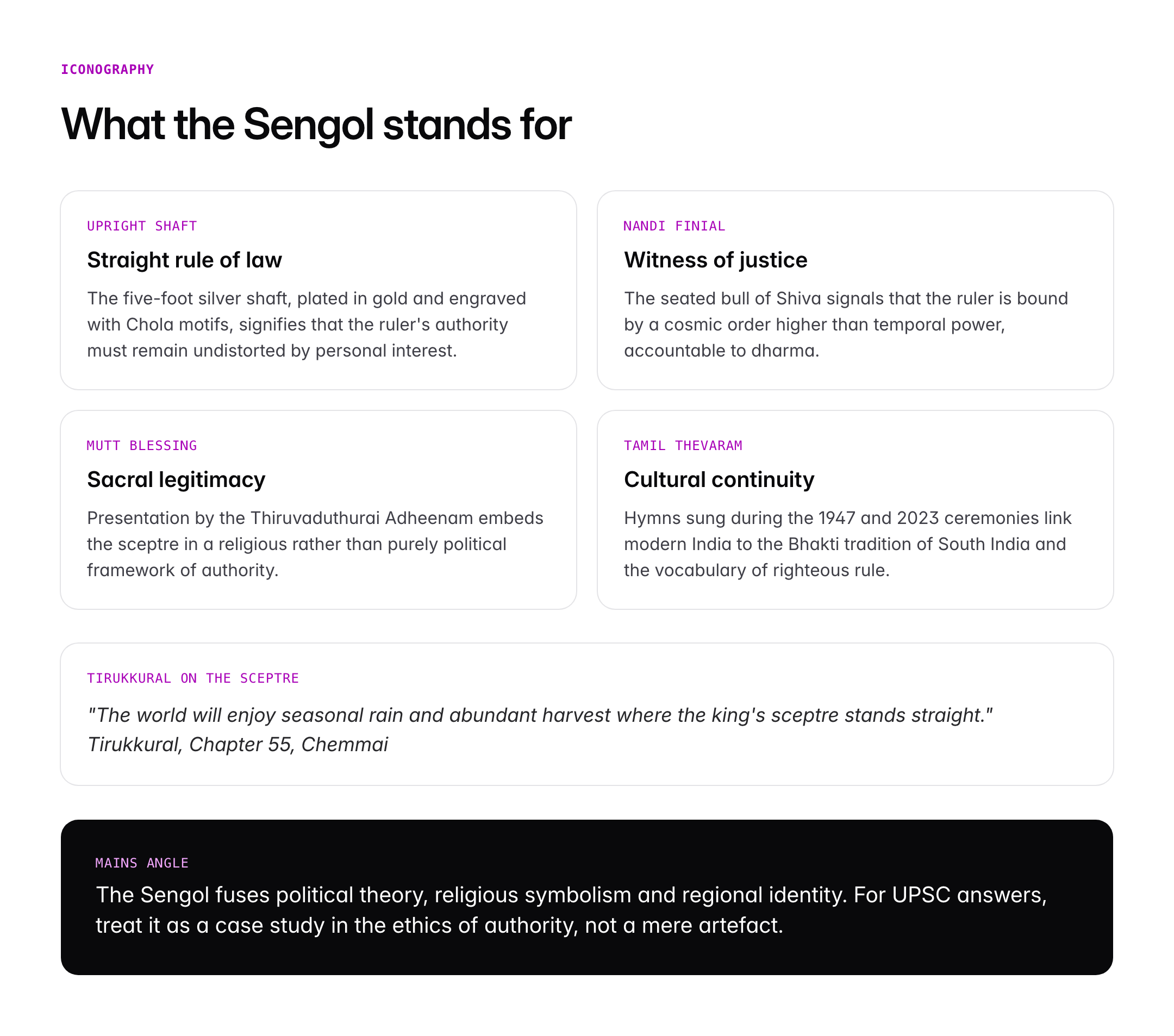
The Sengol is approximately five feet in length, fashioned in silver with a gold plating. Its shaft is octagonal and engraved with motifs drawn from Chola ceremonial metalwork. The finial is a seated Nandi, the sacred bull of Shiva, traditionally invoked as the witness and enforcer of justice. Below the Nandi are floral medallions and pearl-string motifs common in South Indian temple art. The sceptre was crafted in 1947 by the Madras jeweller Vummidi Bangaru Chetty, whose firm continues to operate in Chennai.
Symbolism
The iconography of the Sengol condenses several ideas. The upright staff represents the straight-line rule of law. The Nandi signals that the ruler is bound by cosmic justice. The five-foot height symbolises the elevation of ethical authority above the head of the monarch. The blessing by a mutt rather than a royal priest embeds the sceptre in a sacral rather than merely political framework.
Chola Coronation Ritual
In Chola practice, the sceptre was presented at the coronation by the head of a major mutt, most often the Thiruvaduthurai Adheenam. The king received it on his knees, touched it to his forehead and raised it above his head. This gesture converted private sovereignty into a public dharma covenant, witnessed by the priesthood, nobles and common people.
1947 Transfer Ceremony
The 1947 ritual combined Chola and modern elements. The Adheenam delegation first sprinkled the sceptre with sacred water from the Tanjore temple, presented it briefly to Lord Mountbatten and then to Nehru. Tamil devotional hymns from the Thevaram were sung. The entire sequence was witnessed by journalists and political leaders including Rajagopalachari and Rajendra Prasad.
Significance for UPSC and General Knowledge
- Links ancient Chola polity with the iconography of modern Indian democracy
- Illustrates Tamil contribution to national symbolism, a frequent theme in GS1 Art and Culture
- Provides a reference point for Mains answers on cultural continuity and constitutional morality
- Demonstrates the role of religious institutions like mutts in traditional Indian political theory
- Raises debates on the historiography of Independence and use of symbolism in contemporary politics
- Useful illustration for Ethics (GS4) on the idea of righteous authority and justice
Detailed Analysis: Installation in the New Parliament Building
On 28 May 2023, Prime Minister Narendra Modi inaugurated the New Parliament Building in New Delhi and formally installed the Sengol near the Speaker’s chair in the Lok Sabha chamber. The installation ceremony began early that morning at the Prime Minister’s residence, where a delegation of twenty Adheenams from Shaiva mutts across Tamil Nadu presented the Sengol to the Prime Minister in accordance with the 1947 protocol. Vedic hymns were chanted in Tamil and Sanskrit. The sceptre was then transported in ceremonial procession to the Parliament complex, where it was handed over by the senior Adheenam to the Prime Minister, who carried it into the chamber and placed it in a specially designed glass case on a gold-plated pedestal, angled so that it is visible to members of the Lok Sabha.
The installation was framed by the government as a gesture of civilisational continuity, honouring Tamil heritage and correcting what it described as the marginalisation of the Sengol after 1947. The ceremony was telecast live. The Government published a commemorative coin, a postage stamp and a booklet narrating the history of the sceptre. Twenty-four of the Adheenams blessed the Prime Minister during the ceremony. Opposition parties, including the Indian National Congress and the Dravida Munnetra Kazhagam, questioned the historical interpretation, with the Congress asserting there was no contemporary documentary evidence that the Sengol was used as an official instrument of transfer of power in 1947, while the Bharatiya Janata Party cited news archives, contemporary Tamil publications and the Adheenam’s own records to support the claim.
Beyond the political controversy, the installation has had notable effects. It has brought fresh academic attention to Chola governance and to the Thiruvaduthurai Adheenam, whose manuscripts on the senkol tradition are now being digitised. It has also created a live civic symbol inside the Parliament chamber, something hitherto absent, giving Members of Parliament a daily visual reminder of the ethical demands placed on elected authority. For civil services aspirants, the episode is a compact case study of how symbols from ancient and medieval polities can be reactivated in modern constitutional practice.
Comparative Perspective
The Sengol belongs to a global family of sceptres and ceremonial staffs that signal legitimate authority.
| Symbol | Tradition | Function | Current status |
|---|---|---|---|
| Sengol | Chola, India | Righteous rule, presented by a mutt | In Lok Sabha chamber since 2023 |
| Sovereign’s Sceptre | British monarchy | Temporal authority | Part of Crown Jewels, Tower of London |
| Mace of the House of Commons | United Kingdom | Speaker’s authority over House | Daily use in Westminster |
| Ashtamangala Set | Kerala coronation | Prosperity and dharma | Used in Padmanabhaswamy rituals |
| Rajadanda | Ancient Indian texts (Arthashastra) | Punitive authority of the king | Conceptual, not a physical object |
Unlike the British Sceptre, which primarily encodes sovereign power, the Sengol centres on the ethical subordination of the ruler to justice. Unlike the Westminster Mace, which symbolises the authority of the Speaker, the Sengol in Parliament is installed as a witness rather than an instrument. This makes it a distinctive hybrid: an ancient sacral symbol placed inside a modern constitutional chamber as a reminder rather than a regulator.
Controversies and Debates
The 2023 installation revived sharp disagreements. Critics argued that introducing a religiously blessed sceptre into a secular parliament risks diluting constitutional neutrality, particularly because the Sengol carries Shaivite iconography and was consecrated by a sectarian mutt. Others questioned whether its 1947 role was truly a transfer of power or a private blessing, citing the absence of mention in the Transfer of Power documents published by the British and Indian governments in the 1970s.
Defenders responded that the Sengol does not replace or compete with the Constitution of India, which remains the supreme authority in the chamber. They argued that placing it near the Speaker’s chair honours Tamil civilisational contribution without conferring any legal or ritual function. On the 1947 question, supporters cited news reports in the Hindustan Times, the Hindu and Tamil periodicals, along with photographs and the testimony of the Thiruvaduthurai Adheenam delegation that participated in the ceremony.
A separate concern has been raised about the ceremonial protocol used in 2023. Some constitutional commentators argued that the Sengol should have been handed over to the Speaker of the Lok Sabha or the President of India, who heads the executive, rather than to the Prime Minister, given the principle that Parliament is not the Executive. The government’s rationale was that the Prime Minister acted as the custodian of the ceremony in continuity with Nehru’s role in 1947.
Prelims Pointers
- Sengol is derived from Tamil senkol, meaning righteous rule
- Associated with Chola dynasty coronation tradition
- Topped by the figure of Nandi, the sacred bull and symbol of justice
- Commissioned in 1947 by Thiruvaduthurai Adheenam in Tamil Nadu
- Crafted by Vummidi Bangaru Chetty of Madras
- Length is approximately 5 feet; material is silver with gold plating
- Received by Jawaharlal Nehru on 14 August 1947
- Kept at the Allahabad Museum, Prayagraj, before 2023
- Installed in the New Parliament Building on 28 May 2023
- Placed near the Speaker’s chair in the Lok Sabha chamber
- Inauguration ceremony involved 20 Adheenams from Tamil Nadu Shaiva mutts
- Tirukkural’s chapter Chemmai discusses the sceptre of righteous rule
Mains Practice Questions
- Discuss the symbolism of the Sengol in Tamil political tradition and its relevance to contemporary Indian democracy.
- Senkol in Sangam literature, Tirukkural and Chola practice
- Transition from sacral to civic symbol through 1947 and 2023 ceremonies
- Relevance for constitutional morality and the ethics of public office
- The installation of the Sengol in the New Parliament Building has been both welcomed and criticised. Examine the competing arguments and offer a balanced assessment.
- Case for civilisational continuity and recognition of Tamil heritage
- Concerns on religious iconography in a secular chamber
- Constitutional status of the object as witness and not instrument
Conclusion
The Sengol’s journey from a Chola ritual artefact to a 1947 ceremonial sceptre and finally to a display in the Lok Sabha chamber traces a wider arc of how independent India is choosing to remember and reinterpret its past. Whether one views its 2023 installation as civilisational recovery or political stagecraft, the object itself compresses an ethical claim that predates modern politics: that the legitimate ruler is the one whose sceptre stands straight.
For aspirants, the Sengol is a reminder that symbols are not inert. Inserted into a constitutional chamber, they invite new readings, new debates and new responsibilities. A mature answer on the Sengol neither dismisses its historical basis nor overstates its legal weight, but engages with its capacity to shape the ethical imagination of those who govern.
Frequently Asked Questions
What is the Sengol?
The Sengol is a ceremonial sceptre rooted in the Chola tradition of South India, symbolising righteous rule. The word comes from the Tamil senkol, meaning staff of justice. The modern Sengol is a five-foot silver sceptre plated with gold, topped with a Nandi figure, crafted in 1947 and reinstalled in the New Parliament Building in 2023.
Why is the Sengol important for UPSC?
The Sengol is asked in Prelims as a current-affairs-linked static fact and features in Mains under GS1 Art and Culture, Modern History and GS2 Polity debates. It illustrates Tamil contributions to Indian political symbolism, the idea of dharmic rule in Chola coronations and contemporary debates on civilisational continuity and constitutional morality.
How is the Sengol related to Chola tradition?
In Chola coronations, the rajguru or head of a major Shaiva mutt presented a senkol to the incoming king, binding him to rule with righteousness. The Thiruvaduthurai Adheenam was one such mutt. The 1947 Sengol explicitly recreated this ritual, with the same Adheenam commissioning and blessing the sceptre before handing it to Jawaharlal Nehru.
When was the Sengol used in 1947?
The Sengol was presented to Jawaharlal Nehru on the night of 14 August 1947 at his residence in New Delhi. A delegation from the Thiruvaduthurai Adheenam carried the sceptre from Tamil Nadu, briefly presented it to Lord Mountbatten and then handed it to Nehru. Tamil Thevaram hymns were sung and sacred water from the Tanjore temple was sprinkled.
Where is the Sengol installed in the New Parliament Building?
The Sengol is installed near the Speaker’s chair in the Lok Sabha chamber of the New Parliament Building in New Delhi. It is placed in a specially designed glass case on a gold-plated pedestal, angled to be visible to Members of Parliament. Prime Minister Narendra Modi installed it on 28 May 2023 during the building’s inauguration.
Who crafted the 1947 Sengol?
The 1947 Sengol was crafted by Vummidi Bangaru Chetty, a Madras jewellery firm, on commission from the Thiruvaduthurai Adheenam in Tamil Nadu. It is approximately five feet long, made of silver with gold plating, and topped with a seated Nandi, the sacred bull of Shiva, symbolising justice.
Where was the Sengol kept before 2023?
After the 1947 ceremony the Sengol was preserved in the Nehru family collection at Anand Bhavan and later moved to the Allahabad Museum in Prayagraj, where it was catalogued as a walking stick gifted to Jawaharlal Nehru. It remained there in relative obscurity for more than seven decades before being retrieved in 2023.
What is the significance of the Nandi figure on the Sengol?
The Nandi, seated atop the Sengol, is the sacred bull of Shiva and in Tamil Shaivism is regarded as the witness and enforcer of cosmic justice. Its presence on the sceptre reinforces that the ruler holding it is bound by dharma and accountable to a moral order higher than temporal power.