Indian National Congress: History & Role in Freedom
The Indian National Congress (INC), founded in 1885, was the principal political organisation that led India’s freedom struggle against British colonial rule. From its moderate beginnings as a forum for educated Indians to voice grievances to its transformation into a mass movement under Mahatma Gandhi, the Congress shaped modern India’s political identity. For UPSC, INC history is central to Modern Indian History — covering the Moderate phase, Extremist phase, Gandhian era, and major sessions.
Formation of the Indian National Congress
The INC was founded on 28 December 1885 at the Gowalia Tank Maidan (now August Kranti Maidan) in Bombay. Allan Octavian Hume, a retired British civil servant, is credited as the primary founder. The first session was attended by 72 delegates from across India.
Key Facts About Formation
- First President: Womesh Chandra Bonnerjee (a Calcutta barrister)
- Founder: Allan Octavian Hume (though Indian leaders played significant roles)
- First session venue: Bombay (28–31 December 1885)
- Initial character: A loyal opposition — seeking reforms within the British system, not independence
- Membership: Primarily English-educated professionals — lawyers, journalists, teachers
Why Was the Congress Founded?
Multiple theories explain the founding:
Safety Valve Theory: Proposed by Lala Lajpat Rai, this argues that Hume created the Congress as a “safety valve” to channel growing Indian discontent into a controlled, moderate outlet — preventing a potential revolution. Hume’s private correspondence supports this interpretation.
Nationalist Theory: Indian leaders like Dadabhai Naoroji, Surendranath Banerjee, and others were already organising political activity. The Congress formalised and united pre-existing regional movements — the Indian Association (Calcutta), Poona Sarvajanik Sabha, Madras Mahajana Sabha, and Bombay Presidency Association.
The truth likely combines both — Hume provided the organisational framework, but Indian political consciousness was already maturing.
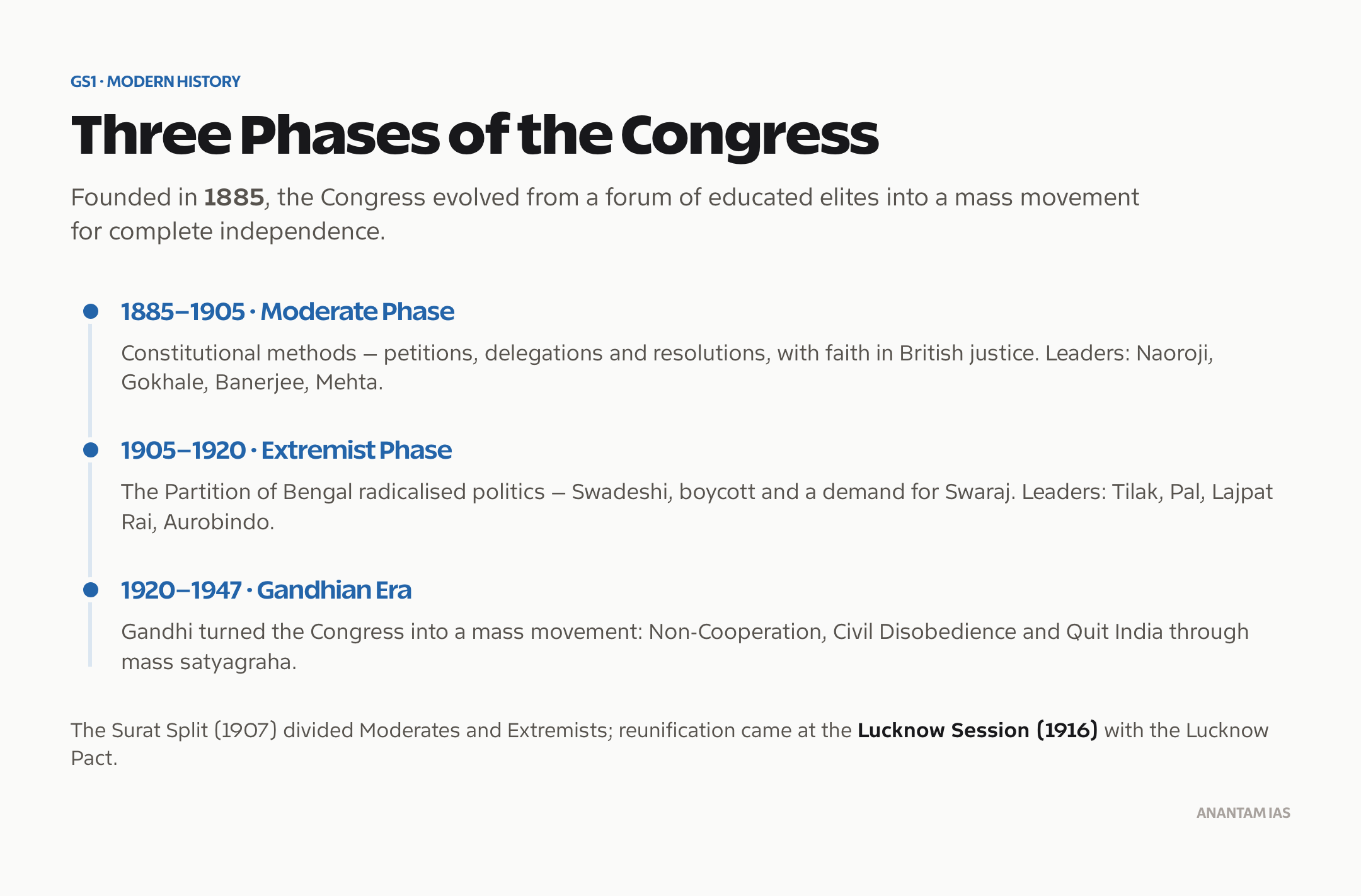
Moderate Phase (1885–1905)
The early Congress was dominated by moderates who believed in constitutional methods — petitions, prayers, and protests within the law. They had faith in British liberalism and justice, believing that once the British understood Indian grievances, they would grant reforms.
Prominent Moderate Leaders
- Dadabhai Naoroji (“Grand Old Man of India”): Authored “Poverty and Un-British Rule in India”; developed the Drain of Wealth theory — arguing that British economic policies systematically drained India’s wealth to Britain
- Gopal Krishna Gokhale: Regarded by Gandhi as his political guru; founded the Servants of India Society (1905); advocated for education, sanitation, and moderate reform
- Surendranath Banerjee (“Indian Burke”): Founded the Indian Association (1876); organised the Indian National Conference before joining the Congress
- Pherozeshah Mehta: Bombay’s leading political figure; dominant in Congress organisation
- R.C. Dutt: Economic historian who documented British exploitation in “The Economic History of India”
Methods of Moderates
| Method | Description |
|---|---|
| Petitions and memorials | Written appeals to the British government and Parliament |
| Delegations to England | Sending representatives to lobby British politicians |
| Resolutions at annual sessions | Passing resolutions demanding specific reforms |
| Press and publications | Using newspapers and books to build public opinion |
| Constitutional agitation | Working within legal frameworks for gradual reform |
Achievements and Limitations
Achievements:
- Created a national political platform uniting Indians across regions
- Developed the economic critique of colonial rule (Drain theory)
- Trained a generation of political leaders
- Indian Councils Act, 1892 (limited legislative expansion) partly resulted from Congress pressure
Limitations:
- Narrow social base — upper caste, English-educated elite
- “Political mendicancy” — begging the British for rights
- Extremely slow progress frustrated younger leaders
- Failed to mobilise the masses
Lord Curzon dismissed the Congress as representing “a microscopic minority.” This criticism, while partisan, captured a real limitation of the moderate approach.
Extremist Phase (1905–1920)
Growing frustration with moderate methods and the Partition of Bengal (1905) by Lord Curzon radicalised Indian politics. A new generation of leaders — called Extremists or Assertive Nationalists — demanded Swaraj (self-rule) and used more assertive methods.
Partition of Bengal (1905)
Lord Curzon partitioned Bengal ostensibly for administrative efficiency but effectively along religious lines (Muslim-majority East Bengal and Hindu-majority West Bengal). This was seen as a divide-and-rule strategy. The partition triggered:
- Swadeshi Movement: Boycott of British goods, promotion of Indian products
- National education: Institutions like the National Council of Education (Bengal National College) established
- Mass mobilisation: For the first time, politics went beyond the elite to include students, workers, and some peasants
- Artistic and cultural renaissance: Songs like “Vande Mataram” (from Bankim Chandra’s Anandamath) became symbols of resistance
Prominent Extremist Leaders
- Bal Gangadhar Tilak (“Lokmanya”): “Swaraj is my birthright and I shall have it”; used Ganesh Chaturthi and Shivaji festivals for political mobilisation; founded Kesari and Maratha newspapers
- Bipin Chandra Pal: Powerful orator; part of the Lal-Bal-Pal trio
- Lala Lajpat Rai (“Punjab Kesari”): Led Swadeshi movement in Punjab; died from injuries sustained during a lathi-charge against the Simon Commission (1928)
- Aurobindo Ghosh: Initially a radical nationalist; later turned spiritual philosopher; edited Vande Mataram journal
Surat Split (1907)
The Congress split at the Surat Session (1907) over the election of the president. Moderates (led by Pherozeshah Mehta) and Extremists (led by Tilak) could not agree on methods and goals. The Extremists were expelled.
Reunification came in 1916 at the Lucknow Session — the Congress reunited and simultaneously signed the Lucknow Pact with the Muslim League, agreeing on a joint scheme for constitutional reforms and separate electorates for Muslims.
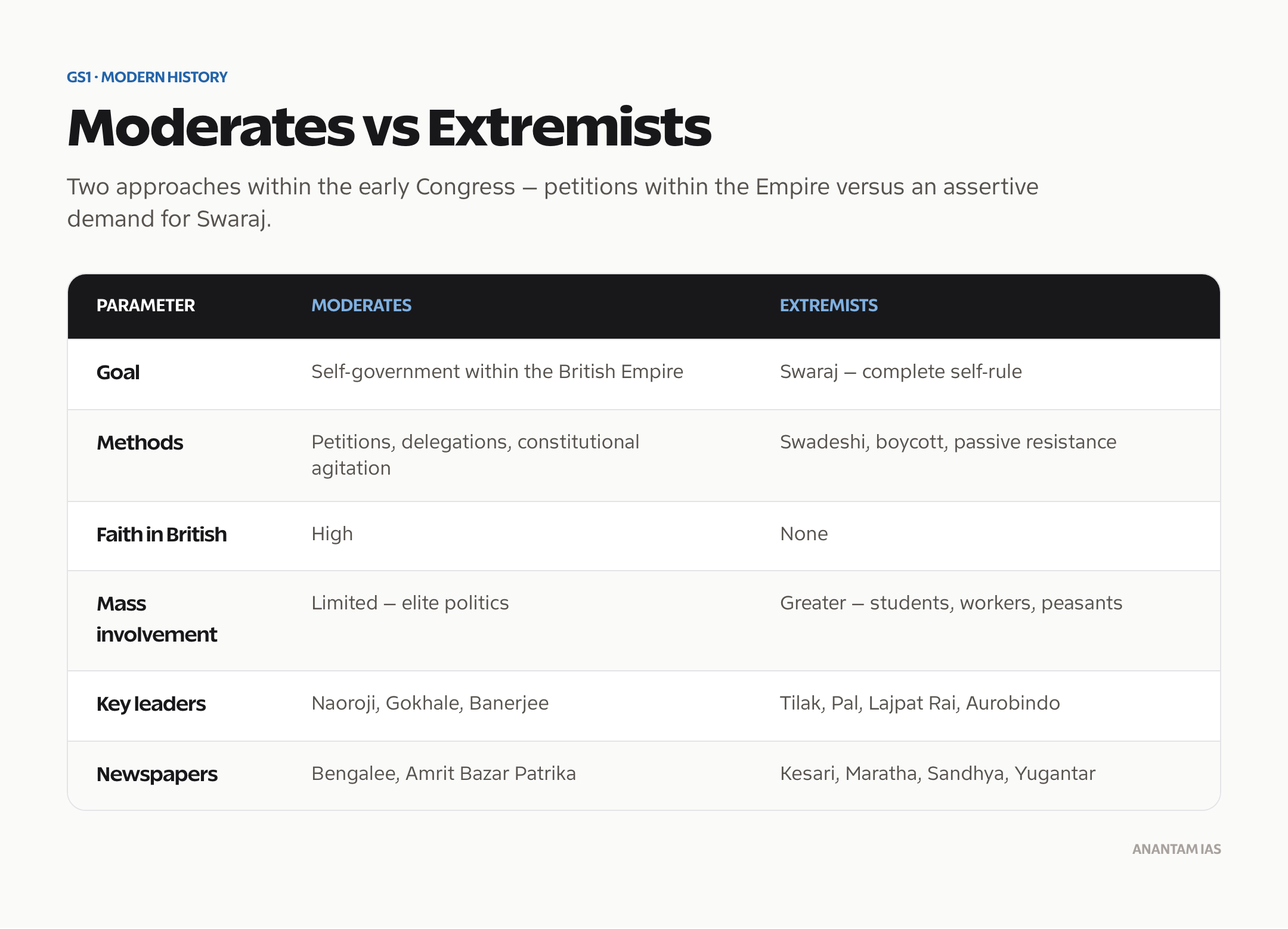
Methods Comparison: Moderates vs Extremists
| Parameter | Moderates | Extremists |
|---|---|---|
| Goal | Self-government within British Empire | Swaraj (complete self-rule) |
| Methods | Petitions, delegations, constitutional | Swadeshi, boycott, passive resistance |
| Faith in British | High | None |
| Mass involvement | Limited (elite politics) | Greater (students, workers, peasants) |
| Key leaders | Naoroji, Gokhale, Banerjee | Tilak, Pal, Lajpat Rai, Aurobindo |
| Newspapers | Bengalee, Amrit Bazar Patrika | Kesari, Maratha, Sandhya, Yugantar |
Gandhian Era (1920–1947)
Mahatma Gandhi transformed the Congress from an elite organisation into a mass movement. His entry into Indian politics fundamentally changed the methods, scale, and social base of the freedom struggle.
Gandhi’s Arrival and Early Campaigns
Gandhi returned to India from South Africa in 1915. His early Indian campaigns established his methods:
- Champaran Satyagraha (1917): Against the exploitative indigo plantation system in Bihar — his first civil disobedience in India
- Kheda Satyagraha (1918): For tax relief to drought-affected farmers in Gujarat
- Ahmedabad Mill Strike (1918): Supported textile workers’ demand for wage increase
Major Movements Under Gandhi
Non-Cooperation Movement (1920–22) Launched in response to the Jallianwala Bagh Massacre (1919) and the Khilafat issue. Indians boycotted British courts, schools, councils, and foreign cloth. Thousands gave up government titles and positions. The movement was called off after the Chauri Chaura incident (1922) — where a mob killed 22 policemen in violence Gandhi couldn’t endorse.
Civil Disobedience Movement (1930–34) Began with the Dandi March (Salt March) — Gandhi walked 241 miles from Sabarmati to Dandi to break the salt law. The movement targeted specific unjust laws. It was broader than Non-Cooperation — including tax refusal, picketing of liquor shops, and forest law violations. The Gandhi-Irwin Pact (1931) temporarily halted the movement.
Quit India Movement (1942) The most radical Congress movement. Gandhi’s call to the British: “Quit India.” His call to Indians: “Do or Die.” Launched on 8 August 1942 at the Bombay session (Gowalia Tank). The entire Congress leadership was immediately arrested. Leaderless masses erupted in a spontaneous revolt — sabotage of railways, telegraph lines, and government buildings. The movement was brutally suppressed but demonstrated that British rule was no longer tenable.
Congress Sessions: Key Milestones
| Year | Session | President | Significance |
|---|---|---|---|
| 1885 | Bombay | WC Bonnerjee | First session |
| 1906 | Calcutta | Dadabhai Naoroji | “Swaraj” first used in Congress platform |
| 1907 | Surat | (Split) | Congress splits — Moderates vs Extremists |
| 1916 | Lucknow | Ambika Charan Majumdar | Reunification; Lucknow Pact |
| 1917 | Calcutta | Annie Besant | First woman president |
| 1920 | Nagpur | (Special) | Non-Cooperation Movement approved |
| 1924 | Belgaum | Mahatma Gandhi | Only session Gandhi presided over |
| 1925 | Kanpur | Sarojini Naidu | First Indian woman president |
| 1929 | Lahore | Jawaharlal Nehru | Purna Swaraj (complete independence) declared |
| 1931 | Karachi | Sardar Patel | Resolution on Fundamental Rights and National Economic Programme |
| 1938 | Haripura | Subhas Chandra Bose | Bose elected president |
| 1939 | Tripuri | Subhas Chandra Bose | Bose re-elected against Gandhi’s candidate; later resigned |
| 1942 | Bombay | Maulana Azad | Quit India Resolution |
Lahore Session (1929): Purna Swaraj
The Lahore Session under Jawaharlal Nehru as president was a turning point. The Congress:
- Declared Purna Swaraj (complete independence) as its goal — replacing the earlier demand for dominion status
- Authorised the Civil Disobedience Movement
- Declared 26 January 1930 as Independence Day (Purna Swaraj Diwas) — celebrated annually until actual independence; this date was later chosen for Republic Day (1950)
Congress and Social Reform
The Congress wasn’t merely a political organisation. It played a significant role in social transformation:
- Hindu-Muslim unity: Gandhi’s support for the Khilafat Movement; Lucknow Pact
- Abolition of untouchability: Gandhi’s campaigns for Dalit rights; the Poona Pact (1932) with Dr. B.R. Ambedkar on reserved seats
- Women’s participation: Sarojini Naidu, Kasturba Gandhi, Aruna Asaf Ali, Sucheta Kripalani — women played vital roles in all major movements
- Constructive programme: Khadi promotion, village industries, basic education, sanitation
- Socialist ideas: Jawaharlal Nehru and the Congress Socialist Party (formed 1934) pushed the Congress towards economic radicalism
Congress and Constitutional Development
The Congress participated in (and sometimes boycotted) the constitutional reforms process:
- Indian Councils Act, 1909 (Morley-Minto Reforms): Introduced separate electorates — Congress opposed this
- Government of India Act, 1919 (Montagu-Chelmsford Reforms): Introduced dyarchy — Congress participated reluctantly
- Simon Commission (1927): Congress boycotted (all-white commission)
- Round Table Conferences (1930–32): Gandhi attended the Second RTC
- Government of India Act, 1935: Congress won provincial elections (1937) and formed governments in 8 of 11 provinces
- Constituent Assembly: Congress dominated the Assembly that drafted India’s Constitution
Frequently Asked Questions
Who founded the Indian National Congress?
The Indian National Congress was founded in 1885 by Allan Octavian Hume, a retired British civil servant, along with prominent Indian leaders like Dadabhai Naoroji and Dinshaw Wacha. The first session was held in Bombay in December 1885 with 72 delegates. WC Bonnerjee was elected the first president. The founding combined British liberal concern (safety valve theory) with genuine Indian political aspiration.
What is the difference between Moderates and Extremists in Congress?
Moderates (1885–1905) believed in constitutional methods — petitions, delegations, and faith in British justice. They sought self-government within the British Empire. Extremists (1905–1920) demanded Swaraj and used assertive methods — boycott, swadeshi, passive resistance, and mass mobilisation. Key moderates included Gokhale and Naoroji; key extremists included Tilak, Lal, and Pal. The Surat Split (1907) formalised this division.
What was the Lahore Session of 1929?
The Lahore Session (December 1929), presided over by Jawaharlal Nehru, declared Purna Swaraj (complete independence) as the Congress goal. It authorised the launch of the Civil Disobedience Movement and declared 26 January 1930 as Independence Day. This session marked the definitive shift from demands for reforms within British rule to the demand for full sovereign independence.
What was the Quit India Movement?
The Quit India Movement was launched on 8 August 1942 at the Bombay session under the presidency of Maulana Azad. Gandhi gave the call u0022Do or Die.u0022 The entire Congress leadership was arrested immediately. The leaderless masses erupted in widespread revolt — sabotaging railways, cutting telegraph lines, and attacking government buildings. Though brutally suppressed, the movement demonstrated that British rule had lost legitimacy.
How did Congress transform from an elite body to a mass movement?
The transformation occurred primarily under Mahatma Gandhi’s leadership after 1920. Gandhi introduced mass participation through techniques accessible to ordinary Indians — non-cooperation, civil disobedience, and constructive work. He connected political struggle with everyday issues (salt tax, land revenue, mill wages). The Congress constitution was rewritten to include grassroots village committees, and membership dues were reduced to attract the poor.
Tell Google you want more of this.
Add Anantam IAS as a preferred sourceOne tap, and this site shows up more often in your own Top Stories, AI Overviews and AI Mode. Remove it any time.