Sericulture in India (UPSC Economy)
India is the world's second-largest silk producer and its largest consumer — yet it still buys Chinese silk every year. Here is why, with the latest numbers, schemes and the UPSC angle on sericulture.
A single mulberry hedge, a tray of silkworms in a corner of a small house, and a fortnight of careful feeding — that is enough to bring a marginal farmer a cash crop several times a year. Sericulture is one of the few livelihoods in rural India where a family with very little land, and almost no machinery, can still earn from a global luxury fibre. That is why a worm that spins a cocoon matters to the economy in a way its size never suggests.
India is the world’s second-largest producer of silk after China, and at the same time its largest consumer. We grow the fibre, we wear the most of it, and we still cannot make enough of the right grade — so every year we buy raw silk from China to feed our own looms. That single contradiction is the whole story of Indian sericulture in one line, and it is the line examiners keep coming back to.
What Sericulture Is and Why It Anchors the Rural Economy
Sericulture is the rearing of silkworms to produce silk, and in India it runs as a four-stage chain that touches agriculture, livestock and textiles all at once. First comes cultivation of the host plant — mulberry for the bulk variety, and forest trees like Arjuna, Som and Castor for the rest. Then comes rearing the worms on that foliage until they spin cocoons. Then the cocoons are reeled into raw silk thread. And finally the thread is woven, dyed and printed into fabric. Each stage employs a different set of hands, which is exactly why the activity spreads income so widely.
What makes sericulture so useful for a country like India is that it is labour-intensive and low on capital. You do not need a large holding or a tractor; you need leaves, sheds, care and time. So it suits the small and marginal farmer who dominates Indian agriculture, and it gives a usable income from a tiny plot. The Central Silk Board puts employment in the sector at roughly 9.76 million people as of FY25, most of them in rural and semi-urban areas, and a large share of them women, because rearing and reeling are tasks that fit around a household. For landless and near-landless families, that is the difference between a livelihood and migration.
And the geography is telling. The bulk mulberry silk comes from the south — Karnataka, Andhra Pradesh and Tamil Nadu lead, with West Bengal also in the mix — while the non-mulberry “vanya” silks belong to the east and the North East: Tasar in the Jharkhand-Chhattisgarh tribal belt, and Eri and Muga across Assam and Meghalaya. So sericulture is not only an income source; it is one of the few agro-industries that reaches deep into tribal districts and the North East, which is why it sits inside the rural-development conversation, not just the textile one.
There is a second reason it punishes idle land less than most crops: it pays quickly and pays often. A mulberry plant, once established, can support several rearing cycles a year, so a farmer earns a cash return every few weeks rather than waiting one harvest. And because the early stages — leaf picking, feeding the worms, tending the cocoons — are light, repeatable tasks that can be done at home, they fit women, the elderly and part-time hands, which is how a single small plot can support several earners. That is the quiet economics behind the employment number: not one big job, but many small, regular ones spread across a household and a village.
The Four Silks and India’s Place in the World Market
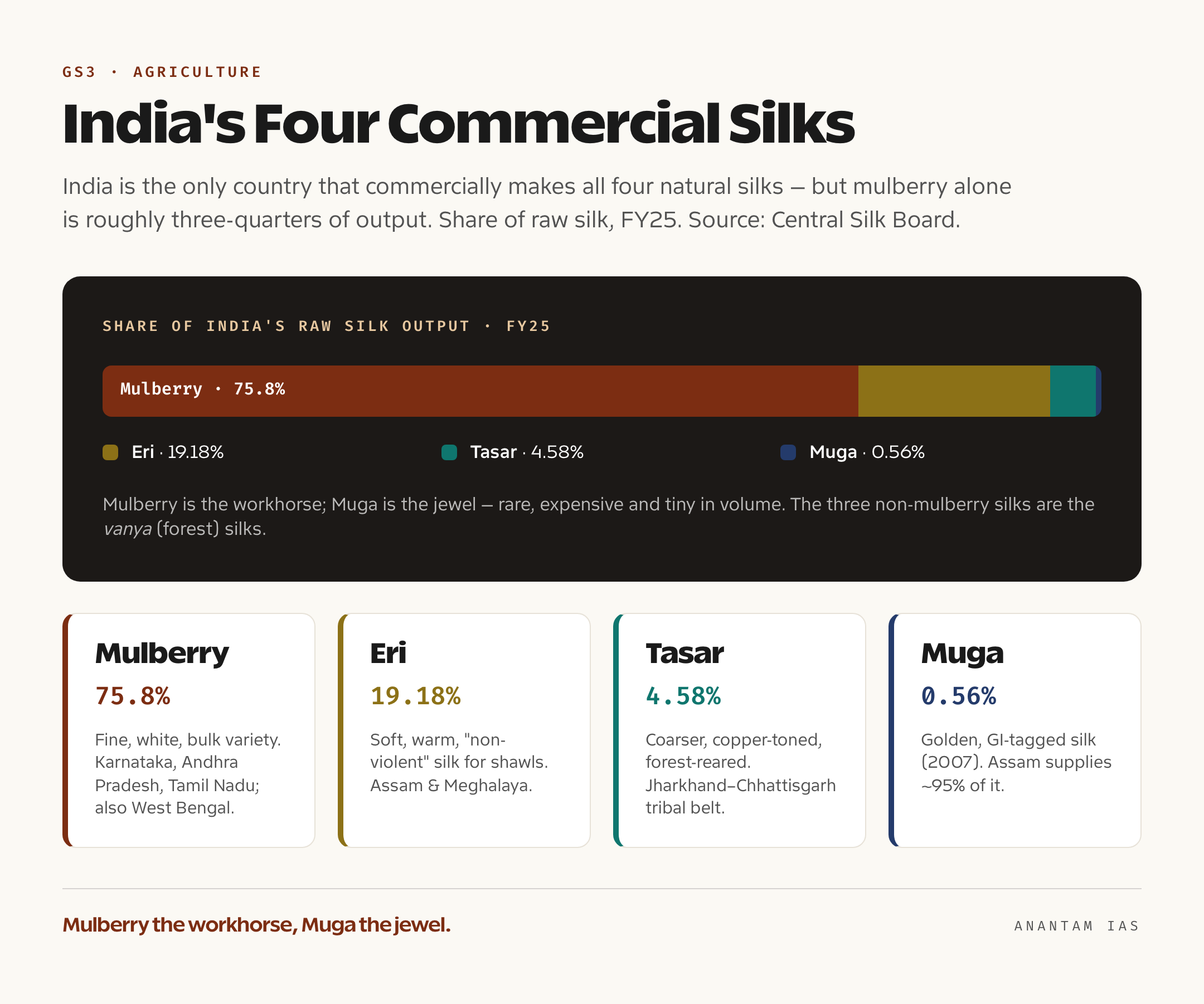
India is the only country that commercially produces all four natural silks, and knowing the four is the fastest way to sound informed on this topic. Mulberry silk is the bulk variety — fine, white and the basis of most Indian silk fabric. The other three are the vanya (wild or forest) silks: Tasar, a coarser copper-toned silk reared on forest trees in central India; Eri, a soft, warm, non-violent silk (the moth leaves the cocoon before it is processed) used for shawls; and Muga, the famous golden silk of Assam, prized for a natural shimmer that grows brighter with age.
The proportions tell you where the industry’s weight sits. Of India’s total raw silk in FY25, the Central Silk Board’s breakdown has mulberry at about 75.8 per cent, Eri at 19.18 per cent, Tasar at 4.58 per cent and Muga at just 0.56 per cent. So mulberry is the workhorse and Muga the jewel — rare, expensive and tiny in volume. Muga has carried a Geographical Indication tag since 2007 (with a GI logo added in 2014), and Assam supplies around 95 per cent of the country’s Muga. Demand for GI-tagged Muga touched about 210 tonnes in 2023-24, of which Assam met more than 96 per cent — a reminder that the value here is in heritage and exclusivity, not tonnage.
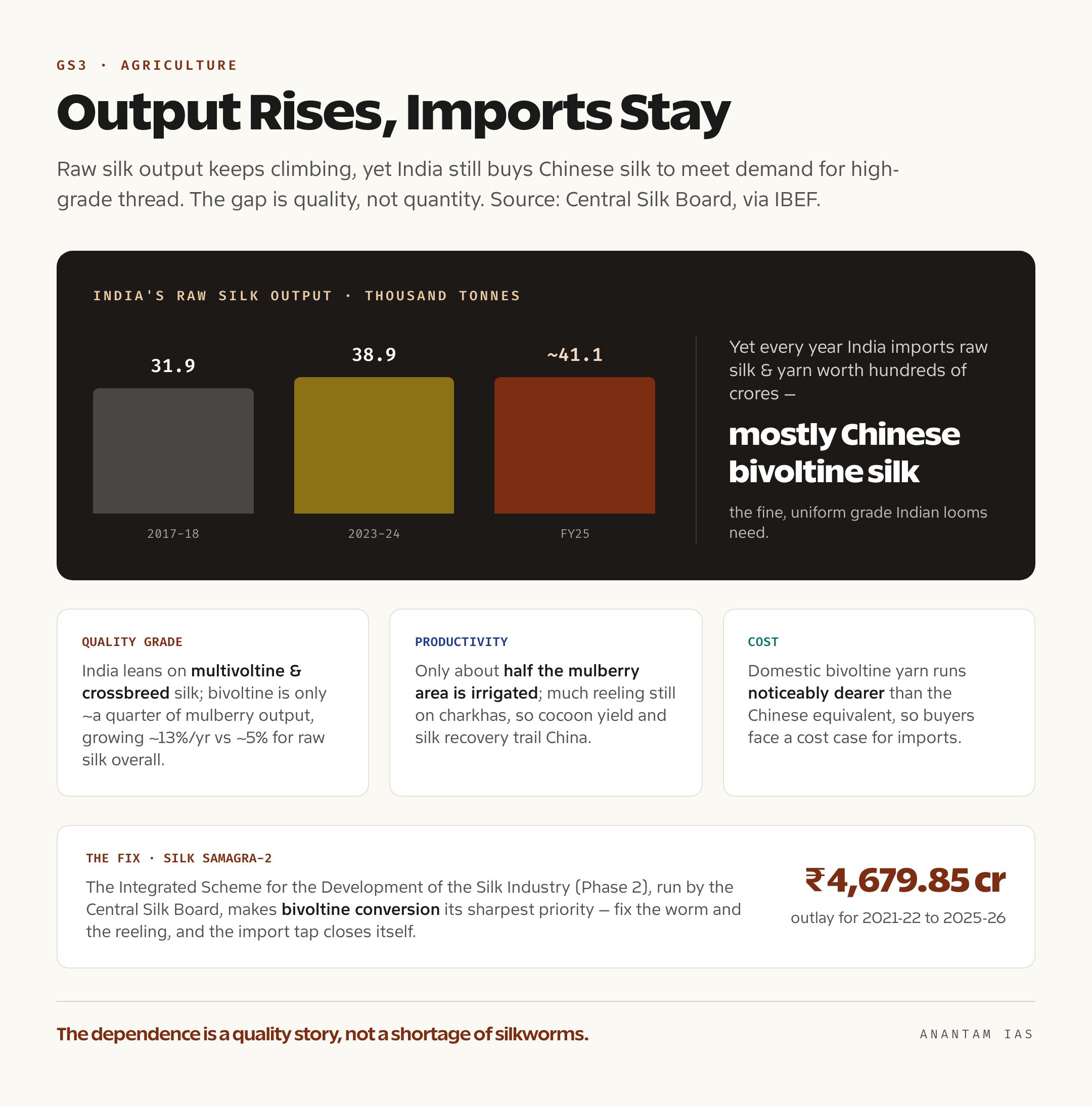
On the global stage, the headline number keeps climbing. India’s raw silk output rose from about 31.9 thousand tonnes in 2017-18 to 38.9 thousand tonnes in 2023-24, and to roughly 41,121 tonnes in FY25, according to figures compiled by IBEF from the Central Silk Board. India and China between them account for the overwhelming majority of the world’s silk. But silk exports are modest — around US$246 million in FY25 — because most of what India makes, India wears. We are the largest consumer of silk on earth, so the domestic saree, the wedding fabric and the handloom soak up the supply long before it reaches a port.
Why India Still Imports Silk Despite Being Number Two
Here is the puzzle that defines the sector. India is the second-largest producer, the largest consumer, and yet it still imports raw silk and silk yarn worth hundreds of crores a year, with the bulk coming from China and Vietnam. The reason is not quantity; it is quality. India’s looms — especially power looms making high-end fabric — need silk of a uniform, fine grade that holds a consistent thickness (denier). Much of India’s own output does not reach that grade, so importers reach for Chinese bivoltine silk to fill the gap.
That word, bivoltine, is the crux. Silkworm races are classed by how many generations they complete in a year. Multivoltine worms breed many times a year and suit India’s warm climate, but they spin coarser, weaker thread. Bivoltine worms (two crops a year) and crossbreeds give finer, stronger, exportable silk — and this is the grade China makes almost entirely. India has historically leaned on multivoltine and crossbreed silk, so a large slice of its output simply cannot compete with imported thread on the loom. Bivoltine silk has been growing fast — by roughly 13 per cent a year against about 5 per cent for raw silk overall — but it is still only around a quarter of mulberry output, which is why the import tap stays open.
Productivity is the other half of the gap. India’s cocoon yield per hectare and silk recovery per kilogram of cocoon both trail Chinese benchmarks, partly because only about half of the mulberry area is irrigated and partly because much reeling still happens on traditional charkhas and cottage basins rather than automatic reeling machines. So the same quantity of cocoons yields less, and lower-quality, thread. Add price: domestic bivoltine yarn can run noticeably dearer than the Chinese equivalent, so even patriotic buyers face a cost case for imports. The dependence, in short, is a quality-and-cost story, not a shortage of silkworms.
The Institutions and Schemes Holding It Together
The nerve centre of Indian sericulture is the Central Silk Board (CSB), a statutory body under the Ministry of Textiles set up back in 1948. The CSB does the research, runs the seed organisations that supply disease-free silkworm eggs, sets quality standards and coordinates the states — silk being a sector where the Centre funds and standardises while states actually run the field extension. Its network of research institutes works on each silk separately, from mulberry to Tasar to Muga, so improved worm races and host-plant varieties flow down to farmers.
The flagship programme is Silk Samagra-2, the second phase of the Integrated Scheme for the Development of the Silk Industry, with an outlay of about Rs 4,679.85 crore for 2021-22 to 2025-26. It is built around four pillars — research and development, seed organisation, coordination and market development, and quality certification systems — and its sharpest priority is pushing bivoltine sericulture so India can finally make export-grade silk at home and stop importing it. The logic is direct: fix the quality gap at the worm and the reeling end, and the import dependence shrinks on its own.
Two more levers matter. The CSB has run a Cluster Promotion Programme, expanding to well over a hundred clusters across mulberry, vanya and post-cocoon work, to lift output of gradable bivoltine and vanya silk by organising farmers and modernising reeling. And weavers and reelers — many of them in sericulture clusters — draw support from broader schemes like PM Vishwakarma for traditional artisans and the Raw Material Supply Scheme that helps handlooms get hank yarn. So the policy stack is layered: CSB for the science, Silk Samagra-2 for the value chain, and artisan schemes for the people at the loom.
Challenges and the Way Forward
The problems are stubborn and they reinforce each other. The area under mulberry has been squeezed as farmers shift to crops they think pay more and as land urbanises. Yields stay low because irrigation and modern rearing houses are patchy. Reeling on old devices produces thread of variable denier that power looms reject, so quality lags. India still leans on crossbreed rather than bivoltine eggs, keeping it short of export grade. Silkworm diseases — pebrine, grasserie, flacherie, muscardine — can wipe out a crop in days, and a single infected batch of eggs can ruin a season’s income for a family that has no buffer.
Climate stress is a real and rising threat. The silkworm is a fussy animal: it wants a narrow band of temperature and humidity, and erratic monsoons, heat spikes and unseasonal rain throw rearing cycles off and cut cocoon quality. The delicate Muga worm of Assam is the clearest casualty, because it rears in the open on host trees and has nowhere to hide from a bad spell of weather — which is exactly why Assam’s prized golden silk is the most exposed of the four. And on top of all that, cheap synthetic fabric and smuggled or under-priced Chinese silk keep undercutting domestic prices, so farmers face genuine income volatility on top of every natural risk.
The way forward follows from the diagnosis. Expand and irrigate mulberry, including into non-traditional states and the North East, so the raw material base grows. Convert aggressively from crossbreed to bivoltine silk to close the quality and import gap, which is exactly Silk Samagra-2’s bet. Replace cottage charkhas with multi-end and automatic reeling machines so the thread that comes off Indian cocoons can actually feed a power loom. Build climate-resilient worm races and protected rearing houses, urgently for Muga. And widen the value beyond fabric: silk by-products — pupae as a protein source, sericin for cosmetics and biomedical uses — plus GI branding of Muga, Banarasi, Kanchipuram and Chanderi silks to capture premium prices. So the strategy is not exotic; it is to make more, better silk at home, mechanise the weak link, and market the heritage end at the top.
There is also a clean development case running through all of it. Because sericulture is labour-intensive, woman-friendly and rooted in tribal and North-Eastern districts, every tonne of extra domestic output is also rural employment that does not require migration. So fixing the quality gap is not only an import-substitution play; it is one of the more efficient rural-livelihood interventions India has, and that dual payoff is the heart of the argument for backing it.
For Your Mains Answer
Sericulture maps cleanly onto GS Paper 3 — “issues related to direct and indirect farm subsidies,” cropping patterns and allied sectors of agriculture, food processing and related industries, and inclusive growth and employment. It also lends itself to GS3 questions on import dependence and Atmanirbhar Bharat, and it gives the Essay and interview a ready example of a traditional industry meeting a modern market.
How to Build the Answer
Open with the contradiction — second-largest producer, largest consumer, still importing — because it frames the whole answer and signals you understand the real issue. Then move outward in steps: what sericulture is and why it suits the rural poor → the four silks and India’s scale → the quality and bivoltine gap behind imports → institutions and Silk Samagra-2 → challenges and a forward-looking close. Tie every challenge to a remedy so the answer reads as analysis, not a list.
Common Mistakes to Avoid
Don’t confuse “second-largest producer” with self-sufficiency — the import gap is the point, so naming it shows depth. Don’t list the four silks without their geography and shares; examiners reward the mulberry-versus-vanya distinction. Don’t reduce the way-forward to “more schemes”; anchor it in bivoltine conversion and mechanised reeling. And don’t forget the employment and women’s-empowerment angle, which is what lifts a dry economy answer into inclusive-growth territory.
A Compact Answer Spine
Labour-intensive agro-industry, rural and woman-friendly → four silks (Mulberry bulk; vanya Tasar, Eri, golden Muga) → second-largest producer, ~41,000 tonnes, largest consumer → still imports Chinese silk because of the quality/bivoltine gap and low productivity → CSB + Silk Samagra-2 push bivoltine and clusters → challenges (mulberry area, yield, reeling, disease, climate, cheap imports) → way forward (bivoltine, irrigation, automatic reeling, climate-resilient races, by-products, GI branding) → import-substitution plus rural employment, a double dividend.
Diagram or Flowchart Idea
Draw the silk value chain as a simple left-to-right flow — Host plant → Silkworm rearing → Cocoon → Reeling → Weaving/Dyeing — and tag the weak link (reeling/quality) with an arrow to “import gap.” A second tiny box listing the four silks with their states earns marks quickly and shows command of the sector.
A Balanced-Conclusion Line
Sericulture’s promise is that the same intervention that closes India’s silk import gap also secures rural and tribal livelihoods — so getting bivoltine, irrigation and reeling right is both an Atmanirbhar Bharat goal and an inclusive-growth one.
How to Use Data Without Cramming
Carry three or four anchors, no more: about 41,000 tonnes of raw silk in FY25; mulberry roughly 75 per cent of output; employment near 9.76 million; Silk Samagra-2 at about Rs 4,680 crore for 2021-26. Drop one figure per paragraph where it proves a point — scale, the mulberry dominance, the rural reach, the policy commitment — and leave the rest out.
FAQ
Why does India import silk if it is the world’s second-largest producer? Because the gap is in quality, not quantity. India’s high-end power looms need fine, uniform, export-grade thread, and much of India’s output is coarser multivoltine or crossbreed silk. So importers buy fine bivoltine raw silk, mostly from China and Vietnam, to fill the gap. Low cocoon productivity and old reeling methods make the shortfall worse, which is why Silk Samagra-2 prioritises bivoltine conversion.
What are the four types of silk produced in India? India is the only country that commercially makes all four natural silks: Mulberry (the fine, bulk variety, about three-quarters of output, mostly from Karnataka, Andhra Pradesh and Tamil Nadu), and the three non-mulberry “vanya” silks — Tasar (central India’s tribal belt), Eri (Assam and Meghalaya, used for warm shawls), and Muga, the golden GI-tagged silk almost wholly from Assam.
What is Silk Samagra-2 and what does it aim to do? Silk Samagra-2 is the central scheme for developing the silk industry, with an outlay of about Rs 4,679.85 crore for 2021-22 to 2025-26, run through the Central Silk Board. It funds research and development, silkworm seed organisations, coordination and market development, and quality certification — with a sharp focus on raising bivoltine silk so India can make export-grade silk at home and cut import dependence.
How important is sericulture for rural employment in India? Very. The Central Silk Board estimates the sector supports around 9.76 million people as of FY25, mostly in rural and semi-urban areas, with a large share of women. Because it needs little land or capital and reaches tribal and North-Eastern districts, sericulture is one of India’s more effective agro-based rural livelihood and women’s-empowerment activities.
Practice Questions
Prelims MCQs
- With reference to the four commercial silks of India, consider the following: which silk is correctly matched with its description?
(a) Tasar — the golden silk almost wholly produced in Assam
(b) Eri — the non-violent silk used for warm shawls in Assam and Meghalaya
(c) Muga — the bulk variety contributing about three-quarters of output
(d) Mulberry — a coarse silk reared on forest trees in central India.
Answer: (b) Eri is the soft, “non-violent” silk of Assam and Meghalaya used for shawls; Muga is the golden silk, Mulberry is the bulk variety, and Tasar is the forest-reared one. - The Central Silk Board, which coordinates sericulture in India, functions under which Union ministry?
(a) Ministry of Agriculture and Farmers’ Welfare
(b) Ministry of Commerce and Industry
(c) Ministry of Textiles
(d) Ministry of Rural Development.
Answer: (c) The Central Silk Board is a statutory body under the Ministry of Textiles. - Consider the following statements about silk production in India:
1. India is the world’s largest producer of silk.
2. Mulberry silk accounts for the largest share of India’s raw silk output.
3. India is the world’s largest consumer of silk. Which statements are correct?
(a) 1 and 2 only
(b) 2 and 3 only
(c) 1 and 3 only
(d) 1, 2 and 3.
Answer: (b) India is the second-largest producer (after China) but the largest consumer; mulberry does about three-quarters of output, so statements 2 and 3 are correct. - The term “bivoltine” in sericulture refers to:
(a) silkworm races that complete two generations or crops in a year and yield finer, export-grade silk
(b) the double reeling of cocoons to remove sericin
(c) a variety of mulberry that fruits twice a year
(d) a two-stage dyeing process for silk fabric.
Answer: (a) Bivoltine worms complete two crops a year and spin finer, stronger thread; raising their share is central to cutting India’s silk imports. - Muga silk, the golden silk of India, carries a Geographical Indication tag and is produced almost entirely in which state?
(a) West Bengal
(b) Jharkhand
(c) Karnataka
(d) Assam.
Answer: (d) Muga is a GI-tagged silk (recognised in 2007) produced almost wholly in Assam, which supplies about 95 per cent of the country’s Muga.
Mains Practice Questions
- “India is the world’s second-largest silk producer yet remains dependent on silk imports.” Examine the reasons for this dependence and suggest measures to bridge the gap. (15 marks, 250 words)
- Discuss how sericulture can serve as an instrument of rural transformation and women’s empowerment in India, especially in tribal and North-Eastern regions. (15 marks, 250 words)
- Evaluate the role of bivoltine sericulture and automatic reeling in making Indian silk globally competitive and reducing import dependence. (10 marks, 150 words)
- Sericulture is an agro-based industry that links agriculture, livestock and textiles. Analyse its potential and the constraints it faces in the context of allied-sector growth and farmer incomes. (15 marks, 250 words)
- Assess the contribution of the Central Silk Board and the Silk Samagra-2 scheme to the development of India’s silk industry. What further reforms would you recommend? (10 marks, 150 words)