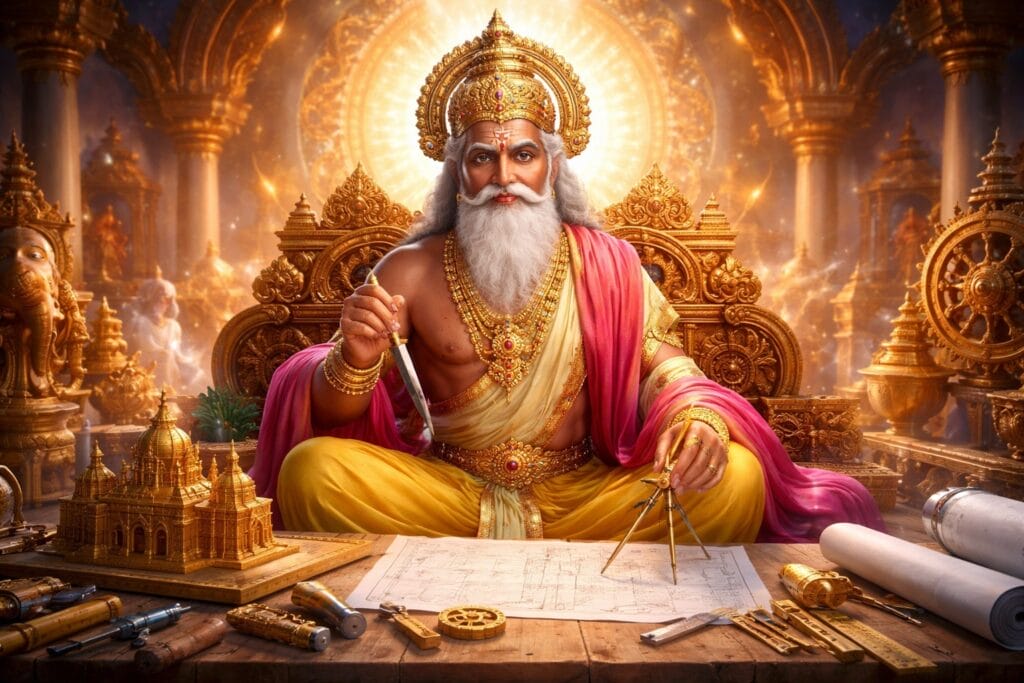
PM Vishwakarma is a Central Sector Scheme launched on 17 September 2023 to support traditional artisans and craftspeople working with their hands and tools. The scheme covers 18 trades, carries an outlay of ₹13,000 crore for five years, and is implemented by the Ministry of Micro, Small and Medium Enterprises (MSME). For UPSC, it matters because it links livelihoods, credit, skilling, digital payments, and informal-sector formalisation.
Quick Facts
| Parameter | Details |
|---|---|
| Scheme name | PM Vishwakarma |
| Launch date | 17 September 2023 |
| Launched by | Prime Minister Narendra Modi |
| Type | Central Sector Scheme (100% Central funding) |
| Nodal ministry | Ministry of MSME |
| Total outlay | ₹13,000 crore |
| Coverage period | FY 2023-24 to FY 2027-28 (5 years) |
| Trades covered | 18 traditional trades |
| Key benefits | Recognition, skilling, toolkit grant, concessional credit, digital & marketing support |
| Target beneficiaries | Traditional artisans and craftspeople in the unorganised sector |
What Is PM Vishwakarma?
PM Vishwakarma is not a broad MSME subsidy for all small businesses. It is targeted support for a specific class of self-employed traditional workers — people such as carpenters, blacksmiths, goldsmiths, cobblers, tailors, potters, barbers, masons, washermen, and fishing-net makers.
The design shows the government's attempt to move beyond welfare alone. It combines identity recognition, skilling, credit, marketing support, and digital incentives into a single end-to-end package.
Eligibility Criteria
| Criterion | Details |
|---|---|
| Age | 18 years or above |
| Occupation | Must be engaged in one of the 18 notified trades |
| Sector | Unorganised sector, self-employed basis |
| Registration limit | One member per family |
| Exclusion | Government employees and their family members are not eligible |
| Verification | Done through Gram Panchayats, Urban Local Bodies, and the Common Service Centre (CSC) network |
The registration architecture is a classic UPSC governance angle: delivery depends on local verification, not only central announcement.
The 18 Trades Covered
The PIB and official scheme material list 18 trades. UPSC may not ask all 18, but it can ask whether the scheme is meant for traditional artisans rather than for all MSMEs.
| S.No. | Trade | S.No. | Trade |
|---|---|---|---|
| 1 | Carpenter | 10 | Fishing Net Maker |
| 2 | Boat Maker | 11 | Blacksmith |
| 3 | Armourer | 12 | Hammer & Tool Kit Maker |
| 4 | Locksmith | 13 | Goldsmith |
| 5 | Mason | 14 | Potter |
| 6 | Sculptor / Stone Carver | 15 | Cobbler / Shoe Smith |
| 7 | Basket / Mat / Broom Maker | 16 | Doll & Toy Maker |
| 8 | Garland Maker | 17 | Barber |
| 9 | Washerman | 18 | Tailor |
Benefits Breakdown
This section is the heart of the topic. The scheme gives end-to-end support, not a single cash transfer.
1. Recognition (PM Vishwakarma Certificate & ID Card)
Beneficiaries receive a PM Vishwakarma Certificate and ID card. Identity recognition makes all subsequent support — credit, training, marketing — administratively easier to deliver.
2. Skill Upgradation (Training + Stipend)
| Component | Details |
|---|---|
| Basic training | 5-7 days (verification of existing skills) |
| Advanced training | 15 days or more (new techniques, design, digital literacy) |
| Training stipend | ₹500 per day during the training period |
The stipend reduces the opportunity cost of participation — a critical design feature for daily-wage artisans.
3. Toolkit Incentive
A toolkit grant of up to ₹15,000 is provided through e-vouchers at the end of skill training. This is one of the most exam-worthy figures in the entire scheme.
4. Credit Support (Collateral-Free Loans)
| Credit component | Details |
|---|---|
| First tranche | Up to ₹1,00,000 (after basic training) |
| Second tranche | Up to ₹2,00,000 (after adopting digital transactions and sustaining enterprise) |
| Total credit access | Up to ₹3,00,000 |
| Interest rate to beneficiary | 5% concessional rate |
| Interest subvention | 8% borne by the government |
| Nature | Collateral-free enterprise development loans |
5. Digital Transaction Incentive
Beneficiaries receive an incentive of ₹1 per digital transaction, up to 100 transactions per month, for encouraging adoption of digital payments (UPI, QR codes).
6. Marketing and Branding Support
The scheme promotes quality certification, branding, e-commerce onboarding (GeM, Amazon, Flipkart), and linkage with trade fairs. This makes PM Vishwakarma more than a credit scheme — it is an attempt to improve market access and business viability.
Implementation Mechanism
| Layer | Role |
|---|---|
| Ministry of MSME | Nodal ministry, policy and fund release |
| District Implementation Committee | Chaired by District Collector/Magistrate, oversees local delivery |
| Gram Panchayats / ULBs | First-level verification and recommendation |
| Common Service Centres (CSCs) | Registration, biometric verification, Aadhaar-based e-KYC |
| Banks | Disburse concessional credit |
| Training partners | Conduct skill training modules |
The multi-layered architecture means implementation quality depends heavily on state- and district-level capacity.
Why PM Vishwakarma Matters Economically
Traditional artisans usually sit in an awkward gap. They are too small for formal enterprise systems, too skilled to be treated as casual labour, and too informal to access structured credit easily. PM Vishwakarma tries to fill that gap.
Three economic points matter:
- It recognizes traditional skills as productive capital.
- It links artisans to formal finance and digital systems.
- It treats local occupations as part of the MSME ecosystem, not as residual backward-sector work.
That is why the scheme belongs in both Economy and Governance preparation.
PM Vishwakarma vs Similar Schemes
UPSC often tests schemes by contrast, not in isolation.
| Parameter | PM Vishwakarma | PM Kaushal Vikas Yojana (PMKVY) | PMEGP | PM Mudra Yojana |
|---|---|---|---|---|
| Target group | Traditional artisans in 18 trades | Youth seeking skill certification | New micro-enterprise creation | Small borrowers and micro-units |
| Main focus | Recognition + skills + tools + credit | Skill training and certification | Enterprise generation with subsidy | Loan access (Shishu, Kishore, Tarun) |
| Nodal ministry | MSME | MSDE | MSME / KVIC | Finance / MUDRA |
| Credit component | ₹1-2 lakh at 5% | No direct credit | Margin-money subsidy model | Loans up to ₹10 lakh |
| Toolkit grant | ₹15,000 | No | No | No |
| Distinct feature | 18 notified trades + end-to-end support | Sector-wide skill certification | Subsidy-linked enterprise creation | Credit segmentation by loan size |
Implementation Challenges
A good Mains answer should not stop at benefits. It should also ask whether the scheme can really transform artisan incomes.
The likely constraints are:
- Weak awareness in scattered artisan communities.
- Local verification delays at Gram Panchayat / ULB level.
- Credit uptake barriers even at concessional rates (risk aversion, documentation gaps).
- Uneven market access after training — skill without market linkage has limited impact.
- Competition from machine-made goods and imported low-cost substitutes.
This is where the scheme must be linked with branding, e-commerce, cluster development, and state-level handholding.
Related: Skill India: Mission, Components & Significance
Related: Make in India: Objectives, Sectors & Impact
UPSC Relevance of PM Vishwakarma
| Paper | Relevance |
|---|---|
| Prelims | Launch year, ministry, outlay, toolkit incentive, 18 trades, Central Sector Scheme |
| GS-II (Governance & Social Justice) | Welfare architecture, local verification, social inclusion of traditional communities |
| GS-III (Economy) | Informal-sector formalisation, MSME policy, credit access, digital payments, livelihood diversification |
| Essay | Inclusive growth, dignity of labour, traditional knowledge systems |
The strongest analytical line is this: PM Vishwakarma is a scheme of productive inclusion, not merely social assistance.
Frequently Asked Questions
What is PM Vishwakarma?
PM Vishwakarma is a Central Sector Scheme launched on 17 September 2023 for traditional artisans and craftspeople. It combines identity recognition, skilling, toolkit support, concessional credit, and marketing assistance.
Which ministry implements PM Vishwakarma?
The scheme is implemented by the Ministry of Micro, Small and Medium Enterprises (MSME). That is important because the scheme is treated as part of the productive enterprise ecosystem, not only as welfare.
How many trades are covered under PM Vishwakarma?
PM Vishwakarma covers 18 traditional trades. These include occupations such as carpenter, blacksmith, mason, tailor, potter, cobbler, barber, washerman, and fishing-net maker.
What credit is available under PM Vishwakarma?
Eligible beneficiaries can access enterprise development loans in two stages — up to ₹1 lakh in the first tranche and up to ₹2 lakh in the second tranche. The beneficiary-facing interest rate is 5%, with the government bearing an 8% interest subvention.
Why is PM Vishwakarma important for UPSC?
The scheme is important because it links MSME policy, skilling, digital transactions, credit access, and traditional occupations. It is a strong example for answers on inclusive growth, livelihood diversification, and informal-sector formalisation.
Tell Google you want more of this.
Add Anantam IAS as a preferred sourceOne tap, and this site shows up more often in your own Top Stories, AI Overviews and AI Mode. Remove it any time.