Service Exports of India: Modes, Limitations, 2024-26 Outlook (UPSC Economy)
India's service exports crossed $341 billion in FY24. Master modes 1-4, IT-BPM dominance, GATS limitations, FTA negotiations, and 2024-26 trends for UPSC GS-III.
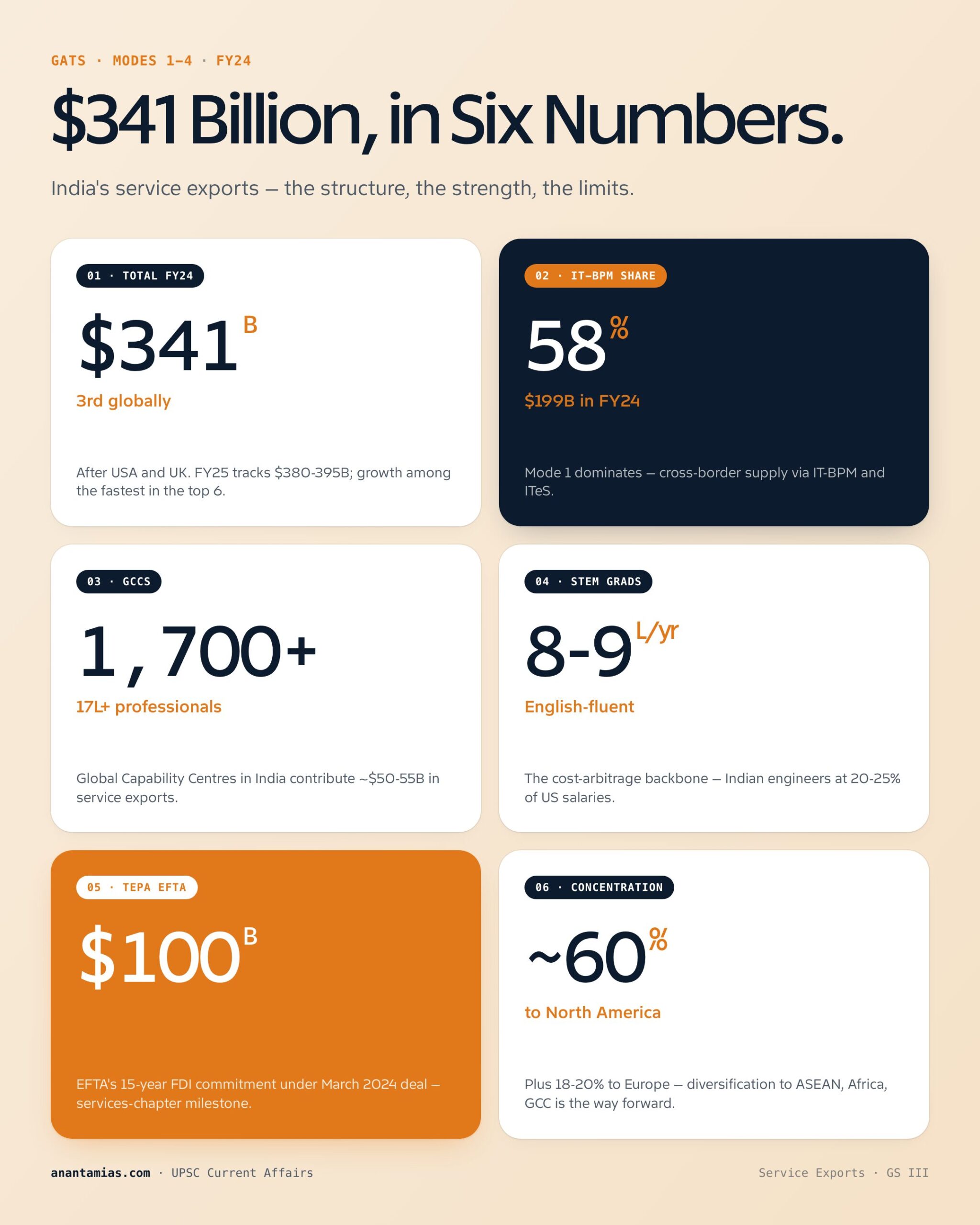
India is a services-export superpower. Services (especially IT-BPM, business services, telecom, and travel) consistently generate a trade surplus that helps offset India's chronic merchandise trade deficit. In FY 2023-24, India's service exports crossed USD 341 billion, while FY 2024-25 is on track for around USD 380-395 billion, the third largest globally after the USA and UK. The current account benefits — net services receipts of around USD 162 billion in FY24 — keep India's external position stable. Yet the structure of service exports faces significant limitations: stringent visa norms abroad, EU data regulations, weak treatment in Free Trade Agreements (FTAs), Mode-1 dominance with low employment elasticity, and dependence on imported software products causing forex leakages. This guide unpacks modes, drivers, limitations, and 2024-26 policy responses for UPSC GS-III on external sector and Indian economy.
What Service Exports Are
Services trade is governed globally by the WTO General Agreement on Trade in Services (GATS, 1995). GATS classifies services trade into four modes, depending on how supplier and consumer interact.
The Four Modes (GATS)
| Mode | Description | Example |
|---|---|---|
| Mode 1: Cross-border supply | Service crosses border; supplier and consumer remain in their countries | Indian IT firm writes code for US client |
| Mode 2: Consumption abroad | Consumer travels to supplier's country | Foreign tourist visits India for medical treatment |
| Mode 3: Commercial presence | Supplier sets up subsidiary in consumer's country | Indian bank opens branch in UK |
| Mode 4: Movement of natural persons | Supplier travels to consumer's country | Indian software professional on H1B visa in US |
India's Mode-Wise Export Mix
- Mode 1 dominates — IT-BPM, ITeS, business process management account for the lion's share.
- Mode 2 has been a growth area — medical tourism, education.
- Mode 3 for Indian banks, IT companies in the US, UK, Singapore.
- Mode 4 is constrained by visa policies in destination countries.
India's Service Exports: The Numbers
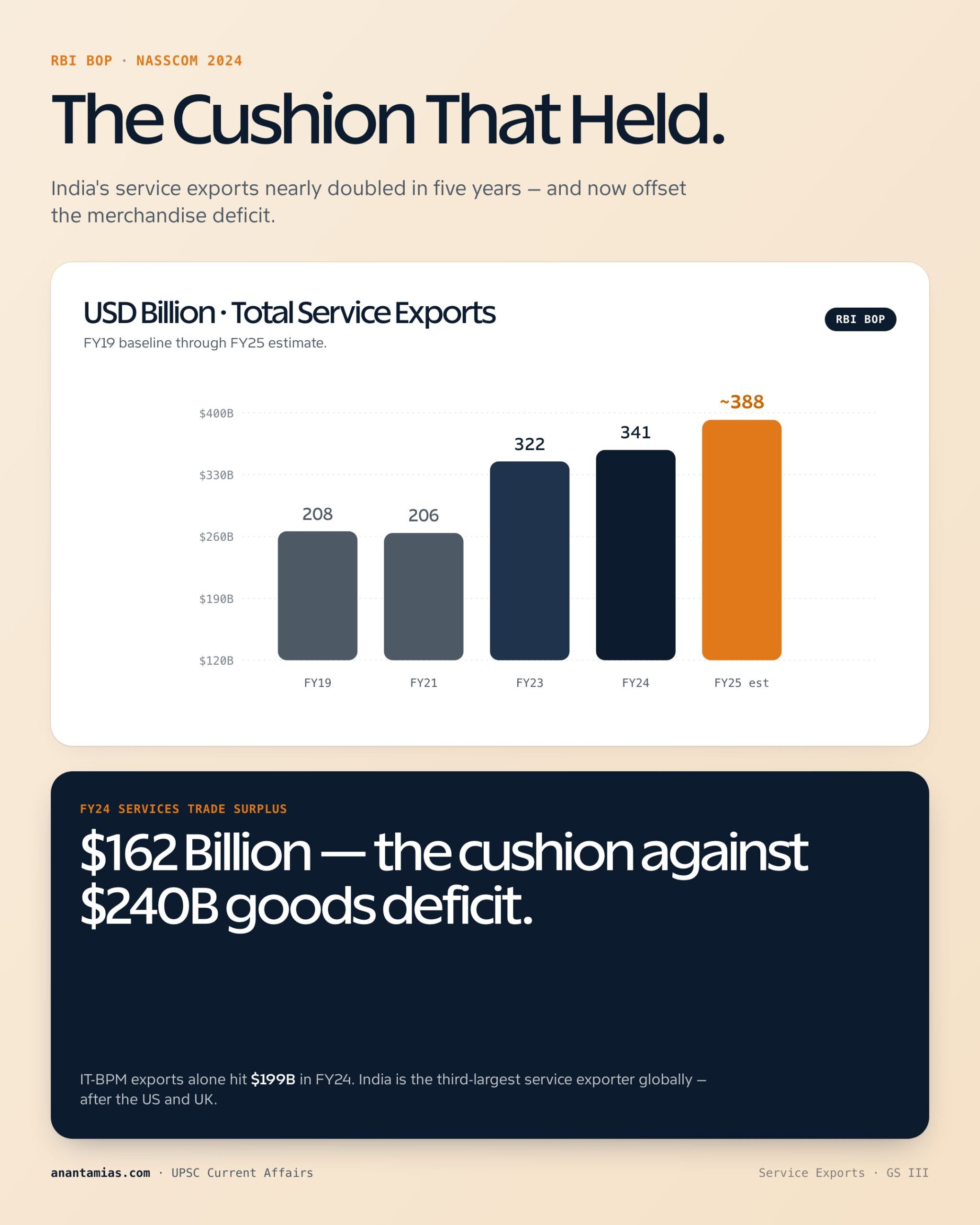
| Year | Total Service Exports (USD bn) | IT-BPM Exports (USD bn) | Trade Surplus from Services (USD bn) |
|---|---|---|---|
| FY 2018-19 | 208 | 137 | 81 |
| FY 2020-21 (Covid) | 206 | 150 | 89 |
| FY 2022-23 | 322 | 194 | 143 |
| FY 2023-24 | 341 | 199 | 162 |
| FY 2024-25 (estimate) | 380-395 | 210-215 | 175-185 |
Sources: RBI Balance of Payments, NASSCOM Strategic Review 2024, Ministry of Commerce.
Drivers of India's Service Export Strength
1. IT-BPM Dominance
- NASSCOM Strategic Review 2024 estimated India's IT-BPM exports at USD 199 billion in FY24, up from USD 130 billion just five years earlier.
- Around 5.4 million people directly employed in IT-BPM, with another 3-4 million indirectly.
- GCC (Global Capability Centres) in India crossed 1,700 units by 2024, driving high-value engineering and product work.
2. English-Language Workforce
India produces 8-9 lakh STEM graduates annually with English fluency, providing a natural cost-arbitrage advantage in global services.
3. Time-Zone Arbitrage
The 9.5-12.5 hour gap with North America enables 24-hour shifts, valuable in customer support, finance back-office, and global broker dealing.
4. Cost Competitiveness
Indian engineers cost 20-25 percent of US salaries even at scale, with productivity comparable in commodity-IT roles.
5. Specialised Niches
- Medical tourism: India hosts 5-7 lakh medical tourists annually pre-Covid, recovering post-2022.
- Higher education: Inbound students rose under Study in India Mission.
- Telecom services and broadcasting: Streaming exports grew with OTT adoption.
Limitations of Indian Service Exports
1. Stringent Visa Norms (Mode 4)
- High H1B visa fees and lottery uncertainty in the US.
- UK Skilled Worker Visa salary thresholds raised in 2024.
- Schengen visa wait times for Indian business travellers remain long.
- Non-issuance of multi-entry, longer-period visas raises transaction costs.
- Mode 4 services often need professional licensing that destination countries do not recognise (architecture, accountancy, medicine).
2. Data Localisation and EU Regulations
- The EU's General Data Protection Regulation (GDPR, 2018) raised compliance costs for Indian IT firms processing EU data.
- The EU's Digital Services Act (2022) and Digital Markets Act (2022) add further layers.
- Cross-border data transfer restrictions make exporting data-driven services harder, especially for fintech and healthtech.
3. Weak Treatment in FTAs
- India's earlier FTAs (e.g., with ASEAN, Korea, Japan) focused mainly on goods; services chapters were underdeveloped.
- Newer FTAs are addressing this, but India's negotiating leverage is limited because most partners want goods access more than services access.
4. Mode-1 Dominance and Low Employment Elasticity
- Most Indian service exports are Mode 1 (cross-border supply, especially IT-BPM).
- Growth in IT-BPM exports is largely driven by labour productivity gains (automation, AI) rather than headcount.
- Hence rising export revenue does not translate proportionately into job creation — a concern for India's demographic dividend.
5. Import Dependence and Forex Leakage
- India is not a major producer of software products — much of the Indian software market is served by Microsoft, Oracle, SAP, Adobe, Salesforce, etc.
- This causes forex leakage through:
- Imports of software products and SaaS subscriptions.
- Royalty payments and IP licensing fees.
- Profit repatriation by foreign software vendors.
- Indian product startups have grown but remain small relative to services exports.
6. Concentration Risk
- Roughly 60 percent of Indian IT-BPM exports go to North America; another 18-20 percent to Europe.
- A US recession or tech-sector contraction (as in 2022-23) directly hits Indian exports.
7. Skill Mismatch in Emerging Areas
- Demand has shifted toward AI/ML, cybersecurity, cloud architecture, data engineering.
- India is building these capabilities but mid-skill commodity coding still dominates the workforce.
Recent Developments (2024-26)
Free Trade Agreements
- India-UAE CEPA (May 2022) — services chapter with provisions for movement of professionals.
- India-Australia ECTA (December 2022) — recognition of qualifications, post-study work rights for Indian students.
- India-EFTA TEPA (March 2024) — EFTA committed USD 100 billion FDI commitment over 15 years; service liberalisation.
- India-UK FTA negotiations — services and Mode 4 commitments are key sticking points.
- India-EU FTA negotiations — extended timeline; services chapter complex due to EU data and regulatory frameworks.
Services Export Promotion Council (SEPC)
The SEPC continues to be the apex body for service-export promotion. Services Export from India Scheme (SEIS) under FTP 2015 was discontinued in 2020-21; replaced by general FTP 2023 measures.
Digital Personal Data Protection Act, 2023
India's DPDP Act, 2023 (notified 2023, rules under finalisation 2024-25) attempts to balance domestic privacy with cross-border service exports. Adequacy decisions with the EU under negotiation.
GIFT-IFSC
- GIFT City IFSC has emerged as an offshore financial services hub.
- International Financial Services Centres Authority (IFSCA) has licensed banks, insurers, fund managers.
- Aircraft and ship leasing, bullion exchange, fintech sandbox, and Direct Listing of Indian Companies on IFSC exchanges all contribute to invisible service exports.
India's Trade in Services Surplus
- RBI Bulletin (October 2024) reported a services trade surplus of USD 162 billion in FY24, up from USD 143 billion in FY23.
- This surplus is the principal cushion against India's merchandise trade deficit (around USD 240 billion in FY24).
NITI Aayog and Trade Strategy
- NITI Aayog working notes (2024) flagged need to deepen services FTAs and Mode 4 access.
- Foreign Trade Policy 2023 includes a stronger services-export focus.
Way Forward
- Mode 4 negotiations: Push aggressively for mutual recognition of qualifications (architects, accountants, doctors, nurses) and multi-entry, longer-validity visas in FTAs.
- Domestic software product ecosystem: Strengthen India Stack, ONDC, Bhashini as showcase products; scale through PLI for product startups.
- Diversify markets: Africa, Latin America, ASEAN, Middle East to reduce US-EU concentration.
- Education exports: Implement Study in India with international branch campuses (NEP 2020 enables foreign universities in India; FY24 onward).
- Healthcare exports: Streamline medical visa, accreditation under JCI/NABH for hospitals.
- GIFT-IFSC: Continue to deepen offshore financial services exports — fintech, asset management, insurance.
- Reduce forex leakage: Promote domestic SaaS, cloud, AI products; tax incentives for IP creation in India.
- Skill upgrade: National AI Mission, AICTE-AI curriculum, NEP-aligned modular credentials.
International Comparisons
| Country | Services Exports (USD bn, 2023) | Top Category |
|---|---|---|
| USA | ~1,025 | IP, finance, travel |
| UK | ~570 | Finance, business, IP |
| Germany | ~440 | Tourism, business |
| China | ~410 | Tourism, transport |
| India | ~341 | IT-BPM, business |
| France | ~330 | Tourism, business |
India's growth rate in services exports has been the highest among the top 6 in 2022-24, suggesting structural rise in global market share.
UPSC Relevance
GS-III Mapping
- Indian economy — external sector.
- Effects of liberalisation on the economy.
- Issues relating to growth, development and employment.
- Mobilisation of resources.
Prelims Pointers
- GATS — General Agreement on Trade in Services, WTO, 1995.
- Four GATS modes — cross-border supply, consumption abroad, commercial presence, movement of natural persons.
- NASSCOM Strategic Review — annual benchmark for IT-BPM exports.
- SEPC — Services Export Promotion Council.
- DPDP Act, 2023 — Digital Personal Data Protection Act.
- GIFT-IFSC — India's only operational International Financial Services Centre.
- India-EFTA TEPA — signed March 2024, USD 100 bn FDI commitment.
Mains Hooks
- "India's service exports are a key cushion for the external sector but face structural limitations. Examine and suggest reforms." (GS-III)
- "Discuss the GATS modes of service trade and India's strengths and weaknesses across them."
- "Why has India's IT-BPM growth not translated into proportionate job creation? Suggest course corrections."
- "Examine the impact of GIFT-IFSC and FTAs on India's services-export trajectory."
India's service exports are a strategic strength — supplying the net invisible inflows that anchor India's balance of payments. The 2024-26 challenge is to diversify modes (Mode 4 access, Mode 2 medical tourism), markets (beyond US-EU), and product mix (domestic software products). For UPSC, internalise the four modes, the trade-surplus data, the FTA pipeline, and the limitations to write authoritative answers on India's external sector.
Sector-Wise Breakdown of Indian Service Exports
| Sector | Share of Total Service Exports (approx) | 2024-26 Outlook |
|---|---|---|
| Software services / IT-BPM | ~58% | Steady; AI-driven productivity, GCC growth |
| Business services | ~20% | Growing rapidly; consulting, R&D, legal |
| Telecommunications | ~3% | Slow growth |
| Travel | ~7% | Recovering post-Covid; 2024-25 close to pre-pandemic |
| Transportation | ~5% | Cyclical with global trade |
| Financial services | ~3% | Growing with GIFT-IFSC |
| Construction / Insurance / Govt services | ~4% | Niche |
The Global Capability Centres (GCC) Story
Global multinationals are increasingly setting up Captive Centres / Global Capability Centres in India to handle R&D, engineering, finance, HR, and analytics for parent companies worldwide.
- Number of GCCs in India crossed 1,700 by 2024 (vs ~1,000 in 2015).
- Employ 17 lakh+ professionals.
- Contribute about USD 50-55 billion to service exports.
- Major hubs: Bengaluru, Hyderabad, Pune, Gurugram, Chennai, NCR.
GCCs represent a structural shift — Indian talent doing higher-value-added work for global parents, not just commodity coding. This pulls up wages, formalisation, and skill levels.
Regulatory and Policy Levers Worth Tracking
- DPDP Act, 2023 rules — adequacy decision with EU, settlement of cross-border data transfer norms.
- Foreign Trade Policy 2023 — stronger services focus, e-commerce export framework.
- GIFT-IFSC — new product permissions, Direct Listing of Indian Companies on IFSC exchanges.
- National Single Window System for trade and services.
- e-Vidhan and digital diplomacy for visa easing.
- Skill India module updates for AI/ML, cybersecurity, cloud.
Why Domestic Software Products Matter
If India produces 100 dollars of IT services exports but spends 60 dollars on imported SaaS, royalty, IP licensing, and profit repatriation, the net invisible benefit shrinks substantially. Building domestic software products — Bhashini (language), Beckn / ONDC (commerce), Account Aggregator framework, India Stack components — captures value at the IP layer and reduces forex leakage. This is why scheme support for product startups (PLI for IT products, Startup India seed fund, Genome India digital twin) is critical to long-term net invisible inflows.