Shivaji Maharaj Punyatithi Date: Death Anniversary & UPSC Notes
Shivaji Maharaj Punyatithi date is 3 April, marking the 1680 death of Chhatrapati Shivaji at Raigad Fort. Full life, legacy, and UPSC notes.
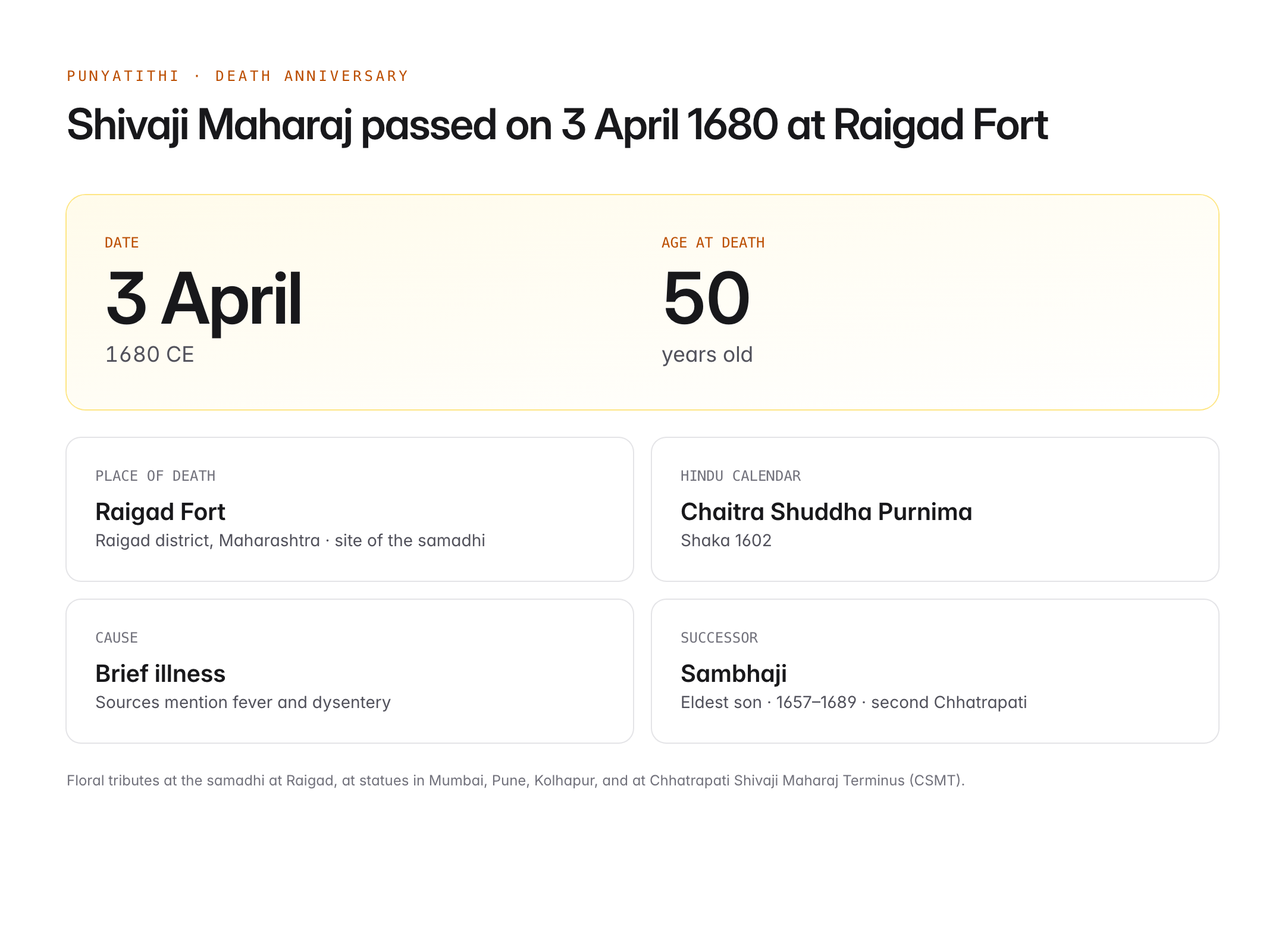
Shivaji Maharaj Punyatithi date is 3 April, observed every year to mark the death of Chhatrapati Shivaji Maharaj on 3 April 1680 at Raigad Fort in Maharashtra at the age of 50. In Marathi, punyatithi means death anniversary, and it is commemorated with prayers, processions at Raigad, and state-level functions across Maharashtra. Shivaji founded the Maratha Swarajya (1674), pioneered guerrilla warfare, built a modern navy, and ran a professional civilian administration through the Ashtapradhan Mandal. For UPSC, the 3 April date, his 1674 coronation at Raigad, his administrative system, and his naval vision are all frequently asked.
Shivaji Maharaj Punyatithi: Date and Significance
- Gregorian date: 3 April 1680.
- Traditional Hindu calendar: Chaitra Shuddha Purnima of Shaka 1602, though some sources use the Hindu lunar equivalent.
- Place of death: Raigad Fort, present-day Raigad district, Maharashtra.
- Cause of death: Historians cite a brief illness, with sources mentioning fever and dysentery.
- Successor: His elder son Sambhaji (1657–1689) became the second Chhatrapati.
The day is observed across Maharashtra with floral tributes at the Samadhi at Raigad, at statues in Mumbai, Pune, and Kolhapur, and at Chhatrapati Shivaji Maharaj Terminus (CSMT) in Mumbai.
Early Life and Rise
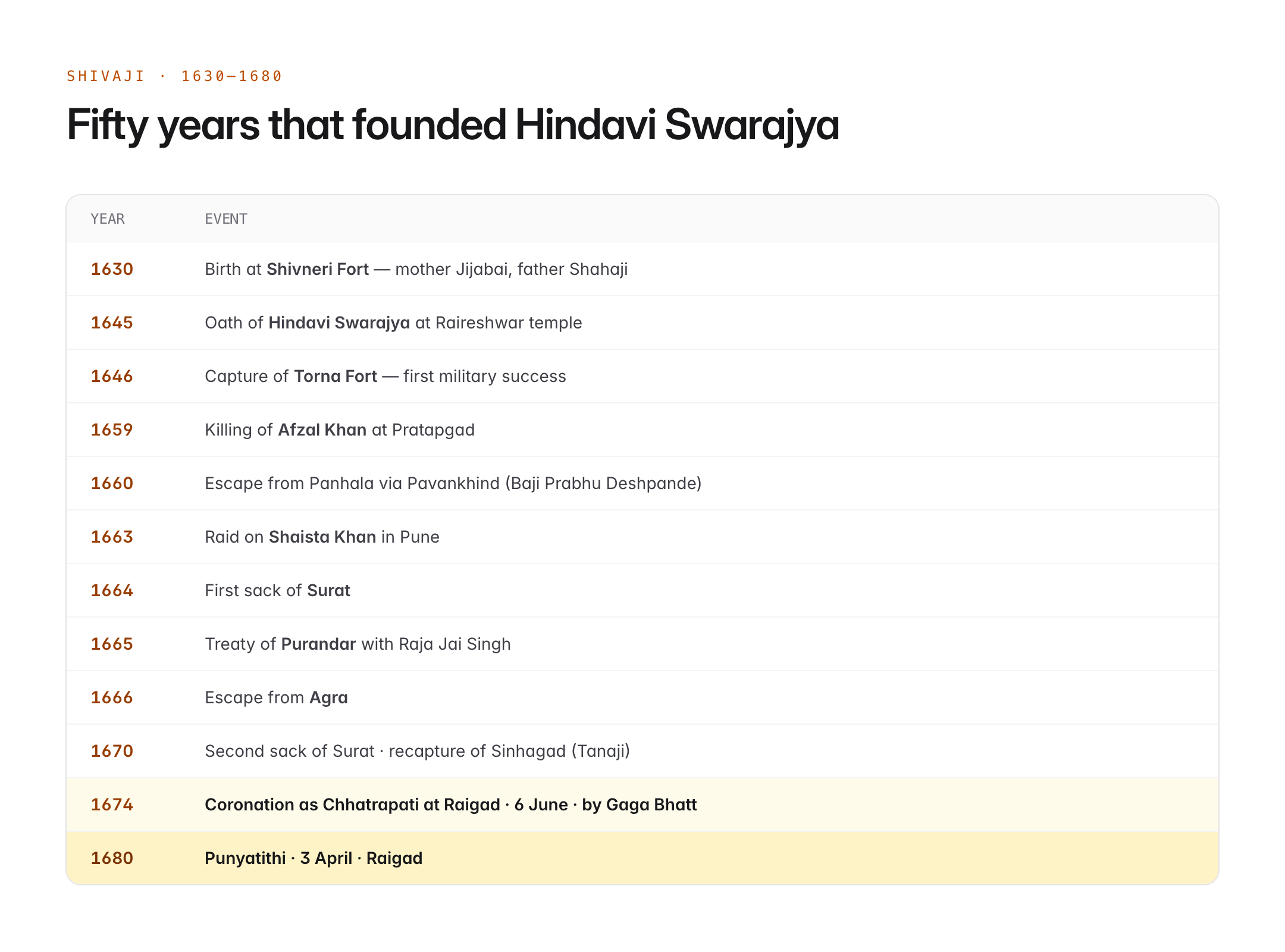
Shivaji was born on 19 February 1630 at Shivneri Fort near Pune to Shahaji Bhonsle, a Maratha general serving the Deccan Sultanates, and Jijabai, who instilled in him strong values of dharma and swarajya. His guru Samarth Ramdas shaped his philosophical outlook; Dadoji Konddev trained him in administration and warfare.
Key early milestones:
| Year | Event |
|---|---|
| 1630 | Birth at Shivneri |
| 1645 | Oath of Hindavi Swarajya at Raireshwar temple |
| 1646 | Capture of Torna Fort — first military success |
| 1656 | Capture of Javli from the Chandrao More family |
| 1659 | Killing of Afzal Khan at Pratapgad |
| 1660 | Escape from Panhala via Pavankhind (Baji Prabhu Deshpande's stand) |
| 1663 | Raid on Shaista Khan in Pune |
| 1664 | Sack of Surat (first raid) |
| 1665 | Treaty of Purandar with Raja Jai Singh (Mughal side) |
| 1666 | Escape from Agra |
| 1670 | Second sack of Surat |
| 1674 | Coronation as Chhatrapati at Raigad |
| 1680 | Death at Raigad; Punyatithi |
Coronation at Raigad (1674)
On 6 June 1674, Shivaji was crowned Chhatrapati at Raigad Fort, performed by the Varanasi-born scholar Gaga Bhatt. A second ceremony in Tantric-Shaiva tradition followed on 24 September 1674. The coronation was not a personal vanity — it was a political assertion of sovereignty, putting the Marathas on par with the Mughals, the Adil Shahis, and the Qutb Shahis, with a Hindu monarch wielding the Chhatra (royal umbrella).
The coronation also produced:
- The Rajyabhishek Shaka era, beginning 1674 CE.
- A new currency — Shivrai (copper) and Hon (gold).
- Use of Marathi and Sanskrit in royal communication, reducing dependence on Persian.
Ashtapradhan: Council of Eight Ministers
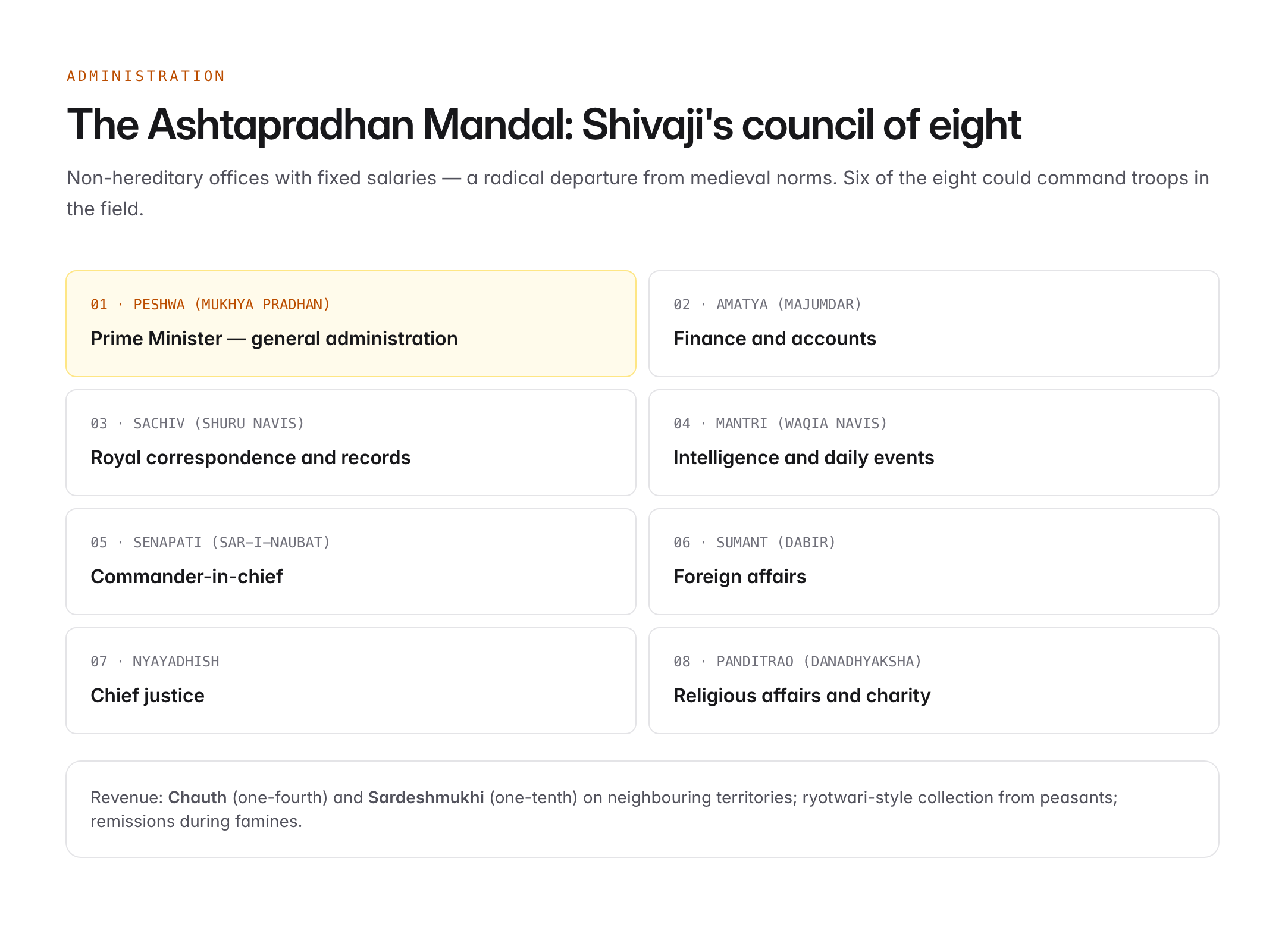
Shivaji's civilian administration is often compared with modern cabinets. The Ashtapradhan Mandal had eight ministers:
| Minister | Portfolio |
|---|---|
| Peshwa (Mukhya Pradhan) | Prime Minister — general administration |
| Amatya (Majumdar) | Finance and accounts |
| Sachiv (Shuru Navis) | Royal correspondence, records |
| Mantri (Waqia Navis) | Intelligence, daily events |
| Senapati (Sar-i-Naubat) | Commander-in-chief |
| Sumant (Dabir) | Foreign affairs |
| Nyayadhish | Chief justice |
| Panditrao (Danadhyaksha) | Religious affairs, charity |
Except for the Panditrao and Nyayadhish, all ministers could command troops in the field. Offices were non-hereditary (a major departure from medieval norms), and ministers were paid salaries.
Military System: Land and Sea
Army: Shivaji built a professional, cash-paid army of infantry (paiga), cavalry (bargirs and siledars), and artillery. He pioneered Ganimi Kava (guerrilla warfare) — sudden raids, night attacks, use of terrain, and swift retreats — highly effective in the Sahyadri hills.
Forts: Over 350 forts (hill, land, and sea) formed the backbone of his empire — Raigad, Rajgad, Sinhagad, Pratapgad, Purandar, Shivneri, Torna, Panhala, Lohagad, Vishalgad, and sea forts like Sindhudurg, Vijaydurg, Suvarnadurg, Khanderi.
Navy: Shivaji is called the "Father of the Indian Navy". He raised a fleet of around 400 ships, maintained naval yards at Kalyan, Bhivandi, and Vijaydurg, and used sea forts to check the Siddis of Janjira, Portuguese of Goa, and the English of Bombay. The Indian Navy Day is celebrated on 4 December, but Shivaji's naval vision is the origin story often cited in Mains answers.
Revenue and Land Administration
Shivaji abolished the oppressive jagirdari system for most territories and introduced a direct revenue system:
- Chauth (one-fourth) and Sardeshmukhi (one-tenth) levied on neighbouring Mughal and Deccan territories.
- Ryotwari-type collection directly from peasants based on land surveys.
- Remission of land revenue during famines.
- Protection of women, mosques, and non-combatants — seen in his standing orders to troops.
Death, Succession, and Legacy
Shivaji died on 3 April 1680 at Raigad. His samadhi is located there. He was succeeded by Sambhaji (1680–1689), who continued the war against Aurangzeb's Deccan campaign until his capture and execution in 1689. The dynasty continued through Rajaram, Shahu, and eventually the Peshwa era, which expanded Maratha power across North and Central India until 1818.
Shivaji's legacy shaped:
- The idea of Hindavi Swarajya and sovereign self-rule.
- Professional bureaucracy and merit-based appointments.
- Naval consciousness in Indian polity.
- Inspiration for later freedom fighters — Lokmanya Tilak revived Shiv Jayanti in 1895 as a mobilising tool during the freedom movement.
UPSC Relevance
Prelims focus:
- Shivaji Maharaj Punyatithi: 3 April (1680), at Raigad Fort.
- Birth: 19 February 1630, Shivneri Fort; mother Jijabai, father Shahaji.
- Coronation: 6 June 1674, performed by Gaga Bhatt.
- Ashtapradhan — eight ministers and their portfolios, especially Peshwa, Amatya, Senapati, Nyayadhish.
- Battles: Pratapgad (Afzal Khan, 1659), Sinhagad (Tanaji Malusare, 1670), Surat raids (1664, 1670).
- Father of the Indian Navy; sea forts — Sindhudurg, Vijaydurg, Suvarnadurg.
Mains GS-I angle:
- Shivaji as a nation-builder and modern ruler in the medieval context.
- Administrative innovations: Ashtapradhan, non-hereditary offices, revenue reforms.
- Guerrilla warfare (Ganimi Kava) and its relevance to later military thought.
- Use of Shiv Jayanti by Tilak in the national movement.
Sample PYQ angle: "Assess the role of Shivaji in the rise of Maratha power." — candidates can structure answers around rise, coronation, administration (Ashtapradhan), military and naval systems, revenue reforms, and the long-term legacy culminating in the 18th-century Maratha Confederacy that directly contested the British East India Company.