Feeling, Mood, Affection, Sentiment, Passion: Distinguishing Similar Emotional Terms (UPSC GS IV)
Feeling, mood, affection, sentiment, passion — clear distinctions between similar emotional terms for UPSC GS IV with civil service examples and case studies.
GS IV asks aspirants to write about emotional intelligence, attitudes, values and the affective life of the public servant. Doing this well requires precision. The everyday English of "feeling," "mood," "sentiment" and "passion" treats them as near-synonyms; psychology, philosophy and the ethics syllabus do not. Each term picks out a different feature of inner life, and confusing them weakens both analysis and answer-writing.
This article works through five neighbouring terms — feeling, mood, affection, sentiment and passion — and shows what each one names, how they relate to emotion proper, and why the distinctions matter for administration.
Why precise vocabulary matters
Two reasons.
- Diagnosis. A petitioner in a "low mood" needs different attention than one in "acute grief." A junior officer with a "passion for justice" is different from one with a "sentiment of resentment." The label changes the response.
- Communication. Examiner, citizen, subordinate, family — each receives more useful guidance from precise emotional language than from approximations.
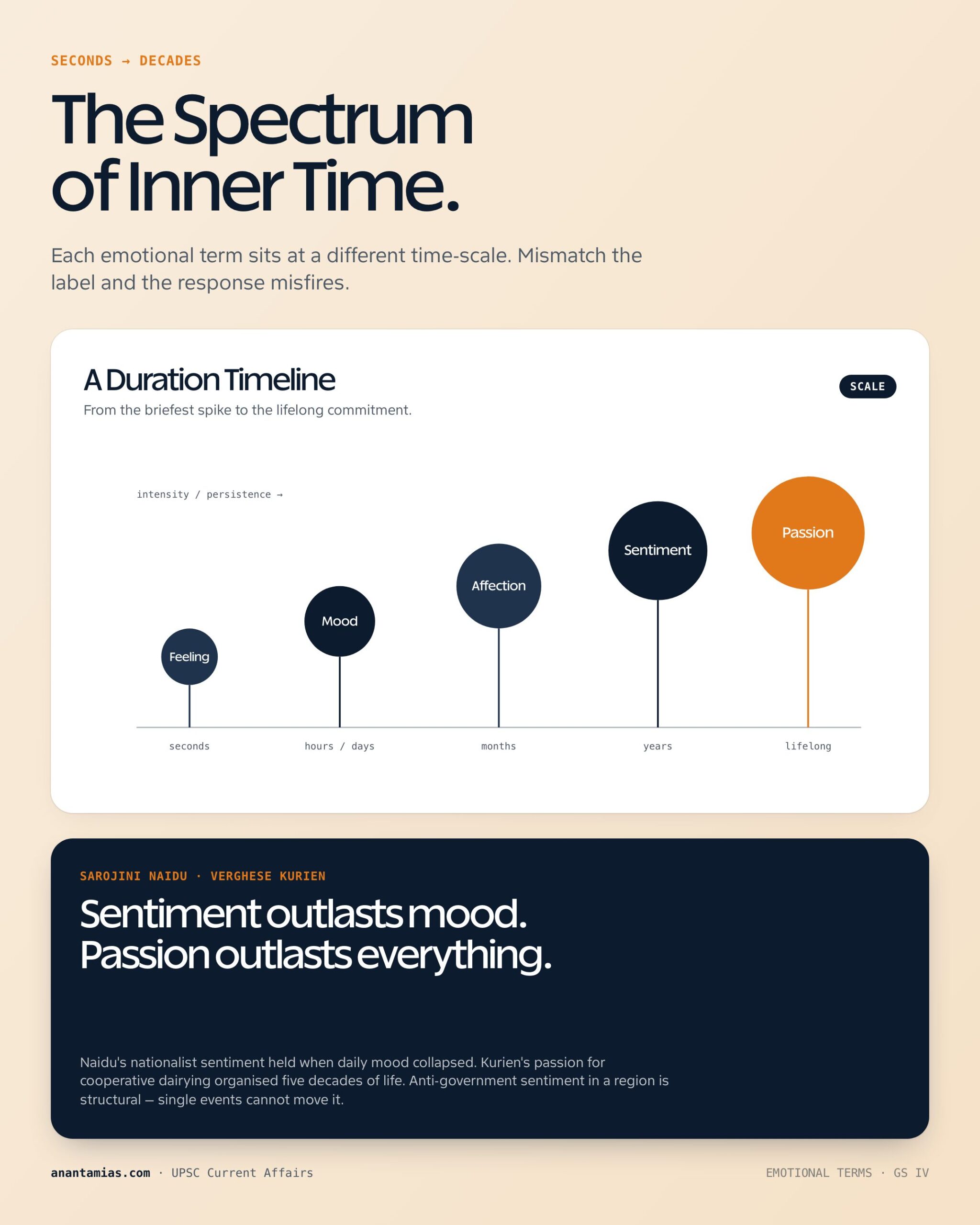
The terms below are arranged from the briefest and most surface (feeling) to the most enduring and motivational (passion).
Feeling
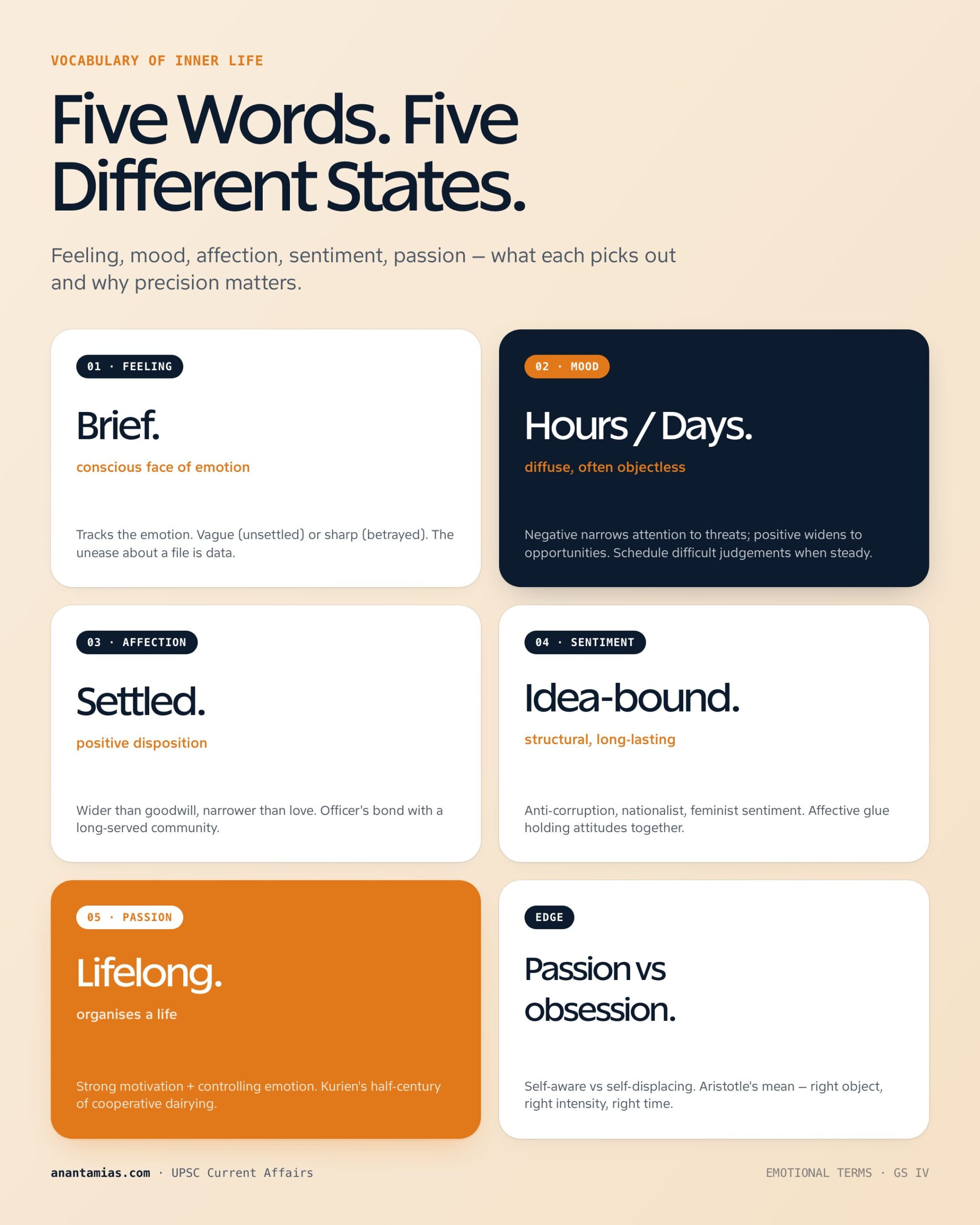
A feeling is a partly mental, partly physical response marked by pleasure, pain, attraction or repulsion. It denotes the existence of a response without specifying its nature, intensity or duration.
Feeling is the conscious experience of an emotion — its subjective face. The emotion of fear may have an unconscious physiological onset; the feeling of fear is the moment one becomes aware of being afraid. In the philosophical literature, William James called feelings the "qualia" of emotional life — what it is like to be in that state.
| Feature | Feeling |
|---|---|
| Component of | Emotion |
| Awareness required | Yes — feeling is the conscious face of emotion |
| Duration | Brief, tracks the emotion |
| Specificity | Variable — can be vague (feeling unsettled) or sharp (feeling betrayed) |
Feelings are influenced by perception, which is why two people in the same situation can feel different things. A senior's blunt feedback feels harsh to one trainee and clarifying to another. The objective stimulus is identical; the perception, and thus the feeling, differs.
For the civil servant, feelings are personal data. The unease one feels about a file is sometimes the early warning of an ethical problem the conscious mind has not yet articulated. Dismissing feelings as soft loses information.
Mood
A mood is a longer-lasting, more diffuse emotional state, lower in intensity than emotion proper, often without a clear precipitating object.
| Feature | Emotion | Mood |
|---|---|---|
| Duration | Seconds to minutes | Hours to days |
| Object | Specific (anger at someone) | Diffuse, often unattached |
| Intensity | Higher | Lower |
| Cause | Often identifiable | Often unclear |
You might feel everything is going your way this week and so be in a "happy mood" — without any single event being responsible. Conversely, you might find yourself feeling gloomy for several days without identifying a clear cause; the mood may track sleep, hormones, weather, or background life events.
Moods colour cognition. A negative mood narrows attention to threats; a positive mood widens attention to opportunities. The same file looks different to the same officer in different moods. Decision-making at the margin is mood-dependent — a fact the disciplined administrator allows for, scheduling difficult judgements when the mood is steady.
Mood disorders
Persistent moods that cross a clinical threshold become mood disorders — major depressive disorder, dysthymia, bipolar disorder. These require psychiatric attention and are not the subject of GS IV but should not be confused with ordinary low mood. The distinction matters for any officer dealing with subordinate well-being.
Affection
Affection applies to feelings that are also inclinations or likings — more than friendship or goodwill, less than romantic love. The word picks out a settled positive disposition toward another person, animal or thing.
Affection is enduring, gentle, oriented to the well-being of the other. The relationship between a long-serving teacher and her students is affectional. So is the bond between an officer and a tribal community she has served for years.
"Affection is the broadest word for emotional attachment, lying between mere goodwill and the more passionate forms of love."
For civil services, affection is the emotional substrate of empathy and compassion. The officer who develops genuine affection for the people of her district produces a different quality of administration than one who serves them at arm's length.
Sentiment
A sentiment often implies an emotion inspired by an idea, principle or memory rather than by an immediate object.
We speak of feminist sentiments, conservative sentiments, anti-corruption sentiments. Each names an emotional disposition aligned with an ideological or evaluative position. A sentiment is not the same as an emotion of the moment — it is the persistent feeling-tone connected to a settled view.
| Feature | Sentiment |
|---|---|
| Trigger | Idea, principle, value, memory |
| Duration | Long-lasting; structural |
| Component | Affective, but tied to cognitive content |
| Public expression | Common in political and moral discourse |
Sentiments are the affective glue that holds attitudes together. A person with anti-corruption sentiments responds with predictable emotion to any case of corruption — anger, disgust, contempt — even before knowing the details. The sentiment pre-loads the emotional response.
The civil servant has to manage public sentiments. Inflammatory speech taps into sentiment; reasoned dialogue addresses cognition. A skilled communicator addresses both.
Passion
A passion is what you get when strong motivation is coupled with powerful and controlling emotion. The term picks out an emotion intense and durable enough to organise a person's life and choices.
Passion is not a fleeting state. It is an emotional commitment that sustains effort over years, focuses attention, structures priorities. The passion for music that produces a great musician; the passion for justice that produces a great reformer; the passion for service that distinguishes the rare officer from the competent one.
"Without passion, talent rusts and even the best aptitudes underperform their potential."
Passion has a shadow. Excessive passion can produce zeal, fanaticism, blindness to evidence. The passionate reformer who cannot hear opposing views is passion turned into vice. Aristotle would say passion needs the discipline of practical wisdom — the right object, the right intensity, at the right time.
A comparison table
| Term | Specificity | Duration | Driving force | Civil-service example |
|---|---|---|---|---|
| Feeling | Subjective face of an emotion | Brief, tracks emotion | Perception | The unease about a file |
| Mood | Diffuse emotional climate | Hours to days | Often unclear | Gloomy week with no obvious cause |
| Affection | Settled positive disposition toward another | Long-lasting | Bond, repeated exposure | Officer's bond with a community |
| Sentiment | Emotion tied to an idea or principle | Structural | Ideology, value | Anti-corruption sentiment |
| Passion | Strong motivation + controlling emotion | Lifelong | Commitment | Passion for public service |
Two Indian case studies
Case study 1 — Verghese Kurien and the passion for cooperative dairying
Verghese Kurien's career is a study in passion. Sent to Anand for an unwanted government bond, he stayed for half a century to build Amul and the White Revolution. The emotional substrate was not transient enthusiasm but sustained passion — for cooperative organisation, for farmer dignity, for Indian rural development. Mood and feeling fluctuated; the sentiment for cooperative principle held; the passion for the work organised an entire life.
Case study 2 — Sarojini Naidu and the sentiment of nationalism
Sarojini Naidu's poetry, oratory and political work were animated by a nationalist sentiment — an emotion attached to the idea of an independent India. Distinguishing this from passing feeling matters. Sentiment outlasts mood. When personal mood was low, the sentiment held. When immediate political setbacks frustrated, the sentiment carried her past the frustration. The pattern repeats across the freedom movement — passions and sentiments doing the long work that fleeting feelings could not.
Civil services application
The vocabulary translates into practice.
- Read your own state correctly. Is this a passing mood, a feeling about a file, or a settled sentiment about a colleague? Each calls for a different response.
- Recognise sentiment in citizens. Anti-government sentiment in a region is structural; it will not be addressed by single events. Pro-development sentiment can be cultivated through visible achievement.
- Calibrate communication. Routine information addresses cognition. Emotional moments need the right register — calm tone for moods, acknowledgement for feelings, principled framing for sentiments.
- Cultivate affection without losing objectivity. The officer who genuinely cares about people serves them better — but affection should not slide into favouritism.
- Distinguish passion from zeal. A passion for justice is a virtue; zeal that ignores evidence is not. Aristotle's mean applies.
UPSC past-year question references
- 2018 GS IV: emotional intelligence and its components.
- 2017 GS IV: managing emotions in public administration; case studies involving sentiment-driven reactions.
- 2014 GS IV: passion and dedication to public service.
Mains answer hook
Emotional vocabulary is not a luxury. A feeling is the conscious face of an emotion; a mood is its diffuse, longer-lasting echo; an affection is a settled positive bond; a sentiment is an emotion attached to an idea; a passion is a sustained emotional commitment that organises a life. For the civil servant, the precision of the vocabulary translates into precision of self-management and citizen-engagement. The officer who can say "this is a mood, not a judgement" or "this is a sentiment, not a transient feeling" handles both her own mind and her territory more skilfully than one who collapses all of inner life into "feelings."
Prelims pointers
- Feeling — conscious experience of an emotion; the qualia of inner life.
- Mood — diffuse, longer-lasting emotional state; often without identifiable cause.
- Affection — settled positive disposition; broader than goodwill, narrower than love.
- Sentiment — emotion attached to an idea or principle.
- Passion — strong motivation + powerful emotion; sustained over time.
FAQ
What is the difference between feeling and emotion?
Emotion is the full multi-component response (subjective + physiological + behavioural). Feeling is the conscious, subjective face of that emotion.
Why does mood last longer than emotion?
Because mood is less object-bound. An emotion is triggered by a specific stimulus and resolves when the stimulus is processed. A mood arises from background factors and does not have a single stimulus to resolve.
Can sentiment be created or only discovered?
Both. Public sentiment is shaped by media, leadership, education and lived experience. The state participates in sentiment formation, for better and worse.
How does passion differ from obsession?
Passion is committed and self-aware; obsession is consuming and self-displacing. The line is fuzzy; the difference is in whether the person controls the passion or the passion controls the person.
Why does affection matter for an officer?
Because cold administration produces cold service. The officer who cares — who has affection for the people, the place, the work — usually administers better than one who treats it as a posting to be served out.
The five terms above are not interchangeable. Their distinctness is the beginning of any precise account of the emotional life — and the precise account is what GS IV rewards.