Sponge Cities: Nature-Based Flood Management for a Wetter Future (UPSC Geography & Environment)
A sponge city soaks up, stores and reuses rainwater like a sponge instead of flushing it into concrete drains. Here is the full picture — the nature-based-solutions idea behind it, China's flagship Sponge City Programme and its limits, and why India's flood-hit cities need blue-green infrastructure — explained for UPSC GS1 and GS3.
Every monsoon, the same pictures come back. A tech park in Bengaluru turns into a lake, commuters wade chest-deep through a Mumbai underpass, an arterial road in Chennai or Hyderabad disappears under brown water within an hour of a heavy cloudburst. We have built our cities to do exactly one thing with rain — get rid of it as fast as possible, through concrete drains, down sealed roads, away into a river or the sea. And every year that design fails a little more badly, because the rain is getting heavier and the ground that used to soak it up has been paved over. The sponge city is the idea that we have been fighting the wrong battle. Instead of fighting water, it says, a city should make friends with it — absorb it, hold it, slow it down, clean it and put it to use.
The phrase is almost self-explanatory. A sponge city is built to behave like a sponge: it soaks rainwater into the ground and into green spaces where it falls, stores it, and releases or reuses it slowly, rather than flushing every drop into pipes that overflow the moment a storm goes beyond what they were sized for. For a UPSC aspirant, this is one of those rare topics that sits across several papers at once — urban flooding and disaster management in GS Paper 3, urbanisation and resource geography in GS Paper 1, and the whole sweep of nature-based solutions and climate adaptation in the environment section. It is also intensely current, because India’s flood-battered cities are only now beginning to borrow the idea, and the first real pilots are just opening.
What a Sponge City Actually Is
Start with the man who named it. The concept was crystallised by Kongjian Yu, a Chinese landscape architect trained at Peking University and Harvard, who began arguing in the early 2010s that the modern habit of armouring cities in concrete and steel pipes — what he calls “grey” infrastructure — was a war against water that water always wins in the end. His alternative, which he framed as the “sponge city” around 2013, was to design the city itself as a living surface that catches and holds rain where it falls, using nature rather than fighting it. He summed up the whole philosophy in a single phrase that is worth memorising: a sponge city is about “making friends with water” instead of treating it as an enemy to be drained away.
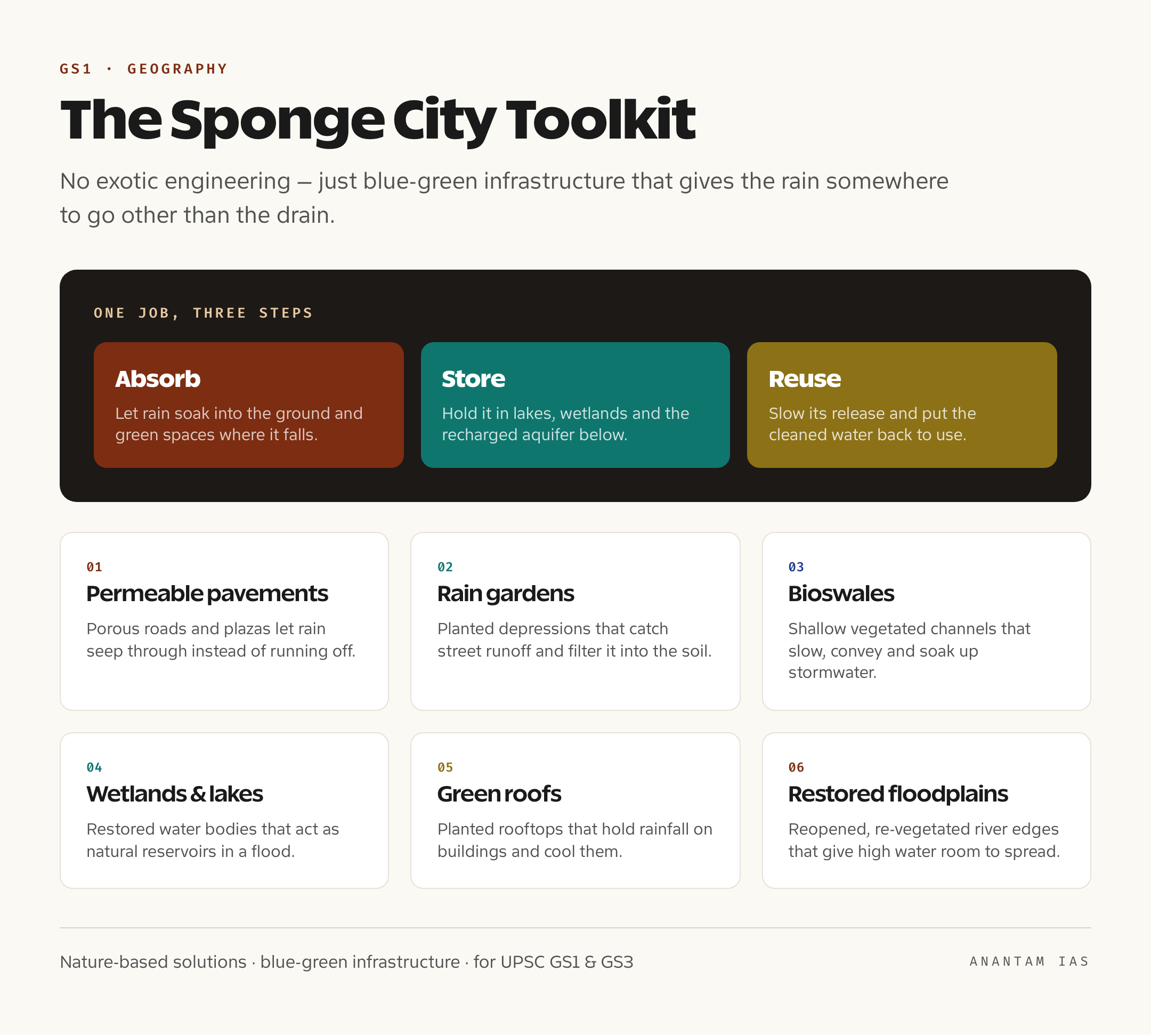
What makes a city a sponge is a toolkit of features that planners group under two labels you should know. The first is nature-based solutions — using natural or semi-natural systems to do a job that engineers used to hand to concrete. The second is blue-green infrastructure — the deliberate weaving of “blue” elements like ponds, lakes and wetlands together with “green” ones like parks, trees and gardens, so that the two work as a single water-handling network. In practice this means permeable pavements that let rain seep through instead of running off; rain gardens and bioswales — shallow planted channels and depressions that catch street runoff, slow it and let it filter into the soil; restored wetlands and urban lakes that act as natural reservoirs; green roofs that hold rainfall on buildings; and reopened, re-vegetated floodplains along city rivers. None of these is exotic. Each is simply a way of giving water somewhere to go other than the drain.
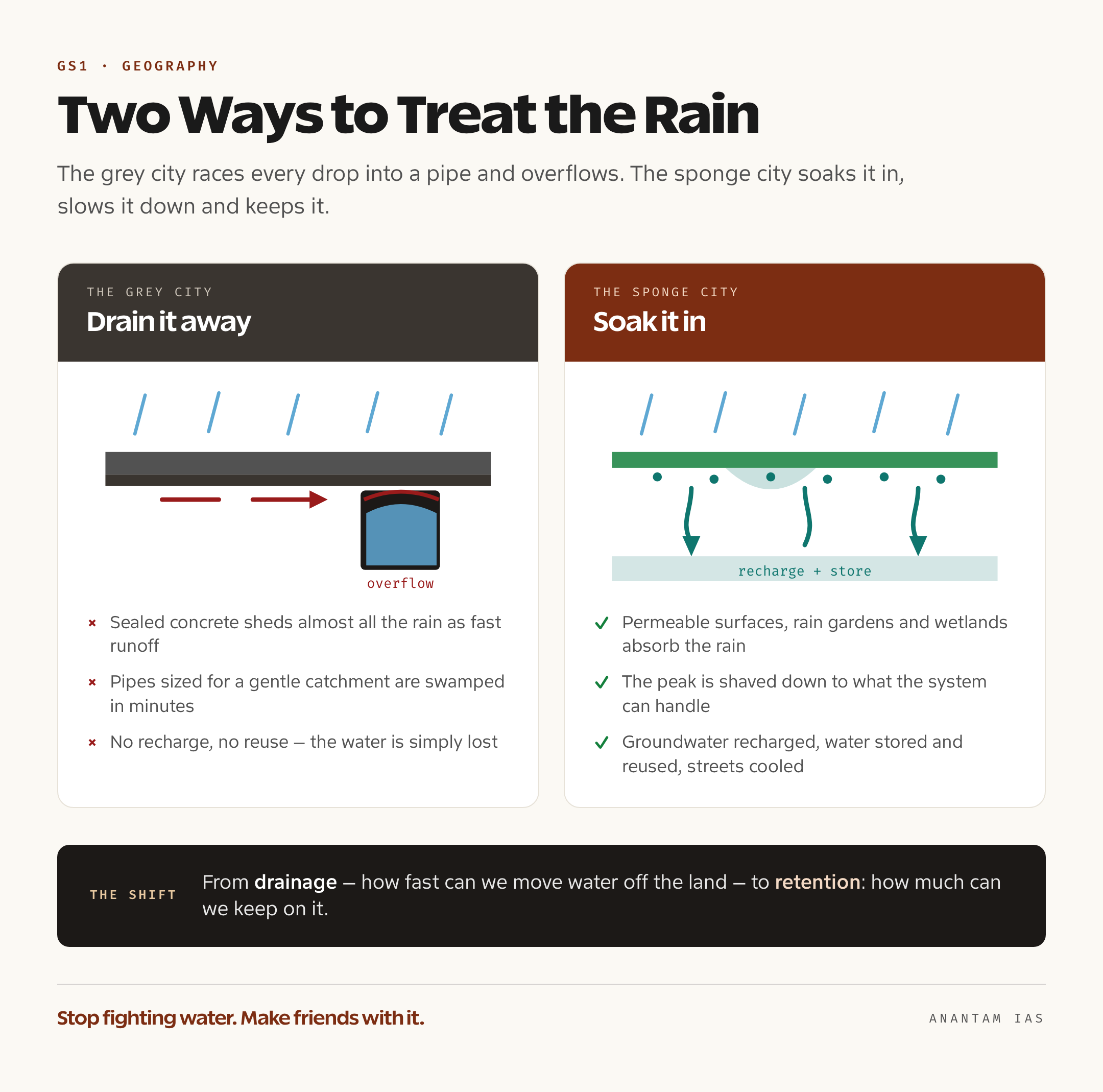
The point that ties the toolkit together is a shift in goal. A conventional storm-drain system is judged on how fast it can move water off the land. A sponge city is judged on how much water it can keep on the land — absorbed, stored and available — and how slowly it lets the rest leave. That one change in objective, from drainage to retention, is the heart of the concept, and it is the line an examiner most wants to see you grasp.
Why Cities Need to Behave Like Sponges Now
The reason this idea has moved from architecture journals to government policy is that two trends are colliding, and both are getting worse. The first is climate change, which is loading the atmosphere with more moisture and delivering rain in shorter, more violent bursts. A storm that drops a month’s rain in a single afternoon is no longer a freak event; it is becoming the design problem. The second is concretisation — the relentless sealing of urban land under buildings, roads and car parks. Soil that once drank rainfall has been replaced by impervious surfaces that shed almost all of it, so the same rain now produces far more runoff, far faster, than the old drains were ever built to carry.
Worse, the natural sponges that cities were originally built around have been destroyed in the process. Lakes, tanks, marshes and floodplains used to absorb the overflow quietly, the way a wetland does, holding water in a flood and recharging the aquifer underneath. As cities expanded, these were filled in, encroached upon and built over, and the channels that once linked them were broken. So a modern Indian city often faces the worst of both worlds: more intense rain arriving on a surface that cannot absorb it, with the natural reservoirs that used to take the surplus already paved away. The result is the flash urban flooding that has become an annual ritual.
There is a hard hydrological logic underneath all this. When rain falls on natural ground, much of it infiltrates into the soil and a good share evaporates back into the air, so only a small fraction runs off the surface. Seal that same ground under tar and concrete and the proportions flip — almost all of the rain becomes runoff, and it arrives at the drain far faster, in a sharper, higher peak. Engineers call this a flashier hydrograph, but the street-level meaning is simple: a drain network sized for the gentle runoff of a green catchment is suddenly asked to swallow several times that volume in a fraction of the time, and it cannot. A sponge city restores the missing infiltration and storage, shaving the peak down to something the system can handle.
A sponge city attacks this at the root, and its benefits run well beyond flood control — which is part of why it is such a rich answer to write. By soaking rain into the ground, it recharges depleted groundwater, the very water table that the same cities over-pump in summer, so the monsoon flood and the summer drought get tackled by one intervention. The stored water can be cleaned and reused, easing pressure on stressed supplies. The green and blue patches cool the city, blunting the urban heat-island effect, and they double as parks, habitat and public amenity. In other words, the sponge city turns a liability — too much water in the wrong place — into a set of co-benefits, which is exactly the framing examiners reward.
China’s Sponge City Programme: The Flagship and Its Limits
The country that turned the idea into national policy is China, and its programme is the example every answer should cite. Pushed by Kongjian Yu’s advocacy and by a flooding crisis — the government found that the great majority of Chinese cities were regularly inundated — the State Council launched a national Sponge City Programme in 2014, and in 2015 and 2016 it selected 30 pilot cities to lead the way, an initial sixteen including Wuhan and Xiamen, then a second batch including Shanghai, Beijing and Shenzhen. The ambition was deliberately bold. Official guidelines set a target that by 2020, a fifth of each city’s built-up area, and by 2030 fully 80 per cent of urban areas, should be able to absorb and reuse at least 70 per cent of the rainwater that falls on them.
The toolkit on the ground is exactly the one described above — permeable roads and plazas, rooftop gardens, constructed wetlands, rain gardens, and the restoration of rivers and lakes that earlier development had straitjacketed in concrete. In the pilot cities it has had real, measurable effects on routine flooding, and it has become a model studied by planners around the world. China has, in effect, run the largest live experiment in nature-based urban water management anywhere, and that alone makes it worth knowing in detail. Wuhan, a low-lying city laced with lakes, rebuilt parks and waterfronts to store storm surges; coastal Xiamen wove permeable surfaces and green corridors through new districts. The underlying design language is what planners call low-impact development — handling rain in small, distributed pieces across the whole city rather than funnelling everything to one big pipe and one big outfall.
But the programme also carries a crucial caveat, and leaving it out would weaken any answer. A sponge absorbs only so much before it is saturated. In July 2021 the city of Zhengzhou, a sponge-city participant, was hit by an extraordinary deluge — roughly a year’s worth of rain in three days, with more than 200 millimetres in a single hour — and it flooded catastrophically anyway, with heavy loss of life. Critics asked whether sponge cities even worked. The honest answer, which experts settled on, is more useful than a simple yes or no: sponge infrastructure is designed to handle ordinary and moderately heavy rain, on the order of up to about 200 millimetres a day, and it does that well, easing the frequent, nuisance flooding that plagues cities. It is not a flood wall against a once-in-a-millennium cloudburst. The lesson is balance — a sponge city reduces flood risk and delivers water, heat and amenity benefits, but it complements rather than replaces conventional drainage and disaster preparedness for the truly extreme event.
The India Angle: From Drowned Cities to Blue-Green Infrastructure
India needs this idea more than almost anyone, because its urban flooding is both chronic and self-inflicted. Chennai’s 2015 deluge, Mumbai’s recurring July paralysis, Bengaluru’s 2022 floods that submerged glittering tech parks, and Hyderabad’s near-annual inundation all share a common cause beneath the heavy rain: the destruction of the natural sponges. Bengaluru, once called the city of lakes, has lost or degraded the bulk of its more than a thousand water bodies to encroachment and construction, and the drains that once linked them have been severed. Chennai’s Pallikaranai marsh, a freshwater wetland that acts as a giant natural sponge for the city’s south, shrank from around 2,450 hectares in the early 1990s to a few hundred hectares as it was built over and used as a dump, even as a surviving core was finally given protection and, in April 2022, Ramsar status as a wetland of international importance. The pattern repeats across Hyderabad and other metros: fill the lake, pave the catchment, then act surprised when the water has nowhere to go. You can read the fuller diagnosis in our explainer on urban flooding in India, and the broader case for protecting these natural sponges in our piece on wetlands and why they matter.
The encouraging news is that the sponge-city logic is finally entering Indian policy and practice. The Atal Mission for Rejuvenation and Urban Transformation, in its second phase as AMRUT 2.0, has pushed cities to draw up City Water Balance Plans and to invest in rejuvenating water bodies, while the Smart Cities Mission has funded lake and waterfront restoration in several places. Planners increasingly talk of a hybrid “green-grey” approach — keeping the big drains but backing them with permeable surfaces, rain gardens, urban forests and restored wetlands that act as a shock absorber. The clearest concrete example arrived in March 2025, when Chennai opened its first wetland sponge park at Porur: a degraded marsh that had been used as a parking lot and dump was rebuilt into roughly sixteen acres of blue-green infrastructure, with the adjoining Chettiyar Agaram lake deepened so it can now hold tens of millions of litres during the monsoon while recharging the aquifer below.
What India still lacks is scale and enforcement, and that is the way-forward half of any answer. The single cheapest sponge intervention — mandatory rainwater harvesting — already exists on paper in states like Tamil Nadu but is unevenly enforced. Lake buffer zones and floodplains are routinely encroached because the rules are weak or ignored. A genuine sponge-city push would mean protecting and reviving every surviving wetland and tank, restoring the channels that connect them, writing permeable surfaces and green roofs into building codes, and treating the city’s blue-green network as critical infrastructure rather than as land waiting to be developed. The technology is simple and ancient; the missing pieces are political will, planning discipline and the patience to keep open space open. For a country that floods every monsoon and runs dry every summer, the sponge city is less a foreign import than a return to how Indian settlements once managed water — through tanks, step-wells and tree-lined catchments — before they were paved over.
For Your Mains Answer
This is a high-value, cross-cutting topic. It maps most directly onto GS Paper 3, under disaster management (urban flooding), environment and ecology (nature-based solutions, wetlands), and infrastructure. It also feeds GS Paper 1, where urbanisation and the geography of cities and rivers sit, and it offers a clean, optimistic example for the Essay paper on themes of sustainability, climate resilience and living with nature. The skill examiners reward here is integration: connect the engineering idea to ecology, to climate change, and to a concrete Indian example, and close with a realistic verdict rather than a slogan.
How to Build the Answer
Define first, then widen. Open by explaining what a sponge city is — the absorb-store-reuse idea, the switch from drainage to retention — and credit Kongjian Yu’s “making friends with water” framing. Move to why it matters now: climate-driven extreme rain plus concretisation plus destroyed natural sponges. List the toolkit briefly (permeable pavements, rain gardens, bioswales, wetlands, urban lakes, green roofs). Bring in China as the flagship, with its 70-per-cent target, and its honest limit shown by Zhengzhou 2021. Then land it in India — Chennai, Bengaluru, Pallikaranai, the Porur sponge park, AMRUT 2.0 — and finish with a balanced way forward on enforcement and scale. That arc — define, why now, toolkit, global model and its limit, India, verdict — fits almost any version of the question.
Common Mistakes to Avoid
Don’t present the sponge city as a magic cure that ends all flooding — the Zhengzhou caveat is exactly what separates a mature answer from a brochure. Don’t reduce it to “more drains” or “more parks”; the core is the retention philosophy, not any single feature. Don’t forget the co-benefits — groundwater recharge, cooling, water reuse — because flood control alone undersells the idea. And don’t treat it as purely foreign; root it in India’s own tradition of tanks and step-wells and in current policy like AMRUT 2.0, or the answer feels disconnected from the syllabus.
A Compact Answer Spine
Sponge city = design that absorbs, stores, slows and reuses rain instead of draining it (Kongjian Yu, “making friends with water”) → driven by climate-intensified rain + concretisation + loss of natural sponges (lakes, wetlands) → toolkit: permeable pavements, rain gardens, bioswales, wetlands, urban lakes, green roofs (nature-based solutions / blue-green infrastructure) → co-benefits: groundwater recharge, water reuse, cooling, amenity → China’s national programme (2014; 30 pilot cities; 80% of urban area to reuse 70% of rain by 2030) → limit: Zhengzhou 2021 shows it handles routine rain, not extreme cloudbursts → India: Chennai, Mumbai, Bengaluru, Hyderabad floods from encroached lakes; Pallikaranai, Porur sponge park (2025), AMRUT 2.0 → way forward: enforce rainwater harvesting, protect wetlands and buffers, write blue-green into building codes.
Diagram or Flowchart Idea
Draw a simple two-panel contrast: on the left, a “grey city” with rain hitting sealed surfaces and rushing into an overflowing drain; on the right, a “sponge city” where the same rain meets permeable pavement, a rain garden and a wetland, with arrows showing some water soaking down to recharge groundwater and some stored for reuse. A clean before/after like this communicates the whole concept — drainage versus retention — in one glance.
A Balanced-Conclusion Line
A line that lands the marks: “The sponge city will not stop a once-in-a-century cloudburst, but by making cities absorb the rain instead of fight it, it tackles routine flooding, recharges groundwater and cools the streets at once — for India’s drowned, thirsty metros, making friends with water is no longer a choice but a necessity.”
How to Use Data Without Cramming
You need only a handful of anchors, not a dossier: China’s target of 80 per cent of urban areas reusing 70 per cent of rainwater by 2030; the 30 pilot cities; Zhengzhou’s 2021 deluge (a year’s rain in three days) as the limit case; and one Indian example you can describe — say Bengaluru losing most of its thousand-plus lakes, or Chennai’s Porur sponge park of 2025. Attribute them plainly — “China’s State Council guidelines”, “the 2021 Zhengzhou floods” — rather than scattering figures loose.
Frequently Asked Questions
What is a sponge city in simple terms?
A sponge city is an urban area designed to soak up rainwater like a sponge instead of flushing it away through concrete drains. It uses permeable pavements, rain gardens, bioswales, wetlands, urban lakes and green roofs to absorb, store, slow and reuse rain where it falls. The goal is a shift from drainage to retention — keeping water on the land to cut flooding, recharge groundwater and supply the city, rather than rushing every drop into overloaded pipes. The concept was popularised by Chinese landscape architect Kongjian Yu, who described it as “making friends with water”.
Who invented the sponge city concept?
The idea is most closely associated with Kongjian Yu, a Chinese landscape architect who articulated the “sponge city” framework around 2013, arguing that armouring cities in concrete pipes was a losing war against water. His advocacy helped persuade China’s government to launch a national Sponge City Programme in 2014. The underlying tools — nature-based solutions and blue-green infrastructure — draw on older traditions of working with natural drainage, including India’s own tanks and step-wells.
Why does India need sponge cities?
Because Indian cities flood badly almost every monsoon — Chennai, Mumbai, Bengaluru and Hyderabad among them — and the main reason, beyond heavy rain, is that their natural sponges have been destroyed. Lakes, tanks and wetlands have been encroached and built over, and impervious concrete now sheds rain straight into drains that cannot cope. Sponge-city features would let the same cities absorb the rain, recharge their depleted groundwater and reduce flooding. Early steps include Chennai’s Porur wetland sponge park and AMRUT 2.0’s push for City Water Balance Plans and water-body rejuvenation.
Do sponge cities actually stop floods?
They reduce routine and moderate flooding effectively, and they deliver groundwater, water-reuse and cooling benefits, but they are not a cure for the most extreme cloudbursts. The clearest proof of the limit was Zhengzhou in 2021, a Chinese sponge city that flooded disastrously when it received roughly a year’s rain in three days. Sponge infrastructure is built to handle ordinary heavy rain — up to around 200 millimetres a day — and must work alongside, not replace, conventional drainage and disaster preparedness for once-in-a-century events.
Practice Questions
Prelims MCQs
- The “sponge city” concept is best described as which of the following?
(a) A plan to build larger underground concrete drains in cities
(b) An urban design approach that absorbs, stores, slows and reuses rainwater using nature-based features
(c) A scheme to relocate cities away from floodplains
(d) A method of desalinating seawater for urban use
Answer: (b) A sponge city is designed to retain rainwater through permeable surfaces, rain gardens, wetlands and similar features, rather than draining it away. - The terms “blue-green infrastructure” and “nature-based solutions,” central to sponge cities, refer to which of the following?
(a) Solar panels and wind turbines on urban buildings
(b) The use of natural and semi-natural systems such as wetlands, parks and permeable surfaces to manage water
(c) Blue-painted roads and green-painted drains
(d) Underground rainwater tunnels lined with concrete
Answer: (b) Blue (water bodies) and green (vegetation) elements work together as a single water-handling network using natural processes. - Which country launched a national Sponge City Programme in 2014 and selected 30 pilot cities?
(a) India
(b) The Netherlands
(c) China
(d) Singapore
Answer: (c) China’s State Council launched the programme, targeting that by 2030, 80 per cent of urban areas absorb and reuse at least 70 per cent of rainwater. - The 2021 flooding of Zhengzhou, a sponge city, is most often cited to illustrate which point?
(a) That sponge cities cannot handle any rainfall
(b) That sponge infrastructure manages routine rain well but cannot stop a once-in-a-century cloudburst on its own
(c) That permeable pavements increase flooding
(d) That wetlands have no role in flood control
Answer: (b) Zhengzhou received roughly a year’s rain in three days, far beyond what sponge infrastructure is designed to absorb, showing it complements rather than replaces conventional defences. - Pallikaranai marsh, often discussed in the context of urban flooding, is associated with which Indian city, and what is its significance?
(a) Bengaluru; a granite quarry
(b) Mumbai; a coastal mangrove park
(c) Chennai; a freshwater wetland and natural sponge, now a Ramsar site
(d) Hyderabad; an artificial reservoir
Answer: (c) The Pallikaranai marsh acts as a natural sponge for south Chennai and was designated a Ramsar wetland of international importance in 2022.
Mains Practice Questions
- What is a “sponge city”? Explain how nature-based solutions and blue-green infrastructure can help Indian cities manage the twin problems of urban flooding and groundwater depletion. (15 marks, 250 words)
- “India’s cities flood not only because it rains harder, but because they have destroyed their own natural sponges.” Critically examine this statement with reference to recent urban floods. (15 marks, 250 words)
- Discuss China’s Sponge City Programme as a model of nature-based urban water management. What are its achievements and what does the Zhengzhou flooding of 2021 reveal about its limits? (15 marks, 250 words)
- Examine how missions such as AMRUT 2.0 and the Smart Cities Mission can be leveraged to make Indian cities behave like sponges. What institutional and regulatory reforms would be needed? (15 marks, 250 words)
- Sponge-city interventions deliver benefits beyond flood control. Discuss their co-benefits for groundwater, water supply and the urban heat-island effect, and assess the challenges in scaling them across Indian cities. (10 marks, 150 words)