Sultanpur National Park: Haryana’s Premier Bird Sanctuary
A 1.43 sq km wetland on Gurugram's edge that draws tens of thousands of migratory birds each winter — Sultanpur National Park is a Ramsar site, a Central Asian Flyway stop, and a UPSC favourite. Here is the full, current picture.
Drive forty-odd kilometres south-west of central Delhi, past the glass towers of Gurugram and the half-built sprawl of the Dwarka Expressway, and the road suddenly opens onto a shallow sheet of water ringed by acacia and reeds. This is Sultanpur National Park — barely 1.43 square kilometres, one of the smallest national parks in India, and yet in a good winter it holds tens of thousands of birds that have flown in from Siberia, Central Asia and the Arctic to sit out the cold beside a city that never stops building.
That contrast is the whole story. A wetland this tiny, this close to a mega-city, should have been swallowed long ago. Instead it carries an international Ramsar designation, sits on one of the planet’s great bird highways, and turns up reliably in the UPSC Prelims as a one-line fact about wetland conservation. So it’s worth knowing properly — not as a flashcard, but as a working example of how a fragile habitat survives on the edge of relentless urban pressure.
What Sultanpur Is, and Where
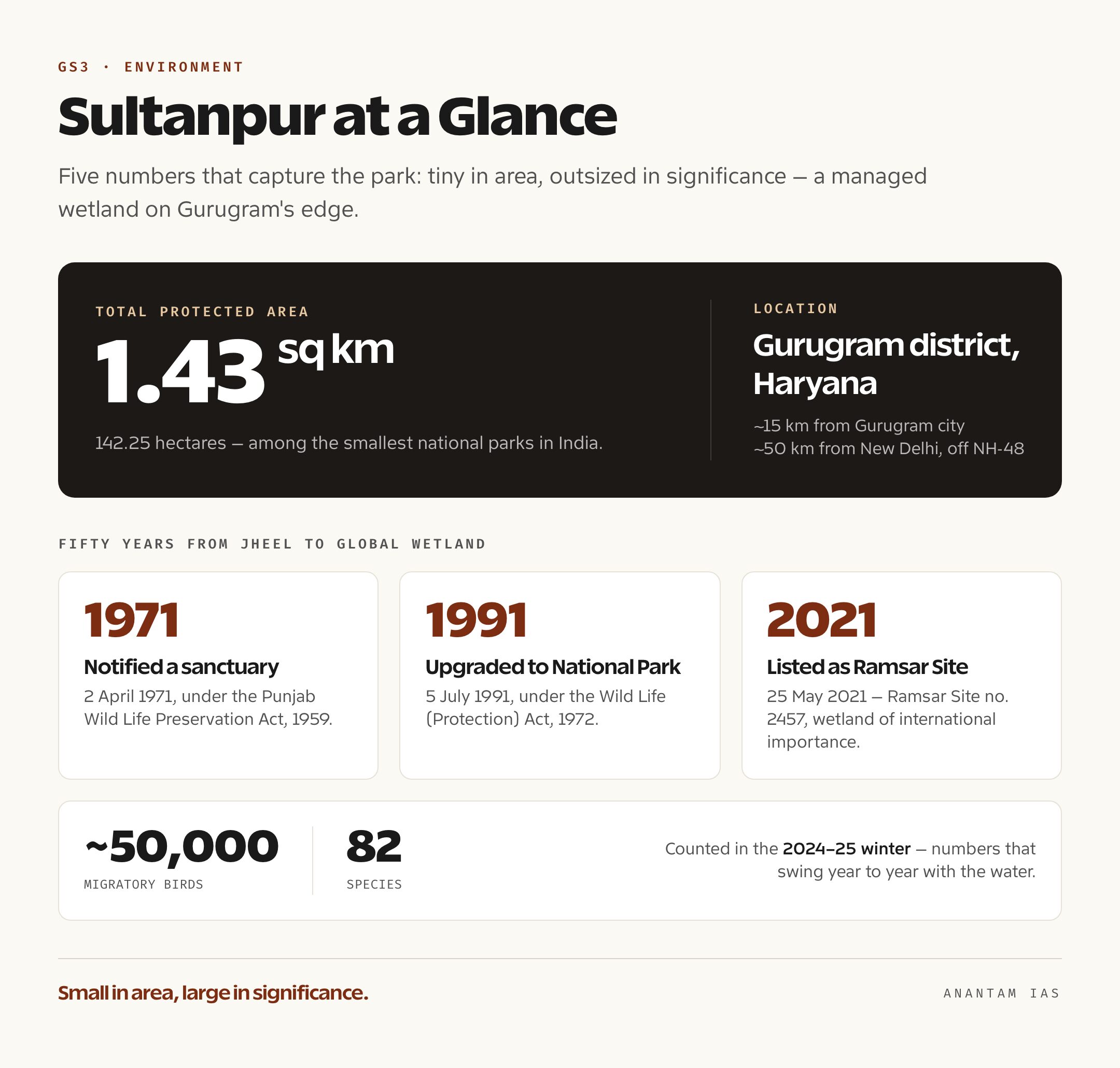
Sultanpur National Park sits near Sultanpur village in Farrukhnagar, in the Gurugram district of Haryana, about 15 km from Gurugram city and roughly 50 km from New Delhi off NH-48. At its heart is a jheel — a shallow, seasonal freshwater lake — surrounded by mixed woodland, grassland and low mounds that double as birdwatching points. The whole protected area covers about 1.43 square kilometres (the official Haryana Wildlife Department records 142.25 hectares), which makes it less a sprawling wilderness than an intensely managed pocket of wetland on the Aravalli-Gangetic transition.
The legal history runs in three clear steps, and it’s worth getting the years right because the older write-ups muddle them. The site first won protection on 2 April 1971, when a roughly 1.21 sq km jheel was notified as a sanctuary under the Punjab Wild Life Preservation Act of 1959. It was then upgraded to a national park on 5 July 1991 under Section 35 of the Wild Life (Protection) Act, 1972 — not in the late 1980s, as several popular accounts claim. And on 25 May 2021 it was added to the Ramsar List of Wetlands of International Importance (Ramsar Site no. 2457), with the information sheet published that August. So the journey from a hunters’ jheel to a globally recognised wetland took exactly fifty years.
The push for that first protection is a small piece of conservation lore. The wetland’s potential was flagged at the 1969 IUCN General Assembly in New Delhi, where the British ornithologist Peter Jackson took up its cause and corresponded with Prime Minister Indira Gandhi. Gandhi, herself a keen birder, is said to have directed the Haryana government to act — and the 1971 notification followed. So Sultanpur owes its existence less to a master plan than to one persuasive birdwatcher and a sympathetic Prime Minister.
Ecology and Birdlife on the Central Asian Flyway
The lake is the engine of the place, and it breathes with the monsoon. It fills with rain-fed runoff between July and September, then shrinks through the dry months, exposing mudflats and shallow margins. That cycle is exactly what makes it valuable: waders need shallow water and exposed mud, ducks need slightly deeper pools, and warblers need the fringing reeds — and a seasonal jheel serves up all three in turn. The vegetation around it is a semi-arid mosaic of Acacia nilotica (babool), Acacia tortilis, neem, jamun, berberis and Ficus species, planted in part to give cover and nesting sites, with water hyacinth, reeds and sedges in the wet zones.
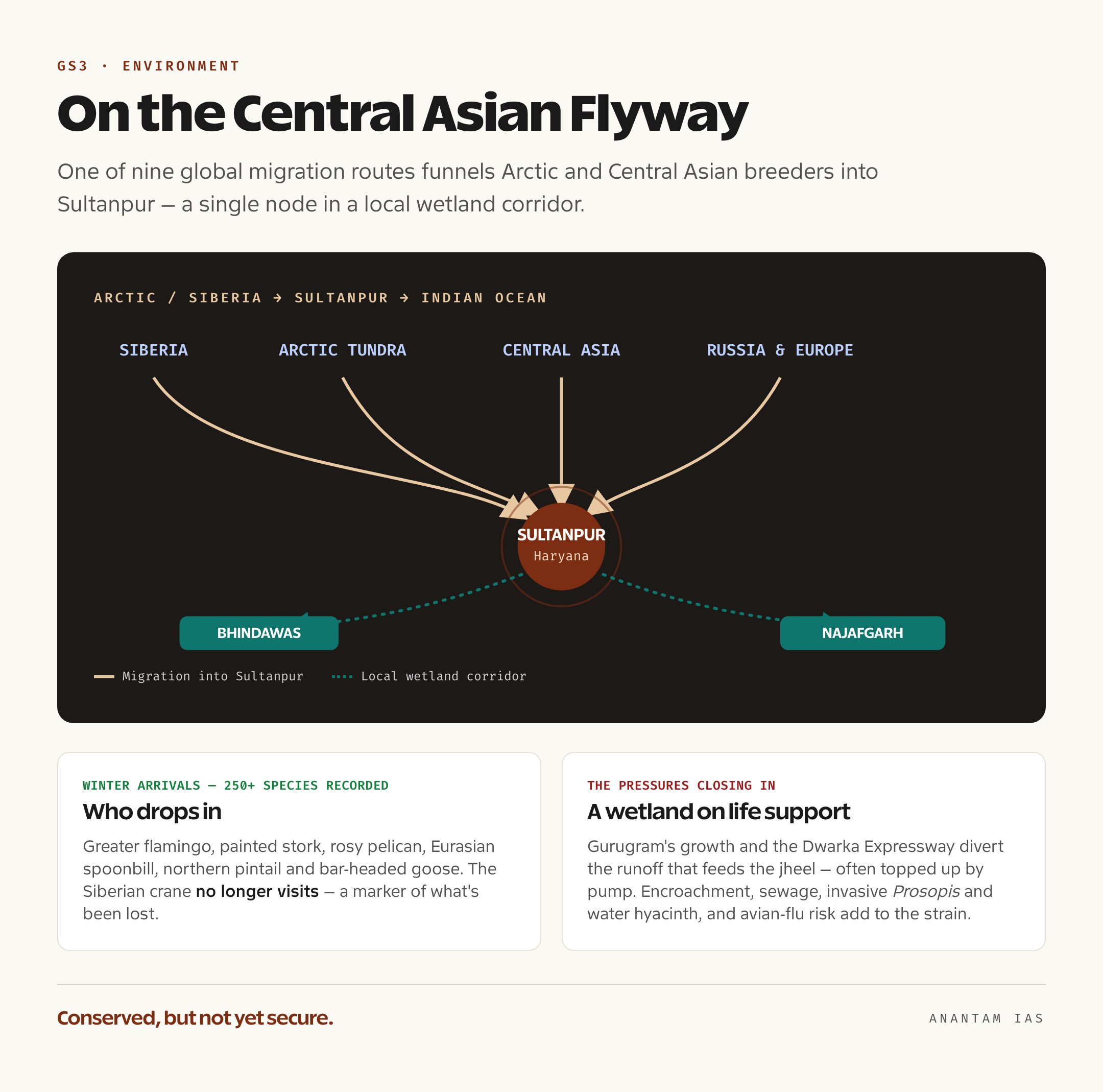
What turns this small jheel into something internationally important is its place on the Central Asian Flyway — one of nine major global bird migration routes, running from the Arctic and Siberian breeding grounds down through Central Asia to South Asia and the Indian Ocean. Every winter, more than a hundred migratory species drop into Sultanpur from Russia, Central Asia, Europe and beyond. Over its history the park has recorded more than 250 bird species, and recent travel and tourism accounts push the cumulative tally past 320.
The standout winter visitors include the greater flamingo, painted stork, rosy (great white) pelican, Eurasian spoonbill, northern pintail, northern shoveler, common teal, Eurasian wigeon, gadwall and bar-headed goose, along with waders like the ruff, black-winged stilt, common greenshank and common redshank. The Siberian crane — once the park’s most celebrated guest — is now effectively a historical record across India and no longer turns up here, a quiet marker of how much migratory birdlife the subcontinent has lost. The resident cast is busy year-round: Indian peafowl, grey and black francolin, Indian roller, green bee-eater, white-throated kingfisher, purple sunbird, Indian cormorant, little and cattle egret, spot-billed duck and purple heron. Nilgai, blackbuck and Bengal fox round out the non-avian fauna.
How many birds actually show up swings hard from year to year, because it tracks the water. In the 2024-25 winter, the park’s wildlife inspector Jyoti Kumar told The Pioneer that about 50,000 migratory birds of 82 species were counted — northern lapwing, pelican, bar-headed and greylag geese, pintail, common pochard, painted stork, spoonbills and common teal among them. The park also took part in the January 2025 Asian Waterbird Census, run with the Haryana State Biodiversity Board and Wetlands International. A full jheel means a full park; a dry one empties it.
Why Sultanpur Keeps Coming Up
So why does a 1.43 sq km wetland punch so far above its size? Because it sits at the intersection of three things examiners and conservationists both care about: a globally recognised migration route, an international treaty obligation, and an urban-wetland survival story playing out in real time.
The Ramsar tag is the formal hook. Ramsar Sites are wetlands of international importance designated under the Ramsar Convention on Wetlands, signed in the Iranian city of Ramsar in 1971 and in force from 1975, which commits member countries to the “wise use” of their wetlands. India joined in 1982, and by 2025 it had crossed 90 Ramsar Sites — the most of any country in Asia and among the highest in the world. Sultanpur made the list in 2021 in a batch that also brought in Bhindawas Wildlife Sanctuary in Jhajjar, which became Haryana’s largest Ramsar wetland. The designation matters because it pulls a small state-managed park into a national and international monitoring frame, and because it commits India to keeping the wetland’s “ecological character” intact — a phrase that has real bite when a builder turns up with a clearance.
There’s a deeper reason too. Sultanpur doesn’t stand alone; it forms an ecological corridor with the nearby Bhindawas and Najafgarh wetlands, so birds move between them depending on where the water is. That makes it a textbook case of why isolated protected areas struggle and why landscape-level thinking matters — a point that travels well into any answer on wetland or biodiversity conservation. The park’s managers have leaned into exactly this, planning new water bodies inside Sultanpur to draw the greater flamingos that have lately favoured the Najafgarh wetland nearby. And as a “weekend wilderness” 50 km from the capital, with watchtowers, an interpretation centre, paved tracks and electric carts, it doubles as one of the most accessible places in north India to teach urban Indians what a living wetland looks like.
The Pressures Closing In
The thing that makes Sultanpur remarkable — a wetland on a mega-city’s doorstep — is also what threatens it. The single biggest problem is water. The lake depends on monsoon runoff and a shrinking natural catchment, and the explosive growth of Gurugram, Manesar and the Dwarka Expressway corridor has paved over and diverted the flows that once fed it. In poor-monsoon years the jheel has run dangerously low or dried out for stretches, which means the managers must top it up by pumping in water from canal and treated sources just to keep the birds coming. A wetland you have to fill with a pump is a wetland living on life support.
Around that core sit the familiar urban-edge pressures. Encroachment and construction creep up to the boundary; sewage, plastic waste and runoff degrade water quality; and light, noise and traffic from new development disorient wildlife and damage the buffer. Conservation writers have flagged that proposals for institutional and housing projects on the park’s fringe have at times secured forest-department clearances — the slow, “seemingly benign” erosion that does more long-term harm than any single bulldozer. Invasive species pile on: Prosopis juliflora (vilayati keekar) and water hyacinth crowd out native flora and choke open water. And because Sultanpur is a dense, urban-adjacent waterbird hub, it carries a standing risk of avian influenza outbreaks, which forces periodic surveillance and, in bad years, restrictions on access.
Put together, these pressures explain why the park’s bird numbers swing so sharply and why its long-term future is genuinely uncertain. The Ramsar designation raises the cost of getting this wrong, but it doesn’t pump water or stop a housing clearance by itself.
Managing a Wetland on the Edge
Sultanpur is run by the Forests and Wildlife Department of Haryana under the Wild Life (Protection) Act, 1972, with the national Wetlands (Conservation and Management) Rules, 2017 governing the wetland’s ecological integrity and the Ramsar Convention layering on a “wise use” obligation. Day-to-day management leans on the basics done well: maintaining water levels through monsoon harvesting and supplementary pumping, controlling invasive Prosopis and hyacinth, managing visitor pressure through fixed tracks and carts, and running bird monitoring — often with help from the Bombay Natural History Society and WWF-India, which have long supported counts here.
The more forward-looking work is about the landscape, not just the fence line. Treating Sultanpur, Bhindawas and Najafgarh as one connected system — and creating new water bodies within the park to spread birds across it — recognises that you cannot conserve a flyway stopover in isolation from the wetlands around it. The harder, unfinished task is protecting the catchment: unless the inflows that feed the jheel are secured against further urban diversion, the park will stay dependent on pumps and good monsoons. The honest way to put it is that Sultanpur is conserved but not yet secure. Its survival so far is a credit to active management; its future depends on whether India is willing to defend small wetlands against big development — which is exactly the tension the UPSC keeps asking you to weigh.
For Your Mains Answer
Sultanpur is most useful as a case study for GS Paper 3 (conservation, environmental pollution and degradation, biodiversity) and, where relevant, GS Paper 1 on the geography of India’s natural regions and drainage. Don’t write a tourist brochure. Use it as a concrete, named example to anchor larger arguments about wetland conservation, the Ramsar framework, migratory bird corridors and the urban-wetland conflict.
How to Build the Answer
Lead with the paradox, not the location: a 1.43 sq km wetland on a mega-city’s edge that still draws tens of thousands of migratory birds. Then layer outward — its place on the Central Asian Flyway, the 2021 Ramsar designation and what “wise use” obligates, the pressures (water diversion, encroachment, invasives), and finally the way forward (catchment protection, landscape-level corridors, the Wetlands Rules 2017). Close on the general principle the case illustrates: small wetlands deliver outsized ecological value and are the easiest to lose.
Common Mistakes to Avoid
Don’t get the dates wrong — sanctuary in 1971, national park in 1991, Ramsar in 2021. Don’t claim the Siberian crane still visits; it doesn’t. Don’t treat the Ramsar tag as automatic protection — name the gap between designation and enforcement. And don’t list birds for their own sake; one or two named species are enough to show you know the place.
A Compact Answer Spine
Tiny urban wetland, huge significance → Central Asian Flyway stopover → Ramsar Site (2021), “wise use” obligation under the 2017 Rules → threats: catchment loss, water diversion, encroachment, invasives, avian flu → corridor with Bhindawas and Najafgarh → way forward: secure the catchment, manage at landscape scale → small wetlands, outsized value.
Diagram or Flowchart Idea
Draw the Central Asian Flyway as arrows funneling from Siberia and Central Asia down into a single dot labelled “Sultanpur, Haryana,” then branch that dot to its neighbours Bhindawas and Najafgarh to show the corridor. A clean flyway-and-corridor sketch communicates the whole argument faster than a paragraph.
A Balanced-Conclusion Line
Something like: “Sultanpur shows that a wetland can be conserved without being secure — its birds return each winter, but only as long as the water does, which is finally a question of how India values the small ecosystems in its growth path.”
How to Use Data Without Cramming
Carry three or four hard anchors, not a table: 1.43 sq km; Ramsar in 2021; on the Central Asian Flyway; roughly 50,000 migratory birds of 82 species in the 2024-25 winter. Those few figures, dropped in at the right moment, signal command of the specifics without turning your answer into a fact dump.
FAQ
Where is Sultanpur National Park and how big is it? It lies near Sultanpur village in the Gurugram district of Haryana, about 15 km from Gurugram city and 50 km from Delhi off NH-48. It covers roughly 1.43 square kilometres (142.25 hectares), making it one of the smallest national parks in India.
When was Sultanpur made a national park and a Ramsar site? It was first notified as a sanctuary on 2 April 1971 under the Punjab Wild Life Preservation Act, upgraded to a national park on 5 July 1991 under the Wild Life (Protection) Act, 1972, and added to the Ramsar List of Wetlands of International Importance on 25 May 2021 as Ramsar Site no. 2457.
Why is Sultanpur important for migratory birds? It sits on the Central Asian Flyway, a major global migration route from the Arctic and Siberia down to South Asia. Each winter more than a hundred migratory species — flamingos, painted storks, pelicans, ducks and waders — stop here, and the park has recorded over 250 bird species in all.
What are the main threats to Sultanpur National Park? Water is the biggest one: the urban growth of Gurugram and the Dwarka Expressway has diverted the runoff that feeds the lake, so it must often be topped up by pumping. Encroachment, sewage and plastic pollution, invasive Prosopis juliflora and water hyacinth, and the risk of avian influenza add to the pressure.
Practice Questions
Prelims MCQs
- With reference to Sultanpur National Park, consider its location and status. Where is it situated and what is its international designation?
(a) Rajasthan; UNESCO World Heritage Site
(b) Haryana; Ramsar Site
(c) Uttar Pradesh; Biosphere Reserve
(d) Punjab; Important Bird Area only.
Answer: (b) — Sultanpur is in Gurugram district, Haryana, and was designated a Ramsar Site of international importance in 2021. - Sultanpur National Park is an important stopover on which of the following bird migration routes?
(a) East Asian-Australasian Flyway
(b) Atlantic Americas Flyway
(c) Central Asian Flyway
(d) Black Sea-Mediterranean Flyway.
Answer: (c) — It lies on the Central Asian Flyway, which links Arctic and Central Asian breeding grounds to South Asia. - Consider the following statements about Sultanpur’s legal history.
1. It was first notified as a sanctuary in 1971.
2. It was upgraded to a national park in 1991.
3. It was designated a Ramsar Site in 2021. Which are correct?
(a) 1 and 2 only
(b) 2 and 3 only
(c) 1 and 3 only
(d) 1, 2 and 3.
Answer: (d) — Sanctuary status came in 1971, national park status in 1991 under the Wild Life (Protection) Act, 1972, and Ramsar designation in 2021. - The Ramsar Convention, under which Sultanpur is listed, is primarily concerned with which of the following?
(a) Protection of coral reefs
(b) Conservation and wise use of wetlands
(c) Trade in endangered species
(d) Control of transboundary air pollution.
Answer: (b) — Ramsar is an intergovernmental treaty for the conservation and “wise use” of wetlands, adopted in 1971. - Which of the following statements about birdlife at Sultanpur is most accurate?
(a) The Siberian crane is a regular winter visitor today
(b) It supports only resident birds and no migrants
(c) It recorded roughly 50,000 migratory birds of 82 species in the 2024-25 winter
(d) It hosts no waterbirds because the lake is permanent and deep.
Answer: (c) — Official counts put the 2024-25 winter at about 50,000 migratory birds of 82 species; the Siberian crane no longer visits.
Mains Practice Questions
- “A wetland can be conserved without being secure.” Critically examine this statement with reference to Sultanpur National Park and the challenges facing urban-edge wetlands in India. (15 marks, 250 words)
- Discuss the role of Ramsar-listed wetlands in sustaining migratory birdlife along the Central Asian Flyway, using Sultanpur and other Indian sites as illustrations. (15 marks, 250 words)
- Examine how rapid urbanisation around metropolitan regions threatens small wetland ecosystems, and suggest a framework for protecting their catchments. (10 marks, 150 words)
- “Designation is not the same as protection.” Evaluate the gap between India’s growing list of Ramsar Sites and the on-ground conservation of those wetlands. (15 marks, 250 words)
- Wetlands deliver ecosystem services far beyond their size. Discuss with reference to groundwater recharge, flood control and biodiversity, citing Indian examples. (10 marks, 150 words)