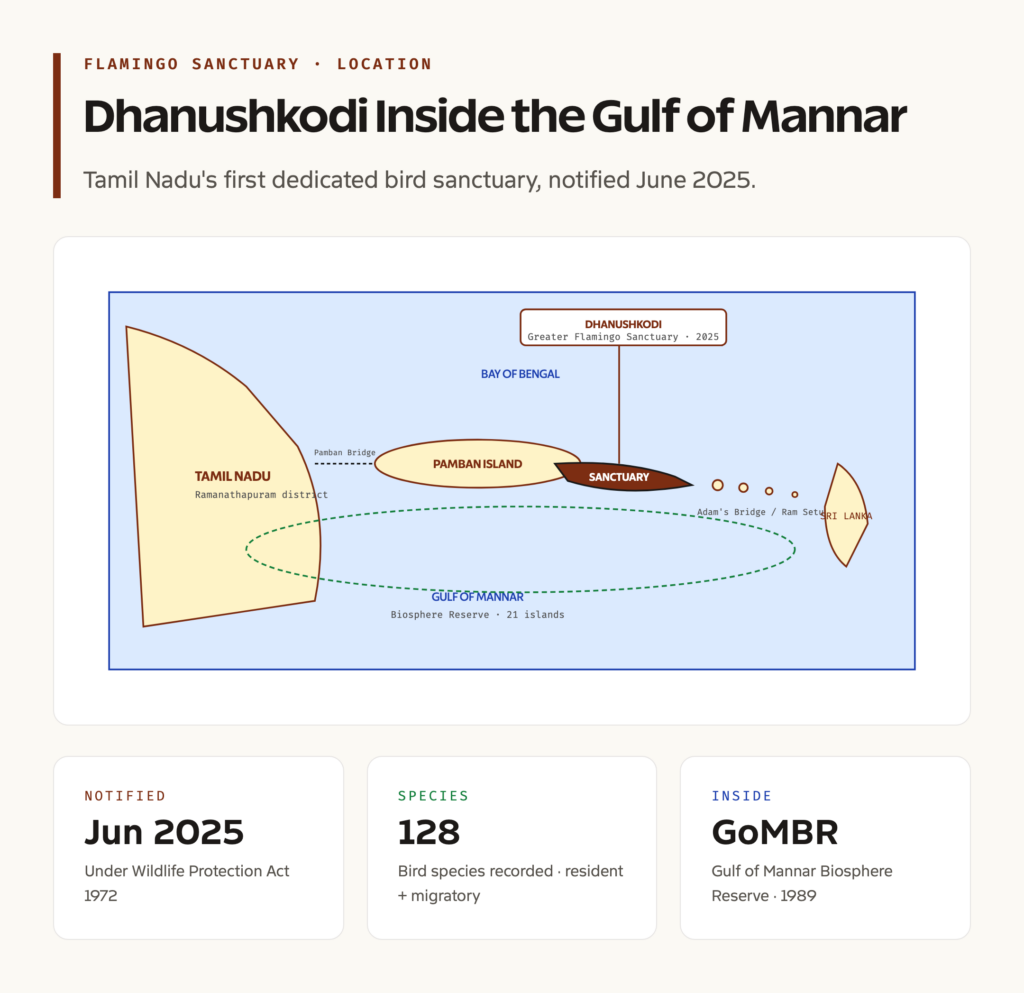
In June 2025, the Tamil Nadu government formally notified India’s first sanctuary dedicated primarily to the Greater Flamingo. The site sits at Dhanushkodi, on the southern tip of the Pamban Island in Ramanathapuram district, where the land thins to a sand spit and the Indian Ocean and the Bay of Bengal meet. The new wildlife sanctuary protects mangroves, mudflats, marshes, shallow lagoons, and sand dunes. It supports 128 recorded bird species, including both the Greater Flamingo and the Lesser Flamingo, and serves as a critical stopover on the Central Asian Flyway.
The notification matters for two reasons. The first is ecological. The Gulf of Mannar coastline has long been recognised as one of the most biologically rich stretches of the Indian seaboard, but most existing protection has centred on coral reefs, sea grass, and dugongs. Birds had no dedicated sanctuary in the area. The second is strategic. The sanctuary sits at one of the world’s nine major flyways. Protecting Dhanushkodi closes a gap on a migratory corridor that runs from Arctic Russia and Central Asia through India to the Indian Ocean.
This article explains what the sanctuary is, why Dhanushkodi was the obvious site, what species use it, how it slots into India’s wetland and flyway commitments, and what the GS-III syllabus expects students to know.
Quick Facts on the Greater Flamingo Sanctuary
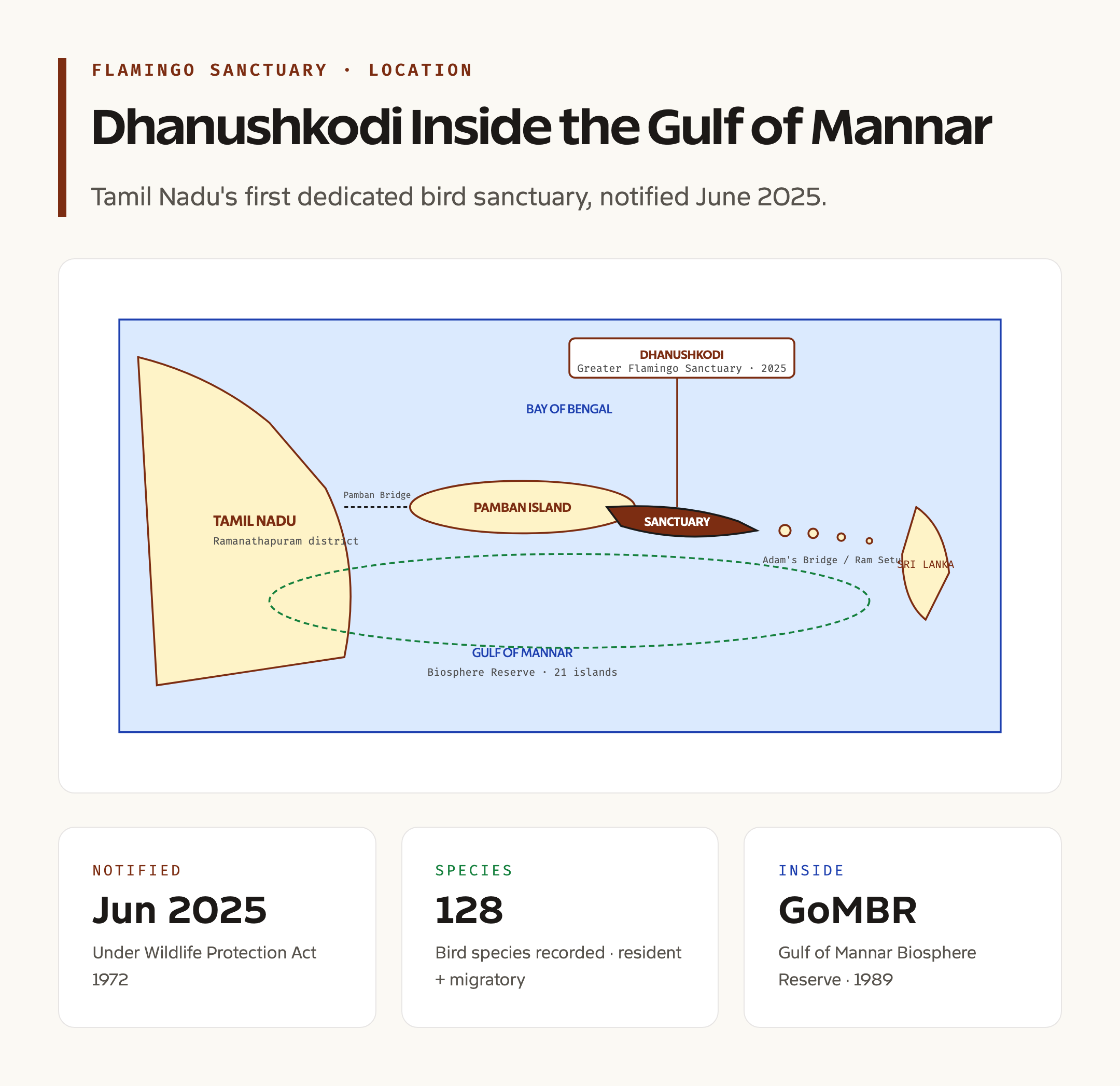
The sanctuary is located at Dhanushkodi in Ramanathapuram district, Tamil Nadu. It lies within the larger Gulf of Mannar Biosphere Reserve. It was declared a wildlife sanctuary in June 2025 by the Government of Tamil Nadu under the Wildlife Protection Act 1972.
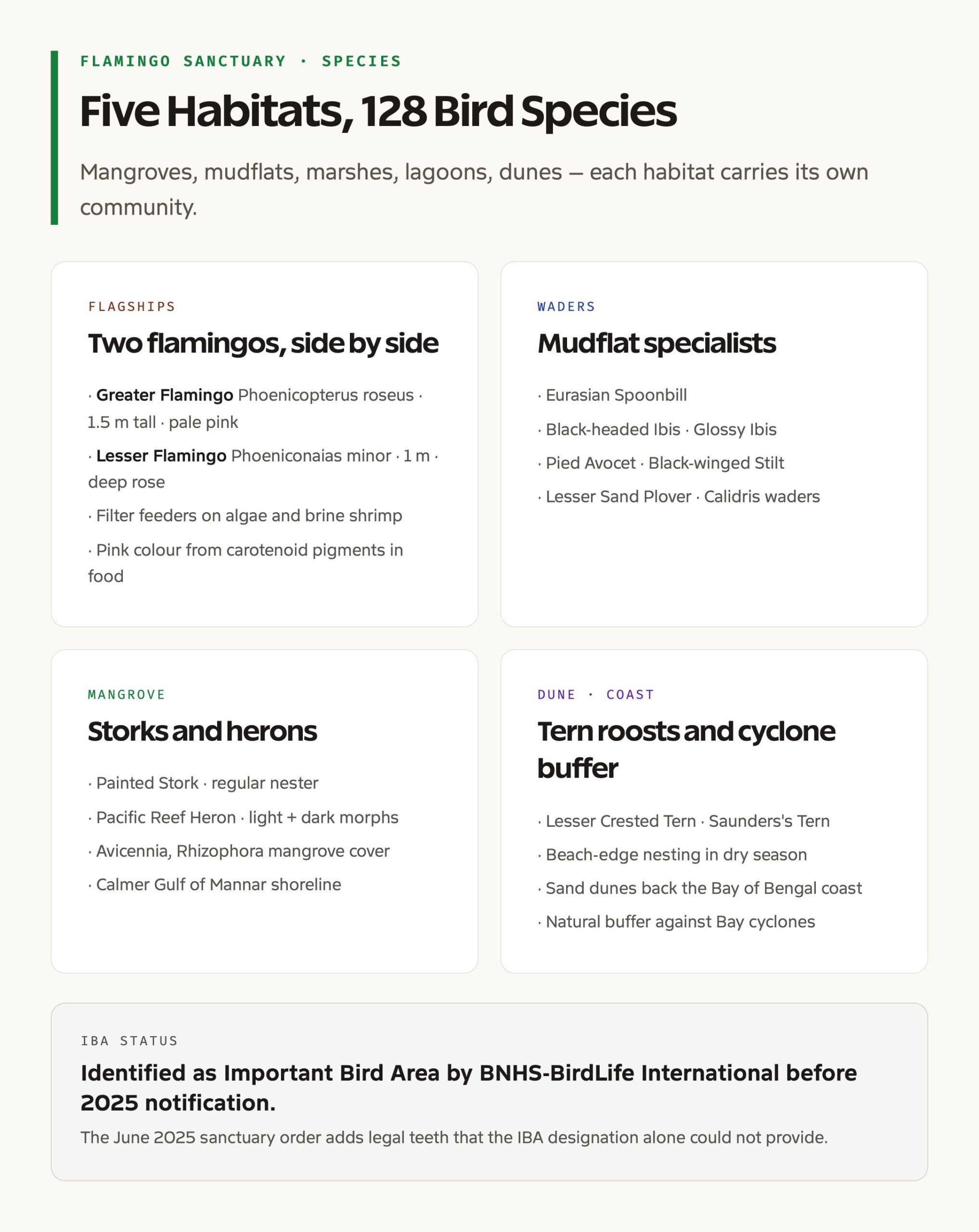
The protected habitat mosaic includes mangroves, intertidal mudflats, salt marshes, shallow coastal lagoons, and sand dunes. The sanctuary supports 128 species of birds, both resident and migratory. The two flagship species are the Greater Flamingo, scientifically Phoenicopterus roseus, and the Lesser Flamingo, scientifically Phoeniconaias minor. Other regularly recorded species include the Painted Stork, the Eurasian Spoonbill, the Pacific Reef Heron, the Pied Avocet, and several species of plovers, sandpipers, and terns.
The site is described as a critical stopover on the Central Asian Flyway, the migration corridor that links Siberian and Central Asian breeding grounds with wintering grounds across South Asia and East Africa. India hosts a substantial share of the flyway’s wintering population every year.
What the Sanctuary Covers
Dhanushkodi sits at the eastern end of Pamban Island. The island is connected to the Tamil Nadu mainland by the Pamban rail bridge and the road bridge that parallels it. The sanctuary covers the slender land tongue that extends east from the inhabited part of the island toward the chain of shoals known historically as Adam’s Bridge. The land is low, flat, and narrow, exposed to the Bay of Bengal on the north and the Gulf of Mannar on the south.
The five protected habitat types are stitched into one continuous wetland system. Mangrove patches, dominated by Avicennia and Rhizophora species, fringe the calmer Gulf of Mannar side. Intertidal mudflats expose at low tide and provide the feeding base for waders. Marshes and shallow lagoons hold standing water that supports the algae and brine shrimp on which flamingos depend. Sand dunes back the beaches, holding the shoreline against the seasonal cyclones that sweep across the Bay of Bengal.
Each habitat does a different job for a different group of birds. Flamingos prefer the lagoons and marshes for filter-feeding. Storks and herons use the mudflats. Plovers and sandpipers work the wet sand at the tidemark. Terns and gulls roost on the dunes and forage offshore. The mosaic is what makes 128 species coexist on a strip of land less than a few kilometres wide.
Why Dhanushkodi Was the Obvious Site
Dhanushkodi has supported large flamingo congregations for decades. Birdwatchers and the Bombay Natural History Society have reported flocks of several thousand individuals during the peak winter months. The combination of warm shallow water, abundant blue-green algae, and very limited human disturbance gives the birds the conditions they need.
The site is also a natural pinch point on the Central Asian Flyway. The Indian peninsula tapers southward, and the migratory flow funnels along the coast. Birds heading to Sri Lanka and East Africa cross at Dhanushkodi. Birds returning northward in spring use the same line in reverse. A sanctuary at this point protects more birds per unit area than a sanctuary further inland.
Tourism has been a complicating pressure. The 1964 cyclone that destroyed the original Dhanushkodi town left the area sparsely populated and ecologically intact, but the new road link to the tip and the rebuilt rail line have brought a steady trickle of visitors. The 2025 notification formalises a regime of zoning, restricted vehicle access, and seasonal entry restrictions designed to keep tourism compatible with bird protection.
The Greater Flamingo and the Lesser Flamingo
The two flagship species are similar at a casual glance and easy to tell apart up close. The Greater Flamingo is the larger of the two, standing up to one and a half metres tall, with pale pink plumage, a long pink-and-black bill, and the slow, stalking gait that defines the genus. The Lesser Flamingo is smaller, about a metre tall, with a deeper rose-pink colour and a darker, more uniformly red bill.
Both species are filter feeders. They sweep their bills upside down through the water, pump water through specialised lamellae, and extract small algae, brine shrimp, and other invertebrates. The pink colour comes from carotenoid pigments in the food. A bird denied carotenoids over a long period fades to white.
In India, the Greater Flamingo is the more widely distributed of the two and turns up at a long list of coastal and inland wetlands, including the Rann of Kutch, the Pulicat lagoon, and the Sewri-Thane creek complex on the Mumbai shore. The Lesser Flamingo is mostly confined to a smaller set of saline sites. Dhanushkodi supports both, which is unusual and adds to the sanctuary’s biological value.
Other Species and the Wider Bird Community
The 128-species count places Dhanushkodi among the richest single-site bird communities on the Indian east coast. The list includes resident species, winter migrants, passage migrants, and a handful of vagrants from outside the regional flyway.
The Painted Stork is a regular nester in the mangroves on the Gulf of Mannar side. The Eurasian Spoonbill, the Black-headed Ibis, and the Glossy Ibis use the mudflats and shallow water. The Pacific Reef Heron, both the dark and the white morph, hunts along the rocky shores. The Pied Avocet, the Black-winged Stilt, the Lesser Sand Plover, and several Charadrius and Calidris waders work the intertidal zone. Terns, including the Lesser Crested Tern and the Saunders’s Tern, nest on the dune-edged beaches in the dry season.
For the Bombay Natural History Society and BirdLife International partner network, Dhanushkodi has been an Important Bird and Biodiversity Area for years. The 2025 notification adds the legal protection that the IBA designation could not, by itself, deliver.
The Gulf of Mannar Biosphere Reserve Linkage
The new sanctuary lies inside the larger Gulf of Mannar Biosphere Reserve, India’s first marine biosphere reserve, designated in 1989. The biosphere reserve covers the chain of 21 islands between Rameswaram and Tuticorin, the surrounding marine waters, and the coastal land. Coral reefs, sea grass beds, mangroves, and dugong populations are the headline assets.
The bird sanctuary now plugs into this larger frame. Coastal marine protection on the Gulf of Mannar side combines with sand-spit and dune protection on the Bay of Bengal side. A single ecological unit, previously split between marine conservation and a hands-off treatment of the bird habitat, now sits inside one coherent regulatory regime. This is consistent with the broader pattern of layered protection that Indian conservation has been moving toward, as documented in Ramsar sites in India and in the network of biosphere reserves in India.
The Central Asian Flyway in Context
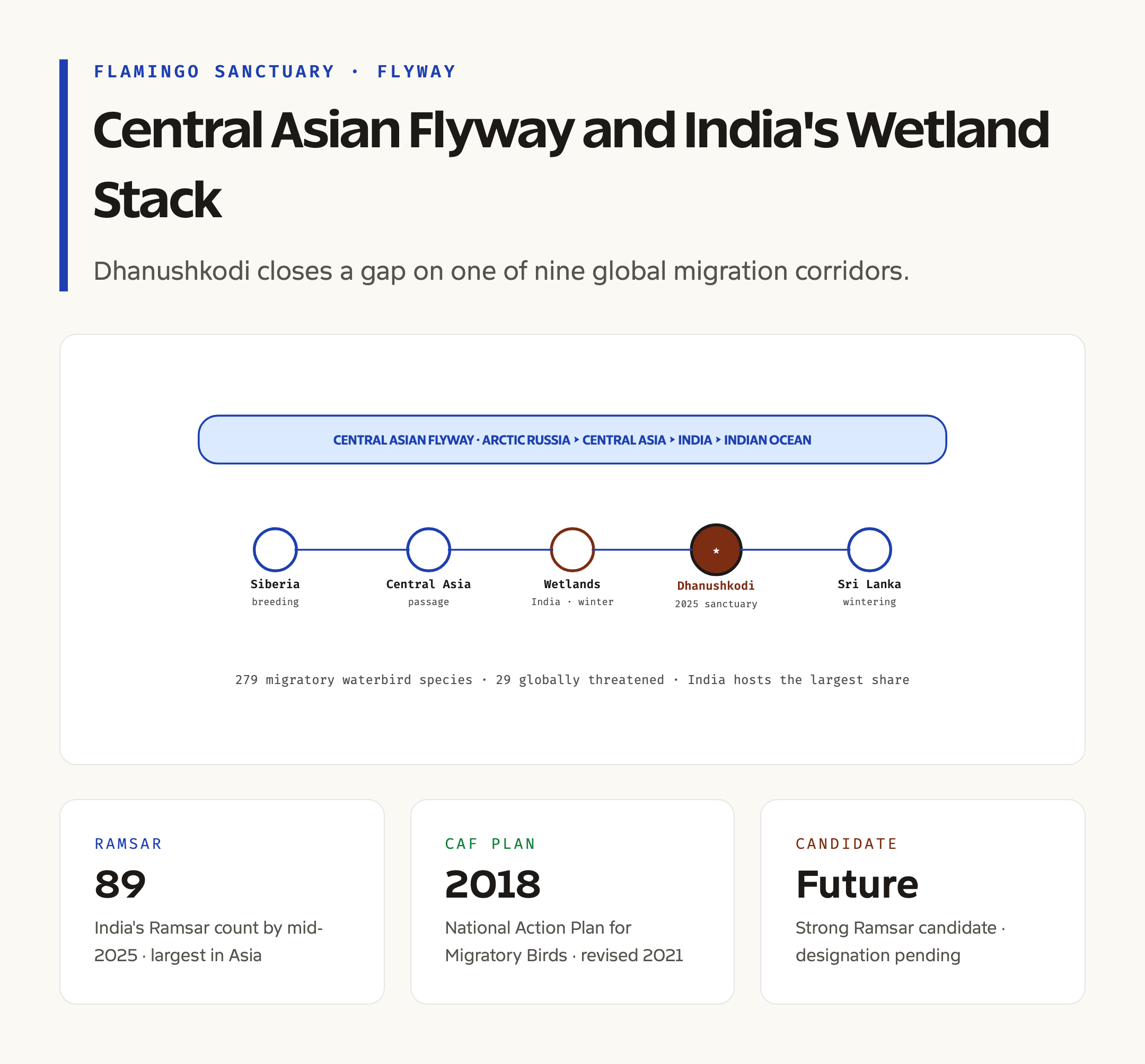
The Central Asian Flyway is one of nine major bird migration corridors recognised globally. It runs from the Arctic and sub-Arctic breeding grounds in Russia and the Central Asian republics, across Afghanistan and Pakistan, down through India, and into Sri Lanka, the Maldives, and the Indian Ocean wintering grounds. The flyway covers at least 279 migratory waterbird species, including 29 species classified as globally threatened.
India is the largest landmass on the corridor and hosts the largest share of wintering populations. The country’s wetlands, including the Ramsar-listed sites, function as fuel stops for migratory waterbirds. Loss of any major site is a loss of carrying capacity for the whole flyway. India ratified the National Action Plan for the Conservation of Migratory Birds along the Central Asian Flyway in 2018 and updated it in 2021. Dhanushkodi’s notification is a direct implementation of that action plan.
The connection to the Ramsar Convention is indirect but important. The Ramsar Convention on Wetlands of International Importance, signed in 1971, commits parties to designate and protect wetlands. India had 89 Ramsar sites by mid-2025, the largest count in Asia. Dhanushkodi is a strong candidate for future Ramsar listing, given its bird counts and flyway role, though it has not been formally added at the time of writing.
Why the Sanctuary Matters for India
Three pressures make the sanctuary timely. The first is coastal development. India’s east coast has seen heavy investment in ports, power plants, and tourism. Habitat fragmentation has accelerated. A formal sanctuary on a stretch this rich removes the option of unplanned land use change.
The second is climate change. Sea-level rise, more intense cyclones, and shifts in monsoon timing all affect coastal wetlands. Mangroves, mudflats, and lagoons respond differently to these pressures. A sanctuary that protects all five habitat types preserves the buffering function of the wetland mosaic and the ecological insurance that diversity provides.
The third is the Central Asian Flyway commitment. India’s reputation as a serious participant in the flyway depends on demonstrable protection of stopover sites. Dhanushkodi is now part of that demonstration.
Why This Matters for the UPSC Syllabus
For prelims, the safe set of facts is the location at Dhanushkodi in Ramanathapuram district, the placement within the Gulf of Mannar Biosphere Reserve, the June 2025 notification date, the 128 bird species count, the presence of both Greater and Lesser Flamingos, and the role as a Central Asian Flyway stopover.
For mains, the sanctuary fits into answers on coastal wetland conservation, the Central Asian Flyway, layered protected-area networks, and India’s flyway and Ramsar commitments. It pairs naturally with wetlands of India, the Wildlife Protection Act 1972, and latest added Ramsar sites in India.
Frequently Asked Questions
Where is the Greater Flamingo Sanctuary located?
At Dhanushkodi, in Ramanathapuram district, Tamil Nadu. The site sits on Pamban Island, within the larger Gulf of Mannar Biosphere Reserve.
When was the sanctuary declared?
The Tamil Nadu government formally notified the sanctuary in June 2025, under the Wildlife Protection Act 1972.
How many bird species does the sanctuary support?
The site supports 128 recorded bird species, including the Greater Flamingo, the Lesser Flamingo, the Painted Stork, the Eurasian Spoonbill, and a wide range of waders and terns.
What habitats does the sanctuary protect?
Five linked habitats: mangroves, intertidal mudflats, salt marshes, shallow coastal lagoons, and sand dunes.
Is the sanctuary a Ramsar site?
Not at the time of writing. It is a strong candidate, but no formal Ramsar designation has been notified yet. The site is, however, a critical stopover on the Central Asian Flyway.
Tell Google you want more of this.
Add Anantam IAS as a preferred sourceOne tap, and this site shows up more often in your own Top Stories, AI Overviews and AI Mode. Remove it any time.