Supreme Court on Election Commission: Appointments, Reforms, CEC Act
Supreme Court on Election Commission: the 2023 Anoop Baranwal verdict reshaped CEC and EC appointments. Read its evolution and UPSC angle.
The Supreme Court's interventions on the Election Commission have reshaped how India's constitutional election watchdog is appointed and held accountable. For decades, the Chief Election Commissioner (CEC) and Election Commissioners (ECs) were appointed by the President on the recommendation of the Prime Minister alone, with no statutory selection mechanism. In Anoop Baranwal v. Union of India (2023), a five-judge Constitution Bench held this practice unconstitutional and prescribed an interim collegium of the PM, Leader of Opposition, and CJI — only for Parliament to enact the CEC and Other ECs Act, 2023, which replaced the CJI with a Union Cabinet Minister. The tension between court and Parliament has made this area one of the most dynamic UPSC Polity topics.
Constitutional Basis: Article 324
The Election Commission of India (ECI) is established under Article 324 of the Constitution. Key features:
- Superintendence, direction and control of elections to Parliament, state legislatures, and the offices of President and Vice-President are vested in the ECI.
- The Commission consists of a Chief Election Commissioner and such other Election Commissioners as the President may fix.
- Appointments are made by the President.
- The CEC can only be removed in the manner and on the grounds of a Supreme Court judge — requiring a resolution by both Houses with special majority. Other ECs can be removed on the CEC's recommendation.
The ECI has been a three-member body since 1993, when two additional commissioners were appointed under the T.N. Seshan-era reforms.
Pre-2023 Appointment Process
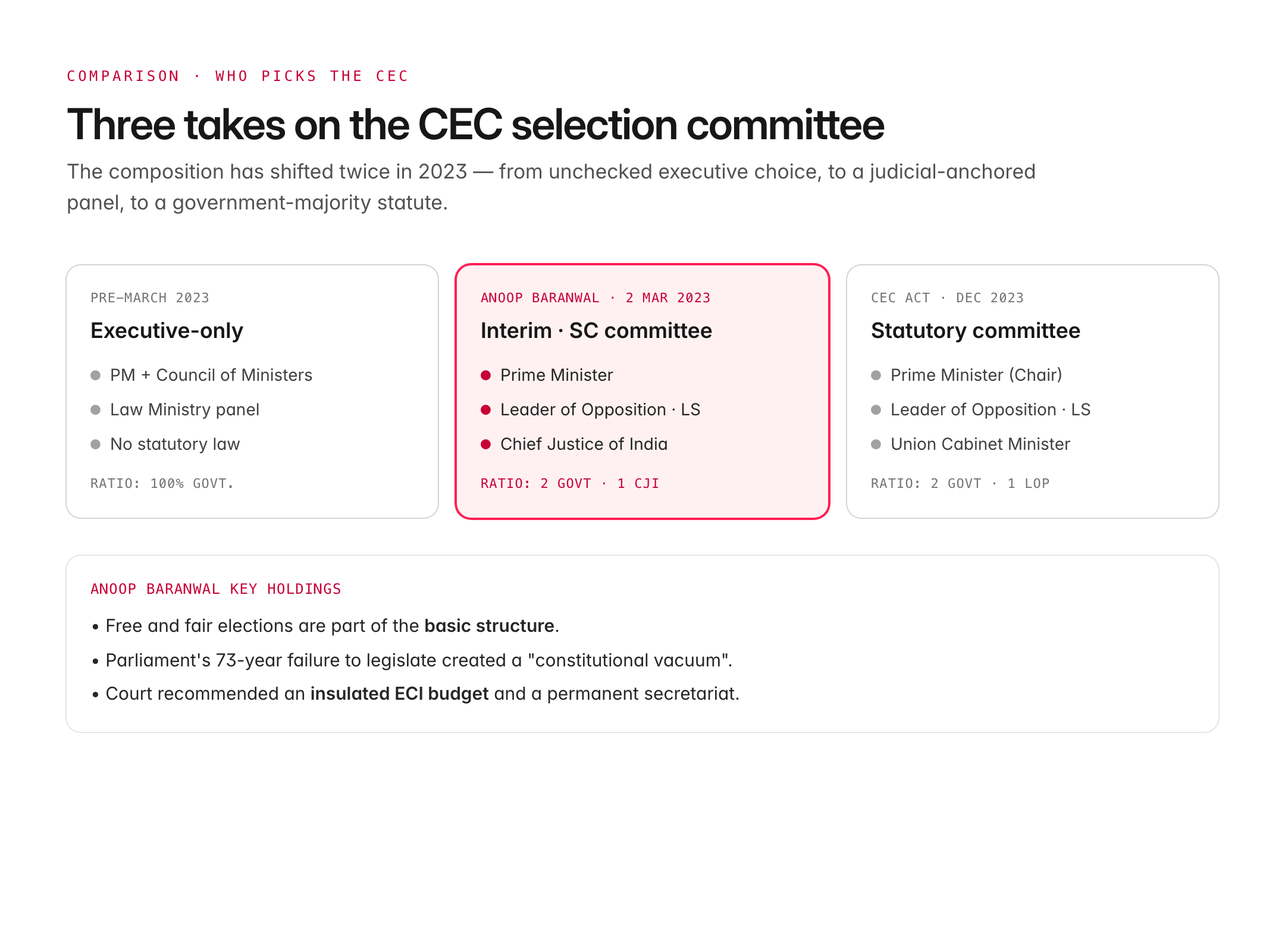
Until March 2023, the CEC and ECs were appointed exclusively on the advice of the Union Council of Ministers, usually through the Law Ministry's panel recommended to the Prime Minister. There was no statutory law governing the appointment, even though Article 324(2) explicitly states that appointments shall be "subject to the provisions of any law made in that behalf by Parliament."
This gap meant the executive enjoyed unchecked discretion, raising concerns about institutional independence — especially given the ECI's duty to regulate the ruling party itself during elections.
Anoop Baranwal Judgment, 2023
In Anoop Baranwal v. Union of India (2 March 2023), a five-judge Constitution Bench led by Justice K.M. Joseph unanimously held that the executive-only appointment process violated the constitutional scheme. Key holdings:
- The right to free and fair elections is part of the basic structure of the Constitution.
- Article 324(2) envisaged a parliamentary law, and Parliament's failure to enact one for over seven decades amounted to a "constitutional vacuum."
- Until Parliament legislated, the CEC and ECs would be appointed on the recommendation of a three-member committee comprising the Prime Minister, Leader of the Opposition in Lok Sabha, and the Chief Justice of India.
- The Court also recommended steps to insulate the budget of the ECI and provide a permanent secretariat, as with the Supreme Court registry.
The judgment was welcomed as a landmark on institutional independence, borrowing the CBI-style Vineet Narain template for the election watchdog.
CEC and Other ECs Act, 2023
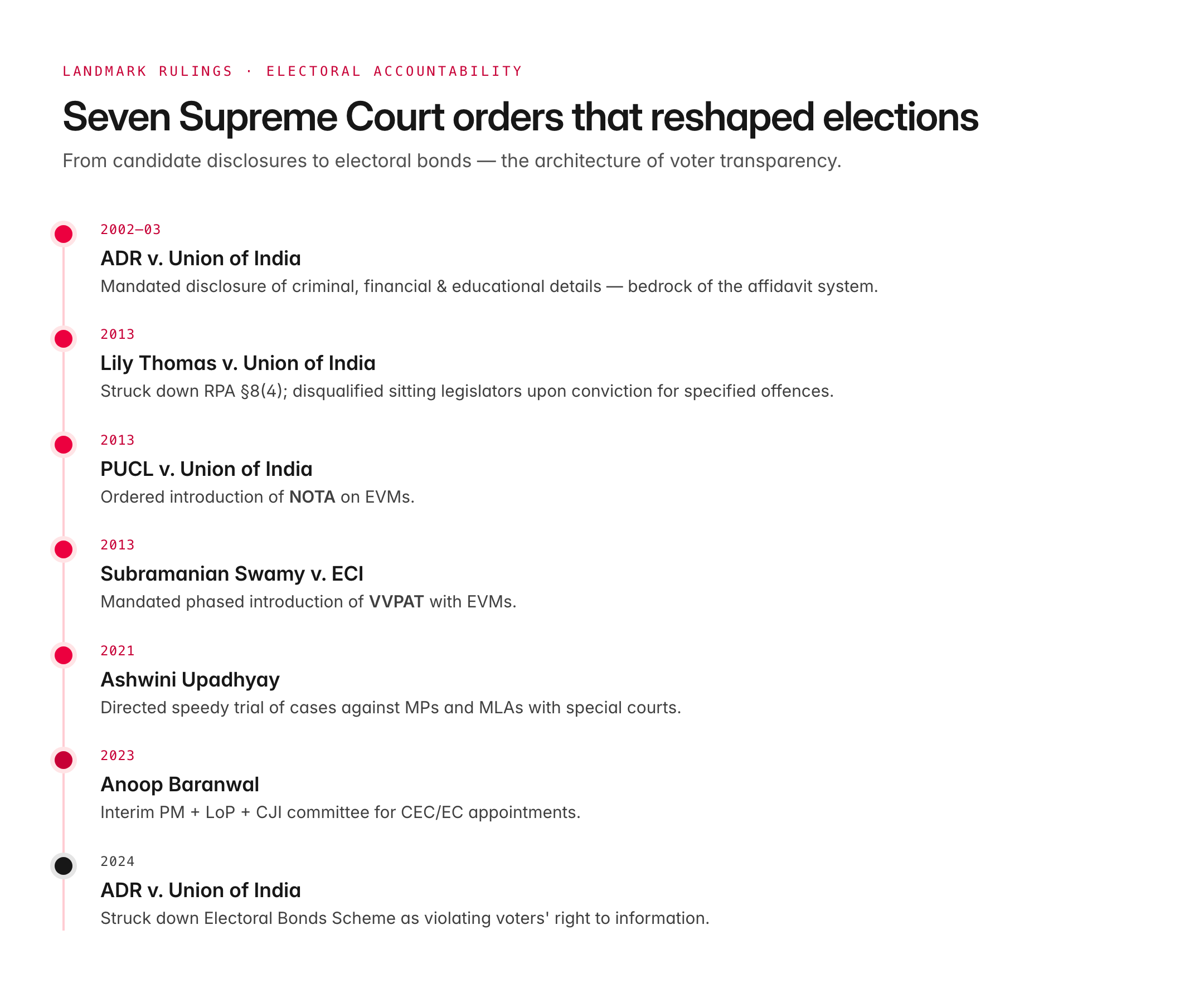
Parliament responded swiftly with the Chief Election Commissioner and Other Election Commissioners (Appointment, Conditions of Service and Term of Office) Act, 2023, passed in December 2023.
Key features of the Act:
| Provision | Detail |
|---|---|
| Selection Committee | Prime Minister (Chair), Leader of Opposition in Lok Sabha, Union Cabinet Minister nominated by PM |
| Search Committee | Headed by Cabinet Secretary; shortlists five names |
| Eligibility | Persons holding or having held a post equivalent to the rank of Secretary to Government of India |
| Term | Six years or up to age 65, whichever earlier |
| Salary | Equated with Supreme Court judge (originally sought parity with Cabinet Secretary, revised after criticism) |
The Act replaced the CJI with a Union Cabinet Minister, giving the government a 2-1 majority on the selection committee. Petitions challenging this composition are currently pending before the Supreme Court.
Other Supreme Court Interventions
Over decades, the Court has expanded the ECI's remit and accountability:
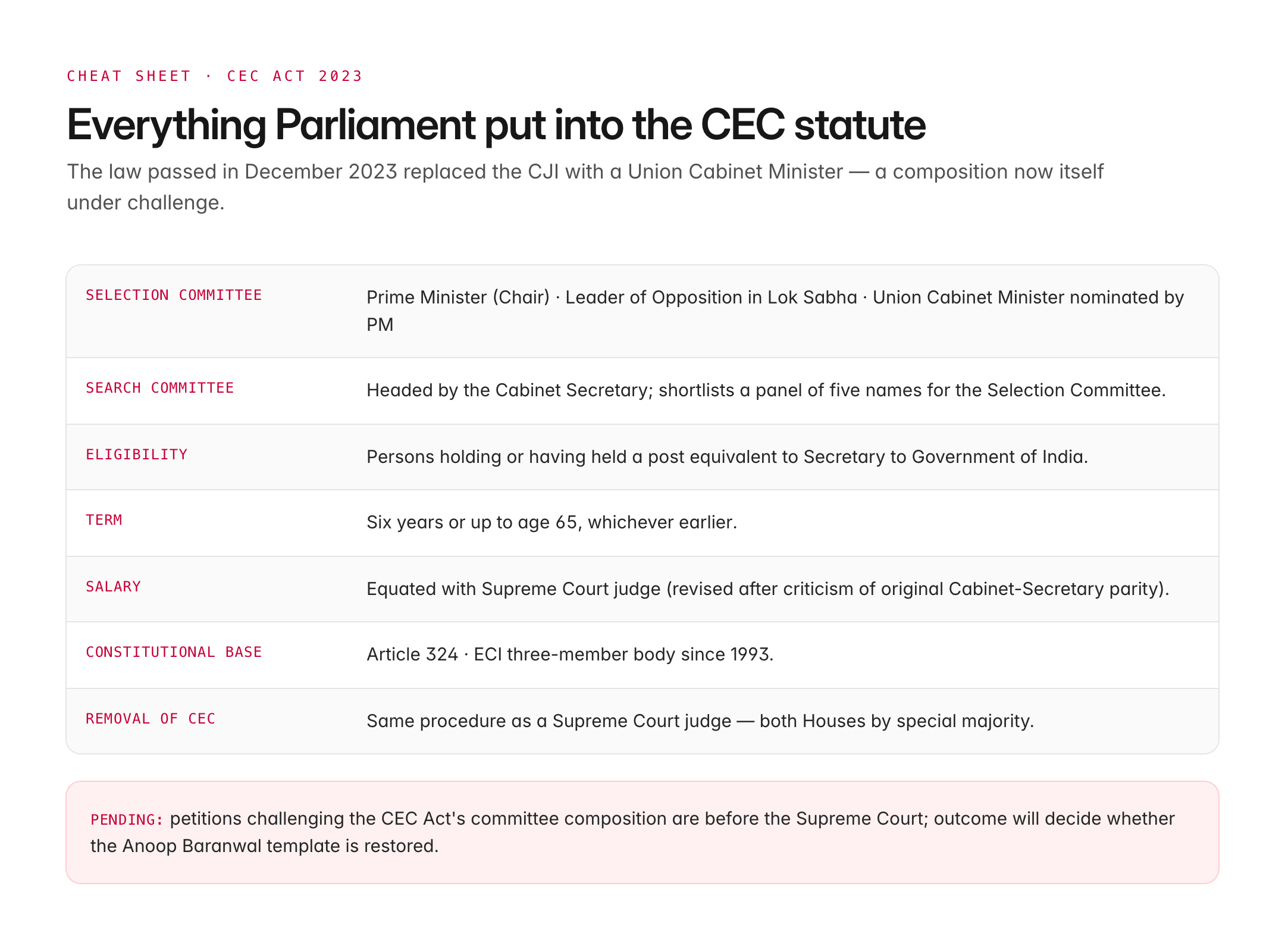
- Union of India v. Association for Democratic Reforms (2002, 2003): Mandated disclosure of criminal, financial, and educational details by candidates — the bedrock of today's affidavit system.
- Lily Thomas v. Union of India (2013): Struck down Section 8(4) of the RPA, disqualifying sitting legislators immediately upon conviction for certain offences.
- PUCL v. Union of India (2013): Ordered the introduction of NOTA (None of the Above) on EVMs.
- Subramanian Swamy v. ECI (2013): Mandated phased introduction of VVPAT with EVMs.
- Ashwini Kumar Upadhyay v. Union of India (2021): Directed speedy trial of cases against MPs and MLAs, with special courts.
- Association for Democratic Reforms v. Union of India (2024): Struck down the Electoral Bonds Scheme as unconstitutional for violating the right to information of voters.
These rulings together form an architecture of electoral transparency and accountability.
Significance and Ongoing Debates
The Court's engagement with the Election Commission matters because:
- Institutional independence. Free and fair elections depend on an autonomous ECI, not on a body beholden to the executive.
- Voter rights. Judgments on candidate disclosures, NOTA, VVPAT, and electoral bonds have progressively empowered voters.
- Checks and balances. The Court has balanced Parliament's legislative competence with the constitutional vacuum when Parliament failed to act.
Ongoing debates include:
- Whether the CEC Act, 2023 composition respects the spirit of Anoop Baranwal.
- Whether the ECI should have an independent secretariat and budget akin to the Supreme Court.
- How to ensure cyber security and integrity of EVMs/VVPATs in the face of repeated petitions.
UPSC Relevance
Prelims focus: Article 324, number of ECs (three since 1993), Anoop Baranwal (2023) interim committee (PM, LoP, CJI), CEC Act 2023 committee (PM, LoP, Union Cabinet Minister), tenure (six years or age 65), NOTA (2013), VVPAT phased rollout, electoral bonds verdict (2024).
Mains GS angle:
- GS II — statutory, regulatory and quasi-judicial bodies; appointment to various constitutional posts; powers, functions and responsibilities of constitutional bodies.
- Critical evaluation of judicial activism vs. legislative supremacy in the context of the ECI.
- Electoral reforms — disclosure, criminalisation of politics, electoral bonds, simultaneous elections.
Sample PYQ angle: Past UPSC questions have asked about the appointment and independence of the Election Commission and whether reforms are needed. A strong answer lays out Article 324, narrates the Anoop Baranwal verdict, compares the interim and statutory committees, and ends with a balanced view recommending a bipartisan committee including the CJI, an independent secretariat, and fully insulated ECI finances to match the Court's vision of free and fair elections as basic structure.