Supreme Court Verdict on Modification of Arbitral Awards: Gayatri Balasamy v. ISG Novasoft and the Limits of Section 34
Gayatri Balasamy v. ISG Novasoft (2025) explained: 4:1 Constitution Bench ruling on whether courts can modify arbitral awards under Section 34 of the Arbitration Act, four narrow grounds, dissent and the M. Hakeem departure.
The promise of arbitration is finality. Two parties pick a forum, agree on arbitrators, and accept the award as a binding commercial verdict that closes the dispute without the long tail of court appeals. That promise has been under quiet strain in India for over a decade. Section 34 of the Arbitration and Conciliation Act, 1996 says a court can set aside an award on narrow grounds, but stops short of saying the court can modify it. For years, parties have asked judges to do something the statute does not explicitly authorise, and judges have inched toward a workable answer.
The Supreme Court delivered that answer in Gayatri Balasamy v. ISG Novasoft Technologies Ltd. in 2025. A five-judge Constitution Bench led by Chief Justice Sanjiv Khanna ruled by a 4:1 majority that courts do hold a “limited power” to modify arbitral awards under Section 34. The judgment overruled the position taken in NHAI v. M. Hakeem in 2021, where the Court had said the Section 34 power was confined to setting aside or refusing to set aside, with no halfway option. The shift is narrow but consequential, and it touches every commercial dispute in India that ends in an arbitral tribunal.
This guide walks through the verdict in detail. It covers the facts, the four grounds on which modification is now permitted, the dissent that warns of judicial overreach, the statutory text of Section 34, the comparative position in other jurisdictions, and the implications for commercial litigation.
Quick Facts on the Modification Verdict
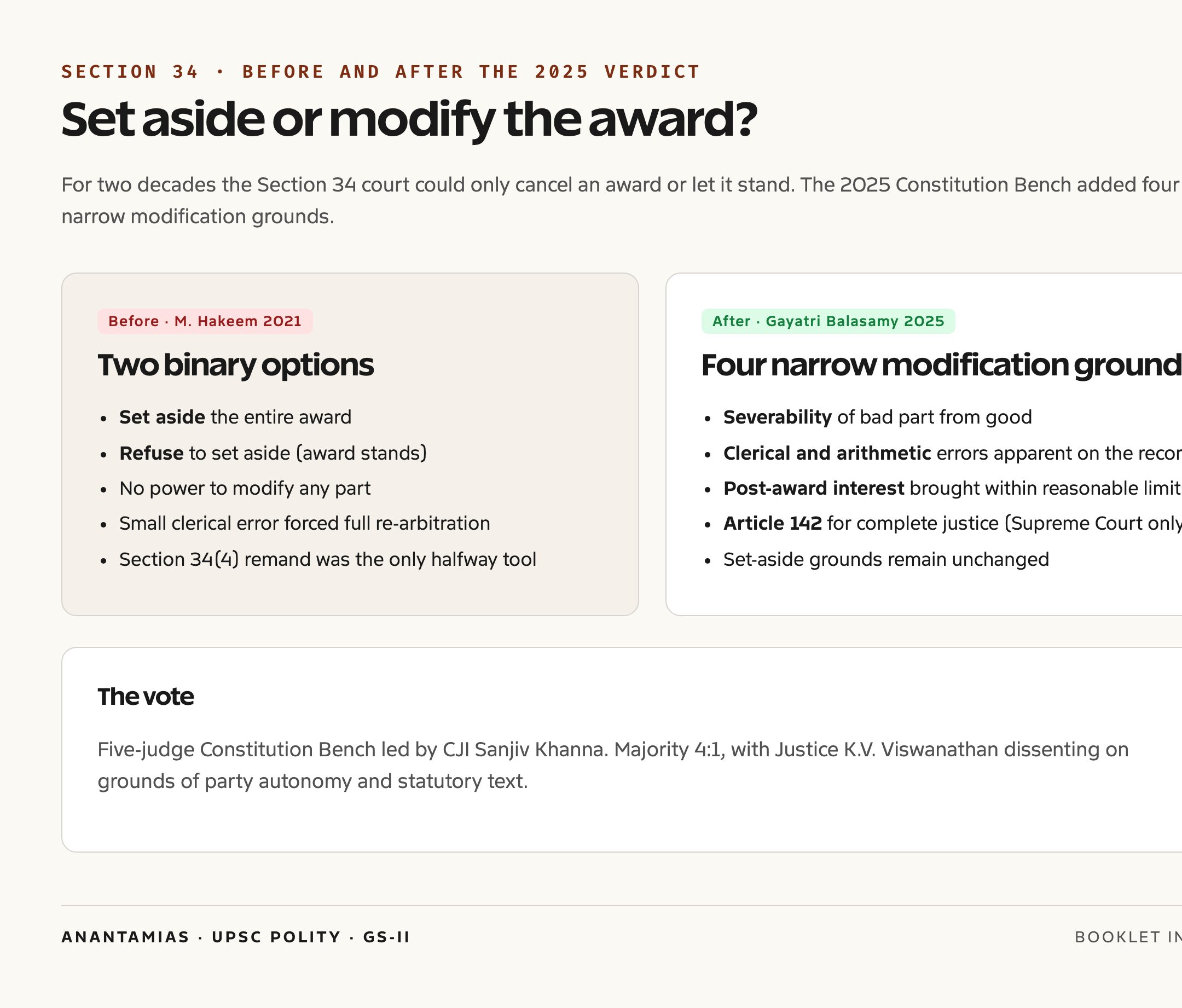
The case is Gayatri Balasamy v. ISG Novasoft Technologies Ltd., decided in 2025 by a five-judge Constitution Bench of the Supreme Court. The bench was led by Chief Justice Sanjiv Khanna. The majority comprised four judges, with Justice K.V. Viswanathan dissenting. The majority held that Section 34 of the Arbitration and Conciliation Act, 1996 carries a limited implied power to modify an arbitral award. Modification is permitted on four narrow grounds: severance of the bad part from the good, correction of clerical, typographical or arithmetic errors apparent on the face of the record, modification of post-award interest, and exercise of Article 142 power by the Supreme Court alone. The judgment overruled the contrary position laid down in NHAI v. M. Hakeem in 2021. The Indian supreme court now sits closer to the position in jurisdictions that allow narrow judicial correction of awards while preserving the principle of party autonomy.
What the Modification Question Actually Is
Section 34 of the 1996 Act is the gateway for any judicial challenge to an arbitral award in India. The provision tells a court what it may do when asked to interfere with an award. The text uses two operative ideas. The first is “set aside”, which means the entire award is cancelled. The second is the implication that the court can refuse to set aside, which means the award stands. Until 2025, the dominant reading was that these were the only two options.
The modification question is whether the Section 34 court can do something between these two. Can it strike down a small part of the award, leave the rest intact, and fix an obvious clerical mistake? Can it cap a runaway interest rate? Can it use a narrow surgical power to do justice without sending the parties back into a fresh arbitration that might take another five years? The statutory text is silent. The Constitution Bench has now answered yes within four narrow grounds.
Background and Historical Context
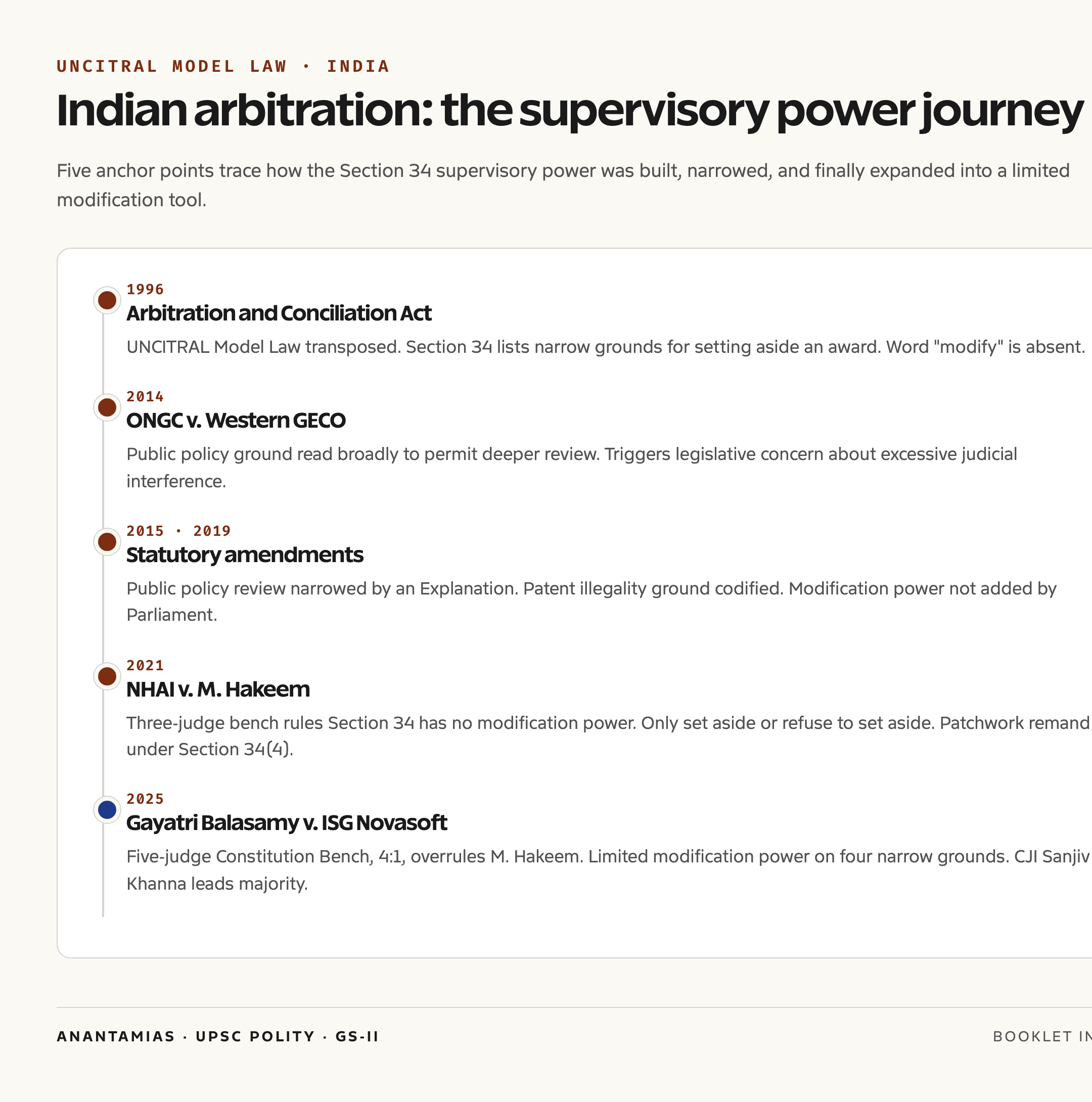
Indian arbitration law has moved through three legislative phases. The Arbitration Act of 1940 ran the field for over half a century and was widely criticised for permitting too much judicial interference. The Arbitration and Conciliation Act of 1996 replaced it, drew heavily on the UNCITRAL Model Law, and aimed to make Indian arbitration internationally credible. The 1996 Act was amended substantively in 2015 and again in 2019 to speed up timelines, professionalise institutional arbitration, and tighten the Section 34 grounds.
The Section 34 question kept returning to the courts. In ONGC v. Western GECO in 2014, the Supreme Court read the public policy ground broadly enough to permit a deeper review of awards. The 2015 amendment narrowed that opening by inserting an Explanation that public policy review does not amount to a review on merits. Then came the modification question. In Project Director, NHAI v. M. Hakeem in 2021, a three-judge bench of the Supreme Court held that the Section 34 power did not include the power to modify. The Court read the statute strictly, looked at comparative practice, and ruled that allowing modification would convert the supervisory court into an appellate one.
The M. Hakeem position had two practical effects. First, when a Section 34 court found a small slice of the award unsustainable, it had to either let the entire award stand or send the matter back for fresh arbitration on the limited point. Second, parties learnt to plead total set-aside even when they really wanted only a small fix, because that was the only remedy on offer. The result was longer litigation and more pressure on the supervisory court.
Inside the Gayatri Balasamy Verdict
The reference to a Constitution Bench grew out of the unease with M. Hakeem. The Court framed the question narrowly: does Section 34 permit any modification, and if so on what grounds. The four-judge majority answered yes on four grounds.
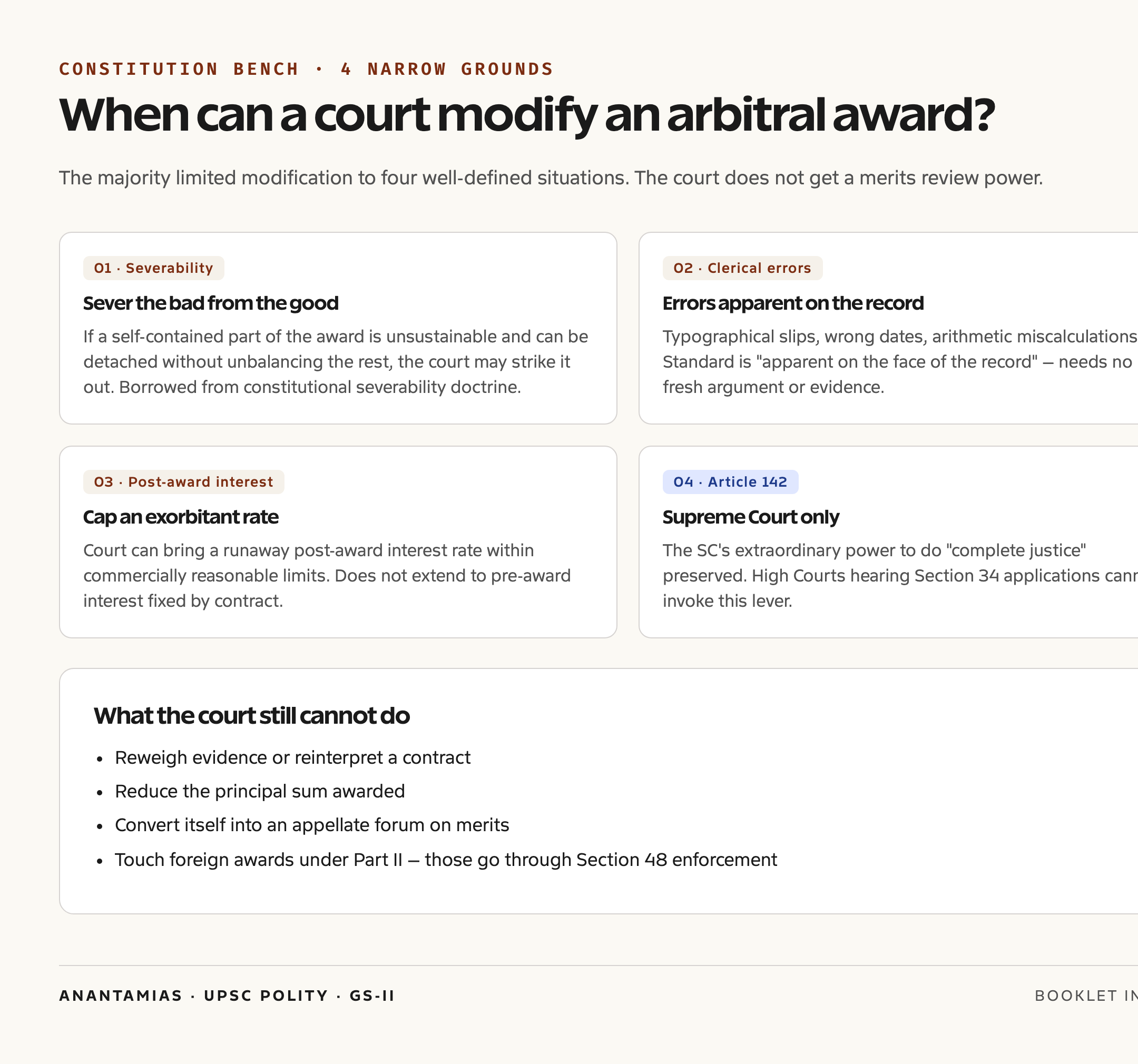
The first ground is severability. If the impugned part of the award is severable from the rest, the court may strike down only that part. The doctrine of severability is borrowed from constitutional law and is well known in Indian jurisprudence on the basic structure doctrine. Applied to an arbitral award, severability means that a self-contained section, like a particular claim or counter-claim, can be removed without unravelling the rest of the award.
The second ground is correction of obvious errors. Clerical, typographical and arithmetic errors apparent on the face of the record can be fixed by the Section 34 court. The majority held that forcing parties back into arbitration to correct a sum or a date is disproportionate. The fix is a textbook judicial function.
The third ground is post-award interest. Arbitrators sometimes fix interest rates that, on a long money decree, lead to outcomes the parties never bargained for. The majority allowed the Section 34 court to bring an exorbitant post-award interest rate within reasonable limits, while leaving the substantive award untouched. The pre-award interest, fixed by reference to the contract or commercial practice, is not on the table.
The fourth ground is Article 142. Only the Supreme Court can use Article 142 to do “complete justice”, and the majority preserved that exclusive constitutional power for unusual cases. The High Court sitting under Section 34 does not have this lever.
Why the Verdict Matters
The verdict matters because it changes the architecture of commercial dispute resolution. Three shifts deserve attention. First, parties no longer face the binary of total set-aside or total surrender. A small clerical error or a single severable claim no longer threatens the entire award. The transactional cost of a Section 34 challenge falls.
Second, the verdict reduces remand. The 1996 Act allows a Section 34 court to remit specific issues to the tribunal under Section 34(4), but remand assumes the tribunal is still functional and willing to take up a sliver of the dispute years later. In practice, remand is slow and uncertain. A direct surgical modification by the court avoids this loop.
Third, the verdict tightens the supervisory role of the court. The four grounds are narrow and well defined. The majority was careful to say that the modification power is not a backdoor to a merits review. The court still cannot reweigh evidence or reinterpret a contract. The line is drawn around clerical and computational errors, severability, and a narrow interest cap.
Detailed Analysis: The Four Grounds Read Carefully
Severability is the strongest of the four grounds because it has independent constitutional pedigree. The doctrine separates the bad from the good in any legal instrument and saves what can stand alone. For arbitral awards, the test is whether the surviving part can function as a coherent award without the severed part. If the severed claim is so entangled with the rest that removing it would alter the financial logic of the award, severance is not available.
Correction of obvious errors is the simplest ground. The standard is “apparent on the face of the record”. A typographical slip, a wrong year, an arithmetic miscalculation in the interest table, all qualify. The standard does not extend to a disagreement with the arbitrator’s reasoning. If an error needs evidence or argument to surface, it is not apparent on the face of the record.
Post-award interest modification is the most contested of the four grounds. The majority recognised that post-award interest is often the largest line item in a long-running arbitration. An exorbitant rate, compounded over years of court appeals, can dwarf the principal. The court can now bring the rate within a reasonable range. The dissent worried that this opens a door for indirect merits review, but the majority held that the rate, unlike the substantive claim, is a forward-looking judicial input.
The Article 142 power is reserved for the Supreme Court. This is not new law. Article 142 has been used to do complete justice in extraordinary cases, and the majority simply confirmed that an arbitral award is not a no-go zone for this power. The High Court Section 34 judges cannot invoke it.
The Dissent: Justice Viswanathan’s Caution
Justice K.V. Viswanathan filed a sole dissent. The dissent did not deny that judicial intervention to fix obvious errors is sensible. It argued that Section 34 is a complete code, that the legislative scheme is deliberate, and that any expansion of the supervisory power should come from Parliament, not from the bench. Three points run through the dissent.
The first is party autonomy. Arbitration is a creature of contract. Parties choose arbitrators, accept their reasoning, and waive the right to a regular court process. A judicial power to modify, even if narrow, intrudes on this choice and turns the supervisory court into a quasi-appellate one. The dissent held that the principle of minimal intervention, written into Section 5 of the 1996 Act, should be the controlling guide.
The second is statutory text. Section 34 uses the word “set aside” and nothing else. To read in a power to modify is to legislate from the bench. The 2015 and 2019 amendments did not insert a modification power, even though the issue was live during the legislative debates. Parliamentary silence after sustained judicial controversy should be read as deliberate.
The third is comparative practice. Most pro-arbitration jurisdictions, including those that follow the UNCITRAL Model Law closely, do not allow merits-based modification. The dissent argued that the majority’s narrow grounds will not stay narrow. The interest cap in particular invites parties to recharacterise their disagreement with the merits as a disagreement with the rate.
Comparative Position in Major Jurisdictions
A short comparative scan helps frame the Indian shift. The English Arbitration Act, 1996 allows the court to confirm, vary, or set aside an award on appeal under Section 69, but only on a question of law and only with leave of court or party agreement. Variation in England is a more explicit power than the Indian “modification”, though it sits behind a narrow leave gate.
The UNCITRAL Model Law, which underpins arbitration statutes in over 80 jurisdictions, allows the supervisory court only to set aside an award. Singapore, Hong Kong, and most Model Law jurisdictions follow this strict bifurcation. The Indian 1996 Act is a Model Law statute, which is why M. Hakeem read Section 34 strictly. The Gayatri Balasamy majority departs from the strict Model Law line, but only for the narrow grounds identified.
The United States Federal Arbitration Act has a separate provision for modification under Section 11, which lists evident miscalculation, an award upon a matter not submitted, and imperfections in form. The Indian majority’s approach broadly tracks the US Section 11 grounds, with the addition of severability and the Article 142 carve-out.
Challenges and Open Questions
Three challenges are visible already. The first is the boundary of “post-award interest” modification. The majority did not lay down a numerical safe harbour. Lower courts will have to develop a body of case law on what counts as exorbitant. Until that crystallises, every interest rate above the bank lending rate will be a litigation invitation.
The second is the severability test in complex commercial awards. Construction and infrastructure arbitrations often involve dozens of intertwined claims. Identifying a self-contained sliver that can be severed without unbalancing the rest will be fact intensive and judge sensitive.
The third is the relationship between modification and Section 34(4) remand. If the court can modify directly, when should it remit? The majority hints that remand is appropriate when the issue requires fresh evidence, while modification fits clerical or computational matters. The line is workable but will be tested in dozens of writ and miscellaneous applications over the next few years.
Prelims Pointers
The case is Gayatri Balasamy v. ISG Novasoft Technologies Ltd., 2025. The bench is a five-judge Constitution Bench of the Supreme Court. The Chief Justice on the bench is Justice Sanjiv Khanna. The majority is 4:1, with Justice K.V. Viswanathan dissenting. The provision in question is Section 34 of the Arbitration and Conciliation Act, 1996. The earlier position is NHAI v. M. Hakeem, 2021, which held that modification is not permitted. The four grounds for modification are severability, correction of obvious errors, modification of post-award interest, and Article 142 power available only to the Supreme Court. The case has not changed the public policy ground or the patent illegality ground for set-aside.
Mains Practice Questions
A typical GS-II question would be: “The Supreme Court verdict in Gayatri Balasamy v. ISG Novasoft has shifted the balance between judicial supervision and party autonomy in Indian arbitration. Critically examine the four grounds on which modification is now permitted and the dissent’s concerns about judicial overreach.” A second question could focus on the Indian arbitration regime in a comparative frame: “Compare the approach to judicial modification of arbitral awards in India after the 2025 Constitution Bench verdict with the position under the UNCITRAL Model Law and the English Arbitration Act, 1996.” A third option is a doctrinal question: “Severability is a constitutional doctrine adapted to arbitral awards. Discuss how the Supreme Court has applied severability in the Gayatri Balasamy verdict and identify the limits of this adaptation.”
Way Forward
The legislative response is the next milestone. A short amendment to Section 34, codifying the four grounds and tightening the boundaries, would reduce the litigation runway. Parliament could also clarify the relationship between Section 34(4) remand and the new modification power. The institutional response is equally important. Indian arbitral institutions like the Indian Arbitration Centre, Mumbai Centre for International Arbitration, and Delhi International Arbitration Centre can revise their model rules to address obvious errors at the tribunal stage, before parties reach a Section 34 court.
For commercial parties, the practical takeaway is simpler. Draft arbitration clauses with care. Insist on rigorous award checking before signature by the tribunal. Build in institutional review that catches clerical errors before they need a court to fix them. The verdict gives a new tool, but the cheapest fix is still the one that never reaches court.
Frequently Asked Questions
What did the Supreme Court rule in Gayatri Balasamy v. ISG Novasoft?
A five-judge Constitution Bench led by Chief Justice Sanjiv Khanna ruled by a 4:1 majority that courts have a limited power to modify arbitral awards under Section 34 of the Arbitration and Conciliation Act, 1996. Modification is permitted on four narrow grounds: severability of bad parts, correction of clerical or arithmetic errors apparent on the record, modification of post-award interest, and the Supreme Court’s Article 142 power. The judgment overruled NHAI v. M. Hakeem, 2021.
Which earlier judgment did the 2025 verdict overrule?
The verdict overruled Project Director, NHAI v. M. Hakeem, 2021, where a three-judge bench had held that the Section 34 power was confined to setting aside or refusing to set aside the award. M. Hakeem is no longer good law to the extent that it ruled out modification altogether.
Can a High Court use Article 142 to modify an award after this verdict?
No. Article 142 is a power available only to the Supreme Court under the Constitution. The majority specifically reserved the Article 142 ground to the Supreme Court. A High Court hearing a Section 34 application has the other three grounds: severability, correction of obvious errors, and post-award interest modification.
Does the verdict allow courts to reduce the principal sum in an arbitral award?
No. The four grounds do not extend to reweighing evidence or reducing the principal claim. The court cannot revisit the merits. The post-award interest modification is the closest the verdict comes to a quantum adjustment, and even there the modification is to bring the rate within a reasonable range, not to second-guess the substantive award.
Why did Justice Viswanathan dissent?
Justice K.V. Viswanathan dissented on three grounds. The 1996 Act is a complete code that uses only the words u0022set asideu0022 and does not authorise modification. Allowing modification, even narrowly, undermines party autonomy, which is the foundational principle of arbitration. The 2015 and 2019 amendments did not insert a modification power, despite the live controversy, and that legislative silence should be respected by the bench.
Does the verdict apply to international commercial arbitration seated in India?
Yes. Section 34 applies to all arbitrations seated in India, both domestic and international commercial arbitration. The four grounds are equally available in both kinds of cases. Foreign awards governed by Part II of the 1996 Act, however, are subject to enforcement and refusal under Section 48, not modification under Section 34.
Will the verdict speed up arbitration in India?
The verdict should reduce one source of delay. Earlier, a small error could trigger a total set-aside or a remand, both of which extended the timeline by years. The new modification power lets the supervisory court fix the error and close the case. Whether this translates into measurably faster arbitration depends on how lower courts apply the four grounds in practice.
Can post-award interest be increased by a Section 34 court?
The majority focused on reducing exorbitant post-award interest rates, not increasing them. The award-debtor will typically be the party seeking modification of an exorbitant rate. The award-holder who wants a higher rate would have had to challenge the original rate at the tribunal stage. The Section 34 court’s modification power on interest is most often used to bring a runaway rate down to a commercially reasonable level.
What is the difference between modification and remand under Section 34(4)?
Modification is a direct change made by the court itself within the four narrow grounds. Remand under Section 34(4) is a remission of specific issues back to the arbitral tribunal for reconsideration. The majority indicated that modification fits clerical, computational and severable issues, while remand is more appropriate when the issue requires fresh evidence or rearguing before the tribunal.
Does the verdict change the public policy or patent illegality grounds for set-aside?
No. The verdict is confined to the modification question. The grounds for setting aside an award under Section 34(2) and Section 34(2A), including violation of public policy and patent illegality on the face of the award, remain unchanged. Modification is an additional remedy, not a replacement for set-aside.