When a constitutional court strikes down a statute, the choice between excising one defective clause and demolishing the entire Act is rarely cosmetic. It decides whether thousands of administrative actions taken under the law continue, whether a transitional vacuum opens up, and whether a legislature has to redo its work from scratch. The Doctrine of Severability is the analytical tool that Indian courts use to make that choice. It allows a judge to separate the unconstitutional portion of a law from the rest and to declare void only what is genuinely inconsistent with the Constitution.
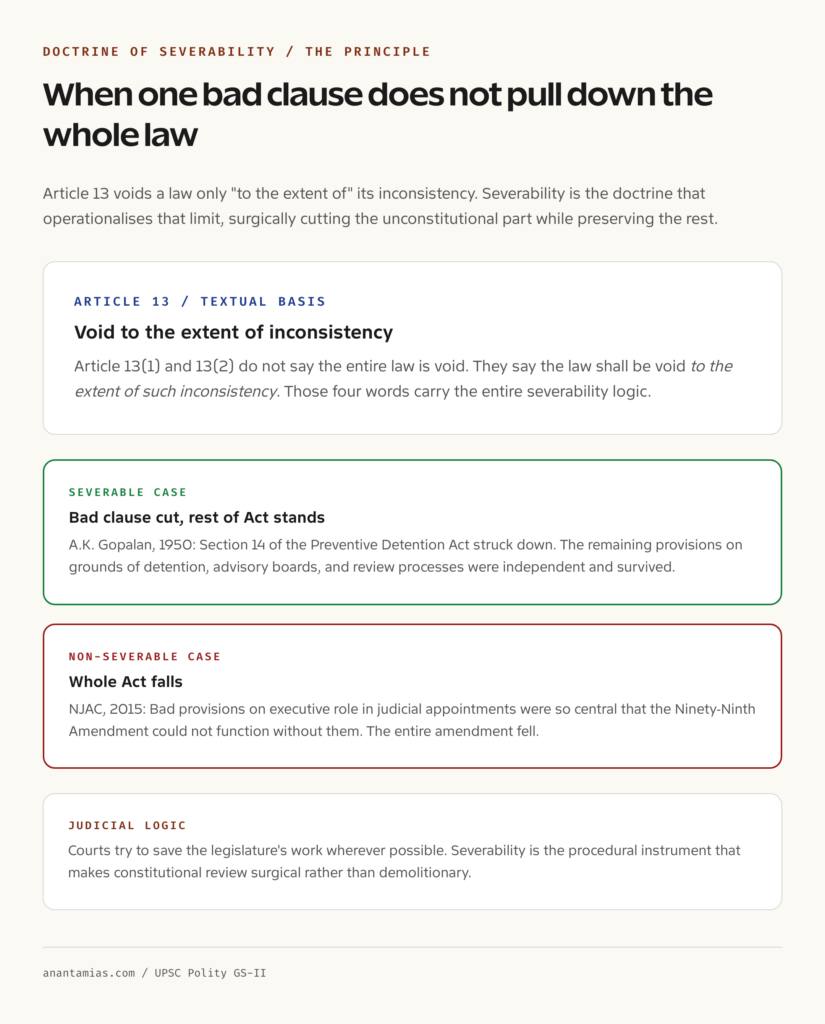
The doctrine flows directly from the language of Article 13. The Constitution does not say that a law inconsistent with Fundamental Rights is void in its entirety. It says the law is void “to the extent of such inconsistency.” That phrase carries the entire constitutional logic of severability. The Supreme Court has, over seven decades, built a working test out of those four words and applied it to questions ranging from preventive detention to constitutional amendments to the appointment of judges.
This guide walks through the meaning of the doctrine, its constitutional source, the operative test laid down in R.M.D. Chamarbaugwalla, the landmark applications including A.K. Gopalan and the NJAC case, the relationship with other doctrines like prospective overruling and reading down, and the prelims and mains pointers a UPSC aspirant should carry. The doctrine sits at the heart of the basic structure doctrine jurisprudence and the broader treatment of fundamental rights under Indian constitutional law.
Quick Facts on the Doctrine of Severability
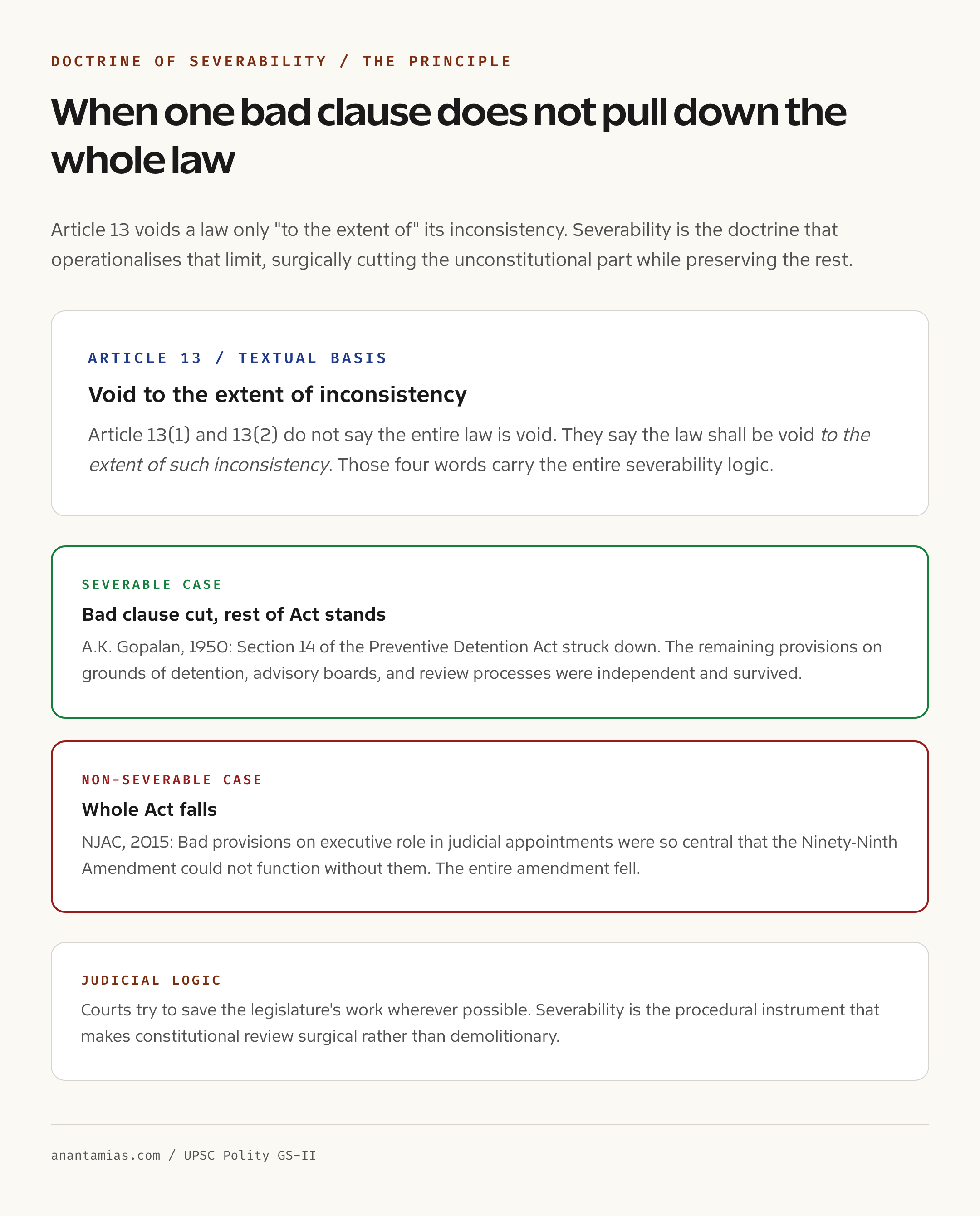
The Doctrine of Severability allows a court to strike down only the unconstitutional part of a law and let the rest survive. The constitutional source is Article 13, which says laws inconsistent with Fundamental Rights are void “to the extent of such inconsistency.” The leading authority on the operating test is R.M.D. Chamarbaugwalla v. Union of India, 1957. The three conditions of the test are distinctness, legislative intent, and survival capacity. A.K. Gopalan v. State of Madras, 1950, was the first major application, where Section 14 of the Preventive Detention Act was severed and the rest of the Act preserved. The NJAC case of 2015 is the leading example of a non-severable striking down, where the entire Ninety-Ninth Constitutional Amendment was held void because the unconstitutional core could not be separated from the surviving structure. The doctrine applies to both ordinary statutes and constitutional amendments.
What the Doctrine of Severability Means
The Doctrine of Severability is the principle that when a court finds a specific provision of a law to be unconstitutional, the court does not automatically strike down the entire law. Instead, the court asks whether the unconstitutional portion can be separated from the rest of the statute. If it can be, only the offending part is declared void. The remainder continues to operate as before. The technical term is “severability”; the older English term “separability” appears in the case law and means the same thing.
The doctrine reflects a respect for the legislative function. A court that strikes down an entire statute because of a single defective clause substitutes its own legislative judgment for that of the elected legislature. The Doctrine of Severability avoids that result wherever the surviving law can stand on its own and continue to express the legislature’s primary purpose. The judicial task is therefore narrow: identify the defect, isolate it, remove it, and let the rest of the statute remain in force.
Background and Constitutional Source
The constitutional source of the doctrine is Article 13 of the Indian Constitution. Article 13(1) states that all laws in force immediately before the commencement of the Constitution that are inconsistent with the Fundamental Rights provisions of Part III shall be void “to the extent of such inconsistency.” Article 13(2) extends the same principle prospectively: the State shall not make any law that takes away or abridges Fundamental Rights, and any law made in contravention of this clause shall, “to the extent of the contravention,” be void.
The operative phrase in both clauses is “to the extent of such inconsistency” or “to the extent of the contravention.” The Constitution’s framers used a calibrated formula. They did not say the law shall be void; they said the law shall be void to the extent it is inconsistent. That language carries the entire logic of severability. The Supreme Court has interpreted the phrase as a textual mandate to consider whether the offending portion can be separated and only that portion declared void.
The doctrine in its modern form predates the Indian Constitution. American courts had developed similar principles to deal with federal and state statutes that contained mixed valid and invalid provisions. British administrative law also recognised that a regulation could be partially struck down. The Indian Supreme Court, drawing on this comparative material and on the explicit textual basis in Article 13, codified the test in the 1957 ruling in R.M.D. Chamarbaugwalla v. Union of India. The doctrine is now a settled feature of Indian constitutional review and applies across statutes, subordinate legislation, and constitutional amendments.
The Three-Part Severability Test in R.M.D. Chamarbaugwalla
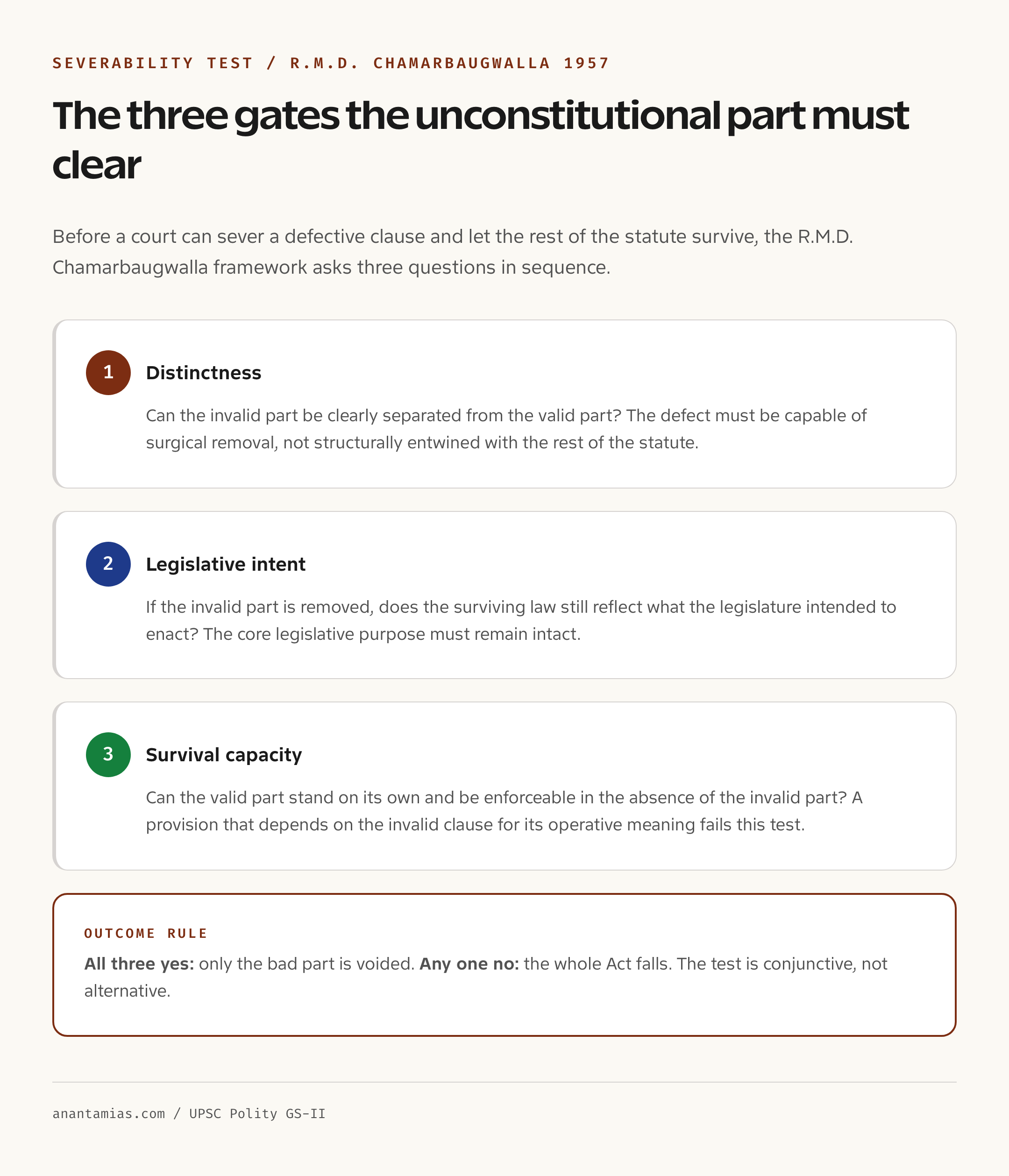
R.M.D. Chamarbaugwalla v. Union of India, 1957, is the leading case on the operative test. The Supreme Court was examining the Prize Competitions Act, 1955, and asked whether the entire Act fell or only specific provisions. The Court laid down three questions that a judge must answer before applying the doctrine.
The first question is distinctness. Can the unconstitutional part be clearly separated from the constitutional part? If the offending provision is structurally entwined with the rest of the statute and cannot be physically excised without dismantling other provisions, severability fails. The defect must be capable of surgical removal.
The second question is legislative intent. If the unconstitutional part is removed, does the remaining law still reflect what the legislature intended to enact? A statute that loses its core purpose when the offending clause is removed cannot be saved by severance. The Court must be satisfied that the legislature would still have enacted the surviving portion as a self-standing law.
The third question is survival capacity. Can the valid part stand on its own and be enforceable in the absence of the invalid part? A provision that depends on the invalid clause for its operative meaning, definitions, or enforcement machinery cannot survive its removal. If the valid part is too thin to function on its own, severability fails and the entire Act must be struck down.
If the answer to all three questions is yes, only the unconstitutional portion is declared void. If the answer to any one of them is no, the entire Act is struck down. The R.M.D. Chamarbaugwalla framework remains the controlling test in modern severability jurisprudence.
Landmark Applications: A.K. Gopalan
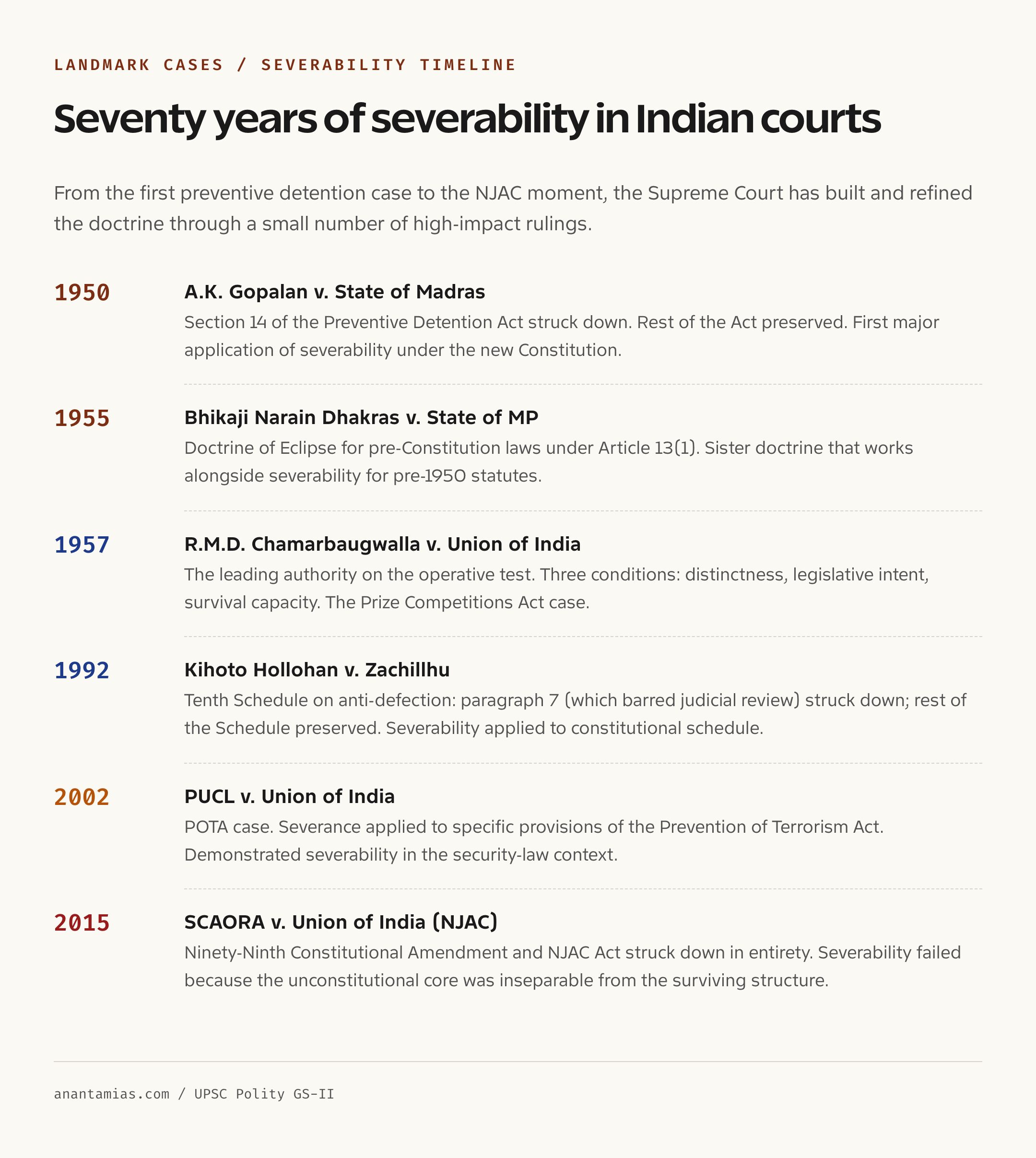
A.K. Gopalan v. State of Madras, 1950, was the first major application of severability by the Supreme Court. Gopalan, a communist leader, had been detained under the Preventive Detention Act, 1950, and challenged the Act’s validity. The Supreme Court found one provision unconstitutional. Section 14 of the Act prevented the detained person from disclosing the grounds of detention to the court when the grounds had been communicated to the detainee by the executive authority. The Court held that this provision violated Article 22 because it deprived the detainee of effective judicial review.
The question was whether the entire Preventive Detention Act fell with Section 14 or whether the rest of the Act could survive. The Supreme Court applied the severability principle and concluded that Section 14 could be removed without disturbing the rest of the Act. The remaining provisions on grounds for detention, advisory boards, and review processes were structurally independent of Section 14. The legislative intent to provide a preventive detention regime survived intact. The Act, minus Section 14, could function on its own.
The Gopalan ruling preserved the rest of the Preventive Detention Act and avoided a legislative vacuum. It also established the operative pattern of severability review in Indian constitutional law: identify the defective provision, test it against the three R.M.D. Chamarbaugwalla questions, and either sever or strike down the whole.
Why It Matters
The doctrine matters for three institutional reasons. The first is the protection of the legislative function. When the Supreme Court strikes down only the offending portion of an Act, it respects the legislature’s primary role in policy-making. The court intervenes only to the extent that the Constitution requires intervention. Anything more would amount to judicial legislation by demolition.
The second reason is the avoidance of administrative chaos. A statute that has been in force for years generates thousands of administrative decisions, contracts, licences, and obligations. Striking down the entire Act would put all of those decisions at risk and force the executive into emergency rule-making. Severability allows the surviving provisions to continue to operate, which preserves stability and protects rights that have already been exercised.
The third reason is the integrity of judicial review. Severability is the procedural instrument that allows the Supreme Court and the High Courts to enforce Fundamental Rights without becoming legislators of last resort. The court strikes down what is unconstitutional and leaves the rest. The doctrine therefore strengthens, rather than weakens, the rule of law.
Detailed Analysis: When Severability Fails
The severability test is not always satisfied. The most cited modern example is the National Judicial Appointments Commission case of 2015. The Ninety-Ninth Constitutional Amendment Act, 2014, had created the National Judicial Appointments Commission to replace the collegium system in the appointment of judges to the Supreme Court and High Courts. The corresponding NJAC Act, 2014, set out the operating procedure.
The Supreme Court in Supreme Court Advocates-on-Record Association v. Union of India, 2015, struck down both the Constitutional Amendment and the NJAC Act in their entirety. The Court reasoned that the unconstitutional provisions, particularly those that gave the executive a controlling voice in judicial appointments, were so central to the design of the Commission that the surviving provisions could not function as a self-standing scheme. The R.M.D. Chamarbaugwalla test failed at the second and third questions: the legislative intent was the introduction of a Commission with executive participation, and the surviving provisions could not deliver that intent. Severability was therefore unavailable, and the entire amendment fell.
The contrast between A.K. Gopalan and NJAC illustrates the doctrine’s working principle. In Gopalan, the offending provision was a peripheral safeguard restriction; the rest of the Act was independent. In NJAC, the offending provisions were the constitutional core; the rest of the amendment depended on them and could not stand alone. Severability worked in the first case and failed in the second.
Comparative Look: Severability and Reading Down
Severability sits within a family of constitutional remedies. The closest cousin is the doctrine of reading down. Where severability surgically removes a defective provision, reading down narrows the interpretation of an otherwise valid provision so that it does not reach unconstitutional applications. Reading down is preferred where the text of the provision is capable of a constitutional interpretation; severability is invoked where the provision is genuinely beyond saving by interpretation.
The Doctrine of Eclipse, articulated in Bhikaji Narain Dhakras v. State of Madhya Pradesh, 1955, applies specifically to pre-Constitution laws under Article 13(1). When a pre-Constitution law becomes inconsistent with a Fundamental Right at the commencement of the Constitution, the law is not abrogated but eclipsed. If the inconsistency is later removed by a constitutional amendment, the eclipse lifts and the law revives. Severability and eclipse can both apply to the same statute and produce different outcomes for different parts of it.
The doctrine of prospective overruling is another related tool. It allows a court to declare a law unconstitutional but limit the declaration to future cases, leaving past actions undisturbed. Prospective overruling concerns the temporal scope of the declaration, while severability concerns its substantive scope. The two doctrines can be combined: a court can sever the unconstitutional portion and apply the declaration prospectively.
Challenges in Applying the Doctrine
Three practical difficulties recur in severability cases. The first is identifying legislative intent in complex statutes. Modern Indian statutes run to hundreds of sections with overlapping definitions, cross-references, and schedules. Determining whether the legislature would have enacted the surviving provisions as a self-standing law requires close textual reading and often resort to legislative history. Courts sometimes differ on whether the intent is preserved or destroyed.
The second difficulty is structural intertwining. Provisions that look independent on the surface may be operationally tied through cross-references and definitions. A defective definition can affect every provision that uses the term. A defective procedural section can render substantive sections unenforceable. Courts must look beyond the surface text to the operating architecture of the statute.
The third difficulty is the temporal complexity of constitutional amendments. The NJAC case is a reminder that severability of constitutional amendments raises additional questions about basic structure, judicial independence, and the limits of amendment power. The doctrine of severability operates within those constraints rather than overriding them. A constitutional amendment that fails the basic structure test cannot be saved by severability if the unconstitutional provisions are integral to the design of the amendment.
Prelims Pointers
The Doctrine of Severability is sourced in Article 13 of the Indian Constitution, which makes laws inconsistent with Fundamental Rights void “to the extent of such inconsistency.” The operative test was laid down in R.M.D. Chamarbaugwalla v. Union of India, 1957, and has three parts: distinctness of the invalid provision, legislative intent of the surviving law, and survival capacity of the valid portion. A.K. Gopalan v. State of Madras, 1950, was the first major application; Section 14 of the Preventive Detention Act was severed and the rest of the Act preserved. The NJAC case, 2015, is the leading non-severable striking down: the entire Ninety-Ninth Constitutional Amendment fell because the unconstitutional parts were core to the design.
A common trap statement: “Article 13 makes the entire law void if any part is inconsistent with Fundamental Rights.” This is incorrect. The Article makes the law void only “to the extent of such inconsistency,” and the Doctrine of Severability operationalises that limit. Another trap: “The Doctrine of Severability does not apply to constitutional amendments.” This is incorrect. The doctrine applies to amendments as it does to ordinary statutes, though the test interacts with basic structure analysis.
Mains Practice Questions
- The Doctrine of Severability is the operational expression of the phrase “to the extent of such inconsistency” in Article 13. Discuss the doctrine’s working test and its institutional significance with reference to R.M.D. Chamarbaugwalla and NJAC. (GS Paper 2, 250 words)
- Compare and contrast the Doctrine of Severability with the Doctrine of Reading Down and the Doctrine of Eclipse. Illustrate with examples. (GS Paper 2, 150 words)
- Examine the role of the Doctrine of Severability in preserving the legislative function while enforcing the Fundamental Rights. (GS Paper 2, 150 words)
- Why was the Ninety-Ninth Constitutional Amendment struck down in its entirety in 2015? Discuss the application of the severability test in that case. (GS Paper 2, 250 words)
Way Forward
The Doctrine of Severability remains an indispensable instrument of Indian constitutional review. Its continuing development depends on three doctrinal clarifications. The first is a more transparent statement of how legislative intent is determined in complex modern statutes. The second is the integration of severability analysis with basic structure analysis in constitutional amendment cases, so that the two doctrines work together rather than at cross-purposes. The third is the calibration of severability with prospective overruling and reading down, so that the court chooses the least intrusive remedy that vindicates the Fundamental Right.
For UPSC aspirants, the doctrine is a reliable test bed for understanding the constitutional review function. The text of Article 13, the three-part R.M.D. Chamarbaugwalla test, and the contrast between A.K. Gopalan and the NJAC case together provide a complete working picture. The doctrine also connects with other parts of the polity syllabus, from the 42nd Amendment of the Indian Constitution and its reception by the courts to the broader fundamental rights deep dive and the basic structure jurisprudence.
Frequently Asked Questions
What does the Doctrine of Severability mean in Indian constitutional law?
The Doctrine of Severability is the principle that when a court finds part of a law unconstitutional, it strikes down only that part and lets the rest of the law continue to operate, provided the valid part can stand on its own. The doctrine flows from the phrase u0022to the extent of such inconsistencyu0022 in Article 13 of the Constitution.
Which constitutional article is the source of the Doctrine of Severability?
Article 13 of the Indian Constitution is the textual source. Article 13(1) deals with pre-Constitution laws and Article 13(2) with post-Constitution laws. Both clauses use the phrase that limits voidness to the extent of inconsistency with Fundamental Rights.
What is the R.M.D. Chamarbaugwalla test?
R.M.D. Chamarbaugwalla v. Union of India, 1957, laid down a three-part test for severability: distinctness of the invalid part, preservation of legislative intent in the surviving law, and survival capacity of the valid portion. All three conditions must be satisfied before severance is permitted.
Why was Section 14 of the Preventive Detention Act severed in A.K. Gopalan?
The Supreme Court in A.K. Gopalan, 1950, found Section 14 unconstitutional because it prevented the detained person from disclosing the grounds of detention to the court. The rest of the Preventive Detention Act, 1950, was structurally independent of Section 14, the legislative intent to provide a preventive detention regime survived, and the Act could function in the absence of Section 14. Severability was therefore satisfied.
Why did the entire NJAC Amendment fall in 2015 instead of just the bad provisions?
The Supreme Court in the NJAC case, 2015, found that the unconstitutional provisions of the Ninety-Ninth Amendment, particularly those giving the executive a controlling role in judicial appointments, were so central to the design of the Commission that the rest of the amendment could not function on its own. Severability failed at the second and third parts of the R.M.D. Chamarbaugwalla test, and the entire amendment was struck down.
Does the Doctrine of Severability apply to constitutional amendments?
Yes. The doctrine applies to constitutional amendments as it does to ordinary statutes. The same three-part test is applied. The interaction with the basic structure doctrine adds an additional analytical layer in amendment cases.
How is the Doctrine of Severability different from the Doctrine of Reading Down?
Severability surgically removes the unconstitutional provision and lets the rest of the statute remain. Reading down narrows the interpretation of an otherwise valid provision to avoid an unconstitutional application. Reading down is preferred where the text is capable of a constitutional interpretation; severability is used where the provision cannot be saved by interpretation.
What is the relationship between the Doctrine of Severability and the Doctrine of Eclipse?
The Doctrine of Eclipse applies specifically to pre-Constitution laws under Article 13(1). When a pre-Constitution law becomes inconsistent with a Fundamental Right at the commencement of the Constitution, the law is eclipsed rather than abrogated. If the inconsistency is later removed, the eclipse lifts. Severability is a more general doctrine that operates on all laws and decides which portion of a law is void.
Can the doctrine apply to subordinate legislation and rules?
Yes. The doctrine applies to all forms of law-making, including statutes, subordinate legislation, regulations, and rules made under enabling Acts. The same test of distinctness, intent, and survival is applied.
What happens to actions already taken under the unconstitutional provision?
Severability does not by itself decide the temporal scope of the declaration. Courts often combine severability with the doctrine of prospective overruling to decide whether the declaration applies only to future cases or also to past actions. The combination protects settled administrative actions while ensuring future compliance with the Constitution.
Tell Google you want more of this.
Add Anantam IAS as a preferred sourceOne tap, and this site shows up more often in your own Top Stories, AI Overviews and AI Mode. Remove it any time.