Techno-Feudalism: Have Big Tech Platforms Replaced the Free Market? (UPSC Economy)
Yanis Varoufakis argues capitalism is dead — replaced by techno-feudalism, where Big Tech platforms act as digital fiefs that charge cloud rent and turn us into unpaid cloud serfs. Here is the full idea, how it differs from surveillance capitalism, the criticisms, and what it means for India's gig workers and digital-competition rules — explained for UPSC GS3.
You probably opened three or four screens this morning that you do not own and cannot leave. A search box that decides what the world looks like. A phone whose apps must pass through one company’s store. A marketplace where a seller cannot reach a buyer except through the platform that also sells against them. None of this feels like a market in the textbook sense, where many buyers and sellers meet and a price emerges from their haggling. It feels more like walking into someone else’s territory, paying a toll at the gate, and being watched while you shop. That uneasy feeling is exactly what the former Greek finance minister Yanis Varoufakis set out to name in his 2023 book Technofeudalism: What Killed Capitalism.
His claim is deliberately shocking: capitalism is dead, and a new system has quietly taken its place. Not socialism, not some utopia, but something older in spirit — a digital version of feudalism, where a handful of tech lords own the “land” we all live and work on, and the rest of us pay rent to be there. For a UPSC aspirant this is not a fringe provocation to skim past. It is a sharp, examinable lens on the platform economy, on why competition regulators across the world are suddenly chasing Big Tech, and on India’s own scramble to keep its digital markets open. The label is contested, the diagnosis is debated, but the questions it forces are squarely on the syllabus.
What Techno-Feudalism Actually Claims
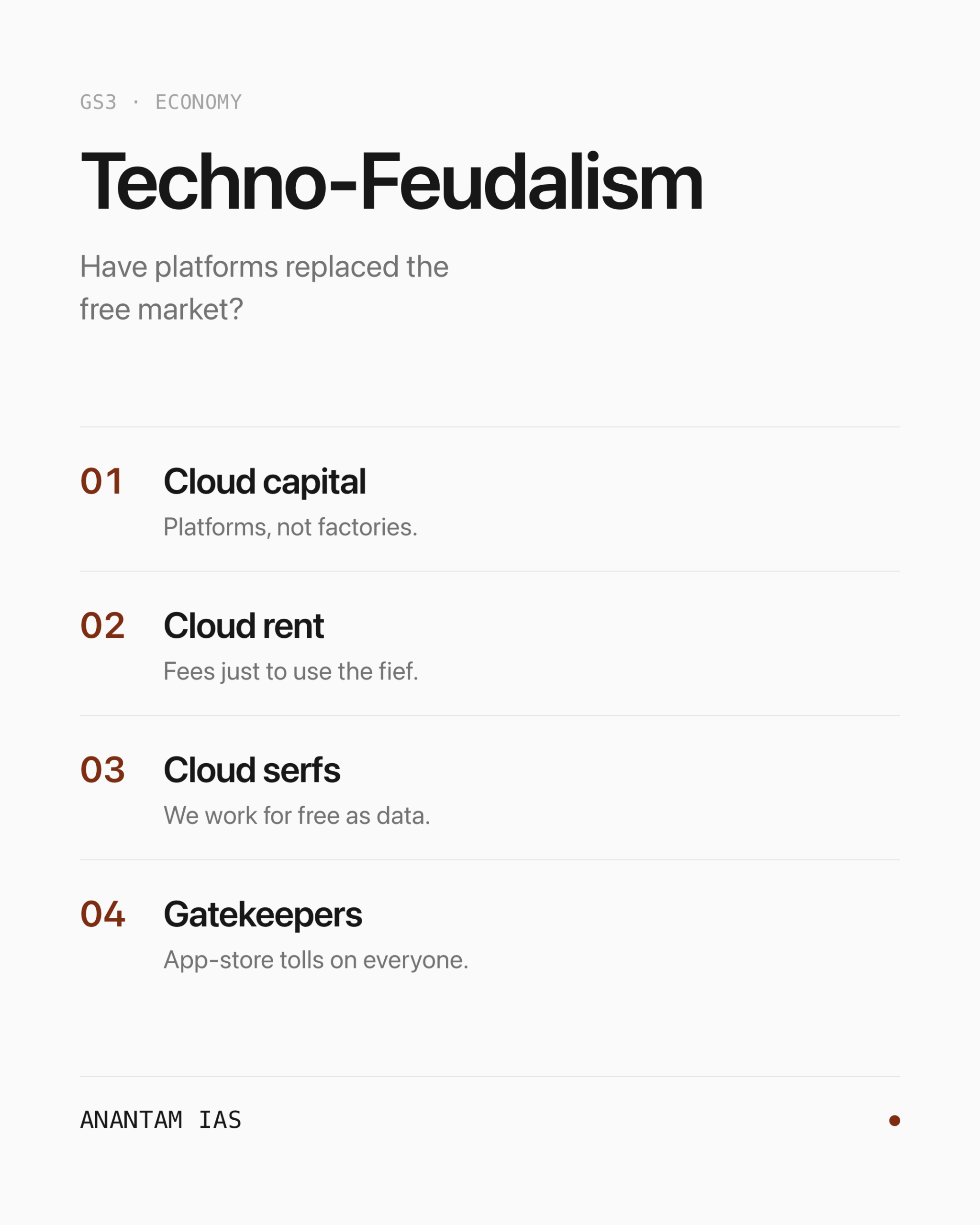
Start with the word, because it does precise work. Feudalism, before capitalism, was an economy of land and rent. A lord owned the manor; serfs farmed it and handed over a slice of everything they produced simply for the right to stay. Wealth came not from making and selling things in a competitive market but from owning the ground others had to use, and charging them for access. Capitalism replaced that with markets and profit — owners hired workers, paid them wages, sold goods to buyers, and pocketed the difference, with competition forever pushing them to do it better and cheaper. Varoufakis’s argument is that the digital age has quietly swung the pendulum back. The defining asset is no longer the factory but what he calls cloud capital — the platforms, data centres, algorithms and app stores that everyone now has to pass through. And the people who own that cloud capital, the “cloudalists,” do not really earn profit in the old sense. They collect rent.
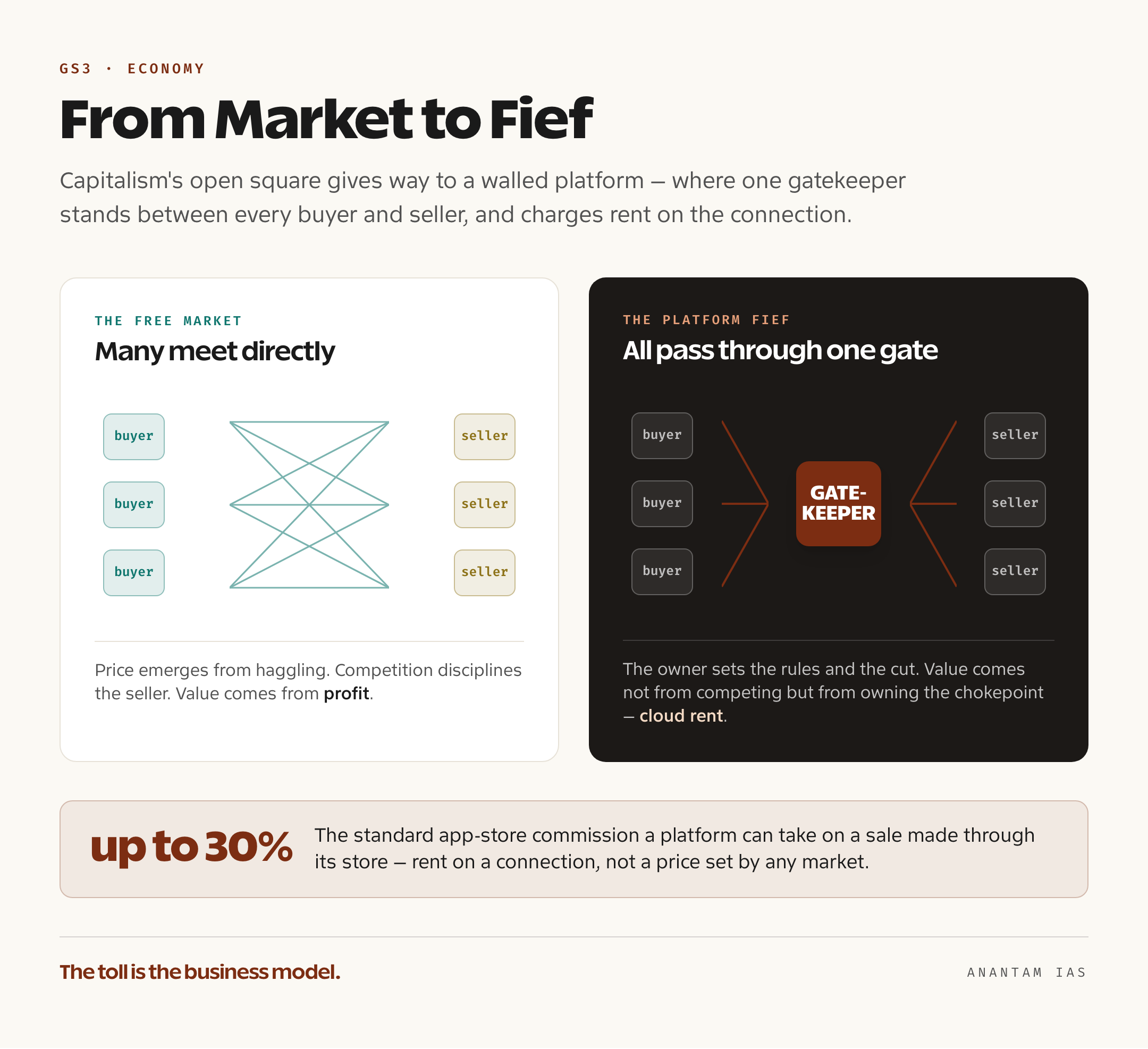
That single swap, from profit to rent, is the heart of the thesis. Profit, in the capitalist story, is disciplined by competition: if your margin is fat, a rival undercuts you, so you keep innovating. Rent is different — it is the money you can charge purely because you own a chokepoint nobody can go around. When Apple takes up to 30 per cent of every sale made through its App Store, or when Google’s search results decide which businesses exist for most users, or when Amazon’s marketplace can quietly rank its own products above the sellers who depend on it, that is not a price set by haggling in an open market. It is a toll set by a landlord. Varoufakis calls the platforms themselves digital fiefs — walled territories where the owner makes the rules, sets the cut, and can evict anyone. Markets have not vanished, but more and more of economic life now happens inside these fiefs, on the lord’s terms, rather than in any open square.
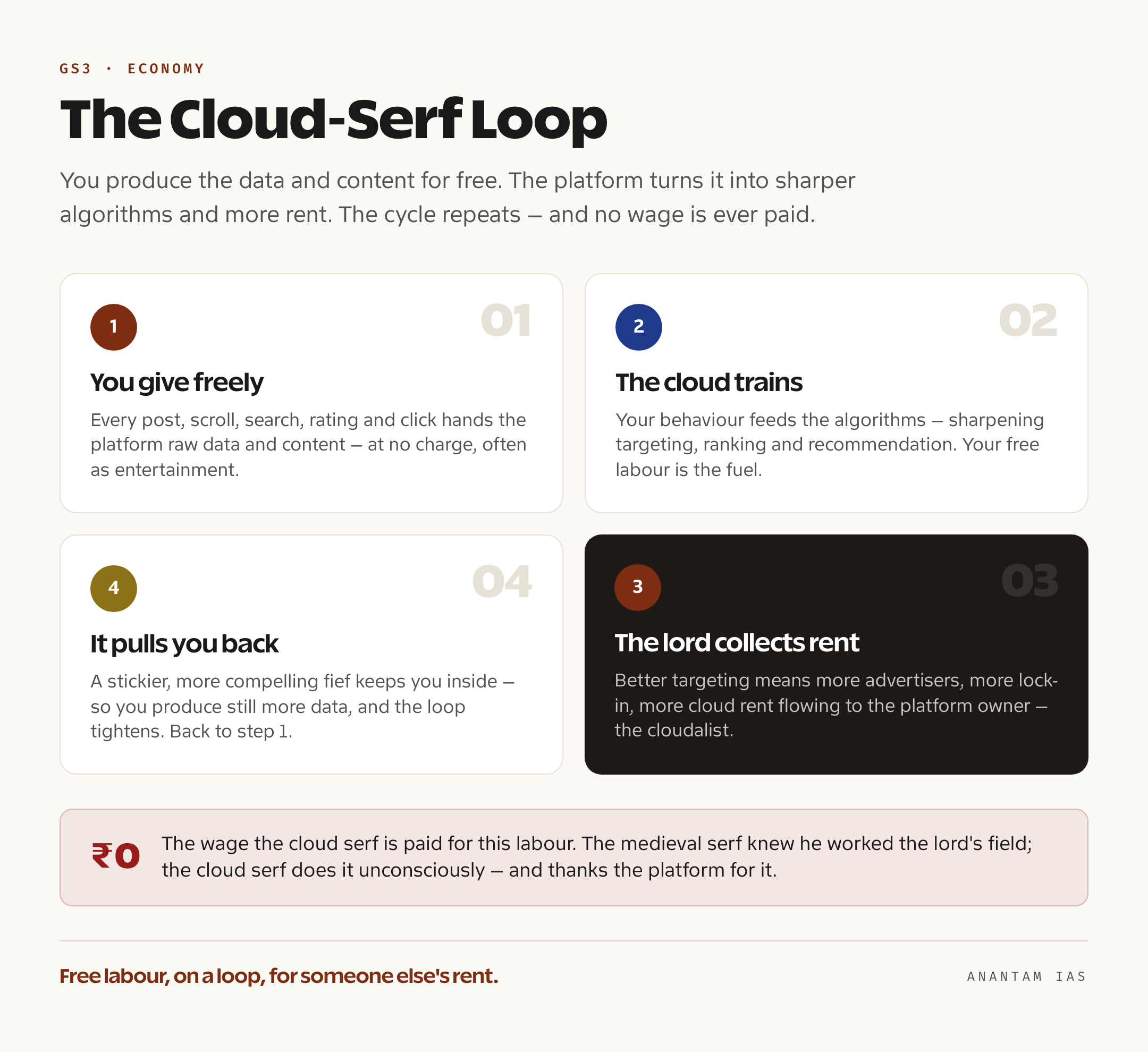
And here is the twist that gives the idea its bite. We are not just paying customers of these fiefs — Varoufakis says we have become cloud serfs. Every time you post, scroll, search, rate or click, you produce data and content for free, and that free labour is exactly what trains the algorithms and sharpens the targeting that make the platform more valuable. The medieval serf at least knew he was working the lord’s field. The cloud serf does it unconsciously, for entertainment, and even thanks the platform for the privilege. Below the lords and above the serfs sits a middle layer he calls vassals — the ordinary capitalist businesses, the app developers, the marketplace sellers, the small brands, who still make and sell real things but must now pay the cloudalist a cut to reach anyone at all. The old class pyramid of capitalists and workers, in his telling, has been overlaid with a new feudal one of lords, vassals and serfs.
The Two Pillars: Cloud Capital and Cheap Money
A fair question is how this happened so fast, and Varoufakis rests his answer on two pillars. The first is the privatisation of the internet itself. The early web was something close to a commons — open protocols, a public space anyone could build on. Over two decades that commons was steadily enclosed, fenced off into the private gardens of a few firms, much as English common land was once enclosed into private estates. Once you have to enter Meta’s garden to find your friends, or Google’s to find anything at all, the owner of the garden controls the terms of your entire social and economic life. This enclosure of the digital commons is what created the chokepoints in the first place.
The second pillar is money — specifically, the wall of cheap money central banks pumped out after the 2008 financial crash. To stop the banking system collapsing, the major central banks slashed interest rates to near zero and created trillions through quantitative easing, the policy of printing new money to buy financial assets. Varoufakis argues this flood of nearly free capital did not flow into wages or productive industry so much as into the tech giants. It let firms like Amazon burn money for years, undercutting rivals and buying scale, without ever needing to turn a normal profit — because investors, drowning in cheap cash, kept funding the land-grab. In his reading, the state and its central banks effectively built cloud capital with public money, then handed the keys to private lords. So techno-feudalism, far from being a pure free-market outcome, is in his view a creature of central-bank policy as much as of Silicon Valley.
This is also where the idea earns its place on a UPSC answer sheet, because both pillars are live policy debates. The enclosure point maps directly onto competition law and data governance — who controls the digital commons, and on what terms. The cheap-money point maps onto monetary policy and the question of whether post-crisis stimulus quietly entrenched monopoly power. You do not have to accept Varoufakis’s conclusion to find both threads genuinely useful for framing the platform economy.
How It Differs From Surveillance Capitalism and Platform Capitalism
This is the part examiners love, because the easiest way to show you understand techno-feudalism is to place it next to its rivals. Three big ideas now compete to name what Big Tech has done to the economy, and they are not the same.
The most famous neighbour is surveillance capitalism, the term coined by the Harvard scholar Shoshana Zuboff. Her argument is that firms like Google discovered a new raw material — our behaviour — and built a business out of capturing it, predicting it and selling those predictions to advertisers. The crucial word in her phrase, though, is capitalism. For Zuboff this is a rogue, predatory mutation of the system, but still the system: companies still compete, still chase profit, still answer to markets. Varoufakis takes her observation and pushes it one step further, and that step is the whole disagreement. He says once you are extracting value by owning a chokepoint and charging rent — rather than competing to sell — you have left capitalism behind altogether. Where Zuboff sees capitalism behaving badly, he sees a different mode of production entirely. As the critic Evgeny Morozov has tartly put it, if you take the surveillance story seriously you might as well call it surveillance feudalism.
Then there is platform capitalism, the more sober academic term for an economy organised around platforms that match buyers and sellers, riders and passengers, viewers and advertisers. Most economists who study Uber, Amazon or Swiggy use this frame. Their point against Varoufakis is simple but powerful: rent and profit have always coexisted under capitalism, monopolies are an old story, and a platform charging a 30 per cent cut is just a very effective capitalist extracting monopoly profit — not a feudal lord presiding over the end of markets. They argue the platforms still compete ferociously, for your attention, for advertisers, for the next market, and that competition is the very signature of capitalism. So the dividing line is precise: surveillance capitalism and platform capitalism both say this is still capitalism, gone wrong; techno-feudalism says this is no longer capitalism at all. Knowing exactly where that line falls is what turns a vague answer into a confident one.
The Power of the Gatekeepers — and the Pushback
Whatever you call it, the concentrated power the thesis describes is real and measurable, which is why regulators are no longer treating it as theory. A small set of firms — Amazon, Apple, Google and Meta among them — now sit as gatekeepers between billions of users and the businesses that want to reach them, and the leverage that gives them is striking. Apple and Google together control almost all the world’s smartphone operating systems, and so control the app stores every developer must use, where commissions have run as high as 30 per cent on digital sales. Amazon runs the marketplace millions of independent sellers depend on while competing against those same sellers with its own products, and the European Commission has formally investigated whether it misused sellers’ non-public data to do so. Google’s search and ad systems shape which businesses are even visible. These are precisely the chokepoints Varoufakis means by digital fiefs, and the rent extracted at each one is exactly what alarms competition authorities.
That alarm has produced the most concrete evidence for the thesis: regulators are now writing rules as if the gatekeeper problem is real. The European Union’s Digital Markets Act, which began to bite in 2024, does something competition law rarely does — instead of waiting for a firm to break the rules and then suing it, it names the biggest platforms “gatekeepers” in advance and forbids specific behaviours outright, such as self-preferencing their own services and locking users into their app stores and payment systems. This is ex-ante regulation: rules set before harm, not punishment after it. The shift matters because it concedes the central point that ordinary market competition is no longer expected to discipline these firms on its own. When the law has to step in to force a “market” to behave like one, you can see why someone like Varoufakis reaches for a word other than capitalism. The implications run wide — for competition, where a handful of gatekeepers can throttle the rivals beneath them; for labour, where platform and gig workers depend on an app whose algorithm sets their pay and can deactivate them without appeal; for democracy, where the same firms that own the public square also shape what is seen there; and for the Global South, which mostly consumes platforms it does not own and exports its citizens’ data to be processed and monetised elsewhere — a digital echo of older extractive relationships.
But the thesis has serious critics, and a balanced answer must carry them. The sharpest objection, made by writers in Jacobin and New Left Review and by Morozov, is that Varoufakis has misnamed something that is still recognisably capitalist. Big Tech firms, they point out, compete savagely — Netflix against YouTube against TikTok for your evening, every ad sold in a live competitive auction — and they remain ruthlessly driven by profit and shareholder returns, which no feudal lord ever was. Rent, monopoly and chokepoints are not new arrivals that killed capitalism; they have always lived inside it. By calling the system feudal, critics warn, you risk romanticising ordinary capitalism’s competitive past and misdiagnosing the cure, because the fix for monopoly power is competition policy and public ownership of digital infrastructure, not a fight against imaginary lords. Even readers sympathetic to Varoufakis often treat “techno-feudalism” as a vivid metaphor that captures how platform power feels rather than a literal claim that markets are gone. That tension — powerful description, contestable label — is the most honest way to hold the idea.
The India Angle: Gig Workers, ONDC and Digital Competition
For India the stakes are not abstract, because the country is among the most platform-dependent large economies on earth, and it sits mostly on the consuming side of the cloud. Hundreds of millions of Indians reach the internet through a few foreign-owned gateways; small traders live or die by their ranking on a marketplace they do not control; and a vast and growing workforce earns its living inside delivery, ride-hailing and logistics apps. That last group is the clearest domestic case of the cloud-serf and vassal dynamic the thesis describes — workers whose hours, pay and even continued access to work are set by an algorithm they cannot see or argue with, a reality explored in our explainer on the gig economy in India. When the platform sets the terms and keeps the data, the worker bears the risk and the firm collects the rent — exactly the asymmetry Varoufakis is pointing at.
India’s most distinctive response is to attack the chokepoint itself. The Open Network for Digital Commerce, or ONDC, is a government-backed attempt to do for e-commerce what the unified payments interface did for payments — replace the single walled marketplace with an open, shared network where any buyer app can transact with any seller app, so no one gatekeeper sits in the middle taking a cut. If it works at scale, it is a structural answer to digital fiefs: you do not regulate the lord, you build a public road that routes around the manor. India has tried the same public-rails philosophy across its “digital public infrastructure” — open identity, open payments, open commerce — precisely so that essential digital plumbing is a commons rather than someone’s private estate.
The other lever is the law, where India is watching the world and weighing its own move. The Competition Commission of India, whose role and powers we cover in our guide to the Competition Commission of India, has so far policed digital markets the traditional way — investigating abuses after they happen. To get ahead of the gatekeepers, the government’s Committee on Digital Competition Law drafted a Digital Competition Bill in 2024, closely modelled on the EU’s gatekeeper approach. It proposed designating the largest platforms as “Systemically Significant Digital Enterprises” using thresholds of turnover, market value and user numbers, and barring them in advance from self-preferencing, anti-competitive data use and lock-in tactics — India’s own version of ex-ante rules. The Bill drew strong pushback from industry and from a parliamentary standing committee, which worried that rigid pre-emptive rules could deter investment and burden start-ups, and as of 2026 it remains under review rather than enacted. That unfinished debate — open public rails on one side, ex-ante gatekeeper rules on the other, and the fear of over-regulation pulling against both — is India’s living, examinable encounter with the questions techno-feudalism raises.
For Your Mains Answer
This topic is most at home in GS Paper 3, which covers the Indian economy, the effects of liberalisation on the economy, changes in industrial policy, science and technology, and awareness in the field of IT. It speaks directly to questions on the platform economy, monopoly and competition, the gig workforce, data as an economic resource, and the regulation of Big Tech. It also offers a rich, contemporary hook for the Essay paper on technology and freedom, and it can sharpen a GS Paper 2 answer on governance and the regulation of digital markets. The examiner’s reward here is balance: explain the idea fairly, weigh it against its rivals and critics, and land it on India’s concrete responses rather than abstract alarm.
How to Build the Answer
Define before you debate. Open by explaining what techno-feudalism claims — markets giving way to digital fiefs, profit giving way to cloud rent, users reduced to cloud serfs — and attribute it plainly to Varoufakis. Then build a chain: what changed (the privatisation of the digital commons plus post-2008 cheap money), how the gatekeepers exert power (app-store cuts, marketplace control, search dominance), why regulators now intervene ex ante (the EU’s Digital Markets Act), and what it means for competition, labour and the Global South. Bring it home with India — gig dependence, ONDC as an open-network counter, and the draft Digital Competition Bill — and close with a judgement on whether “feudalism” is the right word. That arc — define, explain causes, show power, regulate, localise, evaluate — fits almost any version of the question.
Common Mistakes to Avoid
Don’t present techno-feudalism as settled fact; it is a contested thesis, and naming the critics is what earns marks. Don’t confuse it with surveillance capitalism — Zuboff says capitalism gone wrong, Varoufakis says capitalism replaced. Don’t claim markets have literally disappeared; the careful point is that more activity now happens inside platform fiefs on the owner’s terms. Don’t say India’s Digital Competition Bill is law — it was drafted in 2024 and, as of 2026, remains under review. And don’t moralise without mechanism: always pair the big claim with how the rent is actually extracted (commissions, ranking, data, lock-in).
A Compact Answer Spine
Techno-feudalism (Varoufakis, 2023) = capitalism replaced by digital fiefs → profit gives way to cloud rent, users become cloud serfs, ordinary firms become vassals → driven by two pillars: enclosure of the digital commons + post-2008 cheap money → gatekeepers (Apple, Google, Amazon, Meta) charge up to 30% app-store cuts and control marketplaces and search → regulators respond ex ante (EU Digital Markets Act, 2024) → implications for competition, labour, democracy, Global South → critics (Morozov, Jacobin) say it is still profit-driven capitalism with monopoly, just mislabelled → India: high platform/gig dependence → ONDC as open-network counter + draft Digital Competition Bill 2024 (SSDEs, under review) → verdict: a powerful description of platform power, a debatable label.
Diagram or Flowchart Idea
Sketch two small panels side by side. On the left, an open market — many buyers and many sellers connected by lines, prices emerging between them. On the right, a single gatekeeper box sitting between every buyer and every seller, with a small “rent” arrow peeling off each connection into the gatekeeper. Underneath, a tiny loop labelled data and content → algorithm → more rent to show the cloud-serf cycle. That one contrast — market versus fief, plus the unpaid loop — captures the whole thesis at a glance.
A Balanced-Conclusion Line
A line that lands the marks: “Whether or not capitalism has truly died, techno-feudalism names a real shift of power to a few digital gatekeepers — and India’s answer of building open public rails like ONDC while weighing ex-ante competition rules may matter more than the label we finally give the system.”
How to Use Data Without Cramming
You need only a few anchors, not a syllabus: the App Store commission of up to 30 per cent (the rent in one number), the EU Digital Markets Act of 2024 (the regulatory turn), Varoufakis’s book Technofeudalism of 2023 (the source), and India’s draft Digital Competition Bill of 2024 with its SSDE designation (the domestic response). Drop those four into the right sentences and the answer reads as current and grounded. Attribute them in prose — “as Varoufakis argues”, “under the EU’s Digital Markets Act” — rather than scattering figures loose.
Frequently Asked Questions
What is techno-feudalism in simple terms?
It is the argument, made famous by economist Yanis Varoufakis in his 2023 book Technofeudalism: What Killed Capitalism, that capitalism has been replaced by a new feudal-like order. In it a few tech giants own the digital “land” — the platforms, app stores and data systems everyone must use — and charge everyone else cloud rent for access, much as medieval lords charged serfs to farm their manor. Markets and profit, he says, have given way to chokepoints and rent.
How is techno-feudalism different from surveillance capitalism?
Both describe Big Tech harvesting our data, but they reach opposite verdicts on the system. Shoshana Zuboff’s surveillance capitalism says this is capitalism gone predatory — firms still compete and chase profit, just by capturing behaviour. Varoufakis’s techno-feudalism says the firms have stopped behaving like capitalists at all: by owning chokepoints and charging rent rather than competing to sell, they have moved beyond capitalism into something feudal. The disagreement is whether the system is corrupted capitalism or a new system entirely.
Why do critics reject the term “techno-feudalism”?
Critics, including Evgeny Morozov and writers in Jacobin and New Left Review, argue Big Tech is still plainly capitalist. The firms compete fiercely for attention and advertising, are driven by profit and shareholder returns in a way no feudal lord was, and monopoly and rent have always existed inside capitalism. Calling it feudalism, they warn, romanticises capitalism’s competitive past and points to the wrong cure — what is needed is stronger competition policy, not a battle against imaginary lords.
How is India responding to platform gatekeeper power?
On two tracks. Structurally, the government-backed Open Network for Digital Commerce (ONDC) tries to replace the single walled marketplace with an open network where any buyer app can deal with any seller app, so no one gatekeeper takes a cut — part of India’s wider open digital-public-infrastructure approach. Legally, a Digital Competition Bill drafted in 2024, modelled on the EU’s gatekeeper rules, proposed ex-ante curbs on the largest platforms (designated Systemically Significant Digital Enterprises), though it faced pushback and, as of 2026, remains under review.
Practice Questions
Prelims MCQs
- The concept of “techno-feudalism” is most closely associated with which of the following?
(a) Shoshana Zuboff and the idea of surveillance capitalism
(b) Yanis Varoufakis and the idea that cloud capital has replaced capitalism
(c) Thomas Piketty and the study of wealth inequality
(d) Klaus Schwab and the Fourth Industrial Revolution
Answer: (b) Varoufakis set out the techno-feudalism thesis in his 2023 book Technofeudalism: What Killed Capitalism, arguing cloud capital and rent have displaced markets and profit. - In the techno-feudalism thesis, the term “cloud rent” refers to:
(a) the fee paid to rent cloud-storage space from data centres
(b) the value extracted by platform owners through their control of digital chokepoints rather than through market competition
(c) the interest charged on loans to technology start-ups
(d) the tax governments levy on digital services
Answer: (b) Cloud rent is income earned by owning a platform chokepoint everyone must pass through, contrasted with profit earned through competitive selling. - With reference to the European Union’s Digital Markets Act, which statement is correct?
(a) It taxes the global revenue of all technology companies
(b) It designates large platforms as “gatekeepers” and imposes obligations on them in advance (ex-ante)
(c) It bans foreign technology firms from operating in the EU
(d) It applies only to social-media content moderation
Answer: (b) The Digital Markets Act, which began applying in 2024, names the biggest platforms gatekeepers and prohibits practices such as self-preferencing before harm occurs. - The Open Network for Digital Commerce (ONDC) in India is best described as:
(a) a single government-owned e-commerce marketplace replacing private ones
(b) an open network allowing different buyer and seller applications to transact without a single gatekeeper in the middle
(c) a regulator that fines e-commerce companies
(d) a foreign-direct-investment policy for retail
Answer: (b) ONDC is an open, interoperable network meant to route commerce around walled marketplaces, much as UPI did for payments. - Under India’s draft Digital Competition Bill, 2024, the largest platforms were proposed to be designated as:
(a) Systemically Important Financial Institutions
(b) Systemically Significant Digital Enterprises
(c) Core Investment Companies
(d) Significant Beneficial Owners
Answer: (b) The Bill proposed an ex-ante framework designating the biggest platforms as Systemically Significant Digital Enterprises (SSDEs), with curbs on self-preferencing and data misuse; it remains under review.
Mains Practice Questions
- Explain the concept of “techno-feudalism.” How does it differ from the related ideas of surveillance capitalism and platform capitalism? (15 marks, 250 words)
- “The shift from profit to rent is the heart of the techno-feudalism thesis.” Critically examine this claim with reference to the gatekeeper power of major digital platforms. (15 marks, 250 words)
- Discuss how the concentration of power among a few digital gatekeepers affects competition, labour and the interests of the Global South. (15 marks, 250 words)
- Evaluate India’s responses to platform gatekeeper power, with particular reference to the Open Network for Digital Commerce and ex-ante digital-competition regulation. (15 marks, 250 words)
- “Whether or not capitalism is dead, techno-feudalism captures a real shift of economic power.” Critically comment, bringing out the main criticisms of the thesis. (10 marks, 150 words)