

The Competition Commission of India (CCI) is the statutory regulator that polices markets, punishes cartels, checks abuse of dominance, and clears mergers and acquisitions. It was established under the Competition Act, 2002, made functional from 2009, and has emerged as one of India’s most consequential economic watchdogs in the digital age. Understanding CCI matters because it sits at the intersection of consumer welfare, market efficiency, foreign investment regulation and digital economy governance — themes that recur across UPSC Prelims, GS-II, GS-III and Essay papers.
Legislative Background: From MRTP to Competition Act
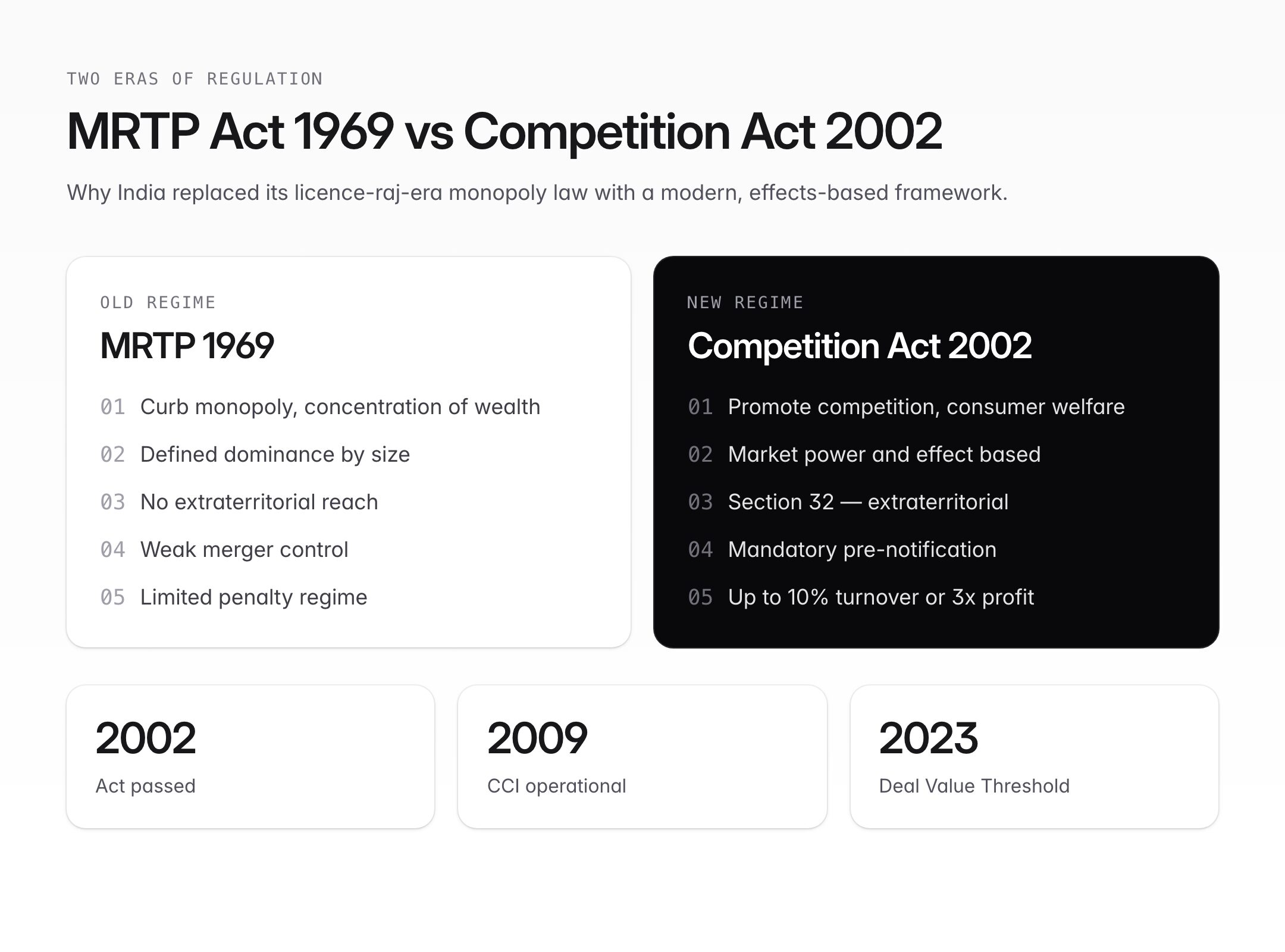
India's earlier anti-monopoly regime, the Monopolies and Restrictive Trade Practices (MRTP) Act, 1969, was designed for a closed, licence-raj economy. Post-1991 liberalisation, it became obsolete. The Raghavan Committee (2000) recommended a modern competition law aligned with global best practices.
| Aspect | MRTP Act 1969 | Competition Act 2002 |
|---|---|---|
| Focus | Curbing monopoly and concentration of wealth | Promoting competition, consumer welfare, efficiency |
| Approach | Restrictive, pre-liberalisation | Facilitative, post-liberalisation |
| Size of firm | Defined "dominant undertaking" by size | Looks at market power and effect, not size |
| Extraterritorial reach | Absent | Section 32 — covers conduct abroad affecting Indian markets |
| Merger control | Weak, rarely enforced | Mandatory pre-notification above thresholds |
| Enforcement body | MRTP Commission | CCI (quasi-judicial, investigation + adjudication) |
| Penalty regime | Limited | Up to 10% of turnover or 3× profit, whichever higher |
The Competition Act received presidential assent in January 2003, but litigation delayed operationalisation until May 2009. The Competition (Amendment) Act, 2023 introduced the Deal Value Threshold, settlement and commitment mechanisms, and leniency-plus provisions.
Composition of CCI
Following the 2023 amendment and subsequent rules:
- Chairperson and minimum two, maximum six Members — appointed by the Central Government.
- Selection via a Selection Committee headed by the Chief Justice of India or nominee, with the Cabinet Secretary and two experts.
- Qualifications: at least 15 years' experience in law, economics, commerce, finance, accountancy, management, industry or public affairs.
- Tenure: five years, eligible for re-appointment; age cap 65.
- Headquarters: New Delhi; regional offices in Mumbai, Kolkata and Chennai.
The Director General (DG) is CCI's investigative arm — functionally separate from the Commission's adjudicatory role, though both are under the same statutory roof.
Core Functions of CCI
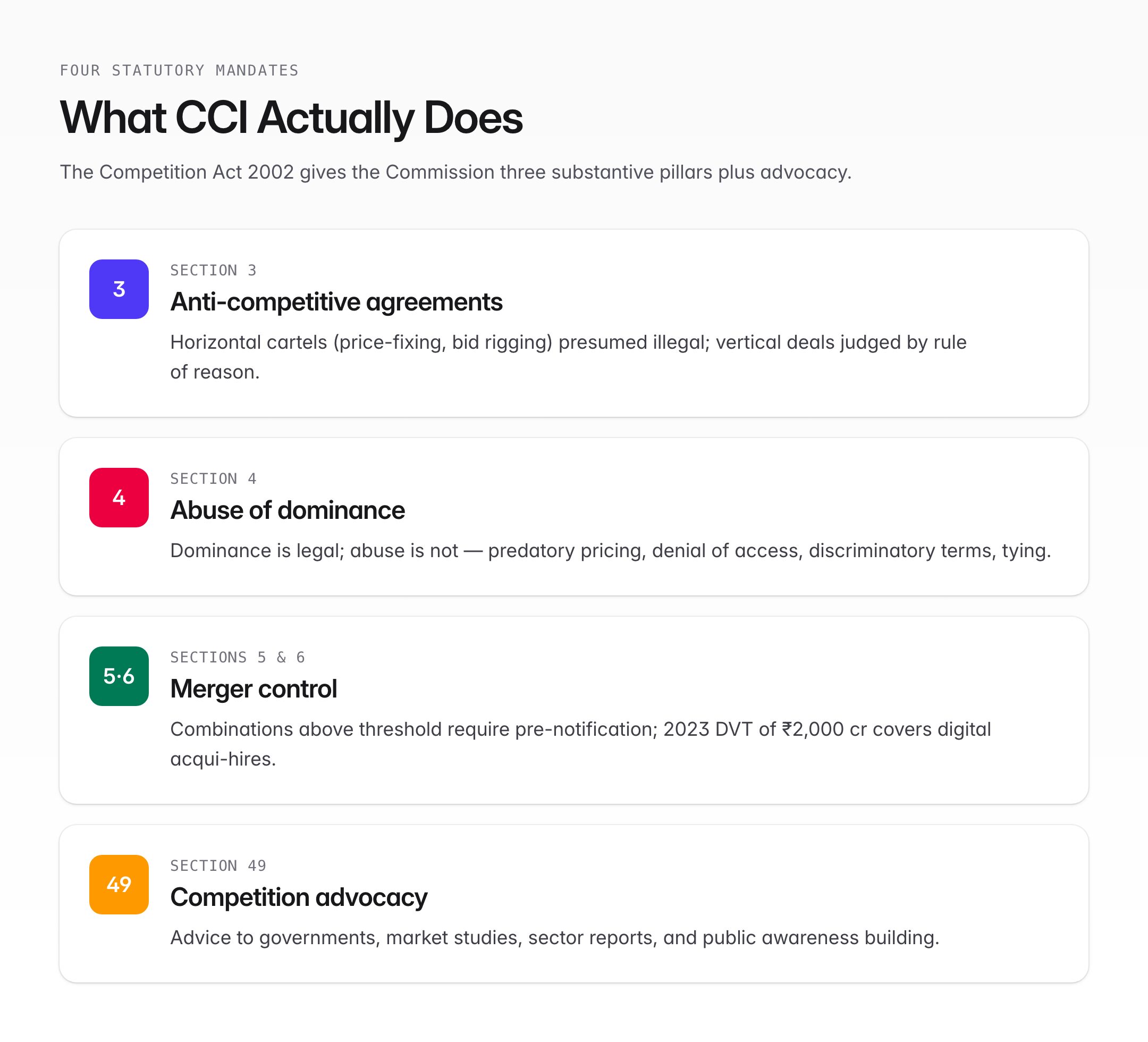
The Act gives CCI three primary substantive mandates, plus advocacy.
1. Prohibiting Anti-Competitive Agreements (Section 3)
CCI prohibits agreements between enterprises that cause Appreciable Adverse Effect on Competition (AAEC) in India.
- Horizontal agreements (between competitors) — price fixing, bid rigging, market sharing, output restriction — are presumed anti-competitive (per se rule).
- Vertical agreements (between enterprises at different levels of the supply chain) — tie-in, exclusive supply/distribution, refusal to deal, resale price maintenance — are examined under the rule of reason.
2. Prohibiting Abuse of Dominant Position (Section 4)
Being dominant is not prohibited; abusing dominance is. Abusive conduct includes predatory pricing, discriminatory conditions, denial of market access, tying, and leveraging dominance in one market to enter another. CCI assesses dominance using factors in Section 19(4) — market share, size and resources, economic power, vertical integration, dependence of consumers, entry barriers.
3. Regulation of Combinations (Sections 5 and 6)
CCI reviews mergers, acquisitions and amalgamations above notified thresholds. Parties must notify within 30 days (pre-notification mandatory). The 2023 amendment introduced a Deal Value Threshold of Rs 2,000 crore to capture digital-economy acquisitions (acqui-hires like WhatsApp–Facebook that fell below asset/turnover thresholds).
4. Competition Advocacy (Section 49)
CCI advises Central and State governments on competition policy, conducts market studies, publishes sectoral reports, and builds public awareness.
Penalty Regime
| Violation | Maximum Penalty |
|---|---|
| Anti-competitive agreement / abuse of dominance | Up to 10% of average turnover (last 3 years) or 3× profit for each year of continuance, whichever is higher |
| Cartel offences | Per the 2023 amendment, linked to relevant turnover rather than total turnover (per Supreme Court in Excel Crop Care, 2017) |
| Failure to notify combination | Up to 1% of turnover or assets |
| Gun-jumping (closing before approval) | Same as above |
| Leniency applicant | Up to 100% reduction for first, 50% second, 30% third informant |
Appeals from CCI orders lie with the National Company Law Appellate Tribunal (NCLAT), and thereafter with the Supreme Court.
Landmark Cases
| Case | Year | Issue | Outcome |
|---|---|---|---|
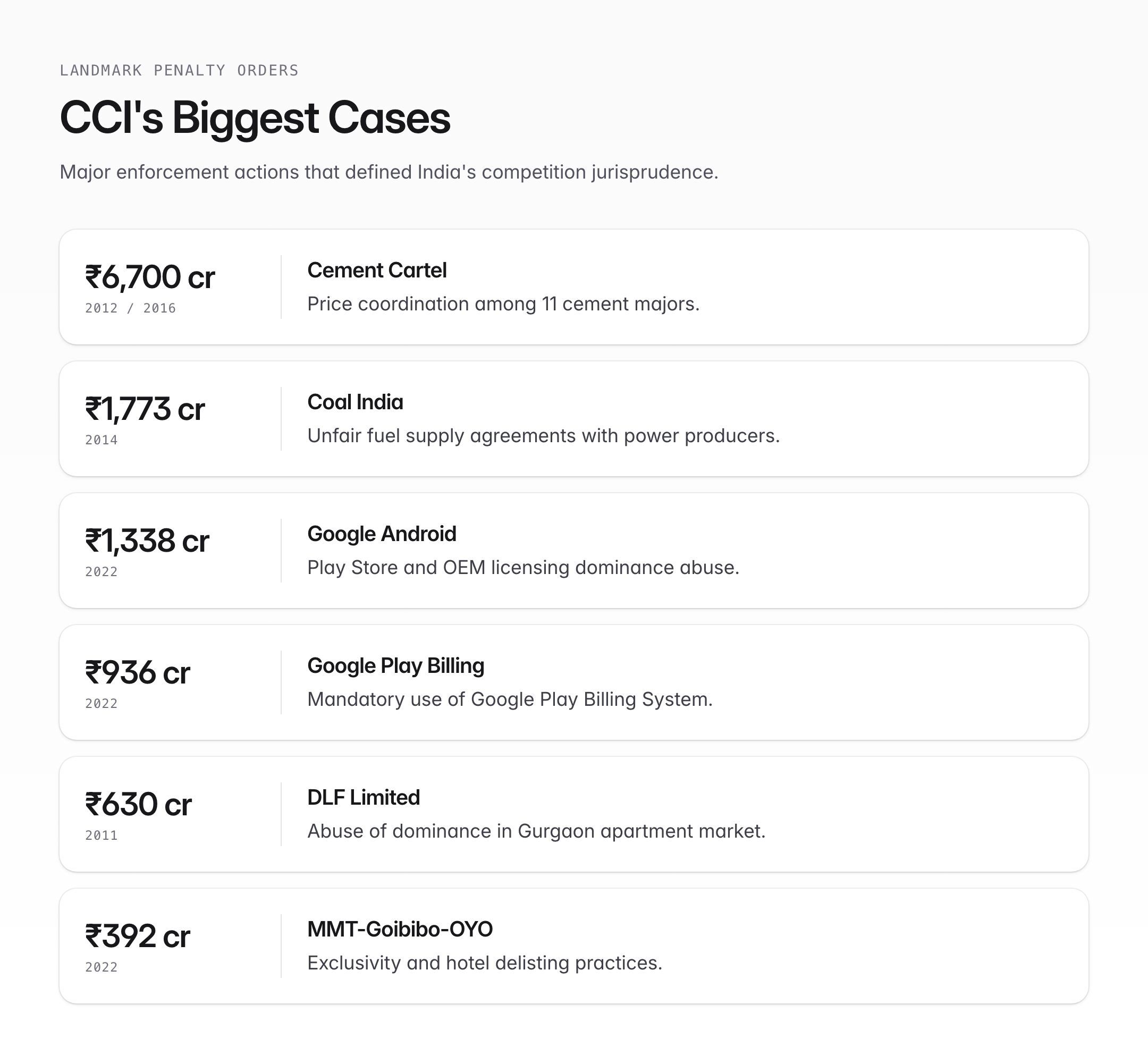
| DLF Limited (Belaire Owners' Association) | 2011 | Abuse of dominance in Gurgaon high-end apartment market | Rs 630 crore penalty; upheld by COMPAT |
| Cement Cartel | 2012, re-ordered 2016 | Price coordination among 11 cement majors | Rs 6,700 crore penalty |
| Coal India | 2014 | Unfair supply agreements with power producers | Rs 1,773 crore (later reduced) |
| Google (Android) | 2022 | Abuse of dominance via Play Store and OEM licensing | Rs 1,337.76 crore penalty, remedial directions |
| Google (Play Store billing) | 2022 | Mandatory use of Google Play Billing System | Rs 936.44 crore penalty |
| MakeMyTrip–Goibibo–OYO | 2022 | Exclusivity and delisting practices | Rs 392 crore penalty |
| WhatsApp 2021 Privacy Policy | 2024 | Leveraging dominance to impose data-sharing | Rs 213.14 crore and behavioural remedies |
CCI in the Digital Economy
The digital economy poses novel challenges: data as a market power source, network effects, multi-sided platforms, algorithmic collusion, and killer acquisitions. CCI's Market Study on E-Commerce (2020) and the proposed Digital Competition Bill (2024 draft) — based on the Committee on Digital Competition Law report — propose ex-ante regulation for Systemically Significant Digital Enterprises (SSDEs), modelled on the EU's Digital Markets Act.
Criticism and Limitations
- Delays in adjudication — multi-year investigations weaken deterrence.
- Overlap with sectoral regulators (TRAI, SEBI, RBI, IRDAI) creating jurisdictional friction; Supreme Court in CCI v. Bharti Airtel (2018) mandated sectoral regulators to examine jurisdictional facts first.
- Appointment controversies — long vacancies, especially of Chairperson, have paralysed quorum-sensitive functions.
- Limited capacity for complex digital-market analysis; understaffing of the DG's office.
- Appellate bottleneck — NCLAT hearing appeals from CCI, NCLT and now other bodies creates backlog.
International Comparison
| Jurisdiction | Authority | Key Law |
|---|---|---|
| India | CCI | Competition Act 2002 |
| USA | FTC and DoJ Antitrust Division | Sherman Act 1890, Clayton Act 1914 |
| EU | European Commission DG COMP | Articles 101, 102 TFEU; EUMR |
| UK | CMA | Competition Act 1998, Enterprise Act 2002 |
India's regime is closest in design to the EU's — effects-based, with a single regulator doing both antitrust and merger control.
UPSC Relevance
Prelims: Factual memorisation — year of Act (2002), operationalisation (2009), composition, penalty caps, thresholds, key sections (3, 4, 5, 6, 19, 32), appellate body (NCLAT), and 2023 amendment highlights (Deal Value Threshold, settlement mechanism).
GS-II (Governance/Statutory Bodies): CCI is a statutory quasi-judicial body. Questions test its constitutional status (none — it is statutory), accountability mechanisms, appointment process, and relationship with sectoral regulators. A typical question: "Discuss the role of CCI in regulating digital markets. How adequate is the existing framework?"
GS-III (Economy): Covers market regulation, ease of doing business, FDI policy, mergers, and the digital economy. Link CCI's role to consumer welfare, start-up ecosystem, killer acquisitions, and data protection (intersection with DPDP Act 2023).
Essay: Useful for topics on "regulation in a liberal economy," "technology and public interest," or "markets and the state."
Interview: Be ready for views on the Google Android order, whether India needs an ex-ante digital competition law, and whether CCI's penalties are sufficiently deterrent.
Master CCI as a living regulator — not a list of sections — whose jurisprudence is actively redefining the frontier between market freedom and public interest in twenty-first-century India.
Tell Google you want more of this.
Add Anantam IAS as a preferred sourceOne tap, and this site shows up more often in your own Top Stories, AI Overviews and AI Mode. Remove it any time.






