Unified Lending Interface (ULI): RBI’s Credit Rail Explained (UPSC Economy)
The Unified Lending Interface (ULI) is RBI's attempt to do for lending what UPI did for payments: a common, consent-based rail that pulls a borrower's data from scattered silos so a loan can move from weeks to minutes. Here is how it actually works, where it sits in India's digital public infrastructure, and what should worry you about it.
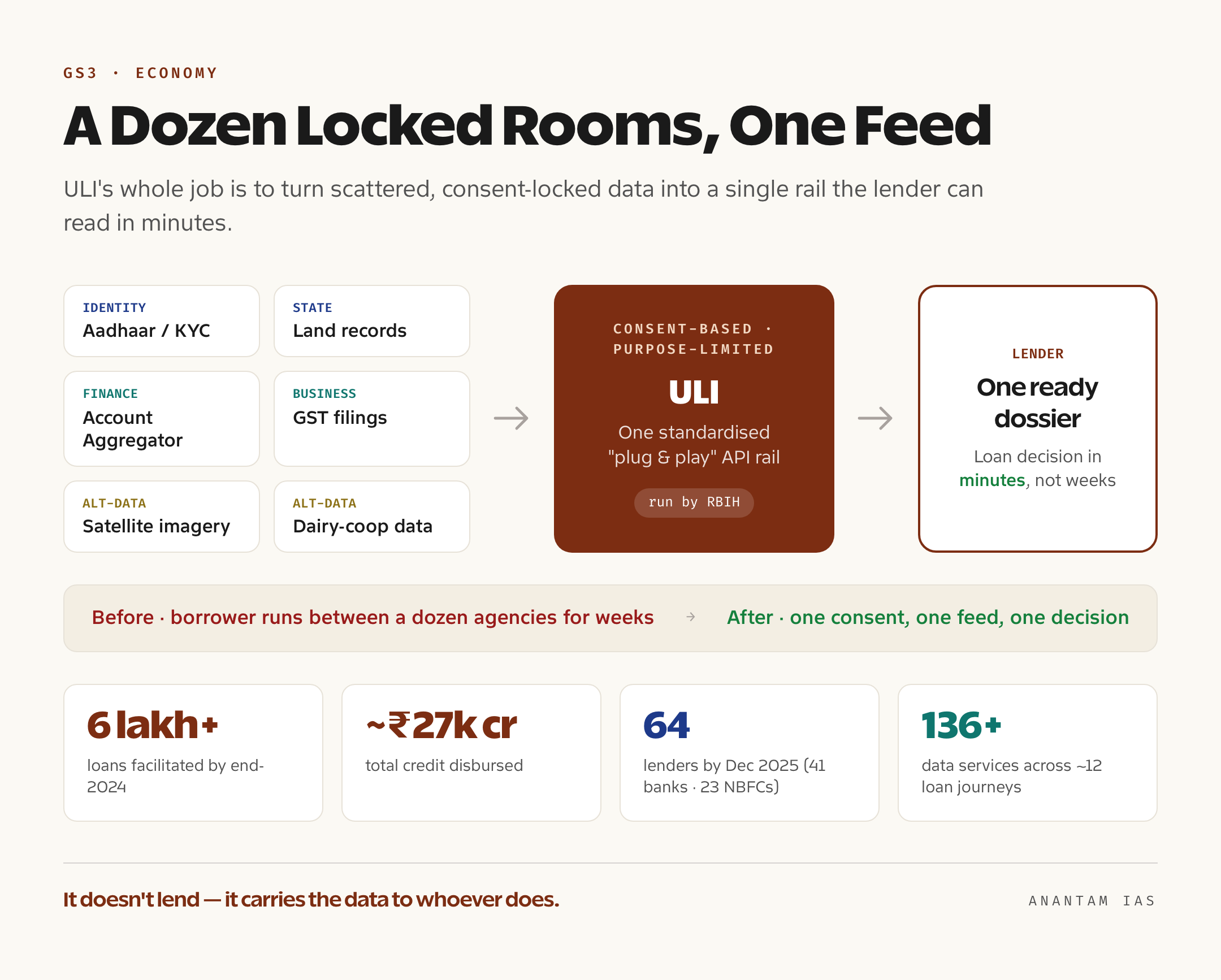
A farmer in Vidarbha wants a ₹1.6 lakh crop loan. On paper the bank can lend it in an afternoon. In practice it has taken weeks, because the loan officer has to chase a land record sitting in a state revenue department, a KYC document in another system, an income signal nobody has digitised, and a credit history the farmer may not have at all. The data exists. It just lives in a dozen locked rooms, and the borrower has been the one running between them. The Unified Lending Interface, or ULI, is the Reserve Bank of India’s answer to that absurdity: a single rail that, with the borrower’s consent, fetches all those scattered pieces and hands the lender a ready-to-decide picture in minutes.
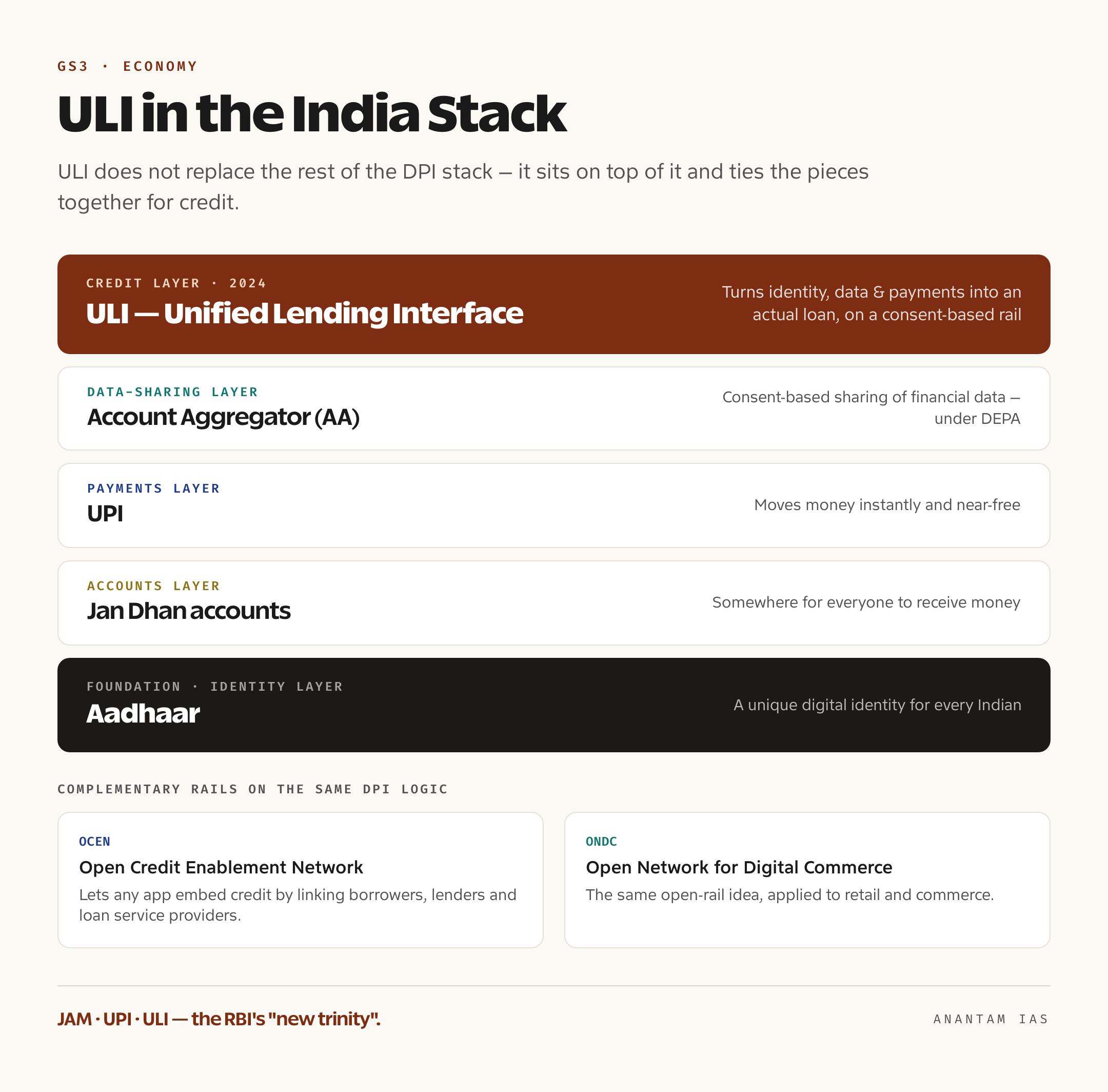
That is why RBI Governor Shaktikanta Das called ULI part of a “new trinity” alongside JAM and UPI when he previewed it in August 2024. The claim is deliberately large. JAM (Jan Dhan accounts, Aadhaar and mobile) gave Indians an identity and a bank account; UPI gave them a way to move money instantly and almost for free. ULI is meant to be the third leg — the one that finally makes credit flow as smoothly as payments do. For a country where small farmers, gig workers and tiny enterprises still borrow from moneylenders at punishing rates because formal lending is too slow and too costly to bother with them, that is not a technical footnote. It is a development question, and it is exactly the kind of digital-public-infrastructure story UPSC’s GS3 paper now expects you to explain.
What ULI Is and Why It Was Built
Let’s define it cleanly before the jargon piles up. ULI is a technology platform — built and operated by the Reserve Bank Innovation Hub (RBIH), the RBI’s wholly owned subsidiary in Bengaluru — that connects lenders to the many places a borrower’s data is stored. It does not lend money itself. It is plumbing. A bank or non-banking financial company (NBFC) plugs into ULI, the borrower consents to share specific records, and ULI pulls those records from the relevant sources and delivers them to the lender in a standard, machine-readable form. The lender still makes the credit decision; ULI just removes the weeks of fetching and verifying that used to sit in front of it.
The problem it solves is what RBI calls credit assessment in a world of “information silos.” To judge whether a loan is safe, a lender wants several things at once — who you are (Aadhaar and KYC), what you own (land and property records), what you earn or transact (bank statements via the Account Aggregator system, GST filings for a business), and softer signals for those with no formal history at all (milk-cooperative payment data for a dairy farmer, satellite imagery of a field, utility-bill behaviour). Each of these lives in a different database, owned by a different agency, with a different way of being accessed. For a large corporate loan that effort is worth it. For a ₹50,000 working-capital loan to a kirana shop it is not, so the loan simply never gets made. That unmet demand — the “credit gap,” especially for agriculture and micro, small and medium enterprises (MSMEs) — is the gap ULI is built to close.
The history matters because it shows ULI is not a press-release scheme. It began life in September 2022 as a narrow pilot to digitise Kisan Credit Card loans under ₹1.6 lakh, letting tenant farmers get crop credit without the usual paper chase. RBI then widened it into the “Public Tech Platform for Frictionless Credit” (PTPFC), launched on 10 August 2023, and ran it quietly while lenders and data sources were onboarded. In August 2024 the Governor rebranded the matured platform as the Unified Lending Interface — a name chosen to rhyme with UPI on purpose — and signalled a national rollout. So the August 2024 “launch” was really a graduation, not a beginning.
What makes ULI worth the hype is the standardisation. Instead of every lender building a separate, expensive integration with every data source, ULI offers common, standardised Application Programming Interfaces (APIs) — a “plug and play” approach, in the RBI’s words. Build to ULI once, and a lender can reach land records, identity checks, financial data and more through a single connection. That is the same trick UPI pulled in payments: one common protocol that everyone builds to, instead of a tangle of one-off bank-to-bank links. Cut the integration cost and the turnaround time, and suddenly the small, awkward, low-value loan becomes worth making.
How ULI Works on the Ground
Walk through an actual loan and the architecture stops being abstract. Say a dairy farmer applies for working capital through her bank’s app. She authenticates with Aadhaar and gives consent — explicitly, for specific data, for this specific purpose. ULI then reaches out, on the lender’s behalf, to the sources that consent unlocks: her land record from the state revenue department to confirm what she farms, her bank-statement data through the Account Aggregator framework, her payment history from the milk cooperative she supplies, perhaps satellite data on her holding. It transliterates names across scripts where needed, verifies the documents, and returns a clean bundle to the lender. The credit team reads a ready dossier instead of assembling one. A process that took weeks of branch visits can close in minutes, often without the borrower handing over a single physical paper.
The numbers from the pilot show this is real, not theoretical. By the end of 2024 RBI reported that ULI had already facilitated more than 600,000 loans worth around ₹27,000 crore, of which roughly 160,000 loans worth about ₹14,500 crore went to MSMEs — exactly the underserved segment the platform targets. The supply side has kept growing: by December 2025 the number of lenders on ULI had risen to 64 (41 banks and 23 NBFCs) from 36 a year earlier, and they were drawing on more than 136 data services across about 12 distinct “loan journeys” — among them authentication and verification, land records from eight states, satellite services, property search, dairy insights and credit-guarantee checks. Those are the plumbing details that make ULI more than a slogan: each new data service is another silo prised open, another type of borrower who becomes assessable.
It helps to be precise about who does what, because ULI is easy to confuse with its neighbours. The Account Aggregator (AA) framework is a consent layer specifically for financial data — it lets you share your bank statements, mutual-fund holdings or insurance data securely with a lender of your choice. The Open Credit Enablement Network (OCEN) is a set of standards meant to let any platform — a tech app, an e-commerce site — embed credit by connecting borrowers, lenders and loan service providers. ULI is broader than the AA and complementary to OCEN: it aggregates financial and non-financial data alike (land, GST, satellite, cooperative records, not just account statements), and it is run by the central bank itself rather than a market network. In practice ULI sits on top of the AA framework and beside OCEN, pulling the whole toolkit into one rail. The simplest way to hold it in your head: the AA carries your financial data, OCEN lets apps offer loans, and ULI is the common counter where a lender collects every kind of record at once.
Where ULI Fits in India’s Digital Public Infrastructure
ULI only makes sense as the latest layer of something larger — what is now called India’s Digital Public Infrastructure, or DPI: open, interoperable, government-backed digital systems that private players build on top of. The stack has a clear logic when you read it from the bottom up. Aadhaar gave India a unique digital identity. The Jan Dhan banking push and Aadhaar-linked accounts gave people somewhere to receive money. UPI made moving that money instant and near-free. The Account Aggregator framework gave people a way to share their financial data on their own terms. ULI is the credit layer that turns all of that into actual loans. Each layer is useless in isolation and powerful in combination — which is the whole point of building infrastructure as public rails rather than private walled gardens.
This “India Stack” approach has become one of the country’s most-cited governance exports, and ULI is the part the RBI is most eager to showcase abroad. The pitch is that DPI lets a developing economy leapfrog: instead of waiting decades for private credit bureaus and bank branches to reach every village, you build a common public rail and let thousands of lenders ride it cheaply. The same data-democratisation logic runs through the Open Network for Digital Commerce (ONDC) for retail and the Data Empowerment and Protection Architecture (DEPA), the consent framework that underpins the AA system. ULI’s distinctive contribution is that it brings the central bank’s regulatory weight to the credit layer — which is both its strength and, as we’ll see, the source of the worries about it.
So the clean GS3 line is this: ULI is to credit what UPI is to payments and what the AA is to data-sharing — a public, consent-based, interoperable rail meant to lower costs and widen access. RBI Deputy Governor T. Rabi Sankar made the comparison explicit, saying ULI will do for lending what UPI did for payments. Whether it lives up to that is still being tested. But the framing tells you how India’s policymakers now think about development: less through subsidy and scheme, more through infrastructure that the market can scale on its own.
Benefits and Why It Matters for India
Start with financial inclusion, because that is the headline case. The Indian credit gap is enormous, particularly for the roughly 60-plus million MSMEs that employ a vast share of the workforce but get a thin slice of formal credit, and for small and tenant farmers who often cannot prove income or title. ULI attacks the two reasons they are excluded — assessment is too slow and too costly — by collapsing both. When a lender can pull a verified data bundle in minutes, the economics of a small loan flip from unviable to viable. That is credit deepening in the most useful direction: not bigger loans to those who already have access, but the first formal loan to those who never did.
The second benefit is cost and speed, which matter more than they sound. Faster turnaround is not just convenience; it is the difference between a farmer financing this season’s sowing on time and missing it, or a small trader catching a festival-season order rather than watching it go to someone with cash. Lower integration costs for lenders mean they can profitably serve segments they used to ignore, and competition among 64-and-rising lenders on a common rail should, in theory, push down the price of credit for borrowers too. The third benefit is data democratisation — the idea that a borrower’s own data, scattered and trapped today, becomes an asset they can deploy, with consent, to get a fairer deal. For someone with no credit score but a steady record of milk sales or GST-paying invoices, that alternative data is the on-ramp to formal finance.
There is a wider strategic payoff as well. A working ULI strengthens the monetary-policy transmission story (formal credit reaches the real economy faster), reduces the grip of informal moneylenders and their predatory rates, and gives India another piece of exportable DPI to offer the Global South. None of this is guaranteed — but the direction is the reason economists treat ULI as more than a fintech product. It is an attempt to re-architect how a billion-plus people access capital.
The Risks: Privacy, Exclusion and Over-Indebtedness
A balanced explainer has to take the worries as seriously as the promise, and ULI carries real ones. The first is privacy. ULI works by aggregating an unusually rich picture of a person — land, finances, GST, location, consumption — and concentrating the rails through which it flows. RBI insists the model is consent-based and purpose-limited, and that it is built to align with the Digital Personal Data Protection (DPDP) Act, 2023, which gives individuals rights over their data and obliges those who process it to limit use to the stated purpose. But the open questions are practical: is consent genuinely informed when it is a tap on a loan app, or is it consent in name only? Are there strong grievance and redress mechanisms if data is wrong or misused? Concentrating so much sensitive data also raises the cybersecurity stakes — a breach or a compromised data provider becomes a far larger problem on a national rail than on one bank’s server.
The second risk is the one DPI evangelists least like to discuss: exclusion through digitisation. A system that runs on smartphones, Aadhaar authentication and digital consent can quietly leave out the very people it claims to serve — the digitally illiterate, those with patchy connectivity, the elderly, those whose biometrics fail or whose land records are missing or wrong. If “no digital footprint” becomes “no loan,” ULI could harden a new divide even as it dissolves an old one. And flawed source data is a live danger: a wrong land record or a transliteration error can produce a wrongful denial or a biased profile, with little recourse for the borrower. Inclusion has to be designed in, not assumed.
The third risk is over-indebtedness. Frictionless credit is a double-edged phrase — the same speed that helps a farmer sow on time can push a vulnerable borrower into loans they don’t understand and can’t repay, which is exactly the harm India has already seen in unsecured digital lending and the app-based loan mess that forced the RBI to clamp down on digital-lending practices. A rail that makes borrowing effortless must be matched by responsible-lending guardrails, financial literacy and the RBI’s own supervision, or it risks industrialising bad loans. The honest way to frame ULI, then, is as a powerful tool whose outcome depends entirely on the governance around it — robust DPDP enforcement, real consent, offline fallbacks for the excluded, and strict conduct rules for lenders. Build those, and ULI could be transformative. Skip them, and the same efficiency cuts the other way.
For Your Mains Answer
ULI is a high-value topic for GS Paper 3, which covers the Indian economy, banking and financial inclusion, infrastructure, and the role of science and technology in everyday life. It maps directly onto questions about digital public infrastructure, fintech, and inclusive growth, and it gives you a fresh, verifiable example to replace the tired “UPI” reference everyone uses. It can also feed an Essay on technology and development or on inclusive growth.
How to Build the Answer
Open with the problem, not the platform — the credit gap for MSMEs and small farmers, and why formal lending was too slow and costly to reach them. Then introduce ULI as the fix: define it in one line (a consent-based, RBI-operated rail that aggregates a borrower’s scattered data through standardised APIs), place it in the DPI stack (Aadhaar-UPI-AA-ULI), give its significance, and close with a balanced section on privacy, exclusion and over-indebtedness plus a way forward. That arc — problem, mechanism, significance, risks, way forward — is the safest structure for any “evaluate this initiative” question.
Common Mistakes to Avoid
Don’t confuse ULI with the Account Aggregator or OCEN — examiners notice. Don’t say ULI lends money; it doesn’t, it only carries data to lenders. Don’t present it as an unqualified success; the privacy and exclusion risks are essential, not optional. And don’t drown the answer in numbers — two or three anchors (600,000+ loans worth ~₹27,000 crore; 64 lenders; the August 2023 PTPFC pilot) are plenty.
A Compact Answer Spine
Credit gap for MSMEs and small farmers → data exists but sits in silos → ULI as a consent-based, RBIH-run rail with standardised “plug and play” APIs → pulls land, Aadhaar, AA financial data, GST, satellite and cooperative data → loan moves from weeks to minutes → part of the JAM-UPI-ULI “new trinity” and India’s DPI stack → benefits: inclusion, credit deepening, lower cost, data democratisation → risks: privacy and DPDP enforcement, digital exclusion, over-indebtedness, cybersecurity → way forward: real consent, offline fallback, responsible-lending guardrails.
Diagram or Flowchart Idea
Draw a simple funnel: on the left, scattered boxes labelled land records, Aadhaar/KYC, Account Aggregator, GST, satellite and cooperative data; an arrow through a single box marked “ULI — consent-based standardised APIs”; and on the right, one box, “Lender → loan in minutes.” A clean before-and-after of fragmentation versus a single rail communicates the whole idea fast.
A Balanced-Conclusion Line
“ULI could do for credit what UPI did for payments — but only if the rail that makes borrowing frictionless is matched by guardrails that keep it fair; the technology is settled, the governance is not.” That sentence credits the promise and names the condition in one breath.
How to Use Data Without Cramming
Attribute in prose and keep it light: “By end-2024 the RBI reported over 600,000 loans worth roughly ₹27,000 crore on ULI, with about ₹14,500 crore reaching MSMEs,” then “lenders rose to 64 by December 2025.” Pair each figure with the point it proves — scale, MSME reach, growing adoption — rather than listing statistics for their own sake.
FAQ
What is the Unified Lending Interface (ULI) in simple terms? ULI is a digital platform built and run by the Reserve Bank Innovation Hub (RBIH), an RBI subsidiary, that connects lenders to the many places a borrower’s data is stored. With the borrower’s consent, it pulls records like land titles, Aadhaar/KYC, bank-statement data and GST filings through standardised APIs and hands them to the lender in one bundle, so a loan can be assessed in minutes instead of weeks. It does not lend money itself — it is the rail that carries data to whoever does the lending.
How is ULI different from UPI and the Account Aggregator? UPI moves money; ULI moves the data needed to make a loan. The Account Aggregator (AA) framework shares only financial data, such as bank statements, with consent. ULI is broader — it aggregates both financial and non-financial data (land, GST, satellite, cooperative records) and is run by the central bank. In practice ULI sits on top of the AA framework, which is why RBI calls JAM, UPI and ULI a “new trinity.”
When was ULI launched and how big is it now? It started as a Kisan Credit Card pilot in September 2022, became the “Public Tech Platform for Frictionless Credit” on 10 August 2023, and was rebranded as the Unified Lending Interface by the RBI Governor in August 2024. By end-2024 it had facilitated over 600,000 loans worth around ₹27,000 crore, and by December 2025 had 64 lenders (41 banks and 23 NBFCs) drawing on more than 136 data services.
What are the main concerns about ULI? Three stand out. Privacy and data security, since ULI concentrates a very rich picture of each borrower and depends on genuine, informed consent under the DPDP Act, 2023. Digital exclusion, since a smartphone-and-Aadhaar system can leave out the digitally illiterate or those with wrong or missing records. And over-indebtedness, since making borrowing frictionless can push vulnerable people into loans they can’t repay unless responsible-lending guardrails are in place.
Practice Questions
Prelims MCQs
- With reference to the Unified Lending Interface (ULI), consider the following statements:
1. It is operated by the Reserve Bank Innovation Hub, a subsidiary of the RBI.
2. ULI itself sanctions and disburses loans to borrowers.
3. It enables consent-based access to both financial and non-financial data.
Which of the statements given above are correct?
(a) 1 and 2 only
(b) 1 and 3 only
(c) 2 and 3 only
(d) 1, 2 and 3
Answer: (b) ULI is a data rail operated by RBIH and works on consent-based access to financial and non-financial data; it does not lend money itself, so statement 2 is wrong. - The “new trinity” of digital public infrastructure described by the RBI Governor consists of:
(a) Aadhaar, PAN and GST
(b) JAM, UPI and ULI
(c) UPI, ONDC and OCEN
(d) Jan Dhan, Mudra and ULI
Answer: (b) The Governor framed JAM (Jan Dhan-Aadhaar-Mobile), UPI and ULI as the “new trinity” of India’s digital infrastructure. - Which of the following best describes the Account Aggregator (AA) framework in relation to ULI?
(a) It is a market network that lets apps embed loans
(b) It is a consent layer for sharing financial data that ULI builds upon
(c) It is the platform that physically disburses ULI loans
(d) It is a credit bureau maintained by the RBI
Answer: (b) The AA framework is a consent-based layer for sharing financial data; ULI sits on top of it and adds non-financial data sources. - ULI began as a pilot to digitise which type of loan before being widened?
(a) Home loans
(b) Education loans
(c) Kisan Credit Card loans
(d) Gold loans
Answer: (c) ULI traces back to a September 2022 pilot digitising Kisan Credit Card loans under ₹1.6 lakh for farmers. - Consider the following data sources that ULI can access with consent:
1. Land records 2. GST filings 3. Satellite imagery 4. Dairy-cooperative data.
How many of the above can ULI use for credit assessment?
(a) Only two
(b) Only three
(c) All four
(d) Only one
Answer: (c) ULI’s onboarded data services include land records, GST, satellite services and dairy insights, among others, so all four are correct.
Mains Practice Questions
- “The Unified Lending Interface aims to do for credit what UPI did for payments.” Examine ULI’s architecture and assess whether this comparison is justified. (15 marks, 250 words)
- Discuss how India’s Digital Public Infrastructure (DPI) stack — from Aadhaar and UPI to the Account Aggregator and ULI — seeks to deepen financial inclusion, and evaluate the risks this model carries. (15 marks, 250 words)
- Frictionless credit can both empower and endanger small borrowers. Critically analyse the benefits and risks of the Unified Lending Interface for farmers and MSMEs. (15 marks, 250 words)
- The effectiveness of ULI depends less on its technology than on its governance. Comment, with reference to data privacy, consent and responsible lending. (10 marks, 150 words)
- How does ULI attempt to close India’s MSME and agricultural credit gap, and what safeguards are needed to prevent digital exclusion and over-indebtedness? (15 marks, 250 words)