Diagrams, Flowcharts and Maps in UPSC Mains Answers: When and How
A labelled sketch does in fifteen seconds what a paragraph does in ninety. Most candidates draw nothing, and the ones who overdo it lose more than they gain.
There is a persistent belief that diagrams are decoration — something to add if you have spare time, which you never do. The arithmetic says otherwise.
An evaluator has roughly ninety seconds per answer. A labelled sketch of a process communicates its content in about five of those, and takes you fifteen to twenty seconds to draw. The same content in prose costs you sixty seconds of writing and the evaluator perhaps thirty of reading. On both sides of the transaction, the diagram wins.
The catch is that this only holds for certain content, and a badly chosen diagram costs time for nothing.
Where Diagrams Pay Most
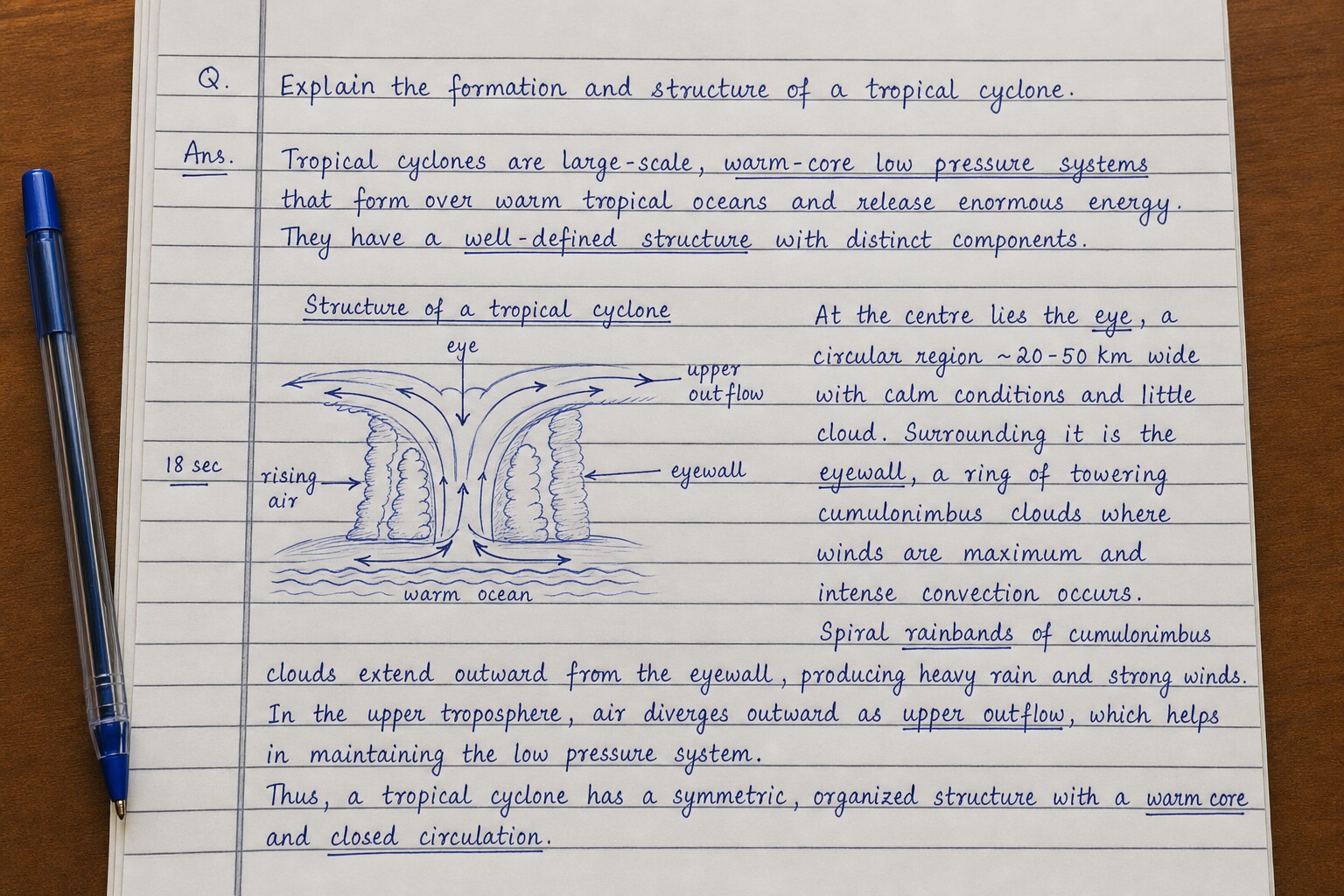
GS-1 physical geography. This is the clearest case. Geography is 31.9% of GS-1 and its physical half is full of processes that are natively spatial: cyclone structure, atmospheric circulation cells, ocean current gyres, plate boundary types, coastal landform sequences, the monsoon’s advance and retreat, temperature inversion. Every one of these is faster drawn than described.
Any comparison. A two-column table beats two paragraphs, always. Himalayan versus peninsular rivers, Nagara versus Dravida, FDI versus FPI, the several deficit measures.
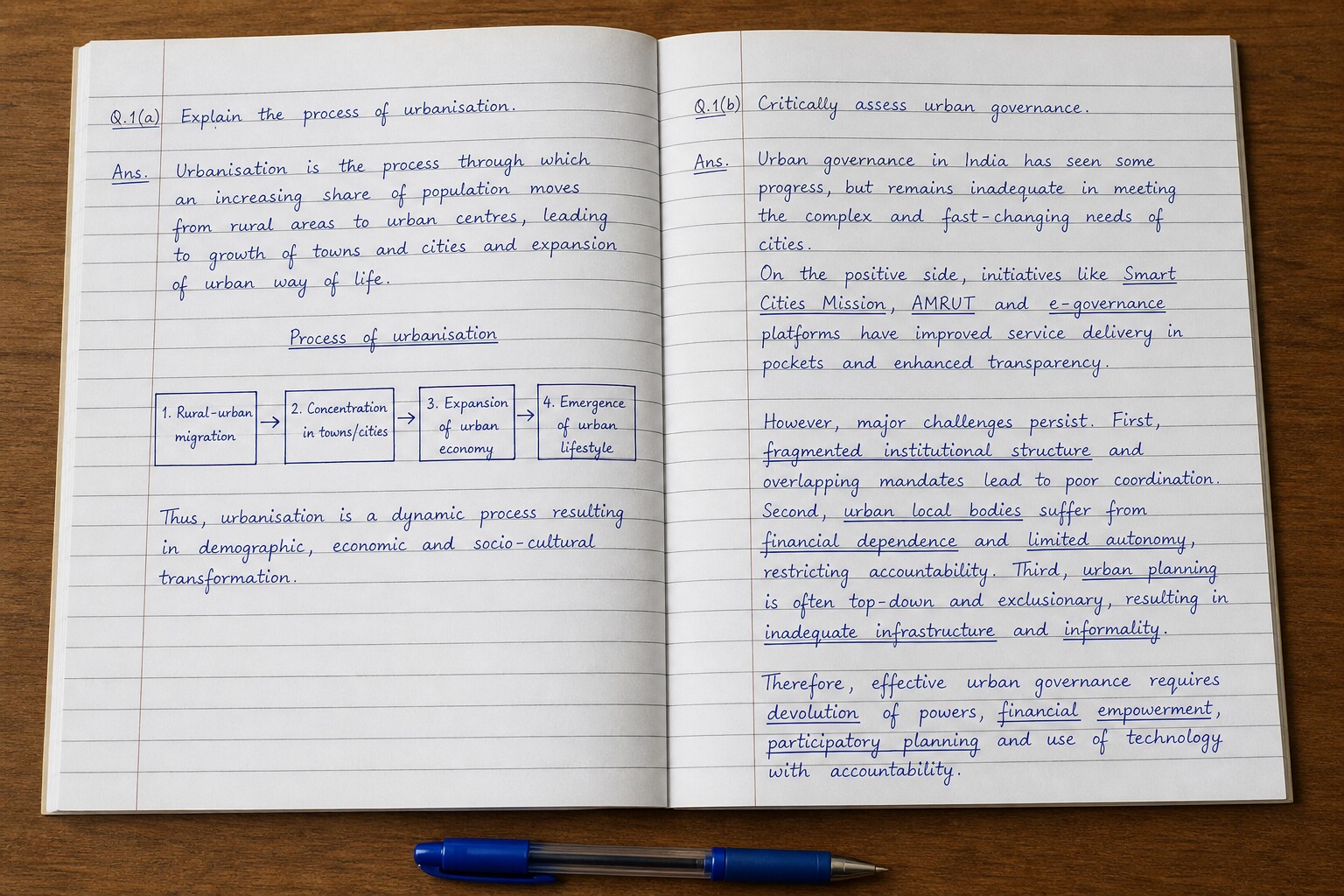
Any process or chain. Policy transmission, a value chain, the stages of a disaster-management cycle, how a bill becomes an act. Boxes and arrows.
Any classification. A simple tree — types of, categories under, the branches of. Three levels maximum.
Locations. A rough India outline with three or four labelled points. Not a work of art; a locator.
Where They Do Not Pay
- Ethics answers. GS-4 rewards reasoning in prose. A stakeholder diagram in a case study reads as evasion of the actual judgment the question demands.
- Evaluative questions. “Critically examine whether X worked” wants argument. A diagram cannot hold a qualified judgment.
- Anything you have not practised. A diagram drawn for the first time in the hall takes three times as long and looks it.
- Decoration. Borders, shading, colour, elaborate arrows. Nothing there earns a mark and all of it costs seconds.
Rules for Drawing Under Time
Small. A third of the width, not half a page. You are rationed on space, and space is the real word limit — see UPSC Answer Writing Copy.
Labelled. An unlabelled diagram is worth nothing, because the evaluator cannot award content they cannot identify. Three to six labels.
Use a pen for every diagram and map. Practise in the same medium you will use in the answer booklet. Keep the lines simple enough that you do not need correction.
Integrated, not appended. Place it in the body segment it belongs to, with a line of prose introducing it. A diagram floating at the end reads as an afterthought.
Titled, briefly. Four or five words so its purpose is unambiguous.
A Caution on India Maps
If you are sketching an outline of India, draw the full and correct external boundary. This matters, and a hurried sketch that clips the northern boundary is the kind of error that is entirely avoidable with a few practice runs.
For most Mains questions you do not need a national outline at all — a regional sketch, a river’s course, or a schematic with relative positions is usually enough and much faster.
The Ten Worth Practising
Build a small repertoire and drill it until each takes under twenty seconds:
- Cyclone cross-section
- Three-cell atmospheric circulation
- Ocean current gyre, one hemisphere
- Plate boundary types (three small panels)
- Monsoon advance and retreat, schematic
- A river system with tributaries, schematic
- Disaster management cycle, four boxes
- Policy transmission chain, five boxes
- A generic two-column comparison table
- A three-level classification tree
Together these cover the large majority of Mains questions where a visual helps. Drawing each twenty times over a month makes them automatic, which is the only condition under which they are usable at speed. Our geography note-making guide covers building them into your notes so the practice happens as a by-product of studying.
How to Practise
Add one to every geography answer during your daily answer-writing build-up, even where it is marginal — the aim in practice is fluency, not judgment. Once the drawing is automatic, start choosing: draw only where it genuinely beats prose.

amblitz A4 Answer-Writing Notebook — 200 pages
- A4 spiral-bound, 200 pages, 70 GSM paper
- Pre-printed margins laid out like the Mains answer booklet
- Room for a 250-word answer, headings and a diagram on a spread
Time it separately. If a diagram is taking more than twenty-five seconds, it is too elaborate for the hall.
Frequently Asked Questions
Should I draw diagrams in UPSC Mains answers? Where the content is spatial, comparative, procedural or classificatory, yes — a labelled sketch conveys more per second of writing than prose. In ethics and in purely evaluative questions, no.
Do diagrams get extra marks in UPSC Mains? There is no separate allocation. They earn marks by conveying content efficiently and by making an answer readable in the ninety seconds an evaluator has.
Should diagrams and maps be drawn in pen? Yes. Use a pen for every diagram, flowchart and map. Practise that way from the start so your speed and line control carry into the examination.
How big should a diagram be in a Mains answer? About a third of the page width. Space is the real word limit, and an oversized diagram eats the body of your answer.
Which subjects benefit most from diagrams? GS-1 physical geography above all — geography is 31.9% of that paper and much of it is natively spatial. Comparisons and process questions in any paper also benefit.
How many diagrams should I practise? About ten core ones, drilled until each takes under twenty seconds. That repertoire covers most Mains questions where a visual genuinely helps.