Disclosure: this guide contains Amazon affiliate links. As an Amazon Associate, Anantam IAS earns from qualifying purchases — at no extra cost to you.
Start with the constraint that shapes everything else. A UPSC Mains evaluator works through a very large number of scripts in a day, on a tight schedule, marking to a scheme. Your answer gets somewhere in the region of a minute and a half.
That is not a complaint about the system; it is the operating condition. An answer that requires careful excavation to find its argument will not get it. An answer that surfaces its argument immediately will. Most of what follows is mechanical, and mechanical things are the cheapest marks in the whole examination.
What the Booklet Actually Is
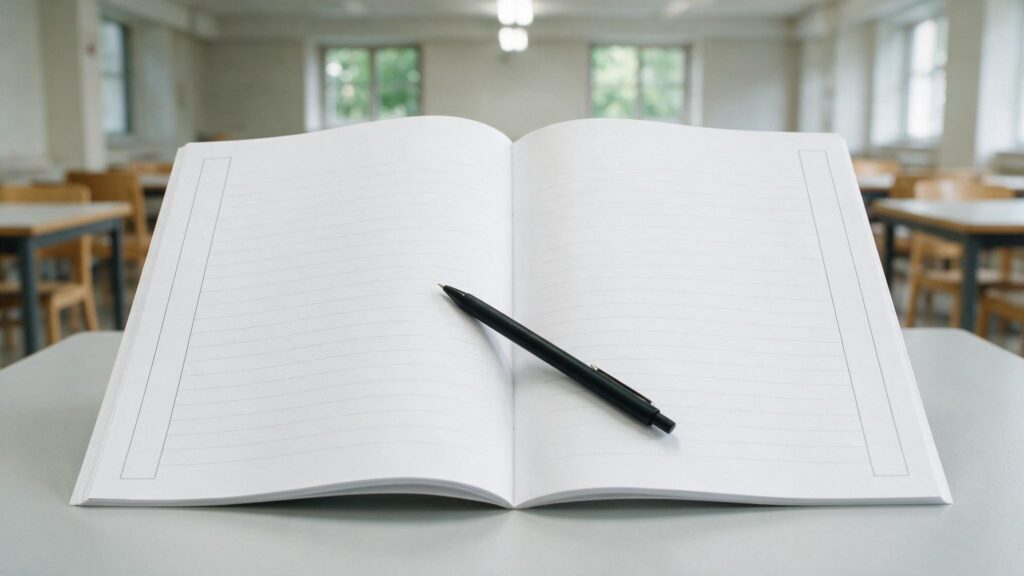
UPSC supplies a bound answer booklet. Each question has a fixed allotment of space, and that space is the real word limit — more binding than the stated one.
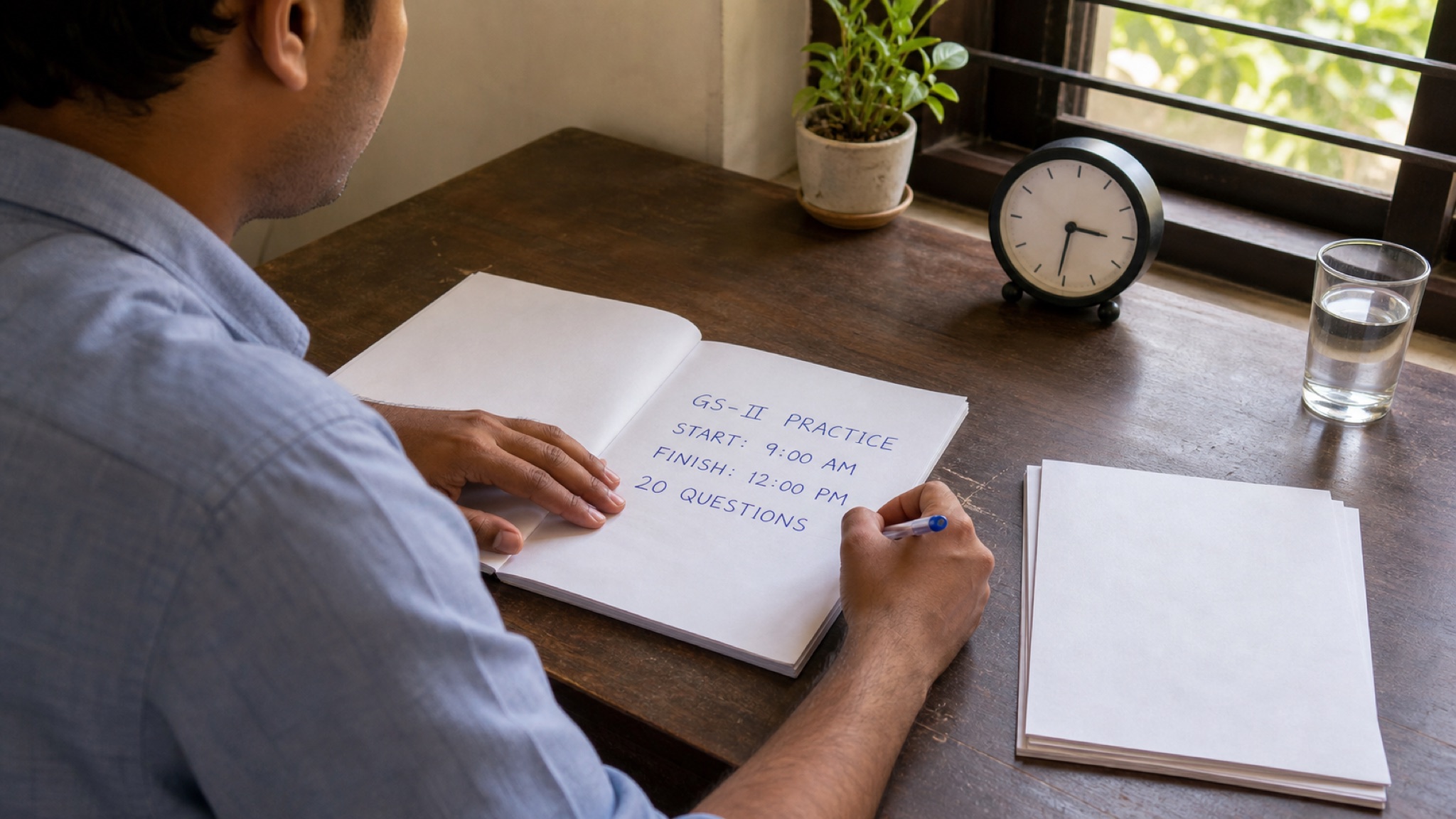
The practical numbers: a 10-mark question expects about 150 words, a 15-mark question about 250. Across GS-1 to GS-3 you have three hours for twenty questions, which is roughly nine minutes each including reading and thinking. In GS-4 the structure differs — most questions are 20-markers and nearly half are case studies, which need more planning time and less writing speed.
You cannot ask for extra sheets. If you write past your space you are, in practice, writing past your marks.
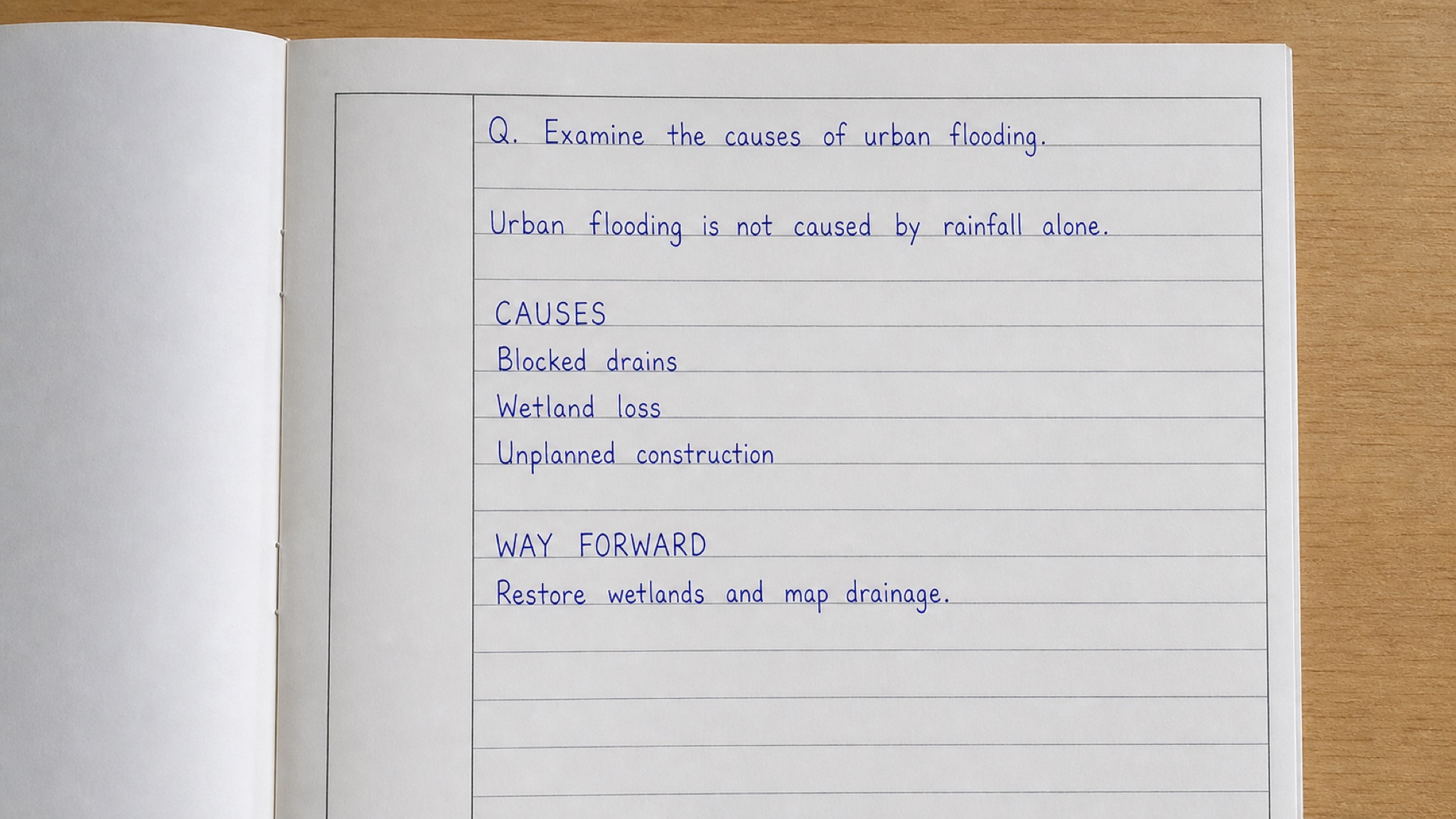
Layout Habits That Earn Marks
Leave the margin alone. The printed margin is where the evaluator writes. Filling it makes their job harder, and it makes your script the one they were annoyed by.
Use the full width otherwise. Narrow columns of text waste the space you are rationed.
Write the question number clearly and start each answer on a fresh page if space allows. A mis-attributed answer is the most expensive avoidable error there is.
Break the answer into visible parts. An intro of two or three lines, a body in labelled segments, a conclusion of two lines. The evaluator should be able to see the structure before reading a word of it.
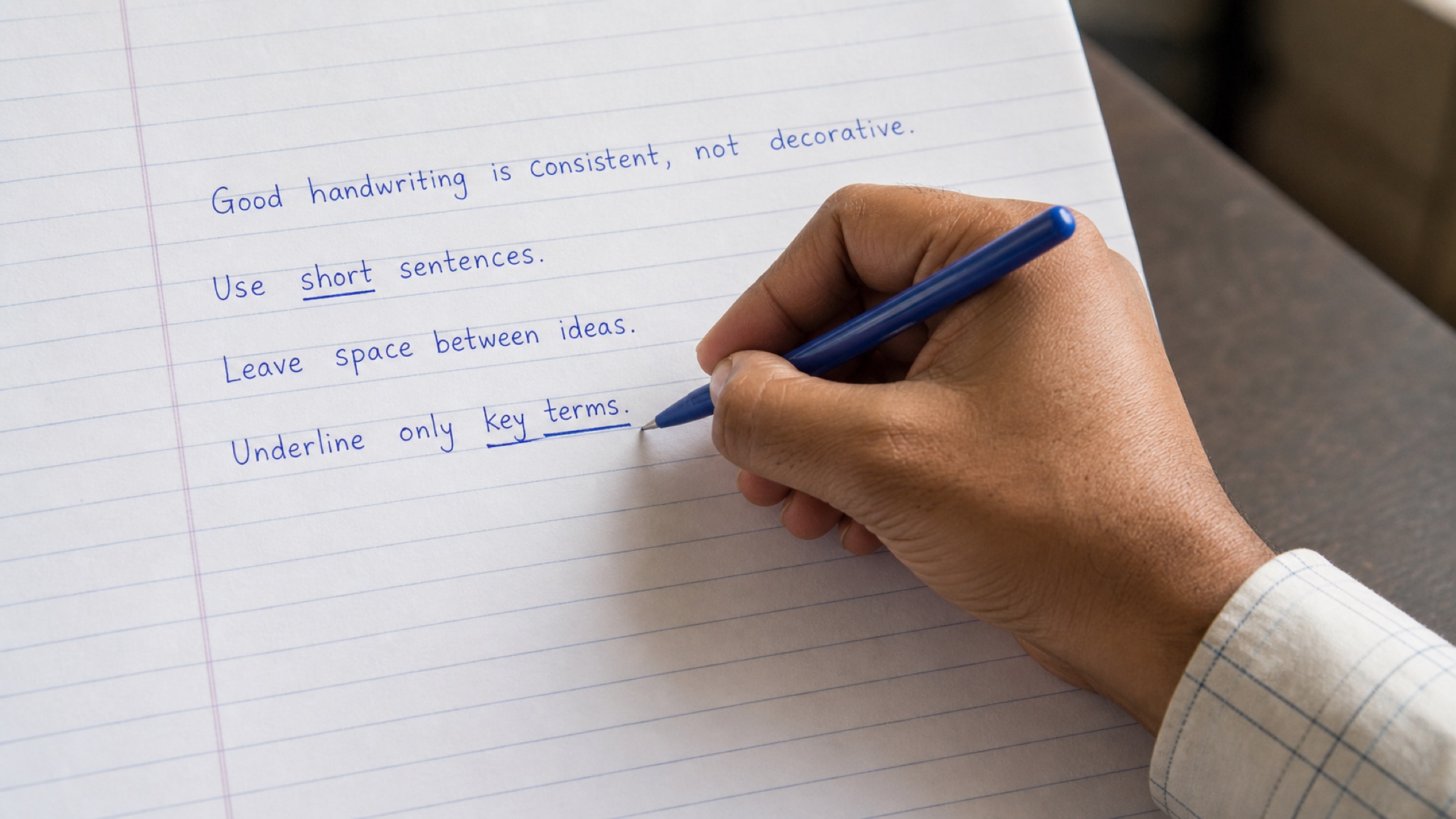
Underline sparingly and deliberately. Two or three underlines per answer, on the terms that carry the argument. An answer with fifteen underlines has none.
Leave a blank line between sections. White space is not wasted space; it is what makes ninety-second reading possible.
Handwriting: Legible Beats Beautiful
There are no marks for elegance and there is no penalty for plainness. There is a very real penalty for illegibility, because an evaluator who cannot read a sentence cannot award it.
If your handwriting deteriorates under speed — and almost everyone’s does — the fix is not to write more slowly. It is to write less. Shorter sentences, fewer clauses, more structure. See Daily Answer Writing Practice for how to build the speed that makes legibility survive.
Pen choice matters more than people expect. Use one you have written thousands of words with. Exam day is not the day to discover that a new pen skips.
There is no universal best pen for UPSC Mains. If your hand already suits liquid ink, the Pilot V5 cartridge set gives you two 0.5 mm blue pens and spare cartridges for long practice. Test it across one full three-hour paper first; comfort, drying time and legibility matter more than the brand.
Bullets or Paragraphs?
Both, on different questions, and the choice is not stylistic.
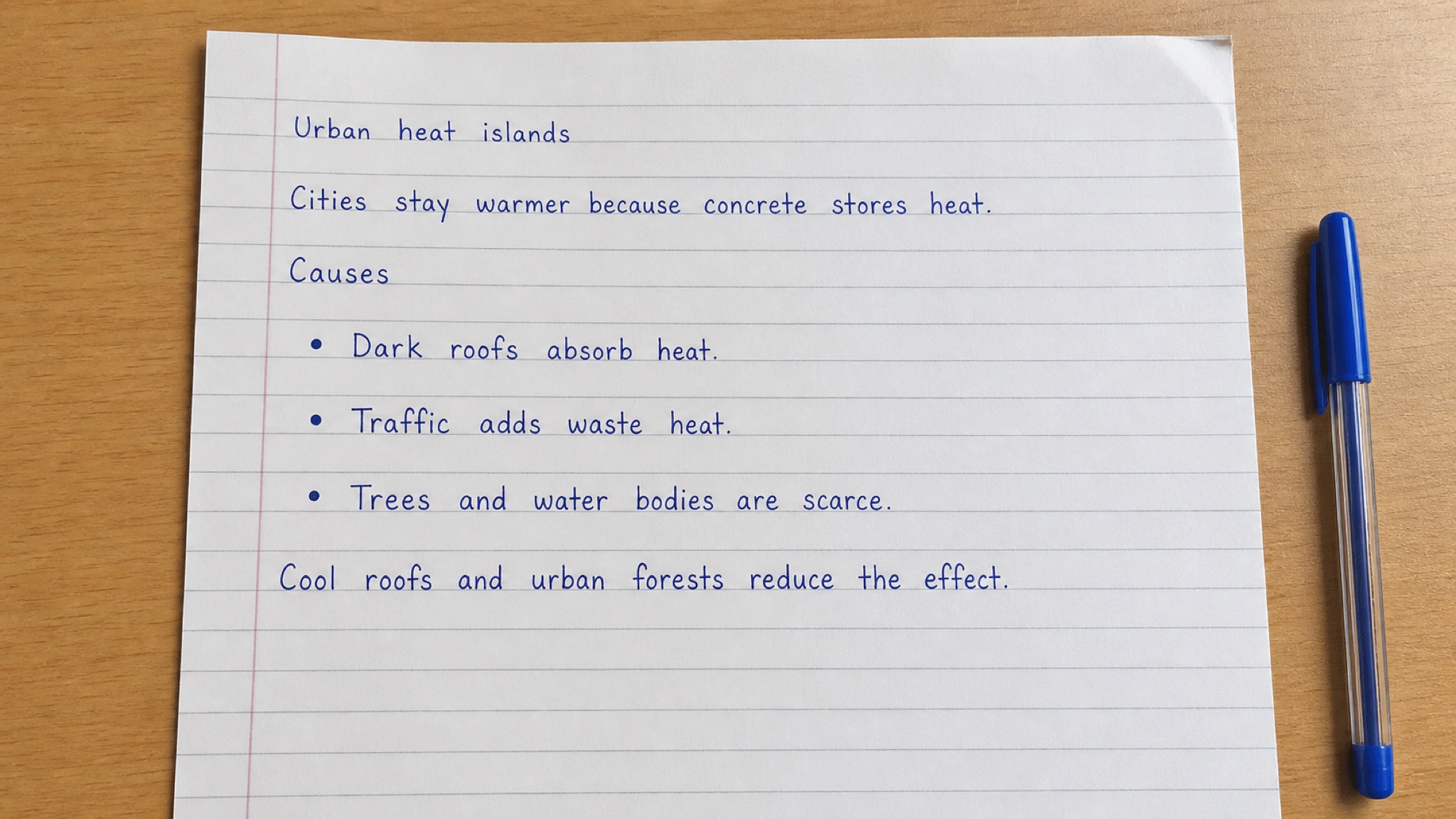
Bullets suit enumerable content — dimensions of a problem, categories of an impact, provisions of an act, steps in a process. They are fast to write and fast to read.
Paragraphs suit argument — where the connection between two ideas is the answer. A question asking you to evaluate a claim cannot be answered in bullets without losing the reasoning that earns the marks.
A reliable default: a short paragraph to frame, bullets for the enumerable middle, a short paragraph to conclude. What does not work is bulleting everything, which turns an evaluative answer into a list and caps your score.
Diagrams, Maps and Tables
These earn marks disproportionately to the time they cost, and most candidates use them too little. A flowchart of a process, a two-column comparison, a sketch map with three labels — each communicates in seconds what a paragraph struggles to.
They are most valuable in GS-1 geography, which is 31.9% of that paper, and in any question with a comparative structure. See Diagrams in UPSC Mains Answers for what to draw and when.
Keep them small, label them, and never draw one you have not practised.
The Errors That Cost Most
- Answering the topic instead of the question. The single most common failure. “Discuss the impact” is not “describe the scheme.”
- A long introduction. Three lines. Anything more eats the body.
- No conclusion. An answer that stops rather than closes reads as unfinished, even at full length.
- Running over. Space is the real limit, and the marks for question twenty are worth exactly as much as those for question one.
- Overwriting and scratching out. Plan for thirty seconds first; it is cheaper than correcting.
- Uniform density. If every answer looks identical on the page, none of them stands out.
Practise on the Real Thing
Ordinary ruled paper trains the wrong habits. Practise on booklets or sheets that match the real allotment, so you learn what 150 words looks like in your handwriting rather than what it counts to. After a few weeks you should be able to judge the length by eye, which is the skill that actually transfers to the hall.
Our Daily Answer Writing programme runs on real previous-year questions, and the Mains PYQ analysis shows which themes are worth practising most.
Frequently Asked Questions
What does the UPSC Mains answer copy look like? A bound booklet with a fixed space allotted to each question and a printed margin reserved for the evaluator. You cannot request additional sheets, so the space is the effective word limit.
How many words should a UPSC Mains answer be? About 150 words for a 10-mark question and about 250 for a 15-mark question. In practice, fit the space rather than counting words.
Should I write in bullets or paragraphs in UPSC Mains? Bullets for enumerable content, paragraphs for argument. A common effective pattern is a short framing paragraph, bullets through the middle, and a short concluding paragraph.
Does handwriting matter in UPSC Mains? Legibility matters a great deal; beauty does not. There are no marks for elegant writing and severe cost to anything an evaluator cannot read.
Can I use diagrams in UPSC Mains answers? Yes, and they are under-used. A small labelled diagram, map or table conveys more per second of writing time than prose, especially in geography and comparative questions.
How much time do I get per answer in UPSC Mains? Roughly nine minutes for twenty questions in three hours, including reading and planning. That is the real constraint behind every layout recommendation here.
Tell Google you want more of this.
Add Anantam IAS as a preferred sourceOne tap, and this site shows up more often in your own Top Stories, AI Overviews and AI Mode. Remove it any time.