UPSC Answer Writing Notebook: How to Set One Up and Actually Use It
Most answer-writing notebooks become write-only archives. The fix is a fixed layout with the evaluation built in — so revisiting it is a five-minute job, not a project.
The answer-writing notebook has a predictable life cycle. Bought with enthusiasm. Filled diligently for three weeks. Then never opened again, because there is no reason to — it contains a hundred answers with no indication of which were good, what went wrong, or what to do differently.
A notebook that gets revisited is built differently from the start. The difference is small and entirely mechanical.
The Physical Setup
A4, not smaller. The real booklet is A4 and you are training your sense of how much space an answer occupies. Practising in a smaller notebook teaches a length that will not transfer.
Single-ruled or unruled. Match whatever you write best on. Avoid four-line or narrow-ruled paper, which forces a smaller hand than you will use in the hall.
Spiral or stitched, not loose sheets. Loose sheets get lost and cannot be reviewed in sequence, which is the whole point.
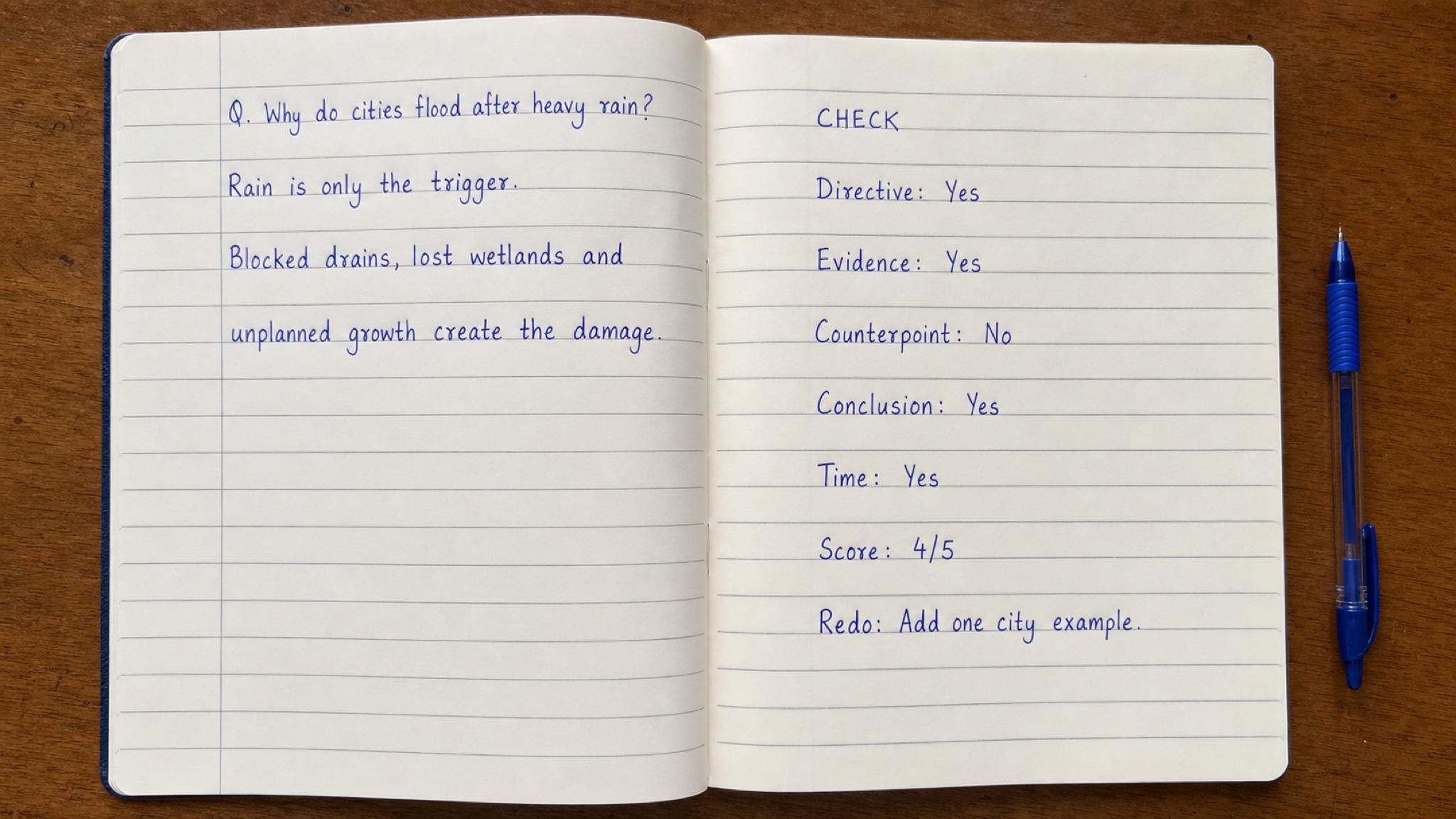
One answer per opening. Left page for the answer, right page for evaluation and the redo. If an answer runs to a page and a half, that is itself useful information about your length control.
Keep a separate notebook per paper if you are writing volume, or one notebook with tabbed sections. What matters is that you can find all your GS-2 governance answers in one place when you want to see whether you have improved.
If you want a ready-made version instead of ruling pages yourself, the amblitz A4 answer-writing notebook matches the useful parts of this setup: spiral binding, pre-printed margins and 200 pages. The product will not fix a weak review habit, so use it only with the evaluation-and-redo system below.
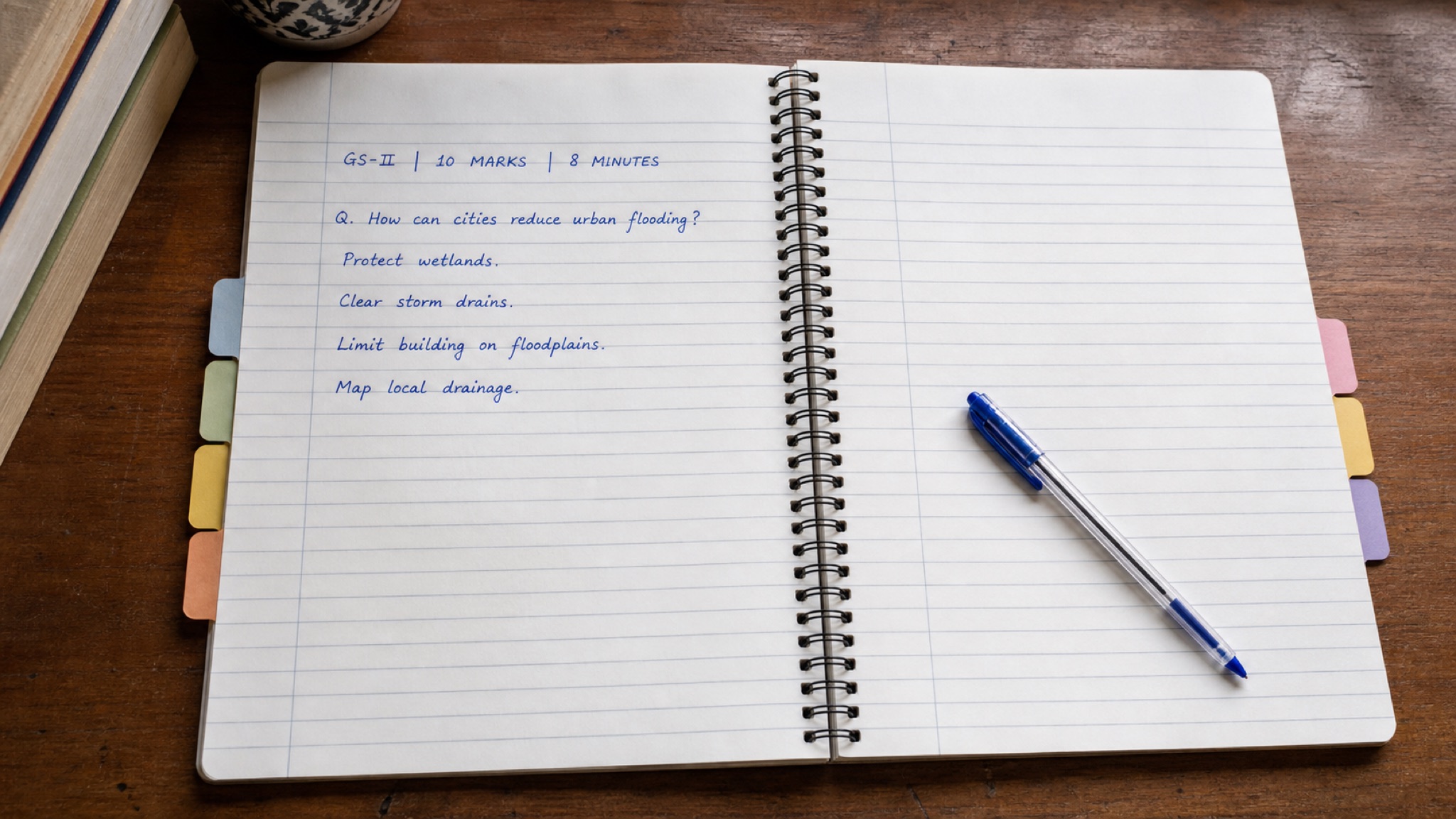
The Layout of a Page
Fix it and never vary it, so the notebook is scannable:
Top line: date · paper · marks · time taken. Four items, one line. The time is the one people skip and the one that matters most in month one.
The answer itself, written as it would be in the hall — margin left alone, visible segments, a real conclusion. See UPSC Answer Writing Copy for the layout habits worth drilling.
The evaluation block on the facing page, always the same five checks:
- Answered the directive verb? (y/n)
- One specific fact per segment? (y/n)
- Counter-position acknowledged? (y/n)
- Conclusion adds something? (y/n)
- Finished inside the space? (y/n)
Score out of 5. That is the whole evaluation, and it takes ninety seconds.
One line: what to do differently. Not a paragraph of self-criticism — one actionable sentence.
The Back of the Notebook
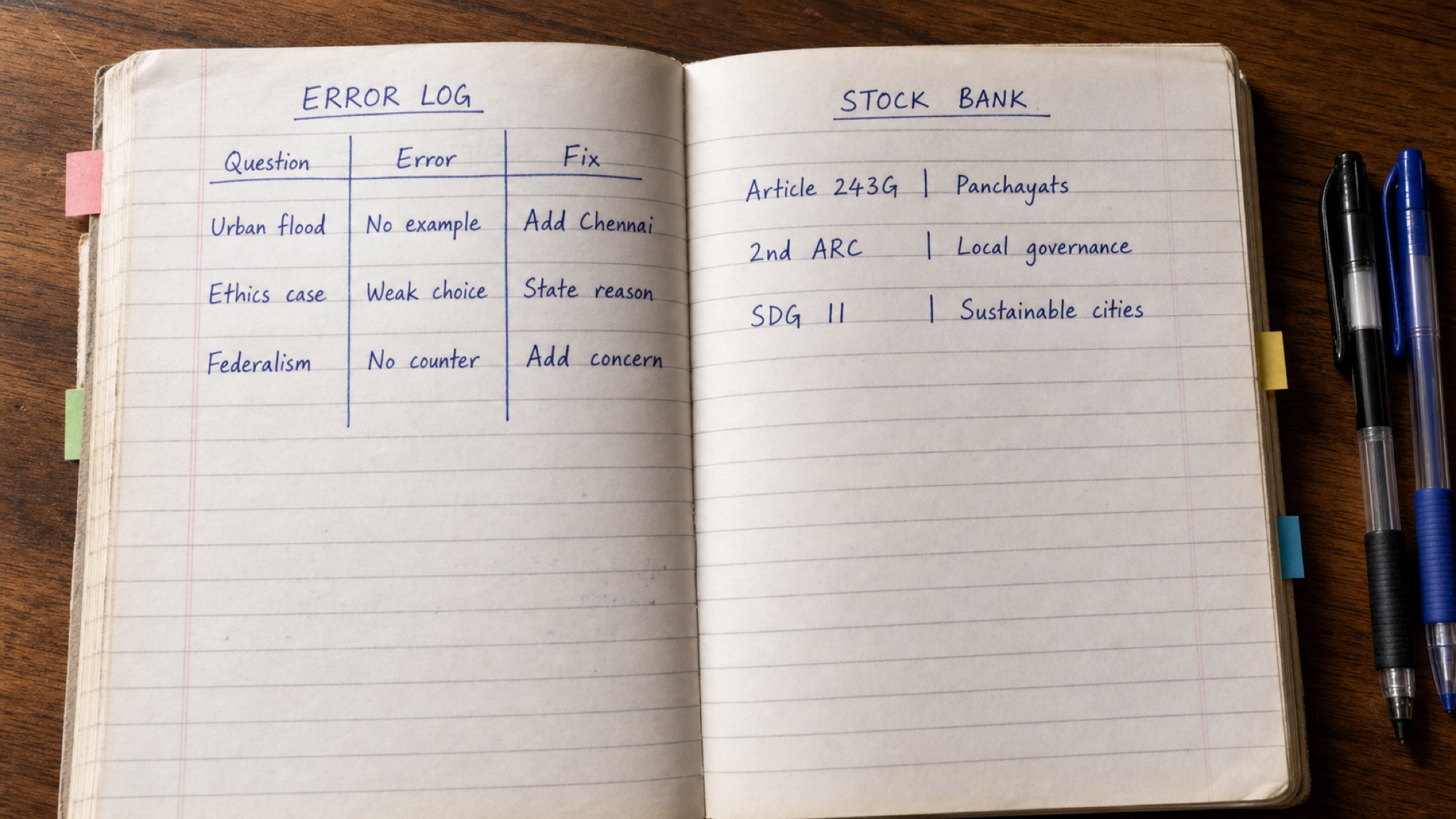
Reserve the last ten pages for two running lists. These are what make the notebook worth keeping.
The error log. Three columns: question, what went wrong, the fix. Grouped by cause, not subject — “ran out of space”, “misread the verb”, “no data”, “no counter-argument”. After a month you will find you are making two mistakes repeatedly, not twenty. Fixing two things is tractable.
The stock bank. Facts, committee names, schemes and figures you found yourself wishing for mid-answer. One line each with its source. This becomes the specificity that lifts answers out of the generic — and because you collected each item at the moment you needed it, you actually remember them.
What Makes Most Notebooks Useless
- No time recorded. Then you cannot tell whether you are improving at the thing Mains actually tests.
- Evaluation as prose. “Could be better structured” is not actionable. The five-point checklist is.
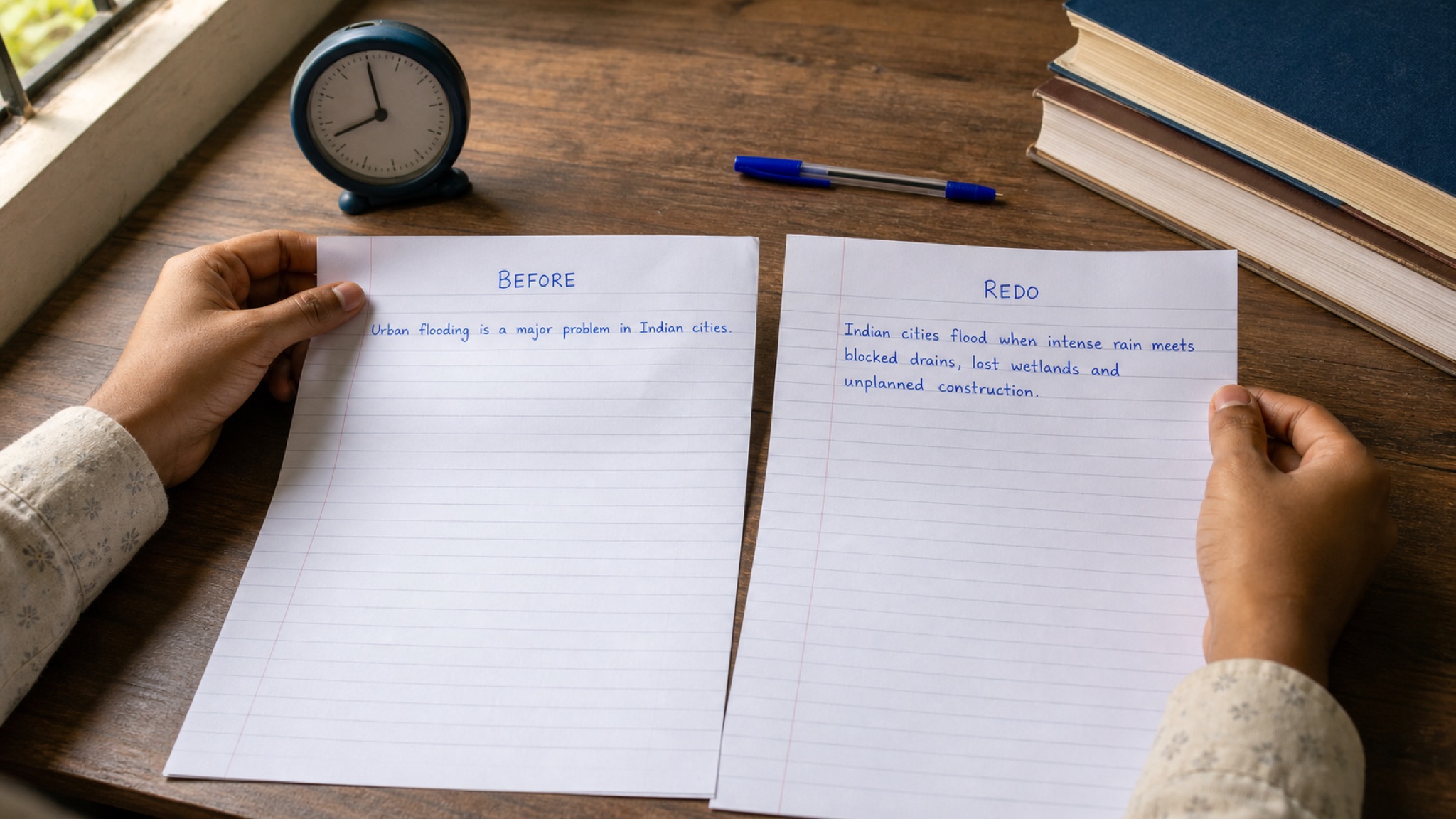
- No redo space. The second attempt at the same question, a week later, is where the improvement consolidates.
- Written only on strong subjects. Comfortable and useless. Weight your practice to what is actually asked — GS-1 is 31.9% geography, not the history paper most people practise.
- Never re-read. If you have not opened it in a month, the format is wrong, not your discipline.
The Weekly Review
Twenty minutes, once a week, and it is the point of the whole apparatus:
- Read the week’s scores. Is the trend up?
- Read the error log. Is the same cause recurring?
- Pick the two lowest-scoring answers and redo one from scratch, timed, without looking at the original.
- Add anything new to the stock bank.
That redo is the highest-value twenty minutes in the week. It is also the step almost everyone omits.
Digital Alternatives
A tablet with a stylus works, and has real advantages — searchable, no storage problem, easy to re-order. It has one significant drawback: the friction and feel are different from pen on paper, and the exam is pen on paper.
A reasonable compromise is paper for timed practice and digital for the stock bank and error log, which you will want to search. That maps onto the same split we set out in Handwritten Notes for UPSC — handwrite what you must reconstruct, type what you must retrieve.
For the ninety-day practice schedule this notebook supports, see Daily Answer Writing Practice, and for the answers themselves, Daily Answer Writing.
Frequently Asked Questions
What kind of notebook should I use for UPSC answer writing? A4, single-ruled or unruled, spiral or stitched, with one answer per opening — left page for the answer, right page for evaluation and the redo. A4 matters because you are training your sense of the real booklet’s space.
How should I evaluate answers in my notebook? With a fixed five-point checklist — directive verb, one fact per segment, counter-position, conclusion that adds something, finished inside the space — scored out of five, plus one actionable line. Prose self-criticism is not usable later.
What should go at the back of the notebook? An error log grouped by cause rather than subject, and a stock bank of facts, committees and figures you wished you had mid-answer.
Should I keep separate notebooks for each GS paper? Either separate notebooks or one with tabbed sections. What matters is being able to review all answers on a theme together to see whether you have improved.
Is a digital notebook fine for answer writing? For the error log and stock bank, yes and better. For timed practice, paper is preferable — the exam is handwritten and the feel and friction differ.
How often should I review the notebook? Twenty minutes weekly: read the scores, read the error log, and redo one weak answer from scratch. The redo is the step that consolidates improvement and the one most often skipped.