Wayanad Wildlife Sanctuary: Location, Biodiversity, and Significance
Wayanad Wildlife Sanctuary in Kerala is part of Nilgiri Biosphere Reserve. Explore flora, fauna, elephant corridor, and UPSC environment notes.
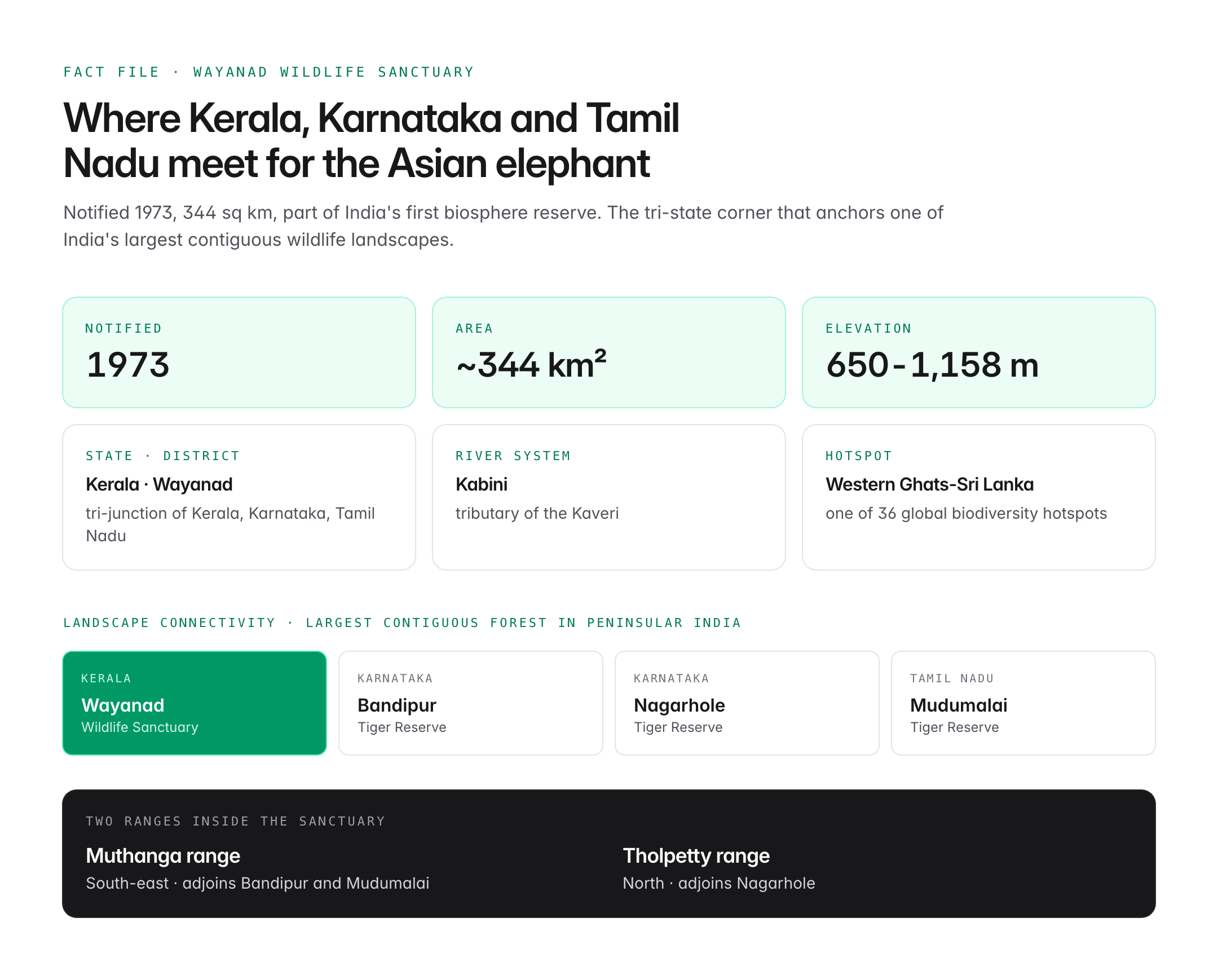
The Wayanad Wildlife Sanctuary is one of the most ecologically important protected areas in southern India, located in the Wayanad district of Kerala along the tri-junction of Kerala, Karnataka and Tamil Nadu. Notified in 1973, it forms a vital part of the Nilgiri Biosphere Reserve, India's first such reserve, and is a critical habitat for the Asian elephant, Bengal tiger, Indian gaur and a host of endemic Western Ghats species. Spread over roughly 344 sq km, the sanctuary sits in the lee of the Western Ghats, connecting with Bandipur and Nagarhole in Karnataka and Mudumalai in Tamil Nadu to form one of the largest contiguous wildlife landscapes in India. For UPSC environment, Wayanad is a compact case in biodiversity, corridors and human-wildlife conflict.
Location and Geography
Wayanad Wildlife Sanctuary lies in the Western Ghats, at elevations of roughly 650-1,158 m above sea level. Key geographical features:
- Districts – Wayanad, Kerala.
- Borders – Bandipur Tiger Reserve (Karnataka) and Nagarhole Tiger Reserve (Karnataka) in the north and east; Mudumalai Tiger Reserve (Tamil Nadu) in the south-east.
- Two main ranges –
- Muthanga range (south-east, adjoining Bandipur and Mudumalai)
- Tholpetty range (north, adjoining Nagarhole)
- Major rivers – tributaries of the Kabini, which is in turn a tributary of the Kaveri.
- Climate – monsoon-driven, with the south-west monsoon bringing heavy rainfall from June to September.
The sanctuary forms part of the Nilgiri Biosphere Reserve (declared in 1986), which also includes Bandipur, Nagarhole, Mudumalai, Sathyamangalam and the Silent Valley-Mukurthi complex.
Flora
Wayanad harbours a mosaic of forest types determined by altitude, rainfall and soil:
- South Indian moist deciduous forests – dominant; teak, rosewood, and bamboo.
- Semi-evergreen patches – along streams and higher elevations.
- Plantations – eucalyptus, teak and acacia from colonial and post-Independence forestry.
- Tropical dry deciduous fringes, particularly towards Muthanga.
- Bamboo brakes – important for elephants and gaur.
Characteristic tree species include Tectona grandis (teak), Dalbergia latifolia (rosewood), Terminalia species, Pterocarpus marsupium (Indian kino), and several Western Ghats endemics.
Fauna
Wayanad's landscape-scale connectivity makes it one of the richest wildlife habitats in peninsular India.
| Category | Representative Species |
|---|---|
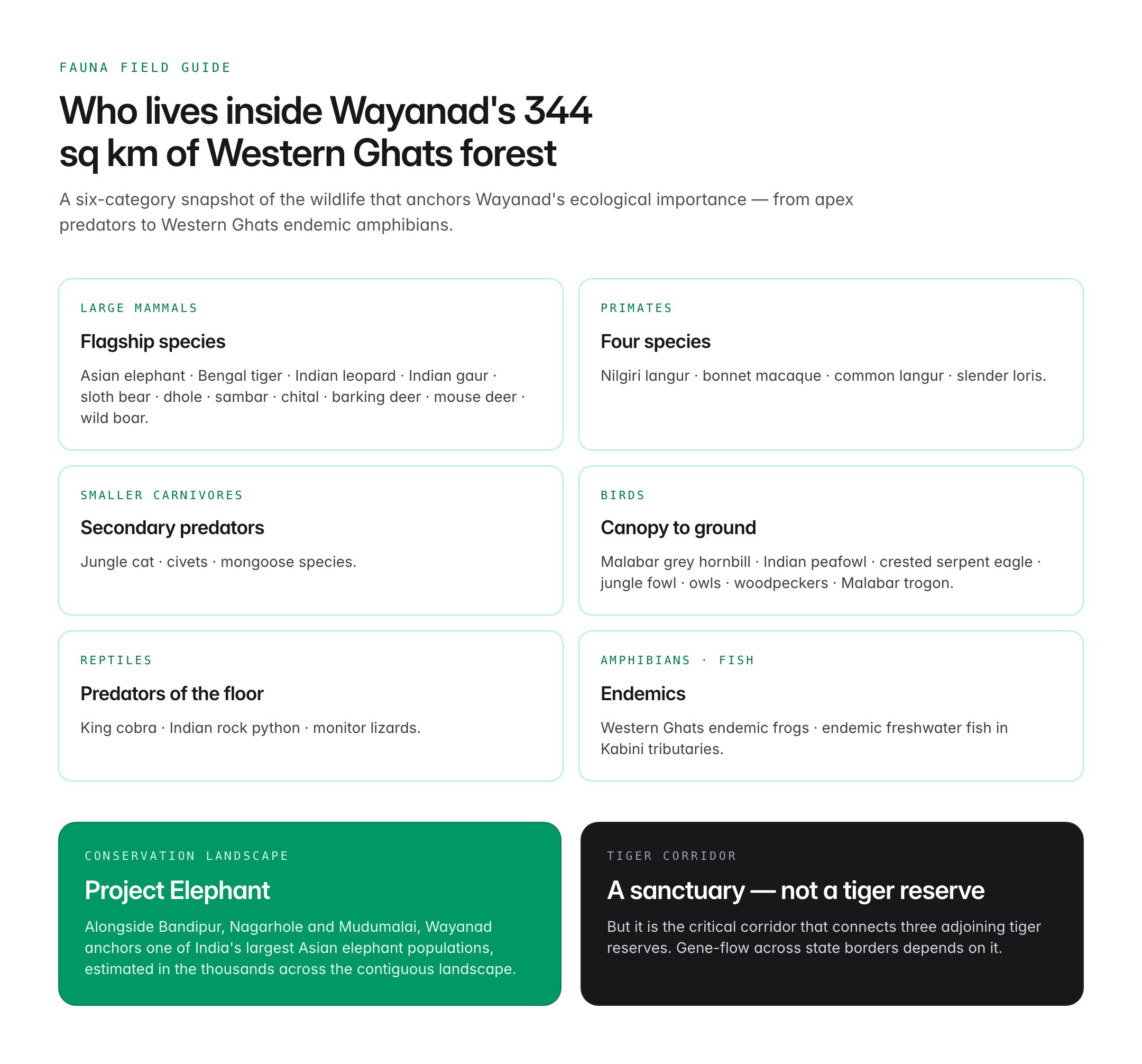
| Large mammals | Asian elephant, Bengal tiger, Indian leopard, Indian gaur, sloth bear, dhole (wild dog), sambar, chital, barking deer, mouse deer, wild boar |
| Primates | Nilgiri langur, bonnet macaque, common langur, slender loris |
| Smaller carnivores | Jungle cat, civets, mongoose species |
| Birds | Malabar grey hornbill, Indian peafowl, crested serpent eagle, jungle fowl, owls, woodpeckers, Malabar trogon |
| Reptiles | King cobra, Indian rock python, monitor lizards |
| Amphibians/Fish | Western Ghats endemic frogs; endemic freshwater fish in Kabini tributaries |
The sanctuary is especially important for the Asian elephant. Along with Bandipur, Nagarhole and Mudumalai, it anchors one of the largest elephant populations in India, estimated in the thousands across the contiguous landscape. It is part of the Project Elephant landscape.
While Wayanad itself is formally a wildlife sanctuary, the adjoining reserves are tiger reserves under Project Tiger and together support a significant tiger population, with Wayanad serving as a critical corridor.
Ecological Significance
Wayanad matters ecologically for several reasons:
- Corridor role – connects Bandipur-Nagarhole-Mudumalai-Wayanad, enabling gene flow for elephants, tigers and other wide-ranging species.
- Biodiversity hotspot – part of the Western Ghats-Sri Lanka biodiversity hotspot; includes Western Ghats World Heritage sites in the broader landscape.
- Watershed – feeds the Kabini, supporting the Kaveri basin downstream.
- Endemism – Western Ghats endemic amphibians, reptiles and fish.
- Climate regulation – contributes to regional rainfall patterns and carbon sequestration.
Tribal Communities and Livelihoods
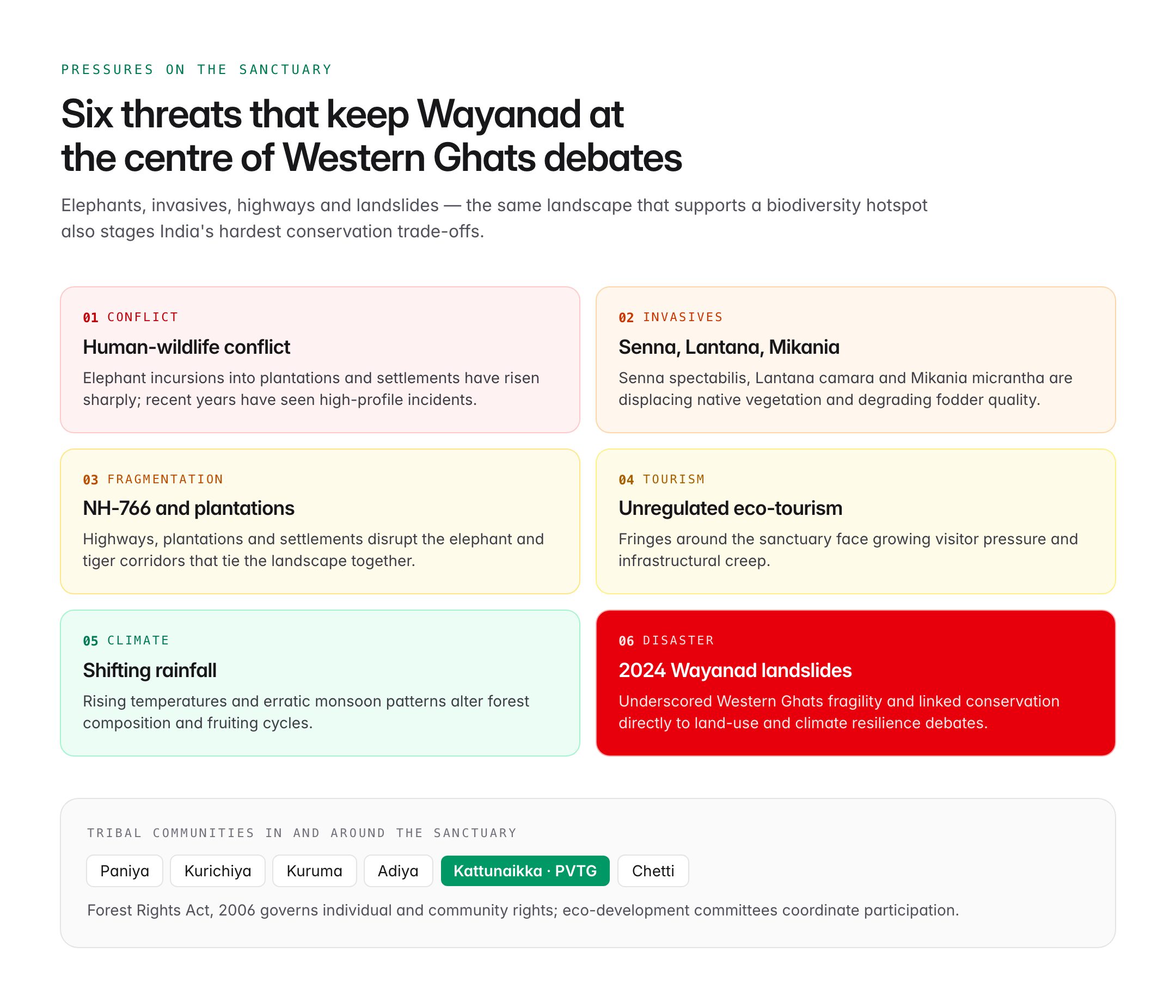
Wayanad district has a significant tribal population, including the Paniya, Kurichiya, Kuruma, Adiya, Kattunaikka and Chetti communities. Many live in and around the sanctuary. Their interaction with the forest ranges from traditional hunter-gathering and honey collection to agriculture, often leading to complex issues of:
- Rights under the Forest Rights Act, 2006.
- Human-wildlife conflict, particularly with elephants raiding crops.
- Relocation and livelihood support.
- Eco-development committees and participation in management.
The Kattunaikka are recognised as a Particularly Vulnerable Tribal Group (PVTG).
Challenges and Conservation Issues
Several pressures affect Wayanad's ecology:
- Human-wildlife conflict – elephant incursions into plantations and settlements have risen. Recent years have seen high-profile incidents involving elephants and humans.
- Invasive species – Senna spectabilis, Lantana camara, Mikania micrantha have spread aggressively, displacing native vegetation and reducing fodder quality.
- Fragmentation – highways (notably NH-766), plantations and settlements disrupt corridors.
- Tourism pressure – unregulated eco-tourism in fringes.
- Climate change – shifting rainfall and rising temperatures affect forest composition.
- Landslides – the 2024 Wayanad landslides in the broader district underscored the ecological fragility of the Western Ghats and linked to larger land-use and climate issues.
Conservation interventions include eco-restoration of invasive-dominated areas, corridor securing, compensatory schemes for conflict losses, and collaboration with Tamil Nadu and Karnataka forest departments for landscape-level planning.
Administrative and Legal Framework
The sanctuary operates within several overlapping frameworks:
- Wildlife (Protection) Act, 1972 – legal basis for notification and management.
- Forest (Conservation) Act, 1980 – regulates diversion of forest land.
- Biological Diversity Act, 2002 – state boards and management committees.
- Forest Rights Act, 2006 – recognition of individual and community forest rights.
- Nilgiri Biosphere Reserve – under the Man and the Biosphere (MAB) Programme of UNESCO.
- Western Ghats Ecologically Sensitive Area debates – Gadgil and Kasturirangan reports.
UPSC Relevance
Prelims focus
- State and district: Kerala, Wayanad district.
- Part of Nilgiri Biosphere Reserve (India's first, 1986).
- Adjoining reserves: Bandipur, Nagarhole (Karnataka), Mudumalai (Tamil Nadu).
- Key species: Asian elephant, Bengal tiger, Indian gaur, Nilgiri langur, sloth bear, dhole.
- Belongs to the Western Ghats-Sri Lanka biodiversity hotspot.
- River system: Kabini (tributary of Kaveri).
Mains GS-III angle
Use Wayanad in questions on:
- Human-wildlife conflict and mitigation strategies.
- Corridor conservation and landscape-level planning.
- Invasive alien species in protected areas.
- Western Ghats conservation – reconciling Gadgil/Kasturirangan recommendations with livelihood concerns.
- Climate-induced disasters – linking Wayanad landslides to land-use and forest degradation.
Sample PYQ angle – questions on "elephant corridors" or "Western Ghats ecology" map well. A good answer ties the sanctuary to the Nilgiri Biosphere Reserve, names adjoining tiger reserves, and integrates community rights with conservation.
Wayanad Wildlife Sanctuary captures, in a single landscape, the promise and pressures of Western Ghats conservation – making it a high-value UPSC case study.