What Are Emotions and Their Structure: Components, Theories and Civil Service Relevance (UPSC GS IV)
Emotions and their structure for UPSC GS IV — three-component model (subjective, physiological, behavioural), theories of emotion, and civil service application.
A district magistrate stepping into a riot-torn neighbourhood is doing two things at once. She is reading documents, planning resource allocation, drafting orders — the work of cognition. And she is reading faces, modulating her own affect, holding her composure when the crowd pushes — the work of emotion. The civil services examination puts emotional intelligence on the syllabus precisely because administration cannot be reduced to cognition. Emotions are not the soft side of public life; they are part of how public life works.
This article works through what an emotion is, the components that make it up, the major psychological theories of emotion, and the civil-service relevance of getting the structure right.
What is an emotion?
An emotion is a complex, short-lived psychological state that arises in response to an object, event or thought, and that combines mental, bodily and behavioural elements. It differs from a mood (which is longer-lasting and lower in intensity) and from a feeling (which is the conscious experience of an emotion).
Don Hockenbury and Sandra E. Hockenbury, in Discovering Psychology, propose the standard contemporary definition. An emotion is a complex psychological state that involves three distinct components.
| Component | Description | Example: anger at injustice |
|---|---|---|
| Subjective experience | The conscious, felt quality — what the emotion "is like" from inside | The hot, tight feeling of indignation when reading a corruption report |
| Physiological response | The bodily changes — heart rate, blood pressure, breathing, sweating, hormones | Faster heart, raised blood pressure, tense muscles |
| Behavioural / expressive response | The outward signs — facial expression, posture, voice, action | Furrowed brow, clipped speech, decision to file a complaint |
All three components are present in every full-fledged emotion. Their relative weight differs across emotions and across individuals.
The subjective experience component
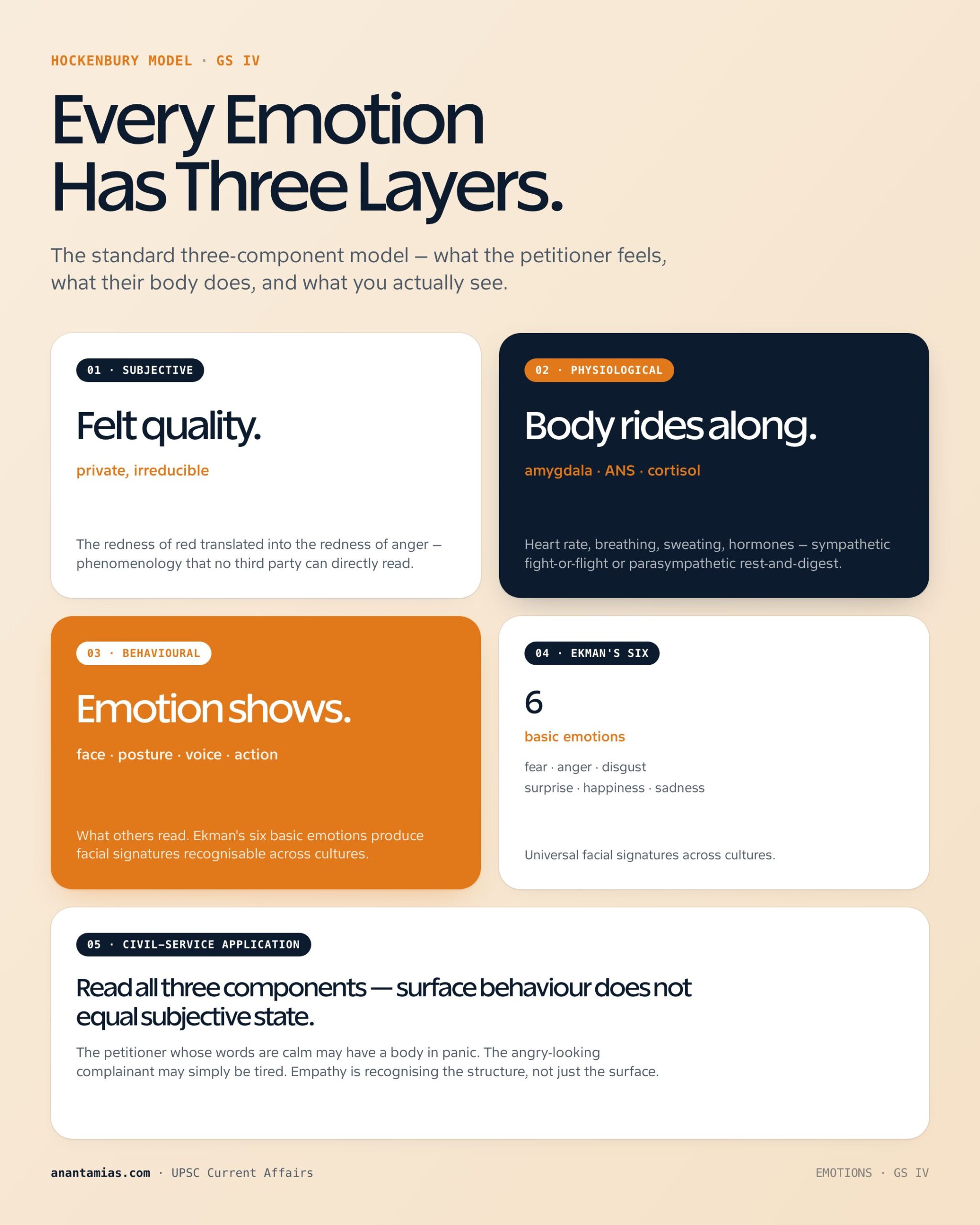
This is the felt quality of the emotion — the redness of red translated into the redness of anger. Even people in the same situation experience the same emotion differently. Two officers may both be angry at a missed deadline, but one experiences anger as a focused alertness while the other experiences it as a heavy, frustrated dullness. The phenomenology — what it feels like — is irreducibly personal.
This subjective dimension matters for civil services because it warns against assuming that two people in the same situation feel the same thing. The petitioner who looks calm may be terrified; the officer who looks angry may simply be tired. Reading emotion correctly requires looking past the assumption that surface behaviour equals subjective state.
The physiological component
Emotions ride on the body. The autonomic nervous system, in particular its sympathetic and parasympathetic branches, drives a stereotyped set of bodily changes during emotion.
- Sympathetic activation — heart rate up, blood pressure up, breathing fast, sweating, pupils dilated, digestion slowed. The fight-or-flight pattern, characteristic of fear and anger.
- Parasympathetic activation — heart rate down, breathing slow, digestion resumed. The rest-and-digest pattern, characteristic of contentment and calm.
- Endocrine response — adrenaline and cortisol in stress; oxytocin in affiliation; serotonin and dopamine in reward.
The amygdala (limbic system) is central to emotion processing; the prefrontal cortex regulates and contextualises it. Damage to either disrupts emotional life — the famous case of Phineas Gage demonstrated how prefrontal damage strips emotional regulation while leaving cognition intact.
The behavioural / expressive component
Emotions show. Paul Ekman's research established that six basic emotions — fear, anger, disgust, surprise, happiness, sadness — produce facial expressions that are recognisable across cultures. Posture, gesture, voice tone and action tendencies follow.
For the civil servant, this is operationally important. The expressive component is what others read. An officer whose face shows contempt at a petitioner's complaint has communicated more than the words she chose. Emotional intelligence, in part, is the management of the expressive component without violating its underlying truth.
Major theories of emotion
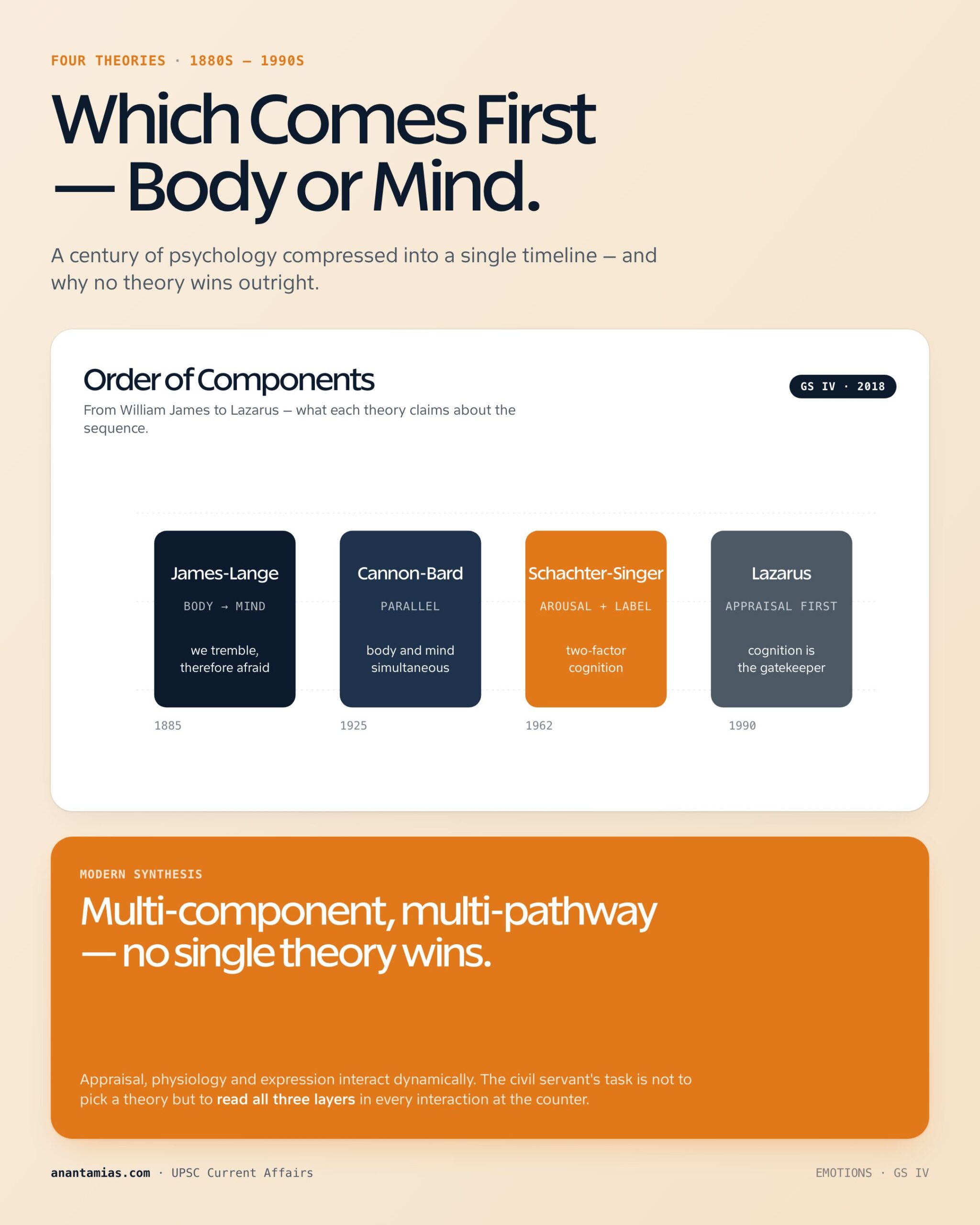
The three components do not arise simultaneously, and the question of which causes which has produced a century of psychological theorising.
James-Lange theory (1880s–90s)
William James and Carl Lange independently proposed that emotion follows bodily change. The traditional view — we tremble because we are afraid — is reversed. We are afraid because we tremble. The bear in the woods produces a physiological reaction; the conscious experience of fear is the perception of that physiological reaction.
The theory is famously counter-intuitive but has empirical support, especially from facial-feedback studies (forcing a smile genuinely improves mood).
Cannon-Bard theory (1920s)
Walter Cannon and Philip Bard objected: the body is too slow, and the same physiological pattern accompanies different emotions. They proposed instead that the subjective experience and the physiological response occur simultaneously, both produced by the thalamus and routed in parallel.
Schachter-Singer two-factor theory (1962)
Stanley Schachter and Jerome Singer combined elements of both. Emotion, they argued, requires two factors — a physiological arousal and a cognitive label that interprets the arousal. Pounding heart plus the cognitive label "I am in danger" produces fear; the same pounding heart with the label "I am attracted" produces excitement. The classic suspension-bridge experiment supported this.
Lazarus appraisal theory
Richard Lazarus emphasised the cognitive appraisal that precedes emotion. We see a stimulus, appraise its significance for our well-being, and only then experience an emotion. This makes cognition the gatekeeper of emotion.
| Theory | Order of components | Key claim |
|---|---|---|
| James-Lange | Body → mind | Emotion is the perception of bodily change |
| Cannon-Bard | Body and mind simultaneous | Both arise in parallel from brain |
| Schachter-Singer | Body + cognitive label | Emotion = arousal + interpretation |
| Lazarus | Appraisal → emotion | Cognitive evaluation comes first |
A modern synthesis treats emotion as a multi-component, multi-pathway response in which appraisal, physiology and expression interact dynamically — no single theory wins outright.
Two Indian case studies
Case study 1 — Mahatma Gandhi at Champaran
Gandhi at Champaran in 1917 displayed a distinctive emotional structure. The subjective experience was sustained moral indignation at indigo planters' exploitation; the physiological component was the extraordinary self-control born of long fasting and meditation; the behavioural component was calm refusal to leave when ordered out by the magistrate. The integration of the three components — feeling deeply, regulating bodily reaction, expressing through measured action — is what made satyagraha possible.
Case study 2 — Kiran Bedi at Tihar Jail
When Kiran Bedi took charge at Tihar Jail in 1993, the prevailing emotional structure of the institution was fear (among inmates) and contempt (among staff). Bedi's reforms — meditation programmes, library access, family meetings — directly intervened in the emotional structure. The cognitive appraisals shifted (from "punishment" to "rehabilitation"), the physiological climate calmed, and the behavioural patterns followed. Emotion as policy lever.
Civil services application
The structure of emotion has direct administrative implications.
- Reading petitioners. The three components do not always align. The petitioner whose words are calm may have a body in panic; the angry-looking complainant may simply be tired. Read all three.
- Self-management. Recognise your own components. The officer whose heart is racing in a tense meeting can use deep breathing (parasympathetic activation) to recover composure before deciding.
- Empathy. Empathy is, in part, recognition of others' emotion structure. The officer who can name what the citizen is feeling treats them differently — and better.
- Public communication. A press briefing during disaster must manage the public's emotion structure — provide accurate information (cognitive), calm bodily affect (tone, pace), and model appropriate behaviour (visible composure). Mismanage any one and panic spreads.
- Conflict resolution. Most administrative conflicts have an emotional layer beneath the procedural one. Recognising the emotion is half the resolution.
UPSC past-year question references
- 2018 GS IV: "What does emotional intelligence mean? Discuss its various components and how they help in better decision-making by a civil servant."
- 2017 GS IV: case study involving emotional pressure from family of victims in a difficult policing situation.
- 2014 GS IV: "Emotional intelligence is helpful in decision making." Discuss.
- 2020 GS IV: ethical implications of suppressing emotions in administrative settings.
Mains answer hook
An emotion is a complex, short-lived psychological state with three components — a subjective felt experience, a physiological response, and a behavioural-expressive response. The classical theories — James-Lange, Cannon-Bard, Schachter-Singer, Lazarus — disagree about the order in which these components arise but agree that all three are present. For the civil servant, the structural understanding of emotion is not psychological trivia. It is the foundation of self-regulation, of empathy, and of the management of public emotion in moments — disasters, riots, policy backlashes — when administration cannot succeed without emotional competence.
Prelims pointers
- Don Hockenbury & Sandra E. Hockenbury — Discovering Psychology — three-component model.
- Paul Ekman — six universal basic emotions.
- William James and Carl Lange — body precedes mind.
- Walter Cannon and Philip Bard — body and mind simultaneous.
- Stanley Schachter and Jerome Singer — two-factor theory (1962).
- Richard Lazarus — appraisal theory.
- Amygdala (limbic system) — central to emotion processing.
FAQ
Are emotions the same across cultures?
The basic six (Ekman's list) appear to have universal facial signatures. Subjective experience and display rules vary substantially by culture.
Are emotions rational or irrational?
Neither cleanly. Emotions encode evaluative judgements that are usually adaptive but can be miscalibrated. The civil servant's task is to keep emotion as input, not as output.
Can emotions be controlled?
The expression and behaviour can be regulated; the subjective experience can be modulated through cognitive reframing; the physiological component can be partly managed through breathing and meditation. Suppression alone tends to backfire.
How does emotion differ from mood?
Emotion is short-lived and object-directed; mood is longer-lasting and diffuse. Anger at a corrupt clerk is an emotion; persistent low spirits over weeks is a mood.
Why does emotional structure matter for governance?
Because administration is human. Petitioners, colleagues, citizens, the officer herself — all bring emotional structures to every interaction. Ignoring them produces brittle, unfair governance.
The structure of emotion is not a side topic in GS IV. It is the architecture beneath every emotional intelligence question, every empathy question, every case study where a citizen confronts an officer with anger, grief or hope. Understand the structure and the rest of the syllabus opens up.