Whistleblowing in India: The Whistle Blowers Protection Act and a Law That Never Commenced (UPSC Ethics — GS IV)
India passed a law to protect whistleblowers over a decade ago. It has never been brought into force — and the ethical question it was meant to settle is still being answered by individuals at their own cost.
An engineer notices that the concrete in a highway project does not match the specification. A doctor sees that the medicines being logged are not the medicines being given. An accountant finds an invoice for work nobody did. In each case the person has information the public needs and an employer who would rather it stayed inside — and no ordinary rule of workplace conduct tells them what to do.
Whistleblowing is the point where loyalty to an organisation and duty to the public come apart. It is one of the few ethical dilemmas where the cost of doing the right thing is reliably borne by the individual who does it, and where the institution’s own procedures are usually the thing being circumvented. India has a statute meant to address exactly this. It has never been brought into force.
What Whistleblowing Is, and What It Is Not
Whistleblowing is the disclosure, by a member of an organisation, of wrongdoing within it, to someone able to act on it. Three elements matter.
Insider status. The whistleblower’s information comes from their position. That is the source of both its value and their vulnerability.
Public interest. The disclosure concerns harm to others — corruption, danger, illegality, abuse of authority — rather than a private grievance. A dispute about one’s own promotion is not whistleblowing, however genuine.
Bypassing the normal chain. Disclosure goes outside the ordinary reporting line, either because that line is implicated or because it has failed. This is what makes it feel like disloyalty.
Internal whistleblowing goes to someone inside with authority to act; external goes to a regulator, court, legislature or the press. The ethical standing of external disclosure is usually held to depend on internal routes having been tried, or being futile — the same structure as the exhausted-remedies condition in the ethics of protest.
The Loyalty Objection, and Why It Fails
The case against whistleblowing runs on loyalty: you accepted employment, you took the organisation’s benefits, and exposing it publicly is betrayal. Confidentiality is a real obligation, organisations cannot function if every member publicises every disagreement, and disclosures are sometimes wrong, malicious or self-serving.
None of that survives contact with the actual cases, for one reason. Loyalty is owed to an organisation’s purpose, not to its reputation. A hospital exists to treat patients; a public works department exists to build safe roads. Someone concealing a danger is not being loyal to the institution — they are protecting it from the consequences of failing at its own purpose, which is a different and lesser thing. On this reading the whistleblower is often the most loyal person in the room.
Two further points close the argument. Confidentiality obligations do not extend to concealing illegality; no employment contract can lawfully require complicity. And the objection proves too much: if loyalty always outranked disclosure, every institutional harm would be permanently invisible, which no defensible ethics can accept.
When Disclosure Becomes Obligatory
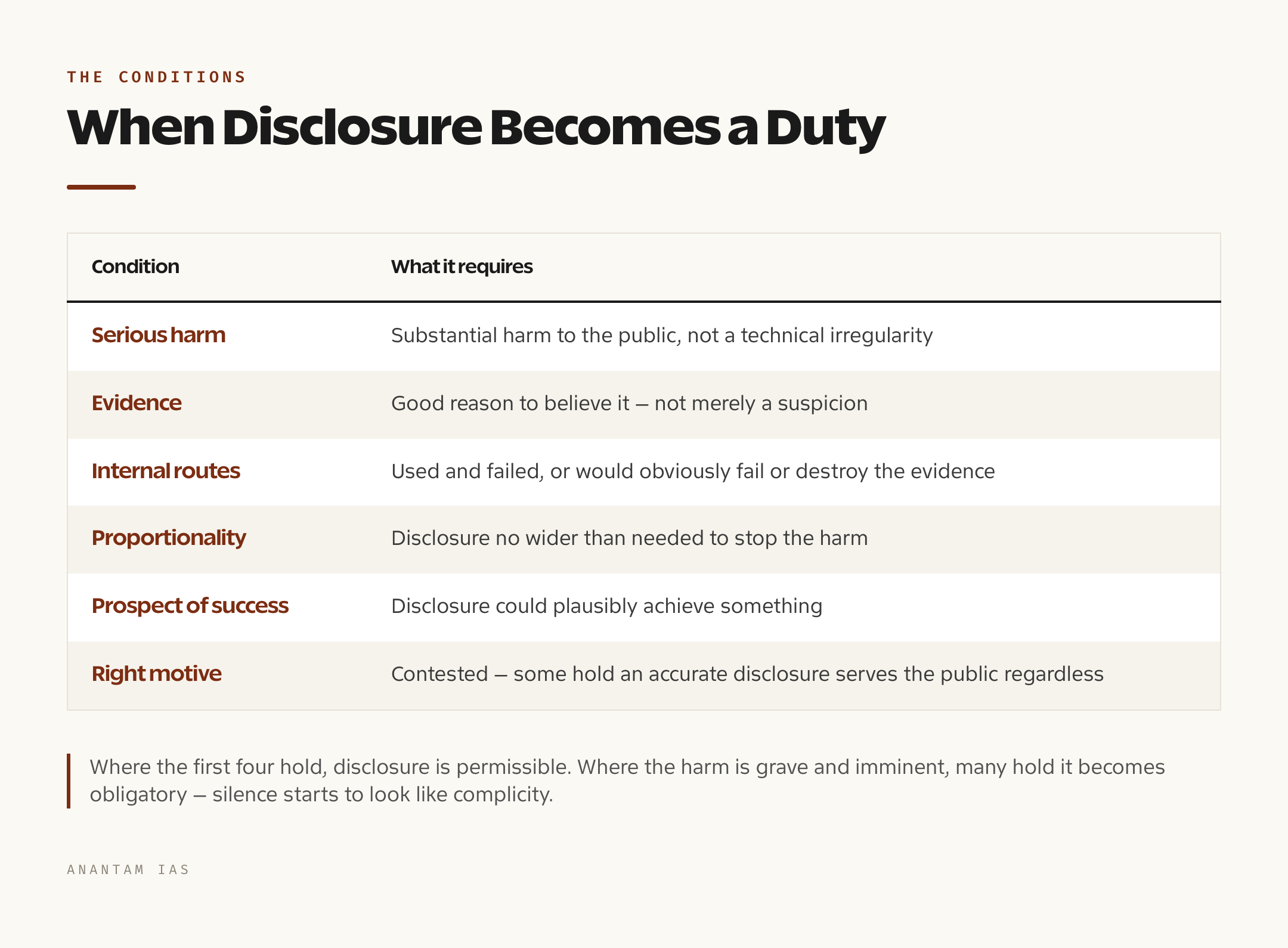
Most frameworks distinguish disclosure that is permitted from disclosure that is required. The standard conditions, adapted from the business-ethics literature, are:
| Condition | What it requires |
|---|---|
| Serious harm | The wrongdoing threatens substantial harm to the public, not a technical irregularity |
| Evidence | The whistleblower has good reason to believe it, not merely a suspicion |
| Internal routes | They have been used and have failed, or would obviously fail or destroy the evidence |
| Proportionality | The disclosure is no wider than necessary to stop the harm |
| Prospect of success | Disclosure could plausibly achieve something |
| Right motive | The aim is to prevent harm, not revenge or gain |
Where the first four hold, disclosure is generally permissible. Where the harm is grave and imminent, many hold it becomes obligatory — silence is complicity. The last two conditions are contested: some argue an accurate disclosure serves the public whatever the motive, and that requiring a pure heart sets a standard no other duty demands.
The Indian Record
The names matter, because they are what the abstract argument costs.
Satyendra Dubey, an IIT graduate and project director with the National Highways Authority of India, wrote to the highest levels of government about corruption and sub-standard work on the Golden Quadrilateral. His letter, sent with a request for confidentiality, was circulated. He was murdered in Gaya in November 2003. The public outcry after his killing is the direct origin of India’s whistleblower legislation.
Shanmugam Manjunath, a Sales Officer with Indian Oil, sealed petrol pumps in Uttar Pradesh for selling adulterated fuel. He was murdered in November 2005.
Sanjiv Chaturvedi, an Indian Forest Service officer, exposed irregularities in a series of postings, most prominently as Chief Vigilance Officer at AIIMS. He was not killed; his career was subjected to repeated transfers, stripped charges and adverse assessments — which is the more common form the cost takes.
The pattern is the point. Two of these disclosures produced action mainly after the discloser was dead, and the third shows how attrition substitutes for violence. An ethics that relies on individual courage without institutional protection is not a system; it is a lottery.
The Act That Never Commenced
Following the Dubey case and a public-interest petition, the government first acted through a resolution authorising the Central Vigilance Commission to receive protected disclosures — the Public Interest Disclosure and Protection of Informers arrangement. Parliament then passed the Whistle Blowers Protection Act, 2014, which received assent on 12 May 2014.
The Act’s architecture is sound in outline. It allows any person, including a public servant, to make a public-interest disclosure about corruption, wilful misuse of power or a criminal offence by a public servant, to a designated competent authority. It requires the identity of the complainant to be protected, prohibits victimisation of the discloser, and penalises the revealing of identity as well as malicious false complaints.
It has never taken effect. Section 1(3) provides that the Act comes into force on a date the central government appoints by notification — and no such notification has ever been issued. The government’s stated reason, given in reply to Parliament, is that the Act requires amendment first, to guard against disclosures affecting the sovereignty and integrity of India. An amendment Bill introduced to narrow the scope of permissible disclosures did not become law, and as of the government’s December 2024 statement, changes were not part of the legislative business before Parliament.
So the position is this: a statute exists, is on the books, and confers nothing. Anyone who discloses today relies on the CVC resolution route, on the courts, or on nothing at all.
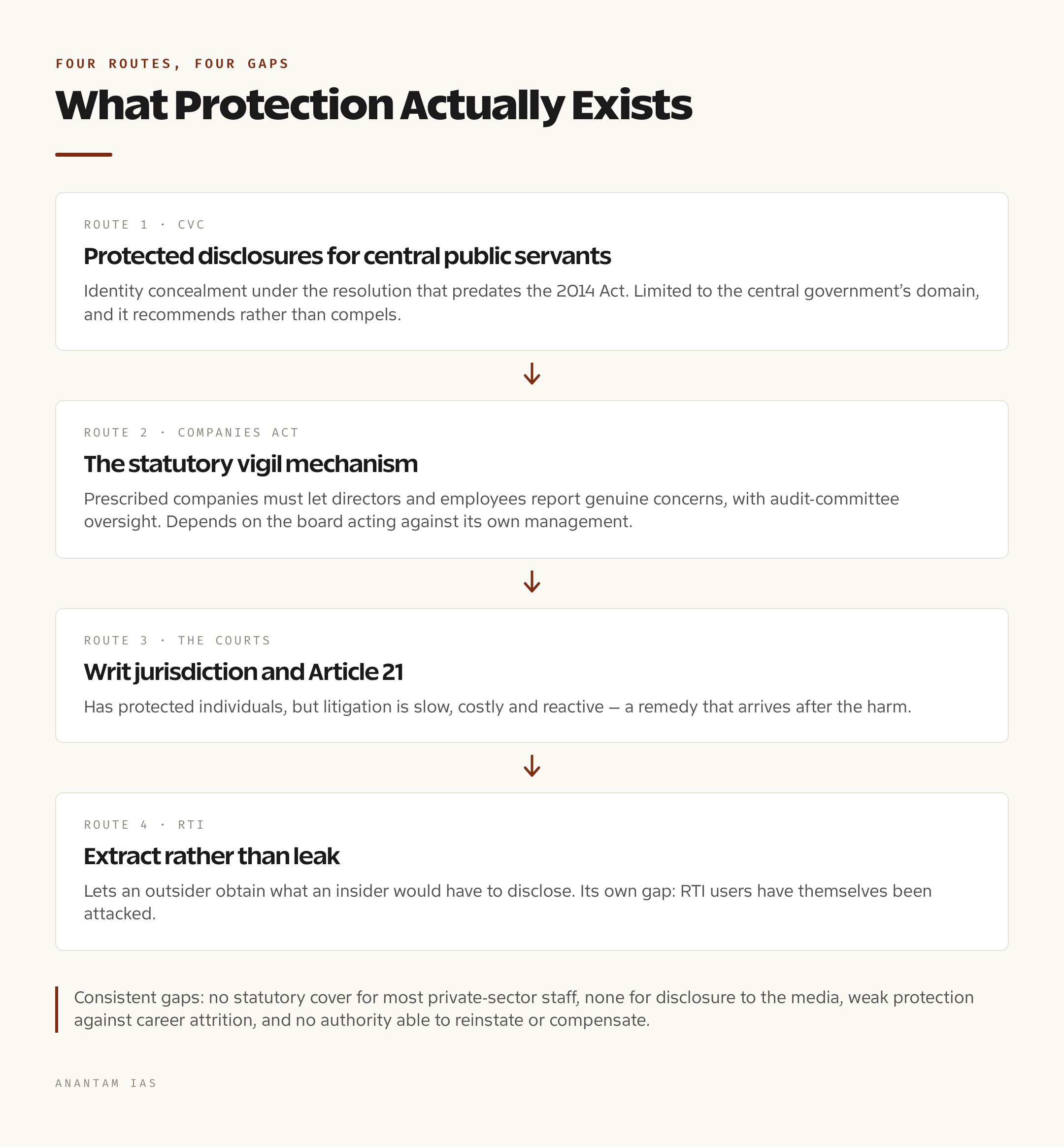
What Protection Actually Exists
The CVC route. Complaints about central public servants can be made to the Central Vigilance Commission as protected disclosures, with identity concealment. Its reach is limited to the central government’s domain, and it can recommend rather than compel.
The Companies Act route. Listed and certain other companies must establish a vigil mechanism for directors and employees to report genuine concerns, with safeguards against victimisation, and audit committees oversee it. This covers the private sector but depends on the board’s willingness to act against management.
The courts. Article 21 and the writ jurisdiction have been used to protect individual disclosers, but litigation is slow, expensive and reactive — a remedy after the harm.
The RTI Act. Not a whistleblower law, but it lets an outsider extract what an insider would otherwise have to leak, which sometimes removes the need for disclosure altogether. Its own protective gap is that RTI users have themselves been attacked.
The gaps are consistent: no statutory protection for private-sector employees outside the vigil mechanism, no protection for disclosures to the media, weak protection against career attrition as distinct from formal victimisation, and no independent authority with power to reinstate or compensate.
What Reform Would Have to Do
An honest reform list follows from the gaps rather than from aspiration. Commence the Act, since an unnotified statute protects nobody. Cover the private sector, because much public harm now originates there. Recognise attrition as victimisation, since transfers and adverse reports are the usual instrument. Give an independent authority remedial power, including reinstatement and compensation, rather than only recommendation. Provide for graded external disclosure, so that going to the press after internal failure is protected rather than punished. And reverse the burden of proof on retaliation once a disclosure is established, because the employer holds the evidence.
The counter-consideration deserves stating: broad protection invites malicious and frivolous complaints, which can paralyse administration and destroy reputations that are never restored. That is a real cost, and the answer is a credible penalty for knowingly false disclosure rather than a narrow definition that chills genuine ones. Where the balance is struck is a legitimate policy argument. Leaving a passed statute permanently inoperative is not a way of striking it.
FAQ
Is the Whistle Blowers Protection Act, 2014 in force in India? No. It received assent on 12 May 2014, but Section 1(3) provides that it commences on a date notified by the central government, and no such notification has been issued. The government has said amendments are needed first.
What protection does an Indian whistleblower actually have? Central public servants can make protected disclosures to the Central Vigilance Commission under the earlier resolution. Company employees may use the statutory vigil mechanism. Beyond that, protection depends on the courts, and there is no general statutory shield — particularly for private-sector employees or for disclosures to the media.
Who was Satyendra Dubey? An NHAI project director who reported corruption and sub-standard work on the Golden Quadrilateral highway project. He was murdered in November 2003 after his confidential letter was circulated, and the resulting outcry led directly to India’s whistleblower legislation.
Is whistleblowing disloyal? Loyalty is owed to an organisation’s purpose rather than its reputation. Someone concealing a danger is protecting the institution from the consequences of failing at its own purpose, so the whistleblower is frequently the more loyal party.
When does whistleblowing become a duty rather than a choice? Generally when the harm is serious and imminent, the whistleblower has good evidence, internal routes have failed or would obviously fail, and the disclosure is no wider than necessary. At that point silence starts to look like complicity.
Does the motive of the whistleblower matter? It is contested. Some frameworks require that the aim be preventing harm rather than revenge or gain. Others argue that an accurate disclosure serves the public regardless of motive, and that demanding purity of intention imposes a standard no other duty carries.
Practice Questions
Prelims MCQs
- The Whistle Blowers Protection Act, 2014 has not come into force because: (a) it was struck down by the Supreme Court (b) the central government has not issued the commencement notification under Section 1(3) (c) it lapsed on dissolution of the Lok Sabha (d) states have not ratified it — Answer: (b) Assent was given in May 2014, but the required commencement notification has never been issued.
- Protected disclosures by central public servants are currently received by: (a) the Lokpal (b) the Central Bureau of Investigation (c) the Central Vigilance Commission (d) the Comptroller and Auditor General — Answer: (c) The CVC receives protected disclosures under the resolution predating the 2014 Act.
- Satyendra Dubey’s disclosure concerned: (a) the 2G spectrum allocation (b) corruption in the Golden Quadrilateral highway project (c) adulteration of petrol (d) irregularities at AIIMS — Answer: (b) He reported corruption and sub-standard work on the highway project; the petrol-adulteration case was Manjunath’s and the AIIMS case Chaturvedi’s.
- The statutory “vigil mechanism” for employees to report genuine concerns in certain companies arises under: (a) the RTI Act, 2005 (b) the Companies Act, 2013 (c) the Prevention of Corruption Act, 1988 (d) the Lokpal and Lokayuktas Act, 2013 — Answer: (b) The Companies Act requires prescribed classes of companies to establish a vigil mechanism with audit-committee oversight.
- Which is NOT among the standard conditions for justified whistleblowing? (a) Serious harm to the public (b) Internal routes tried or futile (c) Unanimous support from colleagues (d) Evidence beyond mere suspicion — Answer: (c) Colleague support is not a condition; the others are standard.
Mains Practice Questions
- “Loyalty is owed to an organisation’s purpose, not its reputation.” Examine this proposition as a resolution of the whistleblower’s dilemma. (15 marks, 250 words)
- India passed a whistleblower protection statute over a decade ago and has never brought it into force. Discuss the ethical implications of an inoperative law, and what reform would have to address. (15 marks, 250 words)
- Distinguish between whistleblowing that is permissible and whistleblowing that is obligatory. Should the discloser’s motive affect the ethical assessment? (15 marks, 250 words)
- Career attrition — transfers, adverse reports, stripped responsibilities — is the usual cost of disclosure in India rather than dismissal. Discuss why this form of retaliation is hard to remedy in law. (10 marks, 150 words)
- Broad whistleblower protection invites malicious complaints. Discuss how a framework can deter false disclosure without chilling genuine ones. (10 marks, 150 words)