Every democracy promises that grievances can be settled through institutions — elections, courts, legislatures, complaint mechanisms. Protest is what happens when someone concludes that the promise is not being kept. That makes it the sharpest test in political ethics, because the protester is claiming a right to impose costs on people who did not consent, in the name of a wrong those people may not accept exists.
The easy positions are both wrong. Treating every protest as legitimate because the cause seems just reduces ethics to agreement. Treating every disruption as illegitimate because it breaks a rule ignores that a great deal of what we now consider settled justice was won by people breaking rules. What is needed is a test that can be applied by someone who disagrees with the protester — and that same test has to constrain what the state may do in reply.
What Civil Disobedience Actually Claims
Civil disobedience is not ordinary law-breaking, and it is not ordinary protest either. A march with permission is protest within the law. Theft is law-breaking for private gain. Civil disobedience occupies a narrow space: a deliberate, public breach of law, undertaken for a public reason, by someone willing to bear the consequences.
That last element is doing most of the ethical work, and it is the one most often dropped. Socrates, in Plato’s account, argued the case for accepting the penalty in its starkest form — he had a chance to escape Athens and refused, on the reasoning that a citizen who takes the benefits of a legal order cannot repudiate its authority when it turns against him. Whether or not one accepts his conclusion, he identified the crux: what distinguishes principled disobedience from mere evasion is the disobedient’s own relationship to punishment.
Henry David Thoreau gave the modern argument its individualist form — that a person’s conscience is not a delegate of the state, and that paying for an injustice makes you a participant in it. Martin Luther King Jr., writing from a Birmingham jail, added the discipline: disobedience follows failed negotiation, requires self-purification, targets an unjust law specifically, and is conducted openly with a willingness to accept the legal penalty. King also drew the crucial distinction between a just law that binds conscience and an unjust one that degrades personality, and insisted that breaking the latter openly and lovingly expresses the highest respect for law.
John Rawls tightened this into conditions. Civil disobedience, on his account, is a public, non-violent act contrary to law, aimed at changing law or policy, and addressed to the sense of justice of the majority. Crucially, he confined its justification to a nearly just society — one where institutions are broadly legitimate and the appeal can plausibly land. In a tyranny the analysis changes entirely, because there is no shared sense of justice to address.
The Indian Inheritance
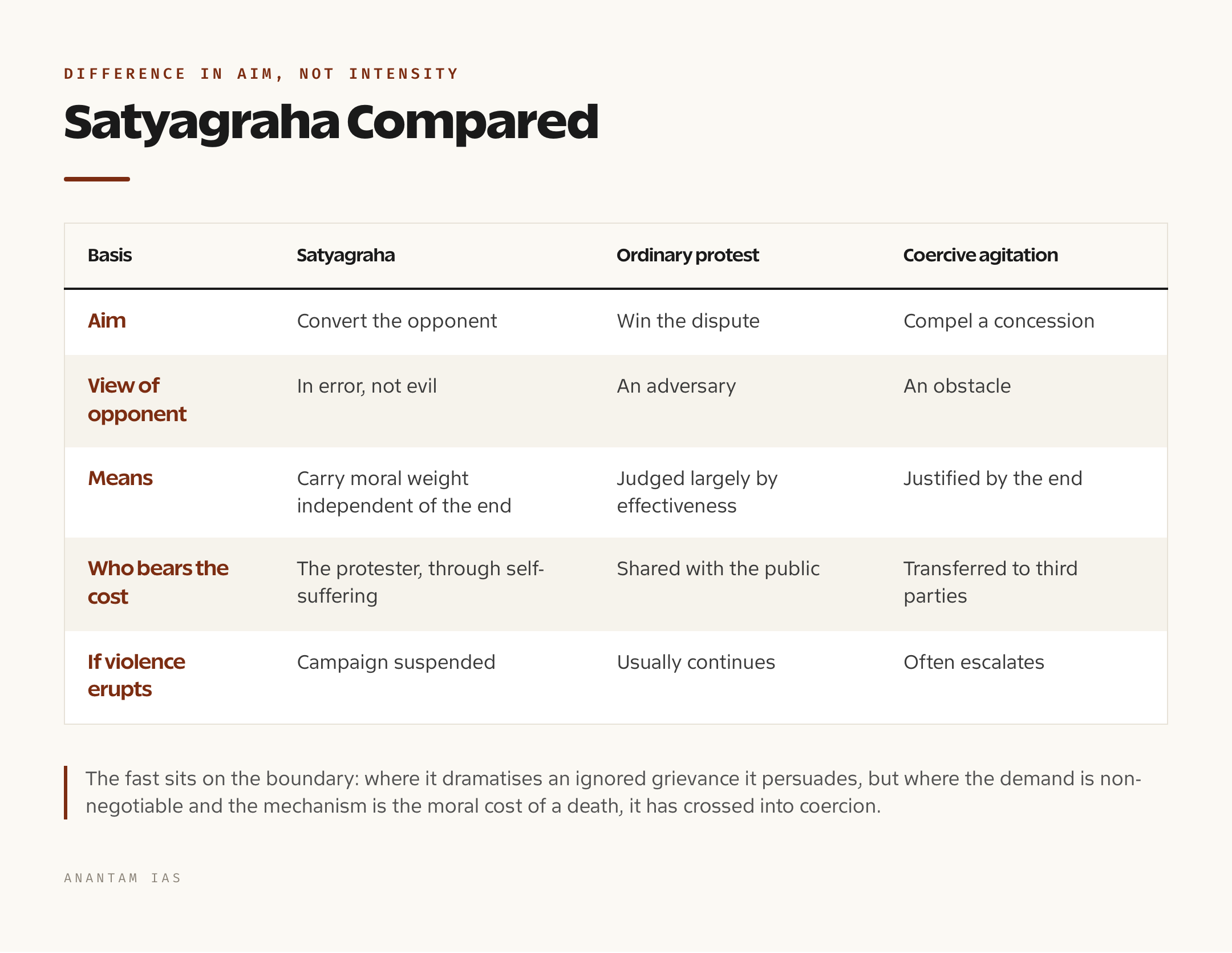
India’s contribution is not a theory of disobedience but a method. Gandhi’s satyagraha differs from Western civil disobedience in ways that matter ethically.
The aim is not to defeat the opponent but to convert them. Satyagraha treats the adversary as someone in error rather than someone evil, which is why Gandhi insisted on suspending campaigns when they turned violent — most famously after Chauri Chaura. If the point is to reach the opponent’s conscience, violence destroys the instrument.
The means carry moral weight independent of the end. Gandhi’s insistence that impure means corrupt a just cause is the strongest available answer to consequentialist justifications of political violence. You cannot, on this view, arrive at truth by way of coercion, because the arrival changes what you have arrived at.
Self-suffering, or tapasya, replaces the infliction of suffering. The satyagrahi absorbs the cost rather than transferring it. This is what makes the fast a characteristic satyagrahi instrument, and it is also where the method becomes most ethically contested.
The full architecture — satya, ahimsa, satyagraha, sarvodaya, trusteeship — is developed in Gandhian philosophy, and its concrete application across Champaran, Kheda and the Civil Disobedience Movement shows a method being refined against real resistance.
Ambedkar’s Objection
The most serious Indian criticism of satyagraha came from within the constitutional founding, and any honest treatment has to confront it.
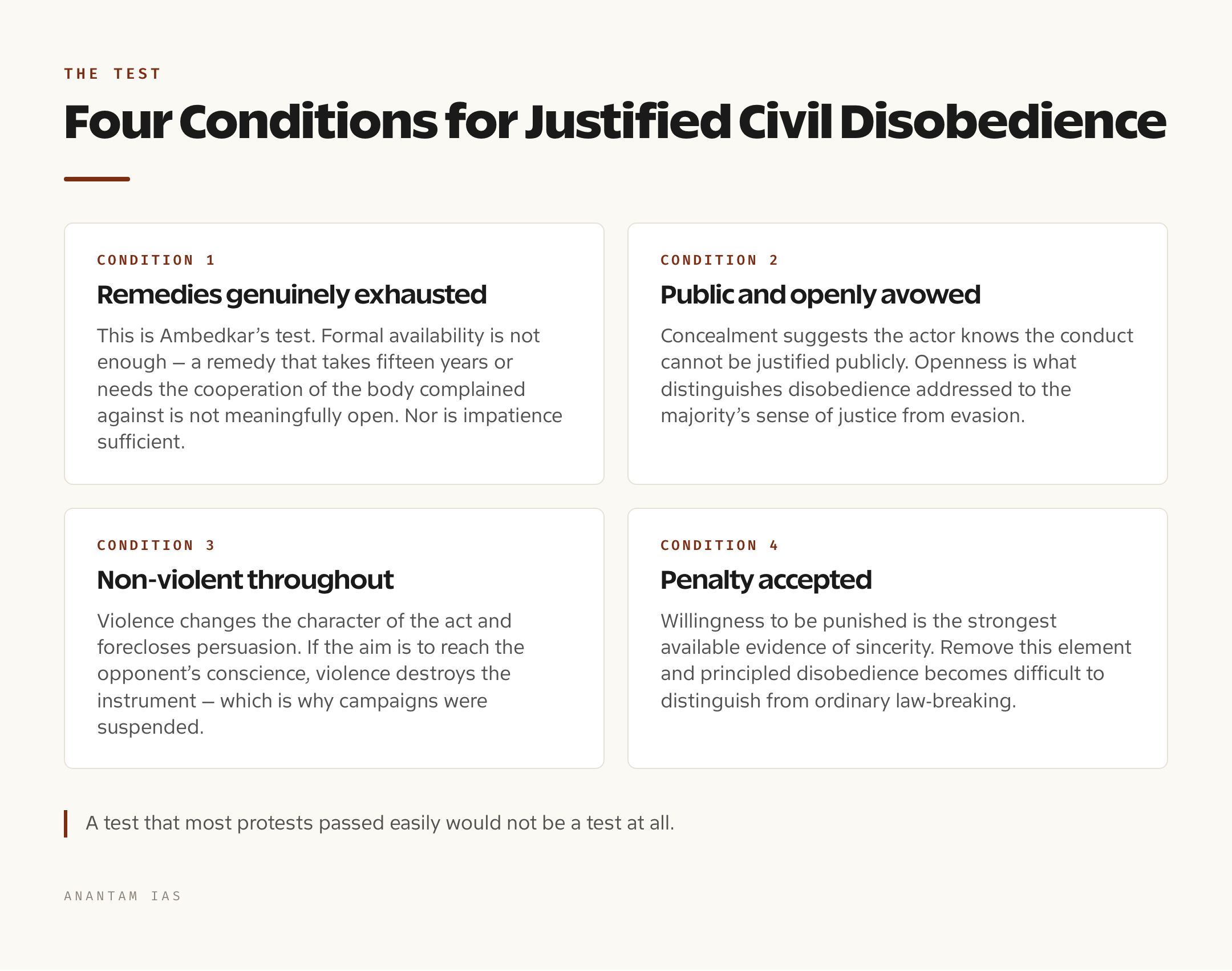
In his closing address to the Constituent Assembly in November 1949, B.R. Ambedkar warned against what he called the grammar of anarchy. His argument was structural rather than moralistic: methods like civil disobedience, non-cooperation and satyagraha were justified when constitutional avenues were closed to Indians, because there was no lawful route to redress. Once a constitution provides those routes, resorting to unconstitutional methods is not heroism but a rejection of the very framework that makes peaceful change possible.
This is a genuinely difficult objection, and it cannot be dismissed by noting that institutions sometimes fail. Ambedkar’s point is that the availability of remedies changes the moral status of bypassing them. Two responses are usually offered.
The first is that formal availability is not the same as real access. A remedy that takes fifteen years, costs more than the claimant earns, or requires the cooperation of the body being complained against is not meaningfully open. The ethical test then becomes whether remedies were genuinely exhausted rather than merely existent.
The second is that Ambedkar’s own warning presupposes a functioning constitutional morality — the habit, among officials and citizens alike, of actually using constitutional forms in good faith. Where that habit erodes, the premise of his objection weakens. This dependence of constitutional text on constitutional temper is exactly what he meant by constitutional morality.
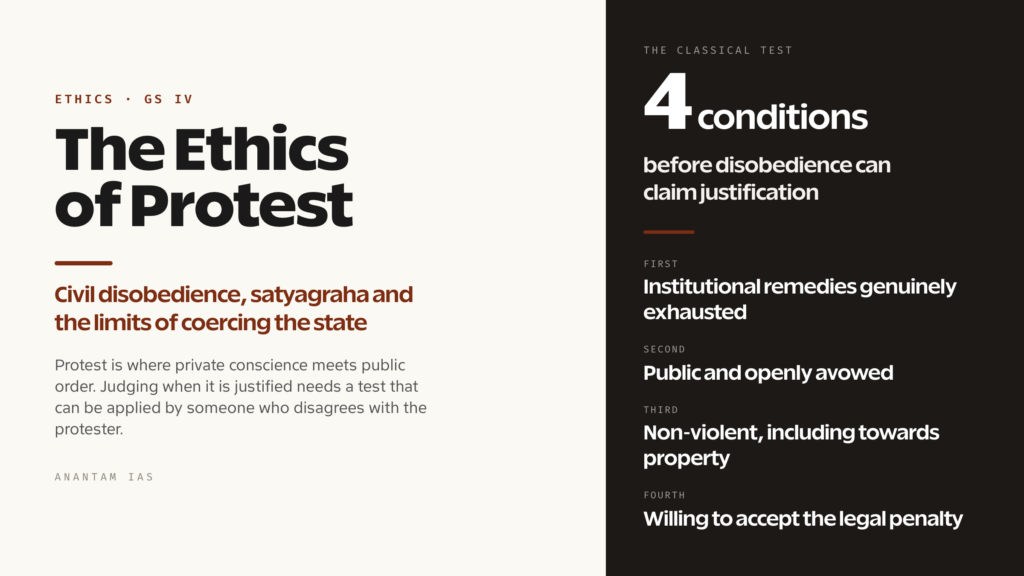
Neither response defeats him. What both establish is that the burden sits on the protester to show that the institutional route was tried and failed — which is precisely the first of the four classical conditions.
The Hunger Strike Problem
The fast is the hardest case in the ethics of protest, and it is worth taking slowly because the standard defence and the standard objection both have force.
Consider the shape of the recent Jantar Mantar protest in Delhi. In June 2026, the activist and educationist Sonam Wangchuk joined an agitation led by the Cockroach Janta Party against repeated leaks of NEET and other examination papers, and began an indefinite hunger strike with six young activists. Their stated demand was singular: the resignation of the Union Education Minister. On the twenty-first day, with his health deteriorating, Delhi Police dispersed the gathering and removed him to hospital. He ended the fast on the twenty-sixth day, after the Prime Minister publicly assured that strict action on examination mismanagement would be pursued through parliamentary process.
The satyagrahi defence is that a fast inflicts harm on no one but the faster. It is the purest form of self-suffering, and it works by making visible a grievance that officialdom has managed to ignore. It converts an argument nobody was listening to into a fact nobody can avoid.
The objection is that this description is incomplete. A fast unto death by a figure of public standing creates a situation in which the government must either concede or be held responsible for a death. That is a form of pressure that does not engage anyone’s reason. Gandhi himself was criticised on exactly this ground — that his fasts, whatever their intention, functioned as coercion of those who loved him. If satyagraha is meant to persuade rather than compel, a mechanism that works through the threat of an unbearable outcome sits uneasily with its own theory.
A workable distinction turns on what the fast is doing. Where it dramatises a grievance and invites attention to an argument, it operates within the satyagrahi logic. Where the demand is non-negotiable and the mechanism is the moral cost of a death, it has crossed into coercion — even if no one else is physically harmed. The relevant question is not whether suffering is self-imposed but whether the opponent is left any room to respond as a reasoning agent.
The case above also illustrates a second ethical problem: the demand was the removal of a named individual. Personalised demands are harder to justify than demands for policy change, because they convert a systemic grievance into a question of one person’s tenure, and they leave the underlying failure — here, the integrity of examinations, an issue examined in paper leaks and exam integrity — potentially untouched by the concession.
What the State May Do
The ethics of protest is only half the subject. The other half is the ethics of the response, and it is governed by tighter constraints than officials often assume.
The Constitution protects the freedom of speech and expression under Article 19(1)(a) and the right to assemble peaceably and without arms under Article 19(1)(b), subject to reasonable restrictions. Two words in that formula carry the weight. Peaceably limits the protester; reasonable limits the state.
Indian courts have worked out the balance in both directions. In the Shaheen Bagh matter, deciding petitions about a prolonged road occupation, the Supreme Court held that public ways cannot be occupied indefinitely and that the right to protest must be exercised in designated spaces — a limit on protesters. In the Ramlila Maidan proceedings, arising from a midnight police action against a sleeping crowd, the Court examined the use of force against a peaceful assembly and treated the manner of state action as itself justiciable — a limit on the state. Petitions concerning alleged police excesses during the recent Jantar Mantar agitation are, at the time of writing, before the Supreme Court.
The ethical principles a public servant should carry into a protest situation are narrower than the legal question of whether force was lawful.
Proportionality. Force must be the minimum necessary for a legitimate objective. Escalation for the sake of asserting authority is impermissible regardless of provocation.
Necessity and last resort. Dispersal is warranted by imminent harm, not by inconvenience or embarrassment. That a protest is politically awkward is not a public-order ground.
Impartiality. The response cannot vary with the protesters’ politics. Where identical conduct is tolerated for one group and dispersed for another, the state has substituted preference for principle — a direct failure of impartiality in civil services.
Distinction. Crowds contain people with different intentions. Collective punishment of an assembly because some within it turned violent treats individuals as fungible.
Care. Where a protester’s health is failing, the duty of care is genuine and can require intervention. But the intervention must be justified by the person’s welfare and not used as a pretext for clearing a politically inconvenient site — and the two are easy to conflate, which is why the reasons must be recorded.
Compelled Reverence
A related question arose in the same weeks. The Minister of State for Home Affairs introduced the Prevention of Insults to National Honour (Amendment) Bill, 2026 in the Rajya Sabha, seeking to criminalise intentional obstruction of, or insult to, the national song Vande Mataram, with punishment of up to five years’ imprisonment, a fine, or both. The Bill would amend the Prevention of Insults to National Honour Act, 1971, extending to the national song the statutory protection the national anthem already has.
Whatever its legislative merits, it raises a distinct ethical question that belongs in this discussion: can reverence be required?
The case for protection is that shared symbols are part of the connective tissue of a diverse republic, and deliberate desecration is an attack on a common possession rather than an argument. Constitutional patriotism needs objects, and India’s fundamental duties already ask citizens to cherish the ideals of the freedom struggle.
The case against compulsion is that reverence obtained by threat is not reverence. A person who stands because of a penalty has expressed nothing about their loyalty, so the law secures the appearance of a sentiment while leaving the sentiment itself untouched — and possibly damaged. There is also a liberty concern about criminalising expressive conduct, and a practical one about how insult is to be determined, since a vague standard invites selective enforcement against precisely the dissenters least liked by whoever is enforcing it.
The honest observation is that both concerns are real, and that the ethical quality of such a law depends almost entirely on how narrowly the offence is drawn and how impartially it is applied. That is not a satisfying conclusion, but it is the accurate one.
A Framework You Can Apply
For judging any specific protest, the following questions do more work than sympathy for the cause.
| Question | Why it matters |
|---|---|
| Were institutional remedies genuinely tried and found closed or futile? | This is Ambedkar’s test; formal availability is not enough, but nor is impatience |
| Is the action public and openly avowed? | Concealment suggests the actor knows the conduct cannot be justified publicly |
| Is it non-violent, including towards property and bystanders? | Violence changes the character of the act and forecloses persuasion |
| Are the costs borne by the protester or transferred to third parties? | Blocking an ambulance transfers cost to someone with no stake in the dispute |
| Is the protester willing to accept the legal penalty? | Willingness to be punished is the strongest available evidence of sincerity |
| Is the demand about policy or about a person? | Systemic demands survive the concession; personalised ones may not |
| Is the opponent left room to respond as a reasoning agent? | This separates persuasion from coercion, including in the case of fasts |
| Is the action proportionate to the wrong alleged? | Grave wrongs license more disruption than minor ones |
Two closing observations. First, the framework applies symmetrically: a protest can be ethically justified and still be unlawful, and a state response can be lawful and still be unethical. Confusing legality with justification is the most common error in this area, and it is made in both directions.
Second, the questions are demanding on purpose. Civil disobedience asks a society to tolerate rule-breaking on the strength of one group’s moral confidence. A test that most protests passed easily would not be a test at all — and the tradition that gives India its distinctive claim here was built by people who held themselves to it far more strictly than their opponents did.
FAQ
Is protest a fundamental right in India? There is no separately named right to protest, but it is derived from Article 19(1)(a) on speech and expression and Article 19(1)(b) on assembling peaceably and without arms, both subject to reasonable restrictions. Courts have repeatedly affirmed the right while holding that it does not extend to indefinite occupation of public ways.
What distinguishes civil disobedience from ordinary law-breaking? Three things: it is done openly rather than concealed, for a public reason rather than private gain, and by someone willing to accept the legal penalty. Remove the third element and the act becomes much harder to justify.
How is satyagraha different from Western civil disobedience? It aims to convert the opponent rather than defeat them, treats means as carrying moral weight independently of ends, and substitutes self-suffering for the infliction of suffering. This is why Gandhi suspended campaigns that turned violent.
What was Ambedkar’s grammar of anarchy argument? That civil disobedience and satyagraha were justified when Indians had no constitutional route to redress, but once a constitution supplies those routes, using unconstitutional methods rejects the framework that makes peaceful change possible. The usual reply is that remedies must be genuinely accessible, not merely formally available.
Is a hunger strike a legitimate form of protest? It depends on what the fast is doing. Where it dramatises an ignored grievance and invites attention to an argument, it fits the satyagrahi logic. Where the demand is non-negotiable and the mechanism is the moral cost of a possible death, it functions as coercion rather than persuasion.
What ethical limits govern the state’s response? Proportionality, necessity and last resort, impartiality across political groupings, distinction between violent individuals and the assembly as a whole, and a genuine duty of care that is not used as a pretext for clearing an inconvenient site.
Practice Questions
Prelims MCQs
- The right to assemble peaceably and without arms is guaranteed by: (a) Article 19(1)(a) (b) Article 19(1)(b) (c) Article 19(1)(c) (d) Article 21 — Answer: (b) Article 19(1)(b) covers peaceful assembly; 19(1)(a) covers speech and expression, and 19(1)(c) covers associations.
- Ambedkar’s “grammar of anarchy” warning was directed against: (a) coalition governments (b) judicial review (c) unconstitutional methods such as satyagraha once constitutional remedies exist (d) linguistic reorganisation of states — Answer: (c) He argued such methods were justified only when constitutional avenues were closed to Indians.
- Which condition, on Rawls’ account, restricts the justification of civil disobedience? (a) It must succeed (b) It must be secret (c) It applies to a nearly just society (d) It must be led by an elected representative — Answer: (c) Rawls confines it to a nearly just society, where an appeal to the majority’s sense of justice can plausibly land.
- Gandhi’s suspension of a major campaign following an outbreak of violence best illustrates: (a) political expediency (b) the doctrine that means carry independent moral weight (c) the primacy of aggregate welfare (d) constitutional morality — Answer: (b) Impure means were held to corrupt a just cause, so violence required suspension.
- The Prevention of Insults to National Honour (Amendment) Bill, 2026 proposes to extend statutory protection to: (a) the national emblem (b) the national song (c) the national flag (d) the Constitution — Answer: (b) It seeks to give Vande Mataram protection comparable to that already available to the national anthem.
Mains Practice Questions
- “A protest can be ethically justified and still be unlawful; a state response can be lawful and still be unethical.” Examine this proposition with reference to the Indian experience. (15 marks, 250 words)
- Critically evaluate Ambedkar’s grammar of anarchy argument against satyagraha in a constitutional democracy. Is the availability of remedies sufficient to render civil disobedience unjustified? (15 marks, 250 words)
- Discuss the ethical status of the hunger strike as a method of protest. Distinguish between conditions in which it persuades and conditions in which it coerces. (15 marks, 250 words)
- “Reverence obtained by threat is not reverence.” Discuss the ethical questions raised by laws that criminalise disrespect to national symbols. (10 marks, 150 words)
- Enumerate the ethical principles that should govern the use of force against a peaceful assembly, and explain why a duty of care can be misused as a pretext. (10 marks, 150 words)
Tell Google you want more of this.
Add Anantam IAS as a preferred sourceOne tap, and this site shows up more often in your own Top Stories, AI Overviews and AI Mode. Remove it any time.