Why Do We Need a Constitution? Purposes, Functions, and UPSC Perspective
A constitution expresses people's aspirations, limits state power, protects rights, and builds national identity. A UPSC-focused explainer with examples.
A constitution is the fundamental law of a country — the single document (or, rarely, an uncodified set of conventions) that establishes how power is organised, exercised, and limited. The question “why do we need a constitution” looks deceptively simple, but it opens onto the deepest concerns of political theory and practical governance: who rules, under what rules, over whom, and with what guarantees for the individual. For UPSC aspirants, this is the foundational question of GS Paper II and Class XI NCERT Indian Constitution at Work. A confident answer is built on six purposes — and a clear-eyed look at what happens when a constitution is missing or weak.
What Is a Constitution?
A constitution is a basic, entrenched set of rules that:
- Creates and defines state institutions — legislature, executive, judiciary.
- Distributes power among levels of government (centre, state, local).
- Guarantees rights and duties to citizens.
- Specifies procedures for law-making, elections, and constitutional amendment.
- Establishes a supreme legal hierarchy — ordinary laws must conform to it.
The Indian Constitution, adopted on 26 November 1949 and effective from 26 January 1950, is the longest written constitution in the world, reflecting the depth and diversity of the polity it governs.
The Six Core Purposes of a Constitution
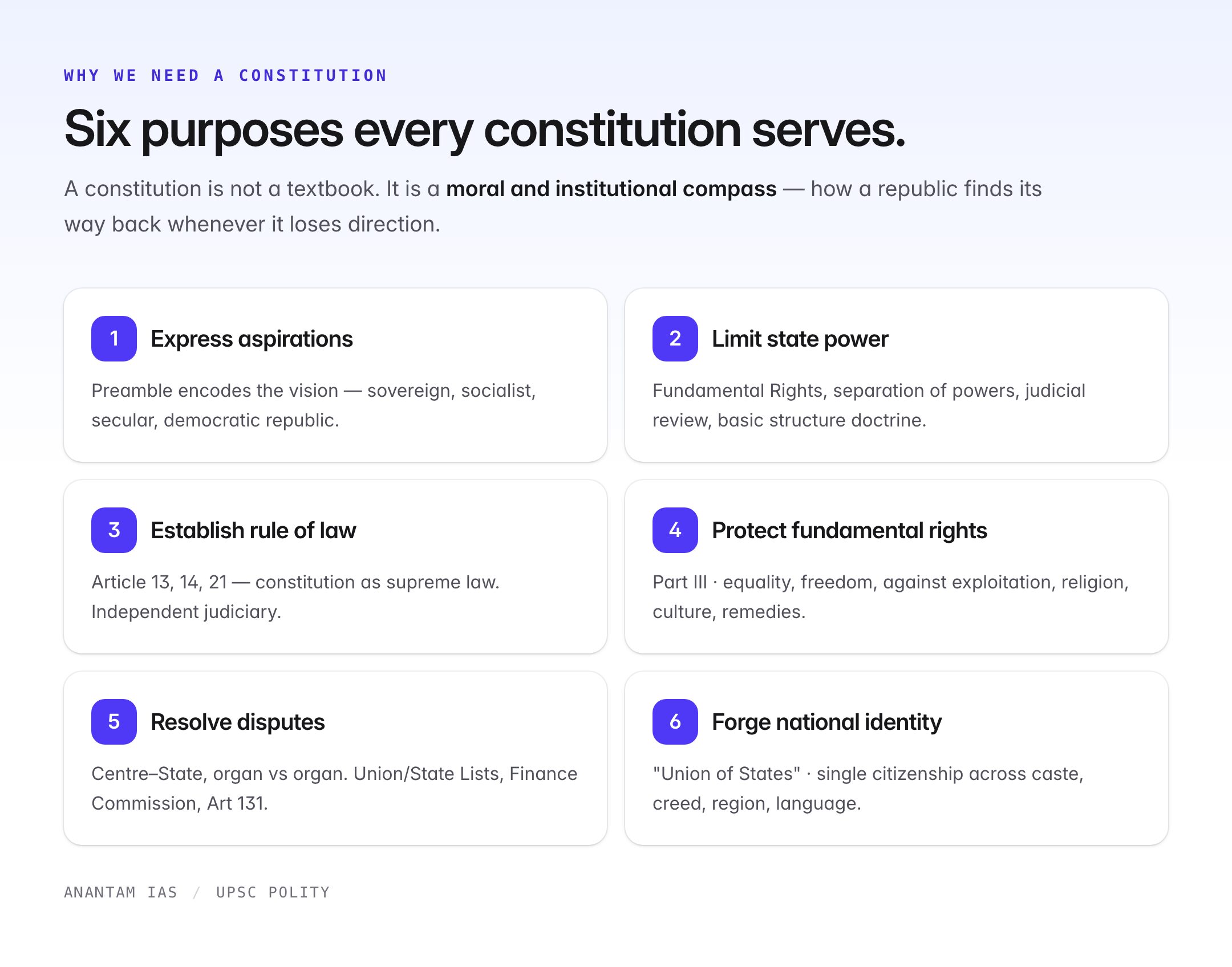
1. To Express the People's Collective Aspirations
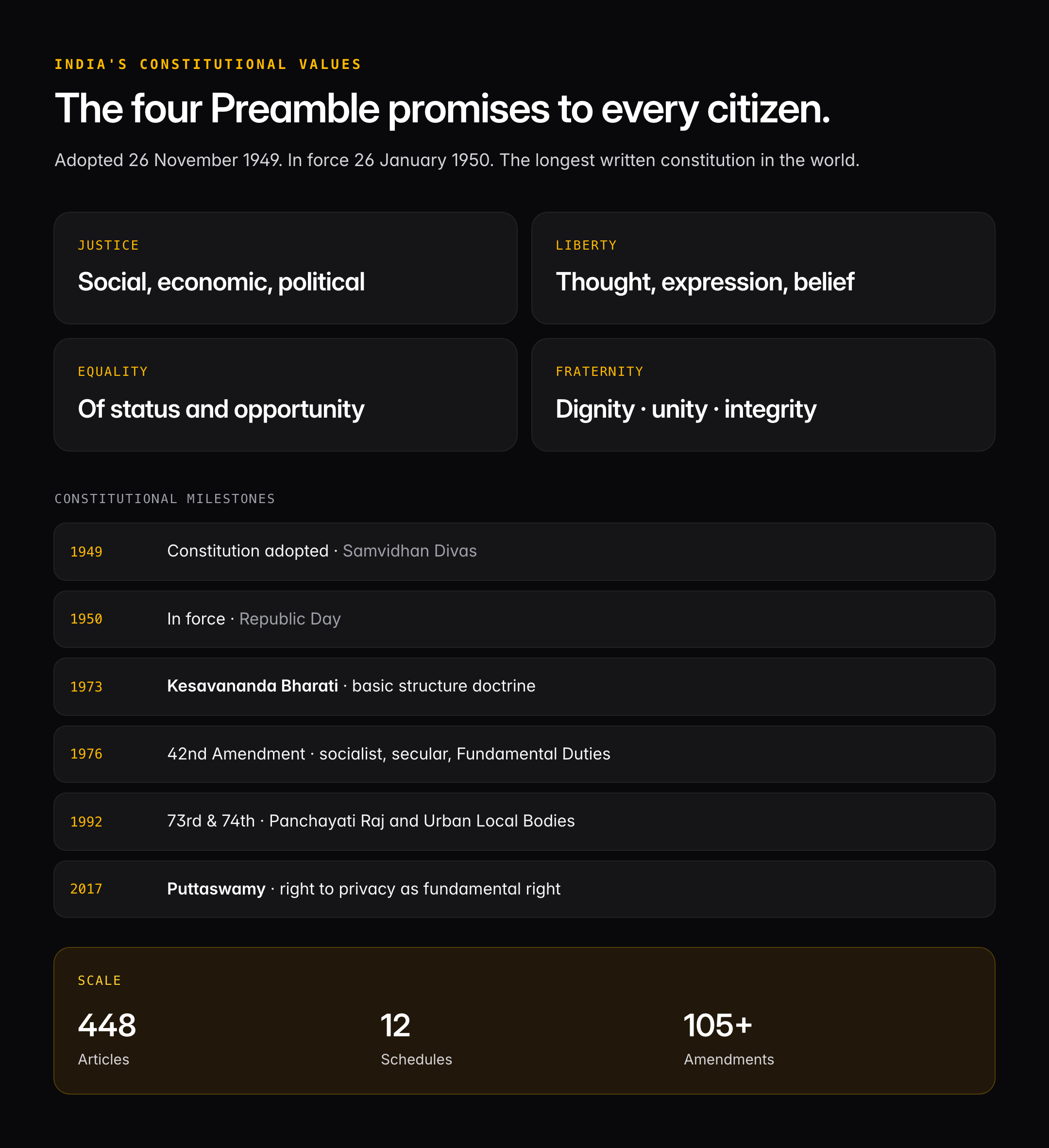
A constitution is, first, a statement of what a nation wants to become. The Preamble of the Indian Constitution — "We, the people of India, having solemnly resolved to constitute India into a sovereign, socialist, secular, democratic republic, and to secure to all its citizens: justice, liberty, equality, and fraternity…" — is not just decorative. It encodes the vision debated over three years in the Constituent Assembly (1946–1949).
Granville Austin called the Indian Constitution a "social revolutionary document". It does not merely describe an existing society — it projects a better one and commits the state to build it.
2. To Limit the Power of the State
The most enduring function of a constitution is restraint on government. Absolute power — whether of a monarch, a majority, or a popularly elected government — threatens individual freedom. A constitution places limits through:
- Fundamental Rights (Part III) — enforceable in courts.
- Separation of powers — legislature, executive, judiciary.
- Judicial review — invalidation of unconstitutional laws.
- Federal distribution — Centre–State power lists (Seventh Schedule).
- Emergency provisions — explicit procedures to prevent arbitrary invocation.
The doctrine of the basic structure (Kesavananda Bharati v. State of Kerala, 1973) further holds that even Parliament cannot amend certain foundational features — an ultimate limit on democratic majorities.
3. To Establish the Rule of Law
Rule of law — a phrase associated with the English jurist A.V. Dicey — means no one, however powerful, is above the law. The constitution makes rule of law operational by:
- Declaring itself the supreme law (Article 13).
- Mandating equality before law (Article 14).
- Requiring due process / procedure established by law for deprivation of liberty (Article 21).
- Providing for independent judiciary (Articles 124–147, 214–231).
Without a constitution, what a ruler calls "the law" is simply what the ruler wants. With a constitution, law becomes a standard against which rulers themselves can be judged.
4. To Protect Fundamental Rights
Rights are the moral core of any modern constitution. Part III of the Indian Constitution guarantees six categories of fundamental rights:
| Right | Articles | Core Guarantee |
|---|---|---|
| Equality | 14–18 | Equal protection, non-discrimination, abolition of untouchability |
| Freedom | 19–22 | Speech, movement, association, personal liberty |
| Against exploitation | 23–24 | Ban on trafficking, forced labour, child labour |
| Religious freedom | 25–28 | Practice and propagation, religious institutions |
| Cultural and educational | 29–30 | Minority protection in culture and education |
| Constitutional remedies | 32 | Right to move SC for enforcement — Ambedkar's "heart and soul" |
Without such constitutional entrenchment, rights exist only at the pleasure of the legislature — revocable by a simple majority.
5. To Resolve Disputes Between Organs and Levels of Government
Modern states are composite. They have centre and states, executive and legislature, majority and minorities. Conflicts are inevitable. The constitution provides institutional machinery for resolution:
- Union and State Lists (Seventh Schedule) to demarcate jurisdictions.
- Inter-State Council (Article 263) for centre–state coordination.
- Finance Commission (Article 280) for revenue sharing.
- Supreme Court's original jurisdiction (Article 131) for centre–state disputes.
- Election Commission (Article 324) for electoral disputes.
- Speaker's role and anti-defection adjudication (Tenth Schedule).
6. To Forge National Identity
A constitution is a shared moral contract that binds diverse communities into a single political community. India's constitution welded together princely states, provinces, languages, and religions into a single republic. By proclaiming India "a Union of States" and providing single citizenship, the Constitution created a civic identity that transcends caste, creed, region, and language.
What Happens Without a Constitution — or With a Weak One?
Three scenarios illustrate the stakes:
| Scenario | Example | Consequence |
|---|---|---|
| No written constitution | United Kingdom | Works only because of centuries of convention and an independent judiciary; still vulnerable to majoritarian overreach |
| Constitution ignored in practice | Pakistan (frequent suspensions, 1956–2023) | Institutional instability, military dominance, eroded rights |
| Constitution amended to concentrate power | Weimar Germany (Enabling Act, 1933) | Transition to dictatorship within months |
| Constitution replaced | USSR 1936 "Stalin Constitution" | Formally progressive; operationally suspended by Party rule |
The absence — or the hollowing out — of a constitution allows arbitrary rule, concentrated power, rights violations, weak federalism, and failure of institutional dispute resolution.
Features That Make the Indian Constitution Distinctive
| Feature | Indian Constitution |
|---|---|
| Length | Longest in the world — 448 Articles, 12 Schedules |
| Nature | Blend of rigidity and flexibility |
| Supremacy | Constitution supreme, not Parliament |
| Federalism | Union of States with a strong centre |
| Rights and duties | Part III (Rights) + Part IV-A (Duties, 42nd Amendment 1976) |
| Directive Principles | Part IV — non-justiciable guidelines for policy |
| Judicial review | Strong, with basic structure doctrine |
| Borrowings | UK (parliamentary system), US (fundamental rights, judicial review), Ireland (DPSP), Canada (federation with strong centre), Australia (concurrent list), Japan (procedure established by law) |
Key Constitutional Milestones
- 1946–49: Constituent Assembly debates the Draft Constitution under Dr. B. R. Ambedkar's chairmanship of the Drafting Committee.
- 26 November 1949: Constitution adopted — now Constitution Day / Samvidhan Divas.
- 26 January 1950: Constitution comes into force — Republic Day.
- 1973: Kesavananda Bharati — basic structure doctrine.
- 1975–77: Emergency — stress test of constitutional limits.
- 1976: 42nd Amendment — added "socialist, secular" to Preamble, Fundamental Duties.
- 1992: 73rd and 74th Amendments — constitutionalised Panchayati Raj and Urban Local Bodies.
- 2017: Justice K.S. Puttaswamy v. Union of India — right to privacy as a fundamental right.
The Living Constitution
A constitution cannot be frozen at the moment of adoption. The Indian Constitution has been amended over 105 times, and its interpretation is continuously refreshed by the judiciary. This "living constitution" approach allows the document to meet challenges its framers could not have imagined — from privacy in the age of data to climate governance.
UPSC Relevance
Why do we need a constitution? is both a Class XI NCERT question and a Mains GS Paper II essay prompt. For Prelims, remember the six purposes, the adoption date (26 November 1949), the effective date (26 January 1950), the Preamble wording, and landmark cases — especially Kesavananda Bharati (1973), Minerva Mills (1980), Maneka Gandhi (1978), and Puttaswamy (2017). For GS Paper II, this topic underpins every subsequent theme: fundamental rights, DPSP, federalism, judicial review, separation of powers, constitutional bodies. In answer writing, structure around limitation + aspiration + rights + federation + identity + rule of law — six purposes, five minutes. Quote Granville Austin ("social revolutionary document") and Ambedkar ("Article 32 is the heart and soul of the Constitution") for weight. In Essay, the question of constitutional need intersects with democracy, justice, and national integration — evergreen UPSC themes. Pair the theoretical purposes with concrete Indian examples: Emergency (1975–77) as a stress test, basic structure doctrine as a judicial safeguard, 73rd/74th amendments as democratisation of power. A constitution, ultimately, is not a textbook — it is a moral and institutional compass that a republic uses to find its way back whenever it loses direction.