Women Empowerment in India: A UPSC Essay Framework
A women empowerment essay framework for UPSC covering constitutional rights, laws, schemes, challenges and the roadmap to gender equality in India.
Introduction
A high-scoring women empowerment essay in UPSC combines constitutional principles, legal instruments, government schemes, data, and a thoughtful critique of India's progress towards gender equality. Women empowerment is not just a moral goal but a constitutional mandate, an economic imperative, and a social necessity. Empowerment means expanding a woman's ability to make strategic choices — over her body, education, work, assets, political participation and public voice — in contexts where she was historically denied them. India's record is mixed — dramatic improvements in school enrolment and maternal health sit alongside persistent gaps in workforce participation, safety, and political representation.
Constitutional and Legal Framework
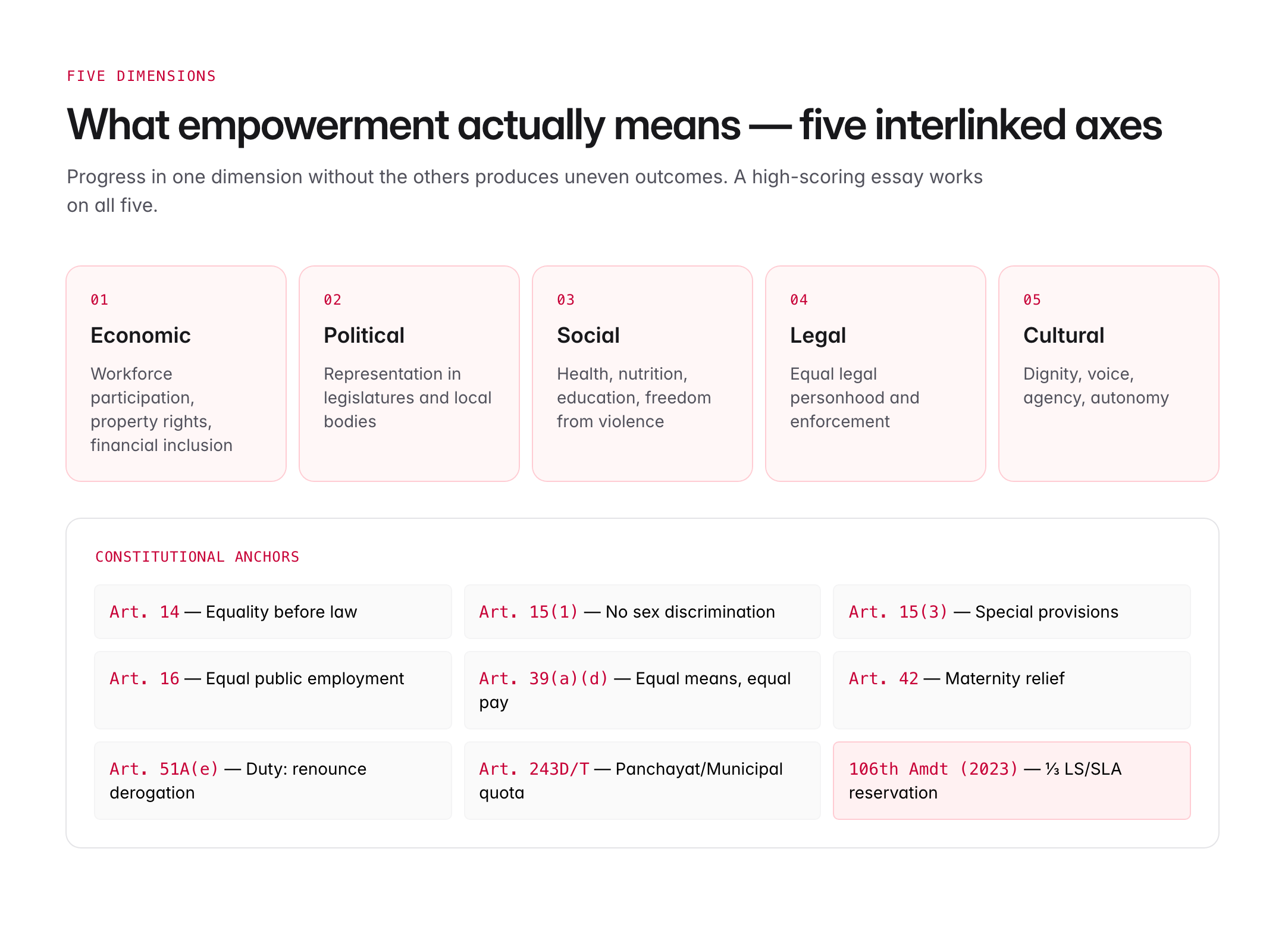
India's Constitution treats gender equality as a foundational value. Key provisions:
- Article 14 — equality before law
- Article 15(1) — prohibition of discrimination on the ground of sex
- Article 15(3) — permits special provisions for women and children
- Article 16 — equal opportunity in public employment
- Article 39(a) and (d) — equal means of livelihood and equal pay
- Article 42 — just and humane conditions of work, maternity relief
- Article 51A(e) — fundamental duty to renounce practices derogatory to women
- Article 243D and 243T — reservation for women in Panchayats and municipalities
- 106th Constitutional Amendment (Nari Shakti Vandan Adhiniyam, 2023) — providing for one-third reservation for women in the Lok Sabha and state legislative assemblies, to be operationalised after delimitation
Statutory protections include the Protection of Women from Domestic Violence Act 2005, the Sexual Harassment of Women at Workplace Act 2013, the Maternity Benefit (Amendment) Act 2017, the Dowry Prohibition Act 1961, the Prohibition of Child Marriage Act 2006, and the POCSO Act 2012.
Dimensions of Women Empowerment
A strong essay framework organises empowerment across five interlinked dimensions:
| Dimension | Empowerment Goal |
|---|---|
| Economic | Workforce participation, property rights, financial inclusion |
| Political | Representation in legislatures and local bodies |
| Social | Health, nutrition, education, freedom from violence |
| Legal | Equal legal personhood and enforcement |
| Cultural | Dignity, voice, agency, autonomy |
Meaningful empowerment requires progress on all five; improvement in one without the others produces uneven outcomes.
Key Government Schemes
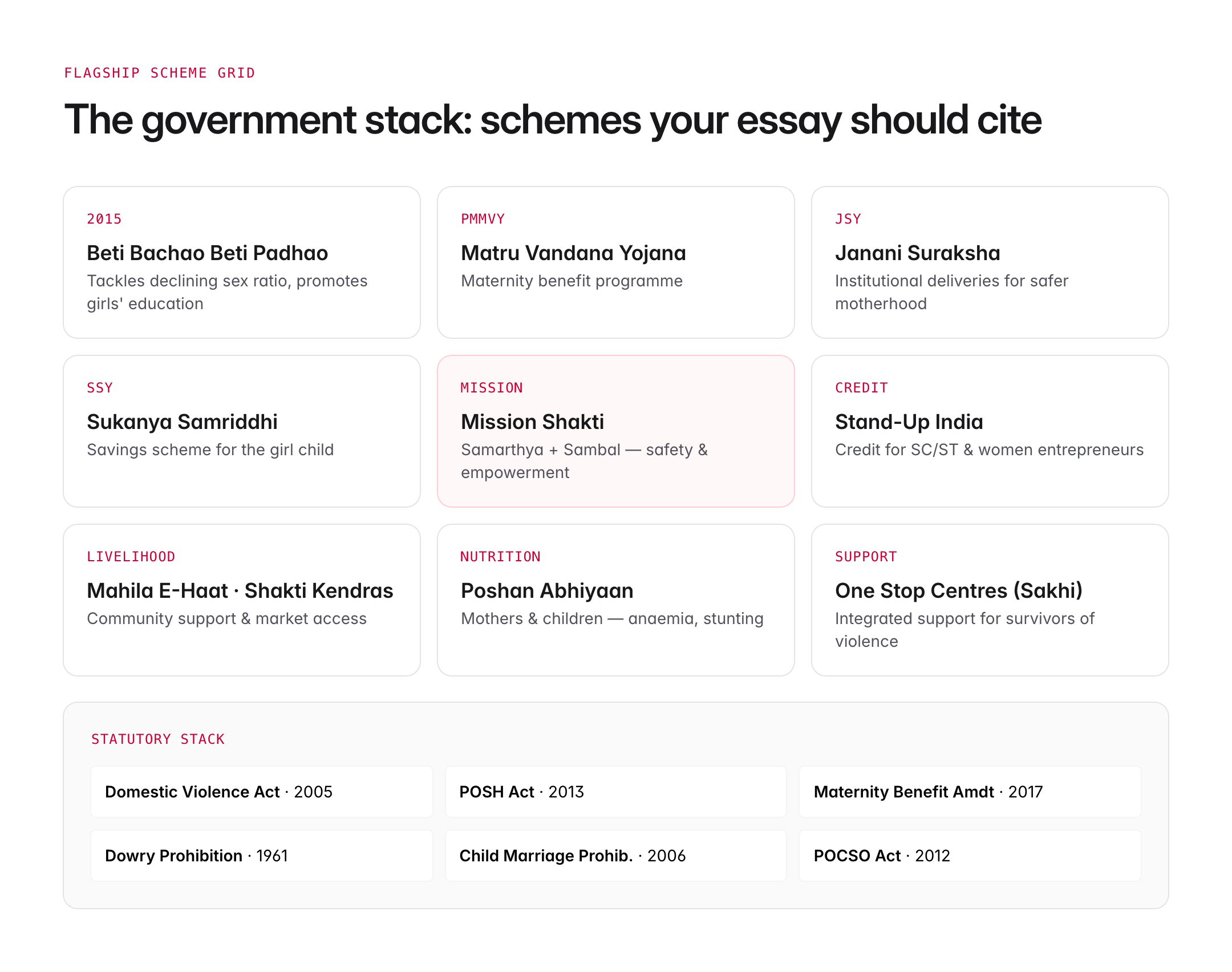
India has layered a wide set of programmes that an essay should cite selectively:
- Beti Bachao Beti Padhao (2015) — tackles declining sex ratio and promotes girls' education
- Pradhan Mantri Matru Vandana Yojana — maternity benefit programme
- Janani Suraksha Yojana — institutional deliveries for safer motherhood
- Sukanya Samriddhi Yojana — savings scheme for the girl child
- Mission Shakti (Samarthya and Sambal) — integrated women's safety and empowerment mission
- Stand-Up India — credit for SC/ST and women entrepreneurs
- Mahila E-Haat, Mahila Shakti Kendras — livelihoods and community support
- Poshan Abhiyaan — targeted nutritional improvement for mothers and children
- One Stop Centres (Sakhi) — integrated support for women affected by violence
Self-Help Group networks under Deendayal Antyodaya Yojana–NRLM have brought millions of rural women into financial agency.
Data Snapshot
A few recurring data points make essays sharper:
- India's sex ratio at birth has been slowly improving after the concerning decline seen in earlier decades, though regional disparities remain
- Female literacy has risen from about 54 per cent in 2001 to over 70 per cent in the 2011 Census, with continued improvement in later surveys such as NFHS-5
- Female Labour Force Participation fell to single-digit-adjacent lows in the 2010s before recovering; the Periodic Labour Force Survey has shown a clear upward trend in recent rounds, especially in rural areas
- Maternal Mortality Ratio has declined significantly as per the Sample Registration System
- Women's political representation in the Lok Sabha crossed the 14 per cent mark for the first time; the 2023 reservation amendment is expected to raise it significantly once operationalised
(Use only verified figures from the latest NFHS, PLFS, SRS and Election Commission data in the exam.)
Challenges That Persist
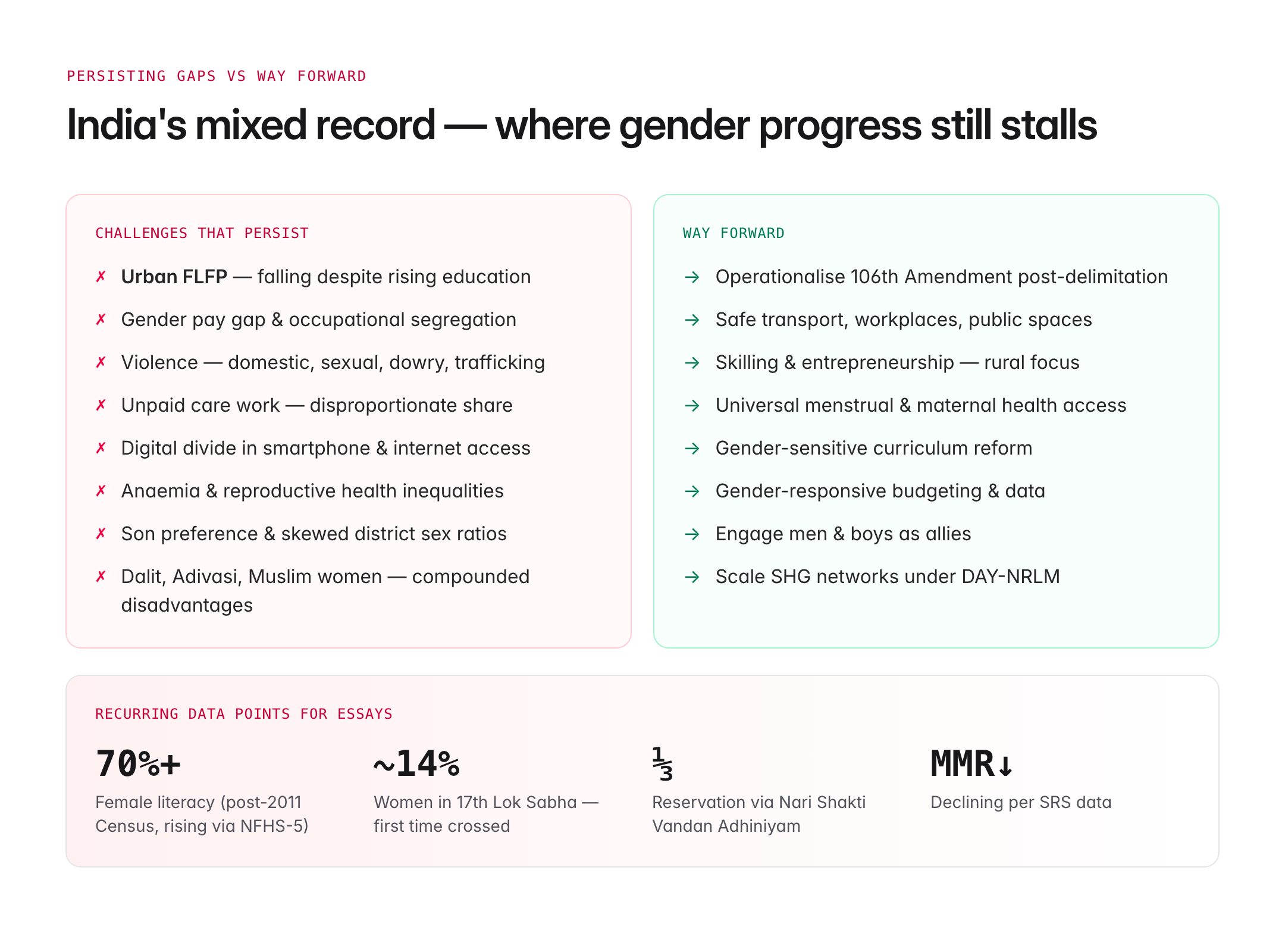
A good essay confronts contradictions:
- Declining female labour force participation in urban areas, despite rising education
- Gender pay gap and occupational segregation
- Violence against women — domestic violence, sexual assault, dowry deaths, trafficking
- Unpaid care work — Indian women perform a disproportionate share
- Digital divide — lower smartphone and internet access among women
- Health inequalities — anaemia, nutrition gaps and reproductive health
- Son preference and skewed child sex ratios in several districts
- Caste and class intersections — Dalit, Adivasi and Muslim women face compounded disadvantages
Way Forward
A structured conclusion usually recommends:
- Effective implementation of the 106th Amendment and timely delimitation
- Scaling up safe public transport, workplaces and public spaces
- Skilling and entrepreneurship focus, especially for rural women
- Universal access to sanitary products, menstrual health and maternal care
- Curriculum reform to promote gender-sensitive education
- Stronger data systems and gender-responsive budgeting
- Engagement of men and boys as allies to dismantle patriarchal norms
Women's empowerment is measured not by laws alone but by the expansion of agency in everyday life.
UPSC Relevance
Prelims focus: Know the constitutional articles, the 73rd, 74th and 106th Amendments, major laws (DV Act, POSH Act), and flagship schemes such as BBBP, PMMVY, Mission Shakti, and Sukanya Samriddhi.
Mains GS-I and GS-II angle: Empowerment links to role of women in society, modernisation, social empowerment, welfare schemes, and governance. GS-II essays on women-centric legislation and GS-I questions on social change can both draw from this framework.
Sample PYQ angle: UPSC has asked how empowerment of women through education is key to national development, the role of self-help groups, and whether laws alone can ensure gender justice. A template that combines data, constitutional mandate, scheme evidence and a critique of persisting gaps consistently earns high marks.