Yamuna River Pollution and Toxic Froth: Causes, Stretch, and Action
The Yamuna's Wazirabad–Okhla stretch is one of India's most polluted river segments. Causes of toxic froth, BOD/DO indicators, action plans, and UPSC pointers.
Every winter, when the air in Delhi turns thick and the Yamuna slows in its bed, a surreal scene unfolds at the river’s surface. Mounds of white foam, sometimes metres high, drift past temple steps and traffic bridges. The foam looks like soap suds. It is, in chemical effect, exactly that. The Yamuna’s Wazirabad-to-Okhla stretch in Delhi is one of the most polluted river segments in India, repeatedly classified as Priority I (BOD greater than 30 mg/L) by the Central Pollution Control Board, and the toxic froth is the most visible symptom of an underlying chemical and biological collapse.
The river itself rises in the snows of Yamunotri in Uttarakhand and flows for about 1,376 kilometres through Himachal Pradesh, Haryana, Delhi, and Uttar Pradesh before merging with the Ganga at the Triveni Sangam in Prayagraj. For most of its length, the Yamuna is recognisably a river, with reasonable water quality and ecosystem function. The crisis is geographically narrow but ecologically and culturally severe: a 22-kilometre stretch in the National Capital Territory absorbs nearly 70 percent of the city’s untreated sewage and most of its industrial effluent.
For UPSC, the Yamuna pollution case touches multiple syllabus zones: river systems, water pollution, the BOD/DO water-quality framework, urban sanitation infrastructure, the Namami Gange and Yamuna Action Plan policies, and the constitutional question of inter-state river management. This guide builds out every dimension.
Quick Facts
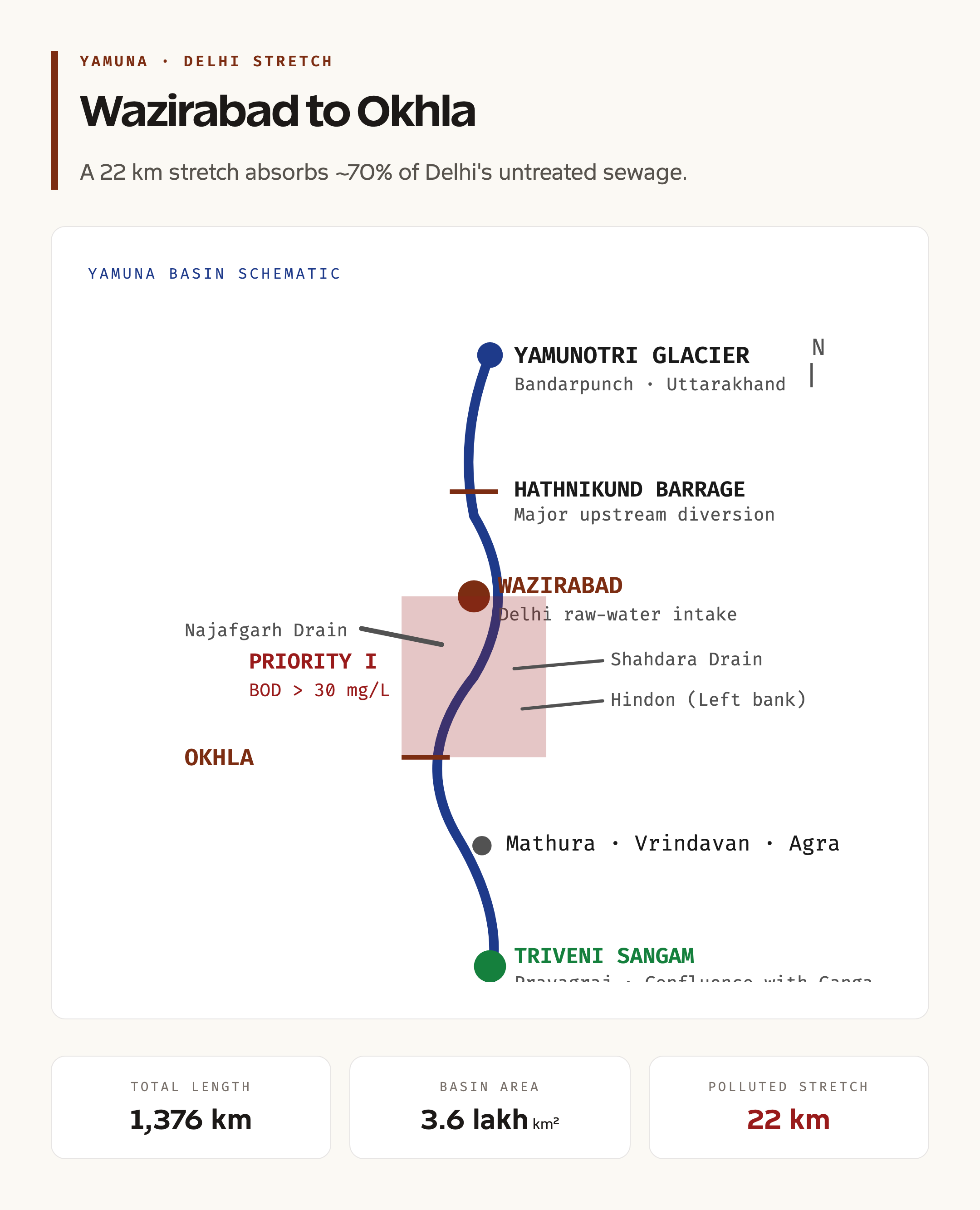
- Source: Yamunotri Glacier in the Bandarpunch massif, Garhwal Himalayas, Uttarakhand
- Total length: Approximately 1,376 kilometres
- Basin area: About 3.6 lakh square kilometres (around 11 percent of India’s total drainage area)
- States traversed: Uttarakhand, Himachal Pradesh, Haryana, Delhi, Uttar Pradesh
- Does NOT flow through: Rajasthan or Madhya Pradesh
- Confluence with the Ganga: Triveni Sangam, Prayagraj, Uttar Pradesh
- Right-bank tributaries: Tons, Chambal, Sindh, Betwa, Ken
- Left-bank tributaries: Hindon, Rind, Sengar, Varuna, Karamnasa
- Major cities on its banks: Dehradun (via the Tons sub-basin), Delhi, Mathura, Vrindavan, Agra, Prayagraj
- Most polluted stretch: Wazirabad to Okhla in Delhi (about 22 km)
- Pollution category: Priority I (BOD greater than 30 mg/L), the highest pollution tier of the CPCB
- Iconic phenomenon: Toxic froth caused by surfactants and filamentous bacteria
What Causes the Toxic Froth
The white mountains of foam that ride the Yamuna’s surface during low-flow months are not mysterious. They are the chemical signature of two pollutants meeting turbulent water in concentrations that the river cannot dilute.
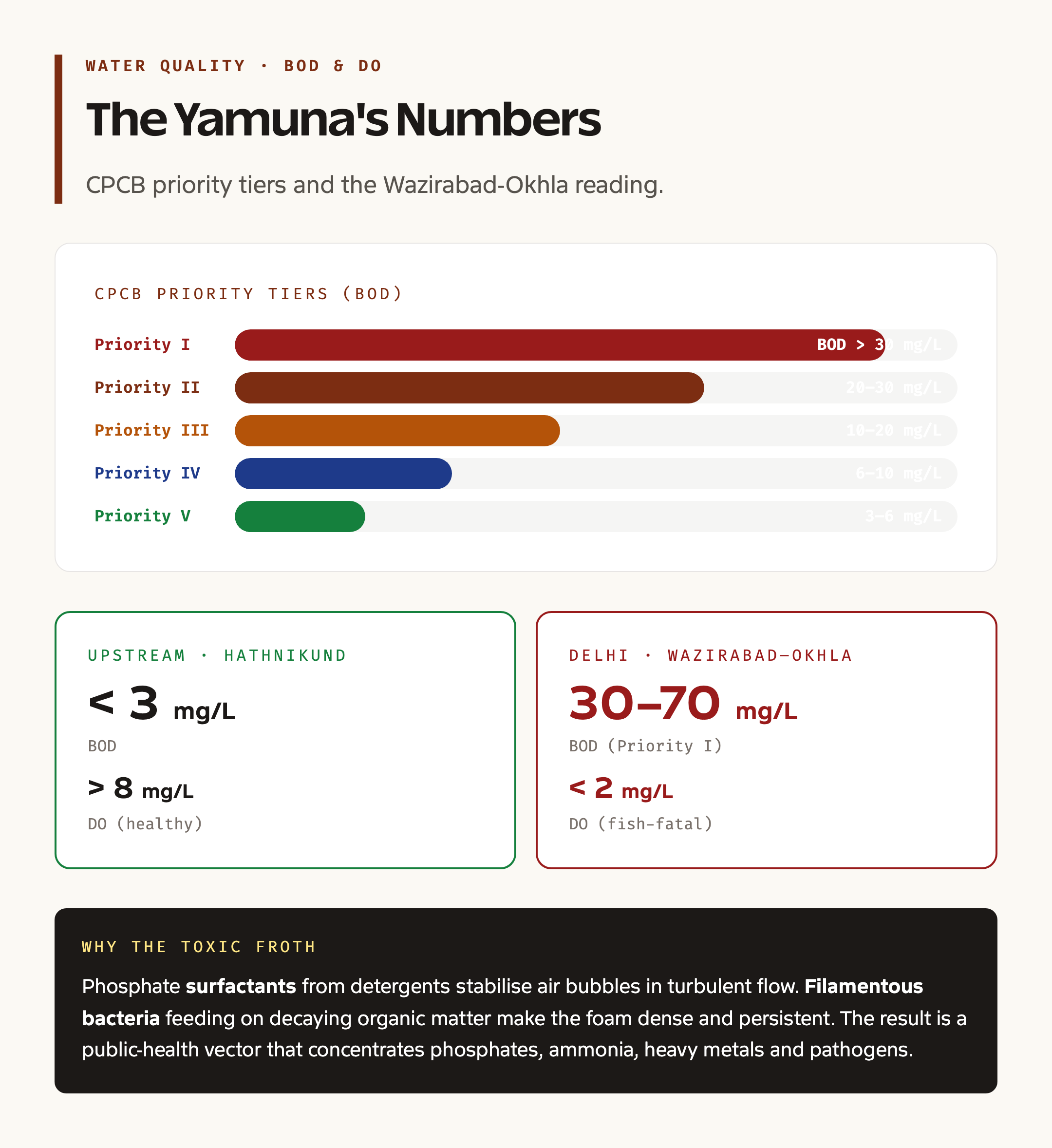
The first pollutant is surfactants, principally the phosphate-based detergents discharged from households and small commercial laundries. Surfactants are amphipathic molecules: one end of each molecule is attracted to water and the other to air, oil, or grease. When water containing high surfactant concentrations is agitated — by a barrage spillway, a weir, or a fast-moving rapids — air gets trapped in millions of tiny bubbles whose walls are stabilised by the surfactant film. The result is a stable foam that can persist for hours.
The second pollutant is biological. Filamentous bacteria, particularly Sphaerotilus and Microthrix species, thrive in rivers loaded with decaying organic matter. They produce extracellular polymeric substances that act as natural foam stabilisers. When the river receives untreated sewage rich in protein and carbohydrates, the bacterial bloom intensifies, and the foam that surfactants generate becomes denser and more persistent.
The combination is what makes Yamuna’s froth “toxic.” The foam concentrates phosphates, ammonia, heavy metals, and pathogens that the river is carrying. Inhaling the airborne droplets or contacting the foam directly can cause skin irritation, respiratory problems, and gastrointestinal infections. The foam is therefore not just unsightly: it is a public health vector.
Background and Historical Context
The Yamuna was clean enough to drink directly from in the early twentieth century. Photographs from the 1940s show locals bathing and fishing along stretches that are now opaque with effluent. The transformation came with the rapid post-independence growth of Delhi, the expansion of industrial belts in Haryana and Uttar Pradesh, and the diversion of upstream flow at the Hathnikund Barrage for irrigation in the Western Yamuna Canal and Eastern Yamuna Canal systems.
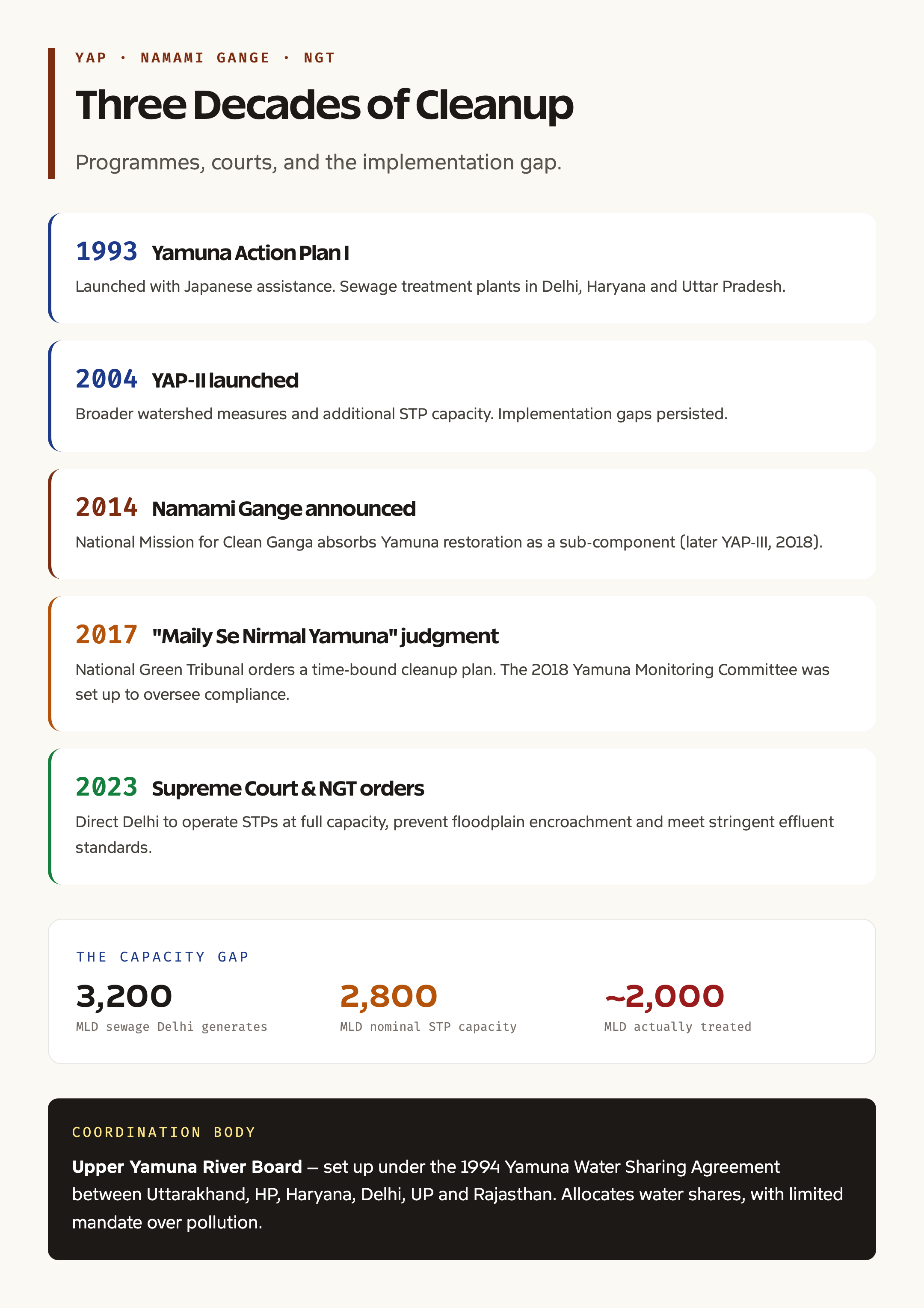
By the 1970s, the Wazirabad-Okhla stretch was already classified as polluted. The first formal river-cleaning programme, the Yamuna Action Plan (YAP), was launched in 1993 with Japanese assistance. YAP-I focused on sewage treatment infrastructure in Delhi, Haryana, and Uttar Pradesh. YAP-II followed in 2004 with broader watershed measures. YAP-III, integrated into the Namami Gange programme in 2018, is currently underway with funding from the National Mission for Clean Ganga.
In 2017, the National Green Tribunal handed down the landmark “Maily Se Nirmal Yamuna” judgment, ordering a time-bound cleanup. In 2021 and 2023, the Supreme Court and the NGT both issued orders directing Delhi to upgrade and operate sewage treatment plants at full capacity. Despite three decades of programmes, the river’s condition in the Delhi stretch has improved only marginally.
Key Provisions and Legal Architecture
Multiple legal instruments converge on the Yamuna question. The Water (Prevention and Control of Pollution) Act, 1974 establishes the regulatory regime of the Central Pollution Control Board and the State Pollution Control Boards, defines water-quality standards (Class A through Class E), and empowers regulators to issue closure orders against polluting industries.
The Environmental Laws of India framework includes the Environment (Protection) Act, 1986, under which several Yamuna-specific notifications have been issued. The National Green Tribunal Act, 2010 created the NGT, which has been the most active forum for river pollution litigation. The Namami Gange programme, formally the National Mission for Clean Ganga, was launched in 2014 and integrates Yamuna restoration as a sub-component.
For the Delhi stretch, the master coordination body is the Upper Yamuna River Board, established by the Yamuna Water Sharing Agreement of 1994 between Uttarakhand, Himachal Pradesh, Haryana, Delhi, Uttar Pradesh, and Rajasthan. The Board allocates water shares but has limited mandate over pollution. The 2018 Yamuna Monitoring Committee, set up under NGT direction, oversees compliance with cleanup orders.
Why It Matters
The Yamuna is more than a river of water. It is a river of culture, economy, and politics. Yamuna water sustains the agriculture of the Western Yamuna Canal command in Haryana, the Eastern Yamuna Canal command in Uttarakhand, and significant portions of the Doab. Delhi’s drinking-water supply depends substantially on the Wazirabad raw-water intake. The Taj Mahal’s marble is reportedly being yellowed by sulphur dioxide and particulates carried partly by the Yamuna’s polluted vapours during the dry months. Vrindavan, Mathura, and Prayagraj are religious pilgrimage centres where ritual bathing in the Yamuna is integral to Hindu practice.
Public health is the most urgent dimension. The Wazirabad-to-Okhla stretch is a vector for waterborne disease. Faecal coliform counts in Delhi’s Yamuna routinely exceed 10,000 per 100 millilitres in violation of the bathing-water standard of 500. Heavy metal accumulation, particularly chromium, lead, and cadmium, is evident in fish tissue and sediment.
There is also a political and federal dimension. Yamuna pollution is a textbook case of inter-state externalities: Delhi receives the load of upstream cities (most importantly the discharge from the Najafgarh and Hindon drainage), processes it inadequately, and passes it on to Mathura, Agra, and Prayagraj downstream. The federal logic of pollution control is therefore essential to any solution.
Detailed Analysis: BOD, DO, and the Pollution Tiers
Two parameters dominate the science of river-pollution monitoring: Biological Oxygen Demand (BOD) and Dissolved Oxygen (DO). BOD measures the quantity of oxygen that microorganisms require to break down organic matter in a water sample over five days at 20 degrees Celsius. High BOD means a high load of biodegradable organic matter, typically from sewage. DO measures how much free oxygen is available in the water for aquatic organisms.
The CPCB classifies polluted river stretches into five priority categories based on BOD:
- Priority I: BOD greater than 30 mg/L (severely polluted)
- Priority II: BOD between 20 and 30 mg/L
- Priority III: BOD between 10 and 20 mg/L
- Priority IV: BOD between 6 and 10 mg/L
- Priority V: BOD between 3 and 6 mg/L
The Wazirabad-to-Okhla stretch routinely records BOD in the 30 to 70 mg/L range, locking it firmly in Priority I. DO at the same stretch frequently falls below 2 mg/L, well below the 4 mg/L threshold required for fish to survive. By comparison, the upstream Yamuna at Hathnikund typically records BOD below 3 mg/L and DO above 8 mg/L.
The pollution sources mapping for Delhi shows that 22 major drains discharge into the Yamuna within the city. The Najafgarh Drain alone contributes nearly half the daily organic load. The Shahdara Drain, the Barapullah Drain, and the Hindon River (entering near the Wazirabad-Okhla axis) account for most of the rest. Industrial effluent from Haryana and the Delhi unauthorised colonies adds heavy metals and refractory organics that biological treatment cannot easily remove.
Comparative Perspective: Yamuna vs Other Indian Rivers
The Yamuna’s Delhi stretch is consistently among the top three most polluted river stretches in India, alongside the Mithi (Mumbai) and the Cooum (Chennai). The Ganga, despite being the focus of the Namami Gange programme, has fewer stretches in Priority I than the Yamuna. The Krishna, Godavari, and Cauvery have local pollution hotspots but are generally cleaner.
The structural reason is the urban load. Delhi alone generates around 3,200 million litres of sewage daily; the city’s sewage treatment capacity is around 2,800 MLD on paper, but actual treated discharge is closer to 2,000 MLD because of capacity utilisation gaps, pumping failures, and unauthorised colonies that are not connected to the sewer network. The shortfall flows directly to the Yamuna through the 22 drains.
By contrast, the Ganga at Varanasi has roughly the same sewage challenge but a much larger river volume, which dilutes the pollutant concentration. The Yamuna at Delhi has near-zero environmental flow during the dry season because of upstream diversions, so dilution is minimal. The same load on a flowing river becomes a chemical sink in a stagnant one.
Challenges and Threats
The first challenge is sewage infrastructure. Delhi’s sewer network does not cover all colonies, particularly the unauthorised settlements that house lakhs of people. Even where sewers exist, illegal cross-connections discharge sewage into stormwater drains that bypass treatment. Capacity expansion programmes have been announced repeatedly but implementation has lagged.
The second challenge is industrial discharge. The Common Effluent Treatment Plants in Haryana’s Panipat, Sonipat, and Faridabad belts operate below capacity because of inadequate maintenance and weak enforcement. Tannery effluent, dye effluent, and electroplating waste enter the Yamuna with limited or no treatment.
The third challenge is the religious and ceremonial use of the river. Floral offerings, idol immersion (particularly during Durga Puja and Ganesh Chaturthi), and large-scale ritual bathing add significant pollutant loads, including paint pigments and heavy metals from idols. Substitute clay-only idol practices have made progress but uptake is uneven.
The fourth challenge is the ecological flow problem. The 1994 Yamuna Water Sharing Agreement allocates the river’s water to upstream states, leaving Delhi and downstream states with deficit flows. Without environmental flow, the river cannot self-purify. Releasing water from upstream barrages would dilute pollutants but would compete with irrigation use.
Prelims Pointers
- The Yamuna originates from the Yamunotri Glacier in the Bandarpunch massif of the Garhwal Himalayas, Uttarakhand
- The Yamuna does NOT flow through Rajasthan or Madhya Pradesh (despite Chambal flowing through MP and joining as a tributary)
- The Yamuna merges with the Ganga at Triveni Sangam, Prayagraj
- Right-bank tributaries: Tons, Chambal, Sindh, Betwa, Ken
- Left-bank tributaries: Hindon, Rind, Sengar, Varuna, Karamnasa
- Wazirabad to Okhla is the most polluted stretch (about 22 km in Delhi)
- The Najafgarh Drain is the largest single contributor of pollution to the Yamuna in Delhi
- CPCB classification: stretch is Priority I (BOD greater than 30 mg/L)
- Toxic froth is caused by phosphate detergents (surfactants) and filamentous bacteria
- Yamuna Action Plan (YAP) launched in 1993; YAP-III now part of Namami Gange (launched 2014)
- The National Green Tribunal delivered the “Maily Se Nirmal Yamuna” judgment in 2017
Mains Practice Questions
- Examine the causes of toxic froth on the Yamuna and discuss the institutional and infrastructural challenges in restoring the river’s water quality. (250 words)
- Discuss the federal dimension of river pollution in India with reference to the inter-state management of the Yamuna basin. (250 words)
- Analyse the role of the National Green Tribunal in driving river restoration. Critically evaluate the implementation gap between NGT orders and ground outcomes. (150 words)
- The cleanup of the Yamuna is a test of urban sanitation infrastructure as much as environmental policy. Discuss. (150 words)
Way Forward
A working sewage infrastructure is the non-negotiable foundation. Delhi must achieve full sewer coverage of all its colonies, including unauthorised settlements, with strict prohibition on illegal cross-connections. Sewage treatment plants must operate at design capacity and meet stringent effluent standards (BOD less than 10 mg/L, faecal coliform less than 1,000/100 ml). The current proposed expansion to 4,000 MLD treatment capacity must be delivered on schedule.
Industrial effluent control needs hardening. Real-time effluent monitoring at all major industrial clusters in Haryana and Uttar Pradesh, with automatic data feed to CPCB and SPCB dashboards, removes the discretion that allows polluters to evade enforcement. Closures of non-compliant units must be enforced.
Environmental flow needs a political settlement. The Upper Yamuna River Board, supported by central government mediation, must allocate a minimum environmental flow during dry months, with corresponding adjustments in upstream irrigation diversion. Modelling studies suggest that even 10 cumecs of additional flow during winter would substantially reduce BOD concentration in the Delhi stretch.
Decentralised solutions complement infrastructure. Wetland-based natural treatment systems at the mouths of major drains, particularly the Najafgarh, can reduce BOD by 40 to 60 percent at relatively low capital cost. Pilot projects in Delhi have shown promising results. Solid waste management, prohibition of plastic dumping into drains, and citizen monitoring through Yamuna Mitra programmes round out the toolkit.
Frequently Asked Questions
What causes the toxic froth on the Yamuna?
Toxic froth on the Yamuna is caused by two pollutants acting together: phosphate-based detergents (surfactants) discharged from households and small businesses, and filamentous bacteria that thrive on decaying organic matter from untreated sewage. Surfactants stabilise air bubbles in turbulent water, and bacterial extracellular substances make the foam denser and more persistent.
Where is the Yamuna’s most polluted stretch?
The Wazirabad-to-Okhla stretch in Delhi, about 22 kilometres long, is the Yamuna’s most polluted segment. It is classified as Priority I by the Central Pollution Control Board, with BOD often above 30 mg/L and dissolved oxygen below 2 mg/L.
What is BOD and why does it matter?
Biological Oxygen Demand (BOD) measures the oxygen required by microorganisms to break down organic matter in water over five days at 20 degrees Celsius. High BOD indicates heavy organic pollution, typically from untreated sewage. BOD greater than 30 mg/L places a river stretch in CPCB’s Priority I category.
Where does the Yamuna originate?
The Yamuna rises from the Yamunotri Glacier in the Bandarpunch massif of the Garhwal Himalayas, Uttarakhand. It flows for about 1,376 kilometres before merging with the Ganga at the Triveni Sangam in Prayagraj.
Does the Yamuna flow through Rajasthan or Madhya Pradesh?
No. The Yamuna flows through Uttarakhand, Himachal Pradesh, Haryana, Delhi, and Uttar Pradesh. The Chambal river, a major tributary of the Yamuna, flows through Madhya Pradesh and Rajasthan, which sometimes causes confusion.
What is the Yamuna Action Plan?
The Yamuna Action Plan (YAP) is a river-cleaning programme launched in 1993 with Japanese assistance. YAP-I focused on sewage treatment in Delhi, Haryana, and Uttar Pradesh. YAP-II followed in 2004. YAP-III is currently being implemented as part of the Namami Gange programme.
What is Namami Gange?
Namami Gange is the National Mission for Clean Ganga, launched in 2014 by the central government. It is an integrated river-rejuvenation programme covering the Ganga and its tributaries, including the Yamuna. It funds sewage infrastructure, riverfront development, biodiversity conservation, and afforestation.
Why is the Najafgarh Drain so polluted?
The Najafgarh Drain is the single largest contributor of pollution to the Yamuna in Delhi. It carries untreated sewage and industrial effluent from a wide catchment, including parts of Haryana, before discharging directly into the river upstream of the Wazirabad barrage.
What did the National Green Tribunal say about the Yamuna?
The NGT delivered the landmark u0022Maily Se Nirmal Yamunau0022 judgment in 2017, ordering a time-bound cleanup. The 2018 Yamuna Monitoring Committee was set up to oversee compliance. The NGT has continued to issue orders on sewage treatment, encroachment, and floodplain protection.
Can the Yamuna be cleaned?
Yes, but only with simultaneous progress on three fronts: full sewage treatment coverage, strict industrial effluent control, and a guaranteed minimum environmental flow during the dry season. The technical solutions are well known. The challenge is political coordination across upstream states, urban infrastructure delivery in Delhi, and sustained enforcement.