101st Amendment of Indian Constitution — GST — One Nation One Tax Foundation (UPSC Polity)
The **101st amendment of indian constitution** is the single biggest indirect-tax reform in independent India's history.
The 101st amendment of indian constitution is the single biggest indirect-tax reform in independent India’s history. Before 1 July 2017, an Indian business shipping pencils from Surat to Patna would touch 17 different taxes. Excise. VAT. CST. Octroi. Entry tax. Luxury tax. Entertainment tax. The compliance bill alone could eat 1.5–2% of revenue. Honestly, I’ve watched aspirants memorise GST rates and miss the constitutional plumbing entirely… and that’s what examiners actually test. This article walks you through the constitutional engineering: what the 101st changed, what the new Articles do, how the GST Council works, and where the 2025–26 GST 2.0 reforms have taken the system.
What is the 101st Amendment in one paragraph?
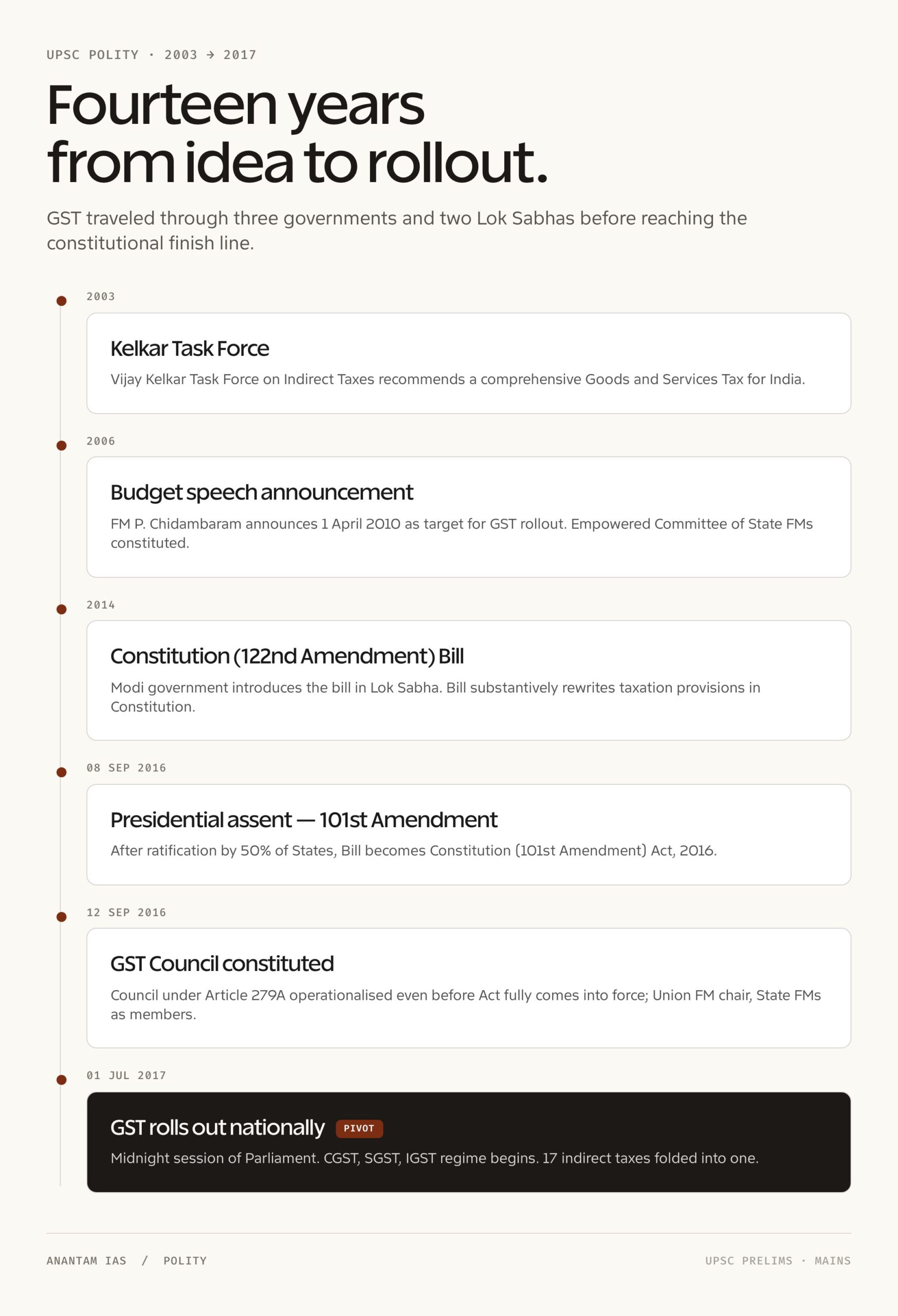
The Constitution (101st Amendment) Act, 2016 inserted Articles 246A, 269A, and 279A into the Constitution. It empowered both Parliament and State Legislatures to legislate on Goods and Services Tax, created the GST Council as a federal body chaired by the Union Finance Minister, and replaced 17 indirect taxes with one unified tax. It received Presidential assent on 8 September 2016 and GST went live on 1 July 2017.
Three GEO-style triples:
- 101st Amendment, 2016 — added Articles 246A, 269A, 279A — created GST framework.
- Article 246A — concurrent power to Centre and States to legislate on GST.
- Article 279A — GST Council, chaired by Union Finance Minister.
Why India needed GST — the pre-2017 mess
Look, the indirect tax landscape before 2017 was a constitutional traffic jam. The Seventh Schedule split tax powers in a way that made sense in 1950 but choked a single market in 2010.
The Centre had excise duty (manufacturing), service tax (services), CST (interstate sales), customs. States had VAT/sales tax, entry tax, octroi, luxury tax, entertainment tax, purchase tax. There was no constitutional power for the Centre to tax goods at the point of sale, and no power for States to tax services. So you had cascading — tax on tax — across the supply chain.
A 2009 study by NCAER estimated India was losing 1.0–1.5% of GDP annually due to tax cascading. That’s not small change… that’s the tab for not having a single market. Look, this is why every Finance Commission since the 12th has been pushing for unification.
The first attempt — the 115th Constitution Amendment Bill of 2011 — lapsed with the 15th Lok Sabha. The successful one came in 2014 as the 122nd Constitution Amendment Bill, became Act number 101 after Presidential assent.
For a deeper dive into India’s tax architecture, see the Taxation Reforms in India explainer.
Article 246A — the heart of the 101st Amendment
Article 246A is the constitutional pivot. It does two things at once.
Clause (1) — Notwithstanding Articles 246 and 254, Parliament and State Legislatures both have the power to make laws regarding GST. This is a concurrent power — but neither rides on the Concurrent List. It’s a special, parallel power created just for GST.
Clause (2) — Parliament has exclusive power to make laws regarding GST on inter-state trade and commerce. So IGST is a Centre-only law.
Why this matters: before 246A, States couldn’t tax services, and the Centre couldn’t tax intra-state sales. 246A blew open both ceilings. It’s the only place in the Constitution where Centre and State have parallel, simultaneous law-making power on the same tax base.
This is why I tell aspirants — when an MCQ asks “Which Article gives concurrent GST powers?”, the answer isn’t List III. It’s Article 246A.
Article 269A — the inter-state plumbing
Article 269A handles inter-state GST. The Centre levies and collects IGST, then apportions it between Centre and States as recommended by the GST Council under Article 270.
Key clauses:
- 269A(1) — IGST levied and collected by Centre on inter-state supplies, apportioned per GST Council recommendations.
- 269A(2) — Imports treated as inter-state supply.
- 269A(5) — Parliament determines the principles for “place of supply” and when a supply is inter-state.
The “place of supply” principle is the entire engineering of how IGST gets divided. Examiners rarely test it directly, but understanding it explains why GST registration is state-by-state, not pan-India.
Article 279A — the GST Council
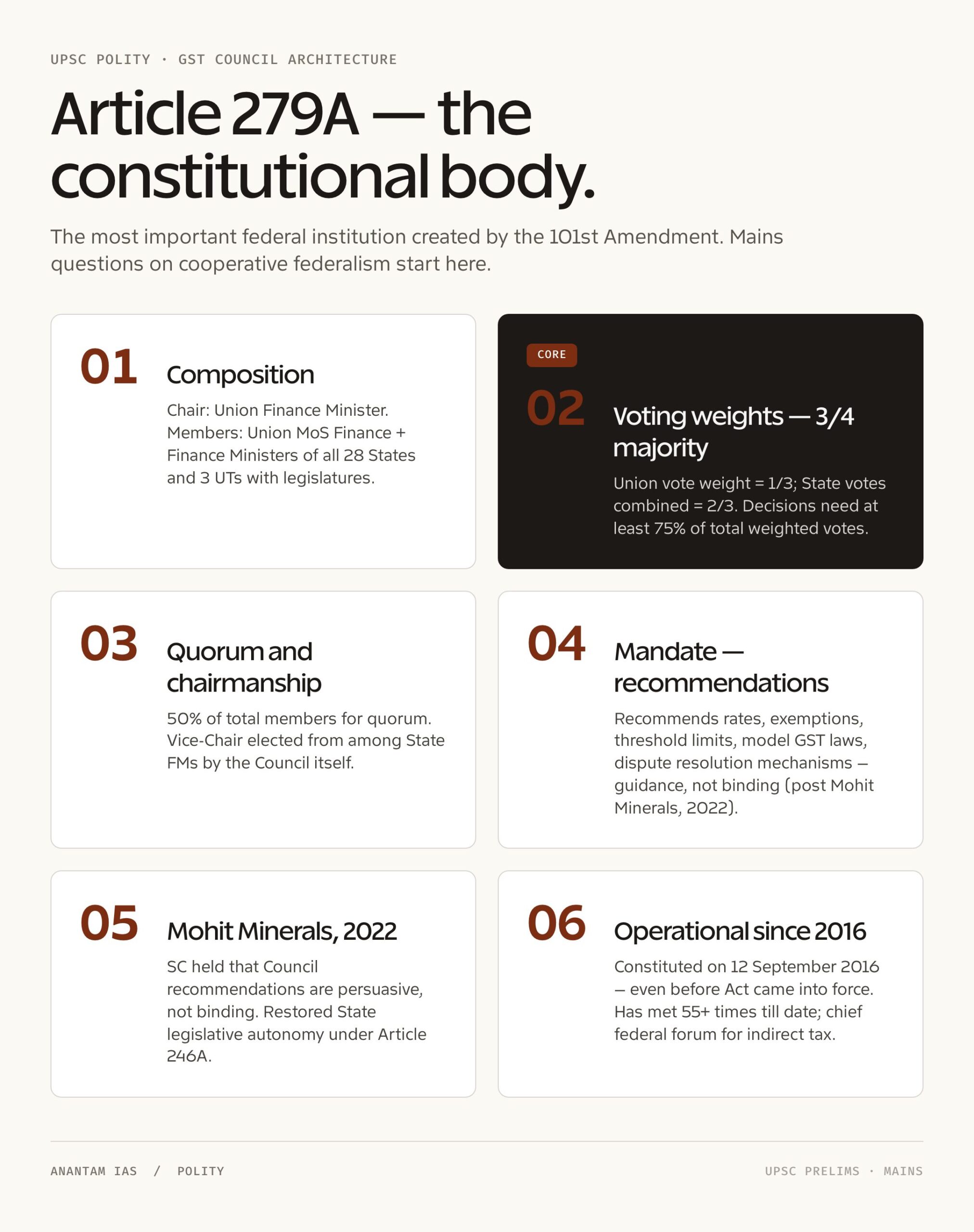
The GST Council is the most important federal body created in the last decade. Article 279A mandates the President to constitute it within 60 days of the Act’s commencement. Composition:
- Chairperson — Union Finance Minister.
- Vice-Chair — chosen from State members by the State members themselves.
- Member (Centre) — Union Minister of State for Revenue or Finance.
- Members (States) — Minister in charge of Finance or Taxation, or any other Minister nominated by each State Government.
Voting weights — Centre has 1/3rd, all States together have 2/3rd. Decisions need a 3/4ths majority of the weighted votes of members present and voting. Quorum is 50% of total members.
This 1/3 vs 2/3 split is genius. The Centre can’t push anything through without at least some states. And no one State can block — because the 2/3 is collective. It forces consensus… at least in theory.
The Council’s mandate under Article 279A(4):
- Goods and services subject to or exempt from GST.
- Model GST laws, principles of levy, place of supply rules.
- Threshold limits.
- Rates including floor rates and bands.
- Special rates for natural calamities/disasters.
- Special provisions for special-category States (e.g. North-East).
The Council also decides dispute resolution mechanisms between Centre and States. Read more on Cooperative & Competitive Federalism — the GST Council is the textbook case of cooperative federalism in action.
What got subsumed — the 17 taxes
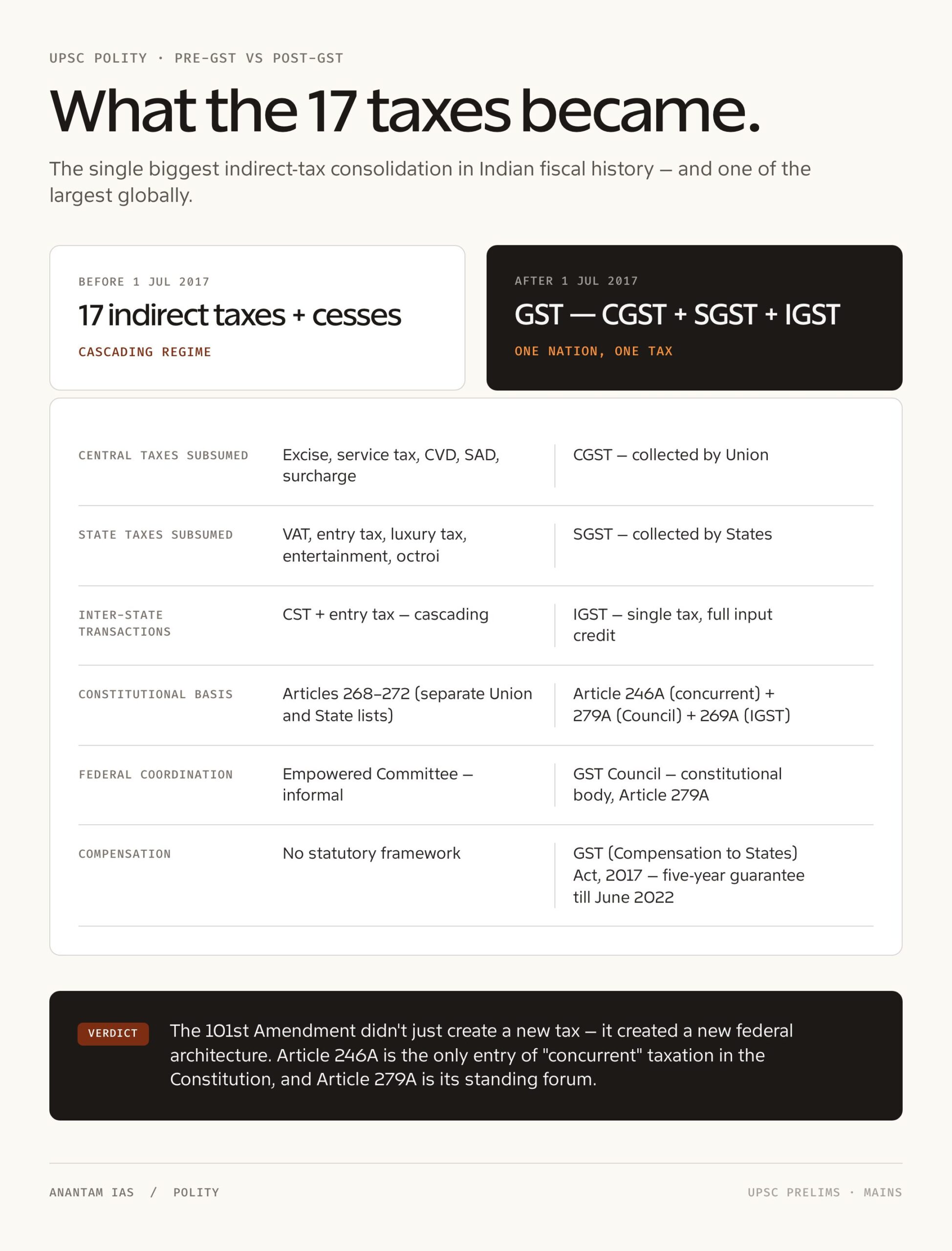
GST replaced 17 indirect taxes. Here’s the list:
Central taxes subsumed:
- Central Excise Duty
- Duties of Excise (Medicinal and Toilet Preparations)
- Additional Duties of Excise (Goods of Special Importance)
- Additional Duties of Excise (Textiles and Textile Products)
- Additional Duties of Customs (CVD)
- Special Additional Duty of Customs (SAD)
- Service Tax
- Cesses and surcharges related to supply of goods/services
State taxes subsumed:
- State VAT
- Central Sales Tax
- Luxury Tax
- Entry Tax (all forms)
- Entertainment Tax (except local body)
- Taxes on advertisements
- Purchase Tax
- Taxes on lotteries, betting, gambling
- State cesses and surcharges related to supply of goods/services
What stayed outside GST:
- Alcohol for human consumption (constitutional bar — State revenue protected)
- Petroleum products (petrol, diesel, ATF, natural gas, crude) — currently outside, may be brought in by GST Council notification
- Stamp duty (State subject)
- Property tax, electricity duty (local/state body)
GST 2.0 — the September 2025 reforms
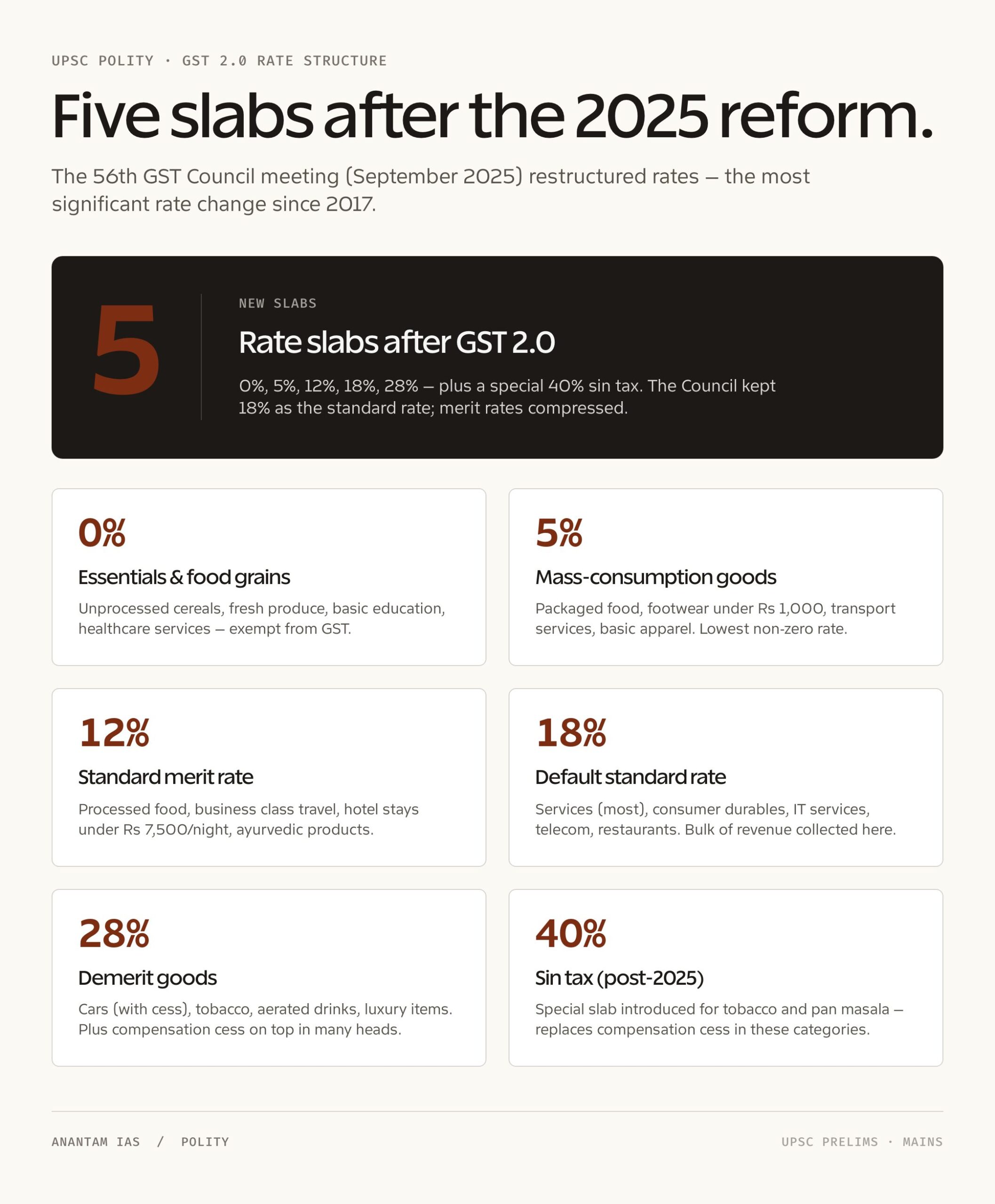
This is where 2026 examiners are concentrating their fire. The 56th GST Council meeting in September 2025 approved the GST 2.0 reforms, effective 22 September 2025.
What changed:
- The four-slab structure (5%, 12%, 18%, 28%) collapsed into three slabs — 5% (merit), 18% (standard), 40% (demerit/sin/luxury).
- 90% of items in the old 28% slab moved to 18%.
- ~99% of items in the old 12% slab moved to 5%.
- 200+ items saw rate cuts effective 22 September 2025.
- A 40% demerit rate covers tobacco, pan masala, online gaming, luxury vehicles.
The Goods and Services Tax Appellate Tribunal (GSTAT) became operational by December 2025, finally giving GST disputes a proper appellate body — eight years after GST itself. The National-level Authority for Advance Rulings (NAAAR) was set up to unify advance rulings across States.
Macro impact: forecasts suggest GST 2.0 lifts GDP growth 0.5–1.2 percentage points in FY 2026 and reduces headline inflation by 0.5–1.1 points.
For the latest rate slab table, see our New GST Rate explainer. For the broader story of GST in India, GST in India: Complete Guide for UPSC is the comprehensive reference.
Centre vs States — the unresolved disputes
GST sounds harmonious. The reality is messier. Three disputes are live in 2026.
1. Compensation cess. When GST started, the Centre promised States a 14% revenue growth guarantee for 5 years (until June 2022). When pandemic-hit collections fell short, the Centre had to borrow ₹1.1 lakh crore in FY21 and ₹1.59 lakh crore in FY22 on behalf of States. The compensation period ended in June 2022. States have repeatedly asked for a 5-year extension under GST 2.0 — that demand is still unaddressed as of April 2026.
2. Revenue loss under GST 2.0. Kerala has projected ₹8,000–10,000 crore annual revenue loss under the new slabs. Tamil Nadu, West Bengal, and Punjab have flagged similar concerns. The 16th Finance Commission‘s interim report (2026) is expected to address vertical fiscal balance.
3. Petroleum inclusion. Petrol and diesel together generate ~₹4 lakh crore for States annually. States resist GST inclusion — and the Centre, despite occasional rhetorical pushes, has not forced the issue.
For the broader fiscal picture, Fiscal Federalism in India and Performance Analysis of GST are essential reading.
Why this matters for UPSC
This topic shows up across papers.
- Prelims — Straightforward MCQs on Articles 246A, 269A, 279A. Voting structure of GST Council. Asked in 2017, 2018, 2020, 2022. Likely again 2026.
- Mains GS Paper II — Federalism questions. “GST Council as an institution of cooperative federalism — discuss.” Asked variations in 2018 and 2022.
- Mains GS Paper III — Indian Economy. “Examine the impact of GST on India’s tax-to-GDP ratio.” 2019.
- Essay — “One Nation One Tax — promise and performance.”
The 2025 GST 2.0 reforms are 100% on the 2026 question paper. Bet on it.
Common misconceptions
Myth 1: GST is a Central tax. Wrong. CGST is Central, SGST is State, IGST is Central but apportioned. GST is constitutionally a shared tax under Article 246A.
Myth 2: The GST Council is a Constitutional body but not a federal one. It is both. Article 279A creates it, and the 1/3-2/3 voting structure is its federal essence.
Myth 3: States lost revenue power because of GST. Half-true. States lost VAT, entry tax, etc., but gained the right to tax services (which they didn’t have before). Net revenue position varies by State.
Myth 4: GST applies to all goods and services. Wrong. Alcohol for human consumption is constitutionally outside GST. Petroleum products are currently outside. Stamp duty stays. Electricity duty stays.
How to revise this in 30 minutes
- Laxmikanth, Chapter 32 (Tax Administration) — 8 minutes. The constitutional framework section.
- PRS Legislative Brief on the 101st Amendment Bill — 7 minutes. Best plain-English summary of what changed.
- GST Council website (gstcouncil.gov.in) — 5 minutes. Skim the structure page.
- PIB release on GST 2.0 (September 2025) — 5 minutes. The Centre’s official narrative.
- One Indian Express explainer on GST 2.0 disputes — 5 minutes. The political-economy angle.
Frequently Asked Questions
What is the 101st amendment of indian constitution?
The 101st Amendment, 2016 introduced GST. It added Articles 246A, 269A, and 279A, allowing Centre and States to levy a unified Goods and Services Tax and creating the GST Council.
When did GST come into force?
1 July 2017. The 101st Amendment received Presidential assent on 8 September 2016.
What is Article 246A?
Article 246A grants concurrent law-making powers to Parliament and State Legislatures on GST, with Parliament having exclusive power on inter-state GST.
What is Article 279A?
Article 279A establishes the GST Council, chaired by the Union Finance Minister, with Union and State finance ministers as members.
How are decisions made in the GST Council?
By 3/4th majority of weighted votes — Centre has 1/3 weight, States together have 2/3.
Is petroleum under GST?
Currently no. The Council can bring petroleum under GST by notification, but States have resisted.
What changed with GST 2.0?
Effective 22 September 2025, the four-slab structure became three — 5%, 18%, and 40% (demerit). 200+ items saw rate cuts.
Which taxes did GST subsume?
17 indirect taxes including Central Excise, Service Tax, VAT, CST, Entry Tax, Luxury Tax, Octroi, and Entertainment Tax.