
The Finance Commission of India is the constitutional body that sits at the centre of fiscal federalism — it decides how taxes that the Union collects are shared with the States, and how additional grants are distributed to bridge revenue gaps and incentivise state spending. Created under Article 280 of the Constitution, the Finance Commission of India has been constituted every five years since 1951; the 16th Finance Commission, chaired by economist Arvind Panagariya, has been mandated to make recommendations for the five-year award period 2026-27 to 2030-31.
The Finance Commission of India is, after the election-commission-india and the cag-comptroller-auditor-general, the most consequential of the statutory-constitutional-bodies-overview — every State Budget, every transfer to local bodies, every grant for disaster relief turns on the Finance Commission of India’s formula. The 14th Finance Commission raised the share of States in the divisible pool from 32% to a transformative 42%, and the 15th held it at 41% after the reorganisation of Jammu and Kashmir. The 16th FC — whose report was submitted to the President on 17 November 2025 and tabled in Parliament on 1 February 2026 — retained that share at 41%, shaping India’s fiscal-deficit-india arithmetic for the rest of the decade.
This explainer walks through the constitutional scheme, the composition and qualifications, the terms of reference, the vertical and horizontal devolution formulas, the grants-in-aid, the path of the 16th FC, and the standing critiques of the institution.
Quick Facts on the Finance Commission of India

- Constitutional article. Article 280, Part XII.
- Composition. Chairman + 4 members, appointed by President.
- Periodicity. Every 5 years, or earlier if necessary.
- Award period. Recommendations for 5 financial years.
- Current. 16th Finance Commission, chaired by Arvind Panagariya; award period 2026-27 to 2030-31; report submitted to the President on 17 November 2025 and tabled in Parliament on 1 February 2026.
- Vertical share. 41% of net proceeds of divisible taxes to States since 14th FC (was 42% before J&K reorganisation).
- Submission. Report submitted to President; laid in Parliament with Action Taken Report.
- Implementation. Recommendations are advisory but conventionally accepted.
Article 280 — Constitutional Scheme
Article 280(1) requires the President to constitute a Finance Commission of India within two years of the commencement of the Constitution and every five years thereafter, or earlier as needed. Article 280(2) authorises Parliament to determine the qualifications of members and the manner of their selection — done through the Finance Commission Act, 1951. Article 280(3) lists the duties of the Commission.
The Finance Commission of India is mandated to recommend:
- the distribution between the Union and the States of the net proceeds of taxes which are to be, or may be, divided between them and the allocation of respective shares (Article 280(3)(a));
- the principles which should govern grants-in-aid to the States out of the Consolidated Fund of India (Article 280(3)(b));
- the measures needed to augment the Consolidated Fund of a State to supplement the resources of Panchayats and Municipalities (Article 280(3)(bb) and 280(3)(c), inserted by the 73rd and 74th Amendments);
- and any other matter referred by the President in the interests of sound finance.
The recommendations are placed before each House of Parliament under Article 281 along with an explanatory memorandum on the action taken. Constitutional convention has hardened into a strong presumption that the Union accepts the core recommendations even though they are formally advisory.
Composition and Qualifications
The Finance Commission of India has a Chairman and four other members. The Finance Commission (Miscellaneous Provisions) Act, 1951, and the regulations under it lay down the qualifications:
- The Chairman shall be a person having experience in public affairs.
- One member shall be a judge of a High Court or qualified to be one.
- One member shall have special knowledge of the finances and accounts of government.
- One member shall have wide experience in financial matters and administration.
- One member shall have special knowledge of economics.
Members hold office for the period specified in the Presidential order. Salaries and conditions are determined by Parliament; tenure is at the pleasure of the President but conventions of independence and full term are routinely honoured.
Terms of Reference
The terms of reference for each Finance Commission of India are issued by the President and shape the report decisively. They typically cover the divisible pool, the vertical share, the horizontal formula, revenue deficit grants, grants for local bodies and disaster relief, performance-based grants for sectors like health, education, and rural infrastructure, and sometimes specific topics — such as cesses and surcharges, defence and internal security expenditure, and centrally sponsored schemes.
For the 16th FC, the terms of reference notified on 29 November 2023 cover the standard ground plus a non-lapsable fund for internal security and defence — a contested addition that some States argue could shrink the divisible pool indirectly.
Vertical Devolution

Vertical devolution is the share of the net proceeds of divisible Union taxes (excluding cesses, surcharges, and the cost of collection) that goes to all States together.
- 13th FC (2010-15): 32%
- 14th FC (2015-20): 42%
- 15th FC (2020-26): 41%
The 14th FC’s 10-percentage-point jump consolidated several earlier conditional transfers into untied tax devolution, giving States more spending flexibility but reducing the Union’s room for centrally sponsored schemes. The 15th FC retained 41% after adjusting for the conversion of Jammu and Kashmir into Union Territories (estimated 1 percentage point). The 16th Finance Commission of India retained this 41% share in its report for 2026-31, declining demands from several States to raise it to 50%.
Horizontal Devolution Formula
Horizontal devolution is the inter-state distribution of the vertical share. Each Finance Commission of India designs a formula combining need, equity, efficiency, and incentive criteria. The 15th FC’s formula assigned weights:
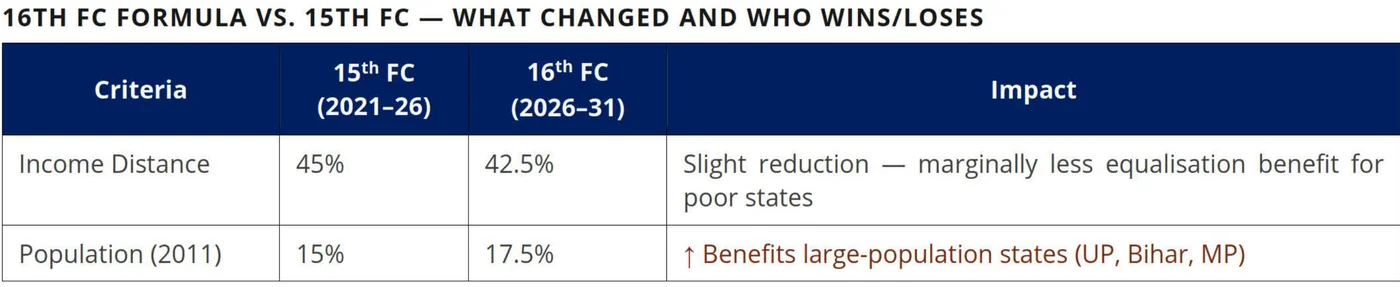
- Income distance: 45%
- Population (2011): 15%
- Area: 15%
- Forest and ecology: 10%
- Demographic performance: 12.5%
- Tax and fiscal effort: 2.5%
The shift to 2011 population was contested by southern States, which feared loss because of their lower fertility rates. The 15th FC partly compensated through the Demographic Performance criterion, which rewards lower total fertility — a credit to states that managed population growth.
Grants-in-Aid
Beyond tax devolution, the Finance Commission of India recommends three families of grants under Articles 275 and 282:
Revenue deficit grants
Awarded to States whose own revenues plus tax devolution cannot meet their committed revenue expenditure on a normative basis. The 15th FC recommended Rs. 2.94 lakh crore over five years to 17 States.
Local body grants
The 73rd and 74th Amendments extended the Finance Commission of India’s mandate to Panchayats and Municipalities. The 15th FC recommended Rs. 4.36 lakh crore over five years for local bodies, split between rural and urban with conditions on audited accounts and own-source revenue.
Sector and performance grants
State-specific grants and performance-based grants for health, school education, higher judiciary, statistics, aspirational districts, and agricultural reforms. The 15th FC’s grants were heavily conditional, which States argued undermined fiscal federalism.
The 16th Finance Commission of India
The 16th Finance Commission of India was constituted on 31 December 2023 with Arvind Panagariya — former Vice Chairman of NITI Aayog and Columbia University economist — as Chairman. The other members are Annie George Mathew (former IAS), Manoj Panda (former director, IEG), Ajay Narayan Jha (former Finance Secretary and Member of 15th FC), and Soumya Kanti Ghosh (Group Chief Economic Adviser, SBI, part-time member).
The 16th FC’s award period is 2026-27 to 2030-31. The Commission submitted its report to the President on 17 November 2025, and the report was tabled in Parliament on 1 February 2026 along with the explanatory memorandum on the action taken. In it, the 16th FC retained the States’ vertical share at 41% of the net divisible pool, declining demands from several States to raise it to 50%.
Standing Critiques
Three critiques have followed the Finance Commission of India through its 75-year journey. First, that despite the 42% vertical share, States’ actual fiscal space has shrunk because cesses and surcharges — which sit outside the divisible pool — have grown disproportionately as a share of Union tax revenue. Second, that conditional grants over-ride state priorities and reintroduce central control through the backdoor. Third, that the use of 2011 population as a base disadvantages states that performed well on demographic transition. The 16th FC’s response on these three will define its legacy.
Finance Commission of India in the Constitutional Architecture
The Finance Commission of India is the bridge between the constitutional promise of federalism and the fiscal reality that taxes are mostly collected centrally and spent locally. With the cag-comptroller-auditor-general policing how that money is spent and the election-commission-india policing how the spenders are chosen, the three pillars of the statutory-constitutional-bodies-overview hold up the day-to-day operation of constitutional government.
Frequently Asked Questions
What is the Finance Commission of India and under which Article is it created?
The Finance Commission of India is the constitutional body that recommends the distribution of central taxes between the Union and the States and the principles governing grants-in-aid to States. It is created under Article 280 of the Constitution and is constituted by the President every five years.
Who chairs the 16th Finance Commission of India?
Arvind Panagariya, former Vice Chairman of NITI Aayog and Professor of Economics at Columbia University, chairs the 16th Finance Commission of India. The Commission was constituted on 31 December 2023, with an award period of five years from 1 April 2026 to 31 March 2031.
What is the current vertical devolution share for States?
States together receive 41% of the net proceeds of the divisible pool of Union taxes (excluding cesses, surcharges, and the cost of collection). This was set by the 15th Finance Commission of India for the period 2020-21 to 2025-26, after the 14th FC raised it from 32% to 42%.
What is the difference between vertical and horizontal devolution?
Vertical devolution is the share of central tax proceeds that goes to all States collectively (currently 41%). Horizontal devolution is the formula that distributes this aggregate among individual States, using weighted criteria like income distance, population, area, forest cover, demographic performance, and tax effort.
What are grants-in-aid recommended by the Finance Commission of India?
The Finance Commission of India recommends grants to States under Article 275 to cover revenue deficits, support local bodies and Panchayati Raj Institutions, finance sector-specific reforms, and provide performance incentives. These grants are charged on the Consolidated Fund of India and are distinct from tax devolution.
Are Finance Commission of India recommendations binding?
The recommendations of the Finance Commission of India are advisory under the Constitution. However, by long convention the Union accepts the core devolution and grant recommendations. The Action Taken Report tabled in Parliament records which recommendations are accepted, modified, or deferred.
Why are cesses and surcharges controversial for the Finance Commission of India?
Cesses and surcharges sit outside the divisible pool of Union taxes and are therefore not shared with States. As their share in total Union tax revenue has grown, States argue that their effective share of Union revenue has shrunk even though the formal vertical devolution is 41%. The 16th Finance Commission of India is expected to address this.
When will the 16th Finance Commission of India submit its report?
The 16th Finance Commission of India is required to submit its report to the President by 31 October 2025. The recommendations cover the five-year award period from 1 April 2026 to 31 March 2031, and will be laid before Parliament along with an explanatory memorandum on the action taken.
Tell Google you want more of this.
Add Anantam IAS as a preferred sourceOne tap, and this site shows up more often in your own Top Stories, AI Overviews and AI Mode. Remove it any time.