Classical and Folk Dances of Indian States: Complete List with Map
States of India and their dance forms: complete list of 8 classical and major folk dances across 28 states and 8 UTs with UPSC facts and map pointers.
Introduction
Dance in India is not decoration, it is a language. Before writing took root in the subcontinent, communities recorded their myths, harvests, marriages and protests through rhythm and posture. A Bharatanatyam arangetram in Chennai, a Chhau mask dance in Purulia, and a Bihu under an Assam kadam tree all perform the same civilisational function: they transmit memory across generations. This is why UPSC aspirants encounter dance forms not just in Art and Culture (GS1) but also in Prelims trivia, Sangeet Natak Akademi awards, GI tag questions and interview prompts on intangible heritage.
This article maps classical and folk dances across all 28 states and 8 union territories, clarifies the “29 states” terminology (which dates to before the Jammu and Kashmir Reorganisation Act, 2019), and draws out the exam-relevant connections: the eight dances officially recognised as classical by Sangeet Natak Akademi, their textual roots in the Natya Shastra, and the UNESCO Intangible Cultural Heritage listings. By the end, you will have a ready-to-memorise table plus the analytical scaffolding to answer Mains-style questions on cultural diversity.
Quick Facts at a Glance
| Item | Figure |
|---|---|
| States in India (current) | 28 |
| Union Territories | 8 |
| Classical dances recognised by SNA | 8 |
| Oldest treatise on dance | Natya Shastra of Bharata Muni (200 BCE to 200 CE) |
| UNESCO Intangible Heritage dances from India | Kutiyattam (2008), Ramlila (2008), Mudiyettu (2010), Chhau (2010), Sankirtana (2013) |
| First classical dance recognised | Bharatanatyam (Tamil Nadu) |
| Most recent addition to classical list | Sattriya of Assam (2000) |
| Apex body | Sangeet Natak Akademi, established 1953 |
| Dance-heavy state | Manipur, with 35+ documented forms |
Background and Historical Context
The phrase “29 states and their dance forms” is one of the most searched cultural queries on Indian search engines. It dates from the period between 2014 (when Telangana was carved out of Andhra Pradesh, making it the 29th state) and 2019 (when the Jammu and Kashmir Reorganisation Act downgraded J&K and Ladakh into Union Territories, bringing the count back to 28). The dances themselves are, of course, older than any state boundary.
The taxonomy of Indian dance runs back to Bharata Muni’s Natya Shastra, compiled between 200 BCE and 200 CE. The treatise distinguishes Nritta (pure dance), Nritya (expressive dance) and Natya (dramatic dance). It also classifies performance into Tandava (vigorous, masculine) and Lasya (graceful, feminine). Later medieval texts like Nandikeshwara’s Abhinaya Darpana and Jayapa Senapati’s Nritta Ratnavali refined the regional styles.
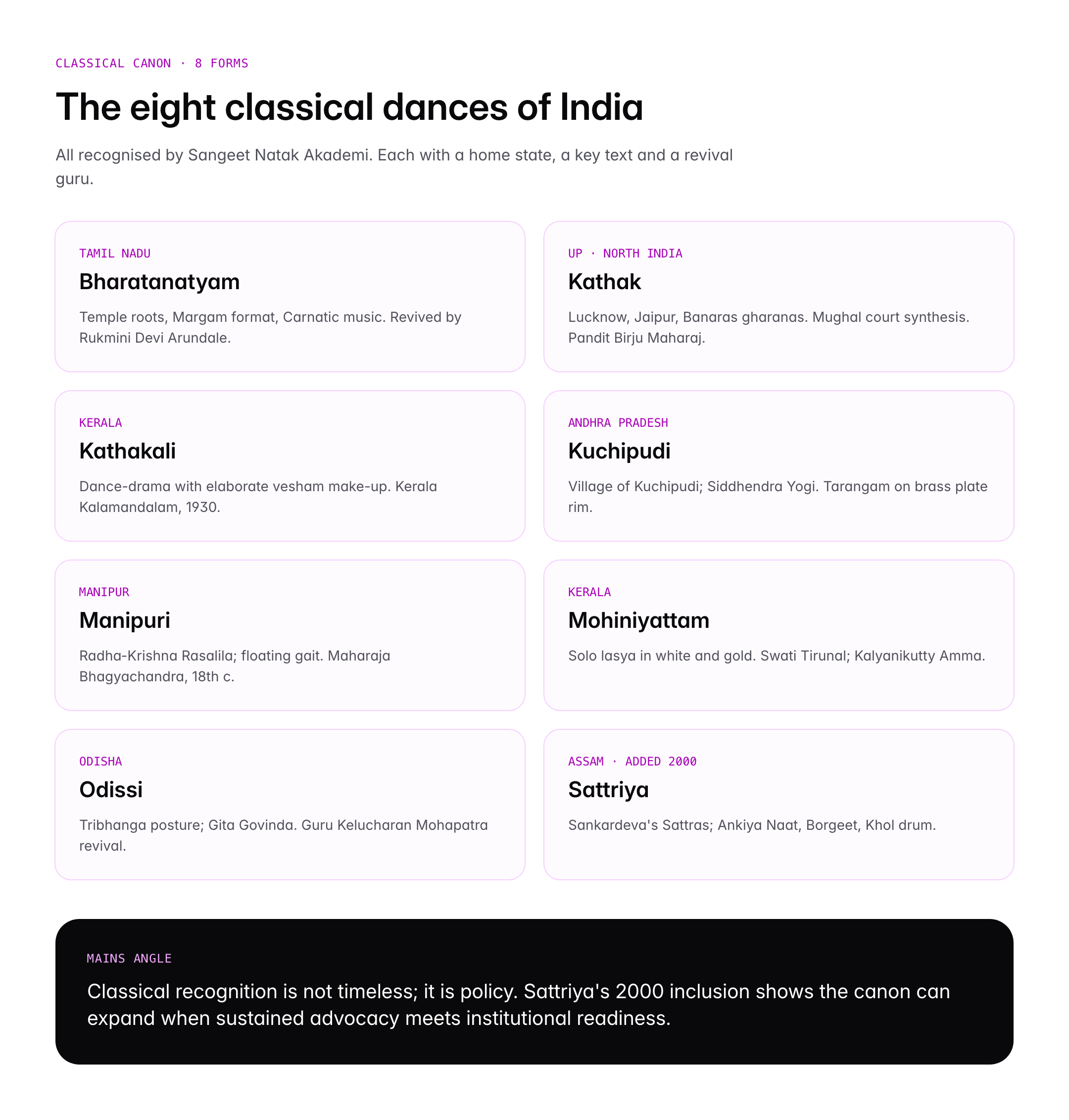
The term classical dance is a modern administrative category. The Sangeet Natak Akademi, established in 1953, progressively recognised eight forms as classical: Bharatanatyam (Tamil Nadu), Kathak (North India, especially UP), Kathakali (Kerala), Kuchipudi (Andhra Pradesh), Manipuri (Manipur), Mohiniyattam (Kerala), Odissi (Odisha) and Sattriya (Assam, added 2000). Chhau, recognised by SNA in 2010 as classical by some accounts, remains officially folk-classical; scholars continue to debate its status.
Folk dances, by contrast, emerged from agrarian cycles, religious festivals and community rituals. Their transmission is oral and embodied rather than codified. Post-independence cultural policy, through the Akademi, the Indira Gandhi National Centre for the Arts (IGNCA) and state-level akademis, has documented hundreds of folk forms. The Zonal Cultural Centres, set up in 1985-86 across Patiala, Kolkata, Thanjavur, Udaipur, Nagpur, Allahabad and Dimapur, now hold the largest inventories.
Key Features: The Eight Classical Dances
Bharatanatyam (Tamil Nadu)
Bharatanatyam evolved from the temple traditions of Tamil Nadu, performed by devadasis before reform movements in the early twentieth century brought it to the public stage. Its format follows the Margam: alarippu, jatiswaram, shabdam, varnam, padam, javali, tillana. The accompanying music is Carnatic. E. Krishna Iyer and Rukmini Devi Arundale were central to its twentieth-century revival.
Kathak (Uttar Pradesh and North India)
Kathak literally means “one who tells a story”. Its roots lie in the kathakars of the Gangetic plain, who narrated Puranic stories in temple courtyards. Under Mughal patronage, the form absorbed Persian aesthetics, moving from temple to court. The three major gharanas are Lucknow, Jaipur and Banaras. Pandit Birju Maharaj was its most celebrated modern exponent.
Kathakali (Kerala)
Kathakali is a spectacular dance-drama combining literature, music, painting, acting and dance. Performers use elaborate vesham (make-up) with chutti (rice paste), colour codes (green for heroic, red for evil), and towering headgear. Stories are drawn largely from the Mahabharata, Ramayana and Puranas. The training at Kerala Kalamandalam, founded by poet Vallathol Narayana Menon in 1930, standardised the form.
Kuchipudi (Andhra Pradesh)
Originating in the village of Kuchipudi in Krishna district, the form was traditionally performed by male Brahmin troupes as dance-drama. Siddhendra Yogi, a 15th century saint-poet, is credited with codifying it through the Bhamakalapam. Modern Kuchipudi is performed by both men and women and is known for its tarangam, where dancers perform on the rim of a brass plate.
Manipuri (Manipur)
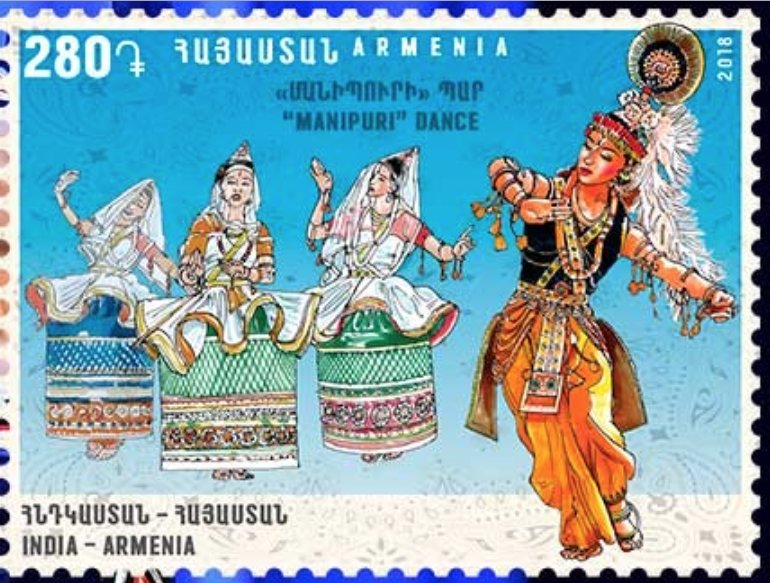
Manipuri centres on the Vaishnava Rasalila traditions around Radha-Krishna. Movements are gentle, almost floating, with the dancer’s feet rarely striking the floor sharply. The iconic kumin skirt for women and the cholom drum dances for men are its signature. The Maharaja Bhagyachandra (18th century) is traditionally credited with formalising Manipuri.
Mohiniyattam (Kerala)
Mohiniyattam translates as “dance of the enchantress”. It is a solo lasya form performed in white and gold saris, with slow, swaying torso movements. Swati Tirunal Maharaja of Travancore and later Kalamandalam Kalyanikutty Amma played key roles in systematising the style.
Odissi (Odisha)
Odissi traces to temple sculptures at Konark, Bhubaneswar and the Maharis of Jagannath Puri. It uses the tribhanga (three-bend) posture and chauka (square stance). The form was revived in the twentieth century by Guru Kelucharan Mohapatra, Guru Pankaj Charan Das and others. Odissi sahitya draws from Jayadeva’s Gita Govinda.
Sattriya (Assam)
Sattriya, added to the classical list in 2000, was developed by the Vaishnava saint Sankardeva in 15th century Assam as part of the monastic Sattra tradition. It combines dance, drama and music. The repertoire includes Ankiya Naat, Borgeet and the Khol drum. Long confined to male monks within sattras, it opened up to women and public stages only in the late twentieth century.
Significance for UPSC and General Knowledge
- GS1 Art and Culture: Repeatedly tested; Prelims MCQs link states to dances, instruments, festivals.
- Intangible Cultural Heritage: UNESCO listings of Kutiyattam, Chhau, Mudiyettu, Ramlila and Sankirtana are recurring.
- GI tags: Several folk dance costumes (Madhubani painting, Pattachitra) are GI-protected, cross-referenced in Mains.
- Essay and Interview: Culture as soft power; Bharat’s civilisational depth reflected in performing arts.
- Schemes: Awareness of SCHEMEs such as Guru Shishya Parampara, Kala Sanskriti Vikas Yojana and Repertory Grants.
- Women’s studies GS1: The devadasi-to-classical-stage trajectory illustrates social reform and gendered art histories.
State-wise Distribution of Major Folk Dances
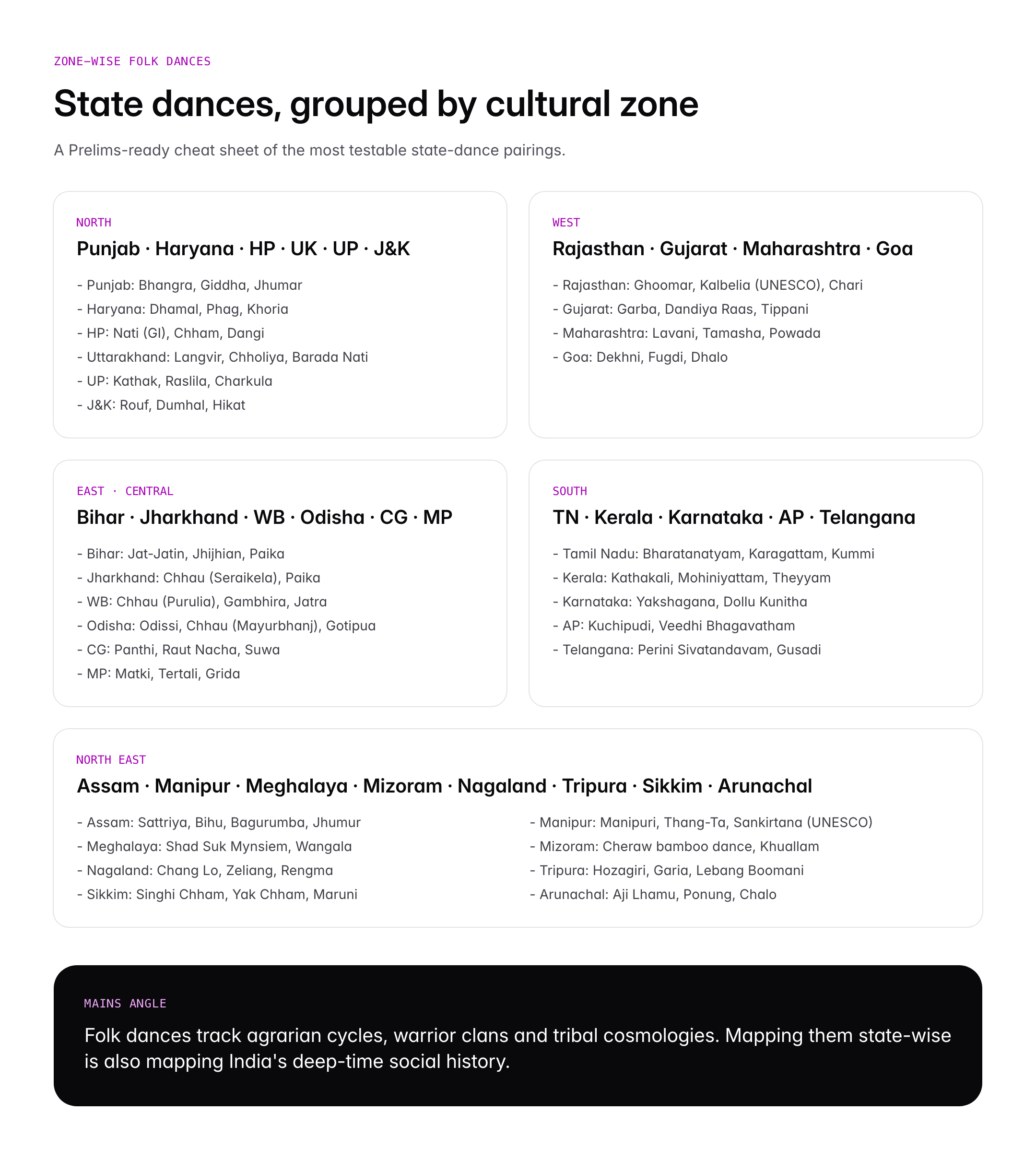
Below is a consolidated, exam-friendly list. Where multiple forms exist, the most frequently tested are listed first.
| State | Major Folk Dances | Classical Link |
|---|---|---|
| Andhra Pradesh | Kuchipudi (classical), Veedhi Bhagavatham, Butta Bommalu, Dhimsa | Kuchipudi |
| Arunachal Pradesh | Aji Lhamu, Chalo, Hiren Khla, Ponung | – |
| Assam | Bihu (Rongali, Bhogali, Kati), Jhumur, Bagurumba, Ojapali | Sattriya |
| Bihar | Jat-Jatin, Jhijhian, Paika, Kajari | – |
| Chhattisgarh | Panthi, Raut Nacha, Suwa, Karma | – |
| Goa | Dekhni, Fugdi, Dhalo, Kunbi | – |
| Gujarat | Garba, Dandiya Raas, Tippani, Bhavai | – |
| Haryana | Dhamal, Phag, Khoria, Saang | – |
| Himachal Pradesh | Nati (GI-tagged), Chham, Dangi, Jhoori | – |
| Jharkhand | Paika, Chhau (Seraikela), Jadur, Santhali Karma | Chhau (shared) |
| Karnataka | Yakshagana, Dollu Kunitha, Veeragase, Kamsale | – |
| Kerala | Kathakali, Mohiniyattam, Theyyam, Koodiyattam, Mudiyettu | Kathakali, Mohiniyattam |
| Madhya Pradesh | Gaur, Matki, Phulpati, Tertali, Grida | – |
| Maharashtra | Lavani, Tamasha, Dindi, Powada, Koli | – |
| Manipur | Manipuri, Thang-Ta, Lai Haraoba, Dhol Cholom | Manipuri |
| Meghalaya | Shad Suk Mynsiem, Behdienkhlam, Nongkrem, Wangala | – |
| Mizoram | Cheraw (bamboo dance), Khuallam, Chheih Lam, Chai | – |
| Nagaland | Chang Lo, Zeliang, Rengma, Aaluyattu | – |
| Odisha | Odissi, Chhau (Mayurbhanj), Ghumura, Gotipua | Odissi |
| Punjab | Bhangra, Giddha, Jhumar, Sammi | – |
| Rajasthan | Ghoomar, Kalbelia (UNESCO), Kachhi Ghodi, Chari, Bhavai | – |
| Sikkim | Singhi Chham, Yak Chham, Maruni, Tamang Selo | – |
| Tamil Nadu | Bharatanatyam, Karagattam, Kummi, Kolattam, Mayil Attam | Bharatanatyam |
| Telangana | Perini Sivatandavam, Lambadi, Dhimsa, Gusadi | – |
| Tripura | Hozagiri, Garia, Lebang Boomani, Bizhu | – |
| Uttar Pradesh | Kathak, Raslila, Charkula, Nautanki | Kathak |
| Uttarakhand | Langvir Nritya, Chholiya, Barada Nati, Hurka Baul | – |
| West Bengal | Chhau (Purulia), Gambhira, Jatra, Dhali | Chhau (shared) |
| Jammu and Kashmir (UT) | Rouf, Dumhal, Hikat, Kud | – |
| Ladakh (UT) | Jabro, Chham, Shondol, Koshan | – |
| Delhi (UT) | Kathak (shared), Raslila | – |
| Puducherry (UT) | Garadi, Kolattam | – |
| Andaman and Nicobar (UT) | Nicobarese Ossuary dance, Kattai | – |
| Lakshadweep (UT) | Lava, Kolkali, Parichakali | – |
| Chandigarh (UT) | Bhangra, Giddha (shared with Punjab) | – |
| Dadra, Nagar Haveli, Daman and Diu (UT) | Tarpa, Mando, Dhangari Gaja | – |
Detailed Analysis: Civilisational Patterns in State-wise Dance
A few cross-cutting patterns are worth internalising. First, temple and Vaishnava monasticism produced classical forms across the east and south: Bharatanatyam (Chola temples), Odissi (Jagannath Puri), Kuchipudi (village temple processions), Sattriya (Vaishnava sattras). Second, court patronage under Hindu and Islamic rulers shaped Kathak and Mohiniyattam. Third, martial traditions fed dances like Thang-Ta (Manipur), Chhau (Jharkhand, Odisha, West Bengal), Kalaripayattu-influenced Kathakali footwork, and Paika (Odisha, Bihar).
Folk dances cluster along agrarian cycles. Bihu in Assam marks the three turning points of the rice calendar. Onam’s Thiruvathirakali in Kerala, Bhangra and Giddha in Punjab celebrate Vaisakhi and harvest. Garba and Dandiya in Gujarat ritualise the nine nights of Navaratri. Cheraw in Mizoram, where dancers step between moving bamboo staves, reportedly began as a ritual for women who died in childbirth.
Tribal dances carry distinct cosmologies. Santhali Karma celebrates the Karam tree and fertility. Gusadi of Telangana is performed by Gond Raj Gonds during Dussehra. Hozagiri of the Reang community in Tripura is performed by women balancing lit lamps on heads while rotating on earthen pots, a feat of body control.
UNESCO’s Representative List of Intangible Cultural Heritage has included five dance-heavy Indian traditions: Kutiyattam (2008), Ramlila (2008), Mudiyettu (2010), Chhau (2010) and Sankirtana (2013). Inclusion secures international recognition and safeguards funding under the 2003 UNESCO Convention.
Comparative Perspective
| Category | Regions Dominated | Example Forms | Typical Music | Performer Tradition |
|---|---|---|---|---|
| Classical | All zones | Bharatanatyam, Odissi, Sattriya | Carnatic, Hindustani, Borgeet | Temple, court, monastic |
| Folk harvest | North, East, NE | Bhangra, Bihu, Hozagiri | Dhol, Pepa, Khol | Village-wide, gender-specific |
| Martial | East, NE, South | Chhau, Thang-Ta, Kalari | Dhol, Nagara | Male warrior clans |
| Ritual/tribal | Central, NE | Gusadi, Cheraw, Santhali | Madal, Bamboo | Clan and community |
| Devotional | Pan-India | Raslila, Mudiyettu, Sankirtana | Bhajan, Kirtan | Bhakti and monastic |
Comparing Indian forms with global equivalents (Flamenco in Spain, Capoeira in Brazil, Ballet in France) highlights how India’s diversity is intra-national rather than international. Few other countries carry eight state-recognised classical forms plus hundreds of documented folk forms, making intangible heritage policy a distinctive aspect of Indian cultural governance.
Challenges and Criticisms
Preservation is the first challenge. Many tribal and folk dances are vanishing as rural youth migrate to cities and as traditional patrons (zamindars, temple trusts) lose economic centrality. Without intergenerational transmission, the oral and embodied knowledge that distinguishes folk forms risks erasure within a generation.
Commercialisation is a second challenge. Classical forms increasingly serve the tourism and wedding-circuit market, producing shortened and aestheticised versions at the cost of textual depth. The Guru Shishya Parampara scheme and SNA fellowships provide some cushion, but funding is uneven.
There are also equity questions. The devadasi reform movement of the early twentieth century moved forms like Bharatanatyam out of temples, but it also dispossessed hereditary practitioners, many from Dalit and lower-caste backgrounds, as urban upper-caste women became the face of classical dance. Scholars such as Davesh Soneji have documented this trajectory in Unfinished Gestures (2012).
Finally, there is a political edge. Debates around classical status (why is Chhau folk rather than classical? Why not Yakshagana?) expose how state recognition shapes prestige, funding and career paths. The growing visibility of North East forms, through zonal cultural centres and festivals like Sangai and Hornbill, is a welcome rebalancing, but policy still leans toward the established classical canon.
Prelims Pointers
- India has 8 classical dances recognised by Sangeet Natak Akademi.
- Sattriya was added to the classical list in 2000.
- Bharatanatyam hails from Tamil Nadu and is rooted in the Natya Shastra.
- Kathak has three gharanas: Lucknow, Jaipur, Banaras.
- Manipuri is strongly associated with Vaishnava Rasalila.
- Kuchipudi is named after a village in Krishna district, Andhra Pradesh.
- Odissi uses the tribhanga and chauka postures.
- Mohiniyattam is a lasya form traditionally performed solo by women.
- Sattriya originated in the sattras founded by Sankardeva in Assam.
- Chhau has three styles: Purulia (WB), Seraikela (Jharkhand), Mayurbhanj (Odisha).
- Kalbelia of Rajasthan is on UNESCO’s Intangible Cultural Heritage list (2010).
- Cheraw of Mizoram is performed with moving bamboo staves.
Mains Practice Questions
Q1. Examine how classical and folk dances together constitute India’s intangible cultural heritage and outline the state’s role in preserving them. (15 marks, 250 words)
- Define classical vs folk with SNA taxonomy; name the 8 classical forms.
- Illustrate diversity with three folk examples from distinct zones (NE, central tribal, southern).
- Discuss preservation tools: SNA, IGNCA, zonal cultural centres, UNESCO ICH listings, Guru Shishya schemes; note gaps in funding and urban bias.
Q2. “The classical dance canon reflects both cultural pride and historical exclusions.” Critically analyse. (15 marks, 250 words)
- Establish canon as post-1950 construction; trace Bharatanatyam revival and devadasi reform.
- Bring in exclusions: hereditary practitioner dispossession (Soneji 2012), underrepresentation of tribal forms, delayed recognition of Sattriya.
- Suggest ways to broaden canon: classical status review, inclusion of underrepresented forms, scholarship grants for Dalit practitioners.
Conclusion
The idea of 29 states and their dance forms captures a simple truth through a slightly dated number: India’s cultural geography is indexed by the rhythms its people keep. Whether it is a Bihu dancer under an Assamese kadam tree or a Kathakali performer in a Kerala village, the dance is a political statement about belonging, a religious statement about cosmos, and an aesthetic statement about the body.
For UPSC preparation, the practical takeaway is to memorise the state-dance pairings, master the eight classical forms with their texts and gurus, and be ready to place any folk form in a larger civilisational context: temple, court, agrarian cycle, martial tradition or tribal cosmology. Add one case of UNESCO listing and one critique of the classical canon, and you have a ready answer for GS1, Essay and Interview alike.
Frequently Asked Questions
What are the 29 states and their dance forms?
The phrase dates to 2014-2019, when India briefly had 29 states. Today there are 28 states and 8 UTs. Each state has distinct classical or folk dances – Bharatanatyam in Tamil Nadu, Kathak across UP, Odissi in Odisha, Sattriya in Assam, Manipuri in Manipur, Bihu in Assam, Garba in Gujarat, Bhangra in Punjab, Lavani in Maharashtra, Ghoomar in Rajasthan, Yakshagana in Karnataka and so on.
What are the 8 classical dances of India?
The Sangeet Natak Akademi recognises eight classical dances: Bharatanatyam (Tamil Nadu), Kathak (Uttar Pradesh and North India), Kathakali (Kerala), Kuchipudi (Andhra Pradesh), Manipuri (Manipur), Mohiniyattam (Kerala), Odissi (Odisha) and Sattriya (Assam, added in 2000). All trace roots to the Natya Shastra or regional temple and monastic traditions.
Why are dance forms important for UPSC?
They appear in GS1 Art and Culture, Prelims trivia, interview prompts on intangible heritage and essay topics on cultural diversity. Aspirants should know state-dance pairings, the eight classical forms with texts and gurus, UNESCO Intangible Heritage listings like Kutiyattam and Chhau, and institutional bodies such as Sangeet Natak Akademi and IGNCA.
How are Indian dance forms related to the Natya Shastra?
The Natya Shastra of Bharata Muni (c. 200 BCE to 200 CE) is the foundational text. It classifies performance into Nritta (pure dance), Nritya (expressive) and Natya (dramatic) and distinguishes Tandava from Lasya. All eight classical forms draw grammar, gestures and aesthetic theory from the Natya Shastra and later treatises like Abhinaya Darpana.
Which dance forms from India are on UNESCO’s Intangible Heritage list?
Five Indian dance-heavy traditions are on UNESCO’s Representative List: Kutiyattam (2008), Ramlila (2008), Mudiyettu (2010), Chhau (2010) and Sankirtana of Manipur (2013). Kalbelia of Rajasthan was also inscribed in 2010. These inscriptions provide international safeguards and funding under the 2003 Convention.
What is the difference between classical and folk dance?
Classical dances follow codified grammar rooted in texts like the Natya Shastra, are taught through guru-shishya lineages, and are recognised by Sangeet Natak Akademi. Folk dances emerge from community rituals, agrarian cycles and festivals, are transmitted orally, and vary widely across regions. Both are valued as intangible cultural heritage.
Which state has the most dance forms?
Manipur is the most dance-dense state, with more than 35 documented forms including the classical Manipuri, the martial Thang-Ta, the ritual Lai Haraoba, the Dhol Cholom drum dance and the UNESCO-listed Sankirtana. Odisha, Kerala, Tamil Nadu and Rajasthan also hold very rich classical and folk dance inventories.
When was Sattriya recognised as a classical dance?
Sattriya was added to India’s classical dance list by the Sangeet Natak Akademi in 2000, becoming the eighth classical form. It was developed in the 15th century by Vaishnava saint Sankardeva within Assam’s Sattra monasteries. For centuries it was performed only by male monks inside sattras; it opened to women and public stages in the late twentieth century.