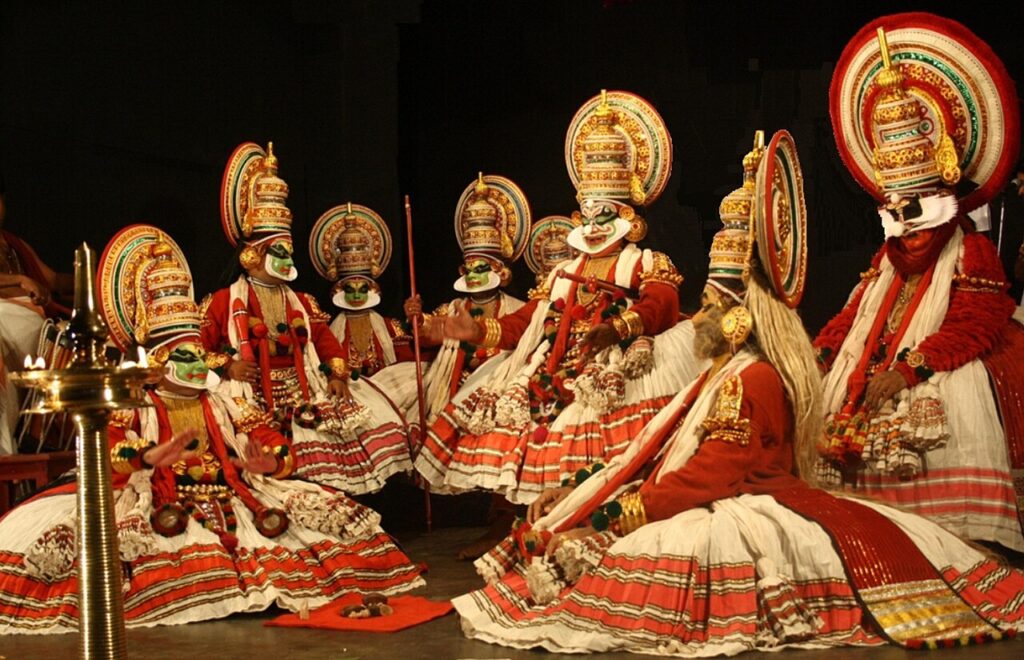
Kathakali is the classical dance-drama of Kerala — a 17th-century synthesis of devotional theatre, martial-arts physicality, and operatic music in which heavily made-up actors silently enact episodes from the Ramayana, Mahabharata, and Puranas while vocalists carry the narrative in song. The name combines katha (story) and kali (play). The form crystallised between roughly 1650 and 1700 in central and north Kerala under the patronage of local rajas, drew on the older temple-arts of Krishnattam and Ramanattam, and absorbed the body discipline of Kalaripayattu, Kerala’s indigenous martial art. Today Kathakali is one of India’s eight officially recognised classical dance traditions.
This article covers the origins of Kathakali in 17th-century Kerala, its relationship to Krishnattam and Ramanattam, the five vesham character categories (Pacha, Kathi, Thadi, Kari, Minukku), elaborate makeup and costume, percussion accompaniment, the padams sung by vocalists, the navarasa expressive grammar, and the major exponents who shaped the modern form.
Origin of Kathakali
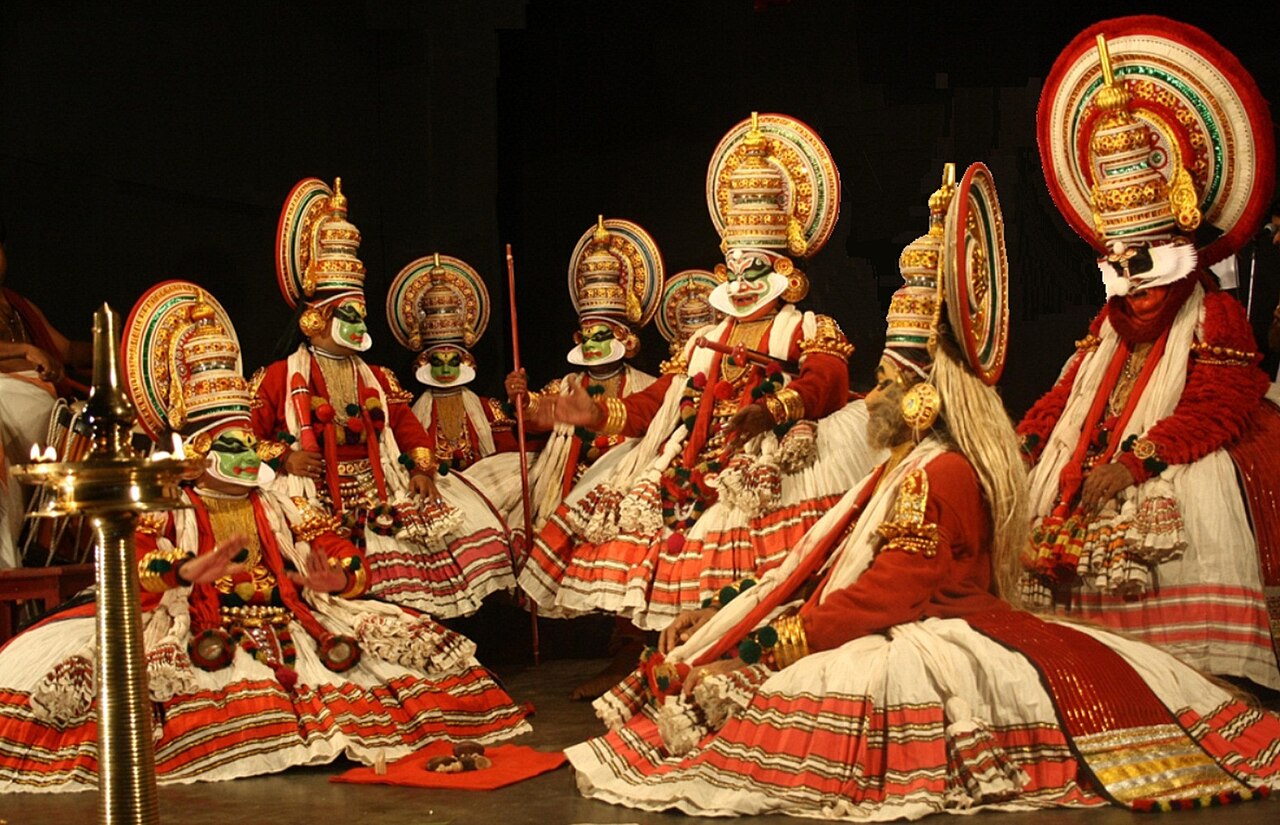
Kathakali emerged in central Kerala in the second half of the seventeenth century. The conventional account credits Kottarakkara Thampuran, the ruler of Kottarakkara, with composing the Ramanattam — a cycle of eight plays based on the Ramayana, performed in Malayalam rather than the Sanskrit of earlier court traditions. Ramanattam is the immediate parent of Kathakali.
Krishnattam — the older ritual cousin
Earlier in the 17th century, the Zamorin ruler Manavedan of Kozhikode (Calicut) composed Krishnattam, a cycle of eight Sanskrit plays on the life of Krishna, performed only at the Guruvayur Sri Krishna temple. When Kottarakkara Thampuran asked the Zamorin to lend his Krishnattam troupe for a wedding, the Zamorin reportedly refused — prompting Kottarakkara to create Ramanattam as a parallel tradition in Malayalam. Both traditions continue to exist; Krishnattam remains temple-bound, while Kathakali developed into the broader, theatrically ambitious form.
Kottayam Thampuran and the classical canon
The next major patron, Kottayam Thampuran (late 17th century), composed four plays — Bakavadham, Kirmiravadham, Kalyanasaugandhikam, and Nivathakavachakalakeyavadham — drawn from the Mahabharata. These plays are considered the classical centre of the Kathakali repertoire. Their padams (sung verses) and choreographic structures still define training standards.
The Kalluvazhi and Kaplingadan schools
In the 19th century, the Kalluvazhi style of Pattikkamthodi Ravunni Menon at Olappamanna Mana and the Kaplingadan style under Kaplingadu Nampoothiri established the modern training pedagogy. Kerala Kalamandalam, founded by the poet Vallathol Narayana Menon in 1930, codified Kalluvazhi as the dominant style and saved Kathakali from likely decline in the colonial era.
The Five Veshams — Character Categories
Kathakali characters are classified into five veshams by makeup colour and personality archetype:
Pacha — the noble hero
Pacha (literally “green”) veshams cover virtuous, heroic, kingly characters — Rama, Yudhishthira, Arjuna, Nala, Krishna. The base makeup is bright green with a white chutti (rice-paste ridge) framing the face. The headdress is elaborate but balanced. Pacha is the most demanding role technically because it requires sustained dignity and restraint.
Kathi — the heroic anti-hero
Kathi (literally “knife”) veshams are arrogant, ambitious villains who retain some heroic stature — Ravana, Duryodhana, Kamsa, Sisupala. The green base is interrupted by a stylised red knife-shape moustache across the cheek, white knobs (chuttipoo) on the nose and forehead, and a fierce headdress. Kathi characters are both fearsome and operatically grand.
Thadi — the bearded
There are three Thadi (“beard”) sub-categories:
- Vella Thadi (white beard) — Hanuman and other divine monkey or sage characters; the white beard is shaggy and the makeup pink-and-black.
- Chuvanna Thadi (red beard) — purely evil, demonic characters like Dussasana and Bali; aggressive red base with elaborate red beard.
- Karutha Thadi (black beard) — forest hunters and tribal characters such as Kattalan, the disguised Shiva in Kalyanasaugandhikam.
Kari — the demoness
Kari (“black”) veshams represent demonesses and ogres — Soorpanakha after her disfigurement, Simhika, Nakratundi. The makeup base is black with red and white patterns; the headdress is small and crude. Kari characters are often comic-grotesque.
Minukku — the polished
Minukku (“polished, radiant”) veshams cover women, sages, brahmins, and messengers — Sita, Draupadi, Damayanti, Narada. The makeup is naturalistic — yellow-orange face with restrained eye-lining. Female roles in Kathakali are traditionally played by male actors in Minukku, though women have entered the form in the 20th and 21st centuries.
Makeup and Costume — Aharya Abhinaya
The chutti — a rice-paste-and-paper ridge applied along the jawline of Pacha and Kathi characters — is Kathakali’s most distinctive visual element. It takes three to four hours to apply by a specialist chutti artist working with the actor lying flat on his back. Eye drops of chundappoo (eggplant) seed redden the whites of the eyes for dramatic intensity on stage.
The costume is built around a vast uduthukettu — a wide stiffened skirt that flares outward, padded with cloth, sometimes weighing over 30 kilograms. Above this sit the kireedam headdress (varying by vesham), a long jacket, ornaments, and the adayabharanam belt. Foot bells (chilanka) mark every step.
Music — Sopanam and Percussion
Kathakali music is a distinct stream within Kerala’s musical heritage, closely linked to Sopanam Sangeetam — the slow, devotional singing tradition of Kerala temples. The lead vocalist sings the padam while the action unfolds; the dancer-actor never sings or speaks, only acts and dances.
The percussion ensemble is the engine of Kathakali:
- Chenda — a tall cylindrical drum struck with sticks; loud, declarative, used for high-energy male sequences and battle scenes.
- Maddalam — a barrel drum played with both hands, softer and more melodic, used for female sequences and lyrical passages.
- Idakka — an hourglass drum with variable tension; used for Minukku female roles.
- Chengila — a bronze gong that marks tala.
- Ilathalam — hand cymbals played by the second vocalist.
The lead vocalist holds the chengila, the second vocalist the ilathalam, and the two of them drive the padam in raga while the drummers articulate the tala.
Technique — Mudras, Navarasa, Eye Movement
Kathakali uses the 24 basic mudras codified in the Hastalakshanadeepika, expandable through combinations and modifications into more than 500 sign units — effectively a full sign language capable of narrating the padam word by word. The audience reads the actor’s hands while listening to the vocalist’s text.
The Navarasa
The nine rasas — Sringara, Hasya, Karuna, Raudra, Veera, Bhayanaka, Bibhatsa, Adbhuta, Shanta — are trained as discrete facial expressions. Students practise each rasa in isolation before combining them. Kathakali’s facial musculature training is unmatched in Indian dance.
Eye exercises
Eye movement (netra abhinaya) is foundational. Students perform daily exercises moving the eyeballs through nine directions, then tracking imagined objects — a bee, a fly, a falling petal. By the end of training, a Kathakali actor can express thought purely through eye movement while the rest of the face is masked behind the makeup.
Body and the Kalaripayattu link
The half-sit posture of Kathakali (ardhamandala) is wider and lower than Bharatanatyam’s Aramandi, drawing on the stances of Kalaripayattu. Traditional training included full-body oil massage performed by the teacher’s feet (chavittiyuzhichil), conditioning the muscles for the demanding stances and leaps.
Performance and Repertoire
A traditional Kathakali performance ran all night — beginning at sundown with the Keli (drum announcement) and ending at dawn with the Dhanasi closing piece. Modern festival performances are shortened to three to four hours and focus on selected scenes from the canonical plays.
The standard plays include:
- Nala Charitam by Unnayi Warrier — the most lyrically prized text.
- Kalyanasaugandhikam by Kottayam Thampuran — Bhima and Hanuman.
- Kirmiravadham by Kottayam Thampuran — Bhima’s killing of Kirmira.
- Duryodhana Vadham by Vayaskara Aryan Narayanan Moosad — the death of Duryodhana.
- Lavanasura Vadham, Bakavadham, and the eight-play Ramanattam cycle.
Major Exponents
The 20th-century canon includes Kavalappara Narayanan Nair, Pattikkamthodi Ravunni Menon, Vazhenkada Kunchu Nair, Kalamandalam Krishnan Nair, Kalamandalam Gopi, Kalamandalam Ramankutty Nair, Kottakkal Sivaraman (the great Minukku female-role specialist), and the chutti artist tradition exemplified by Kalamandalam Govindan Kutty. Kavungal Chathunni Panicker, Kalamandalam Vasu Pisharody, and Sadanam Krishnankutty sustained parallel lineages. Among women, Chavara Parukutty and the dancers of the Tripunithura troupe were early breakthroughs.
Kathakali Today
The Kerala Kalamandalam at Cheruthuruthy remains the central training institution, supplemented by Margi (Thiruvananthapuram), Sadanam (Perur), and Kottakkal. The Sangeet Natak Akademi recognises Kathakali as one of India’s eight classical dance forms. UNESCO’s intangible heritage list does not include Kathakali specifically, but the form is internationally taught and performed.
Kathakali shares the wider Indian classical-dance ecosystem with Bharatanatyam of Tamil Nadu — both build from temple traditions and codify the navarasa — and contemporary choreographers cross-pollinate with painting traditions such as Madhubani and Mughal miniatures for set design and themes. Kerala’s older temple ritual base also connects to the Chola heritage at Brihadeeswara temple, Thanjavur, and the courtly arts patronage tradition includes figures like Akbar’s navratna in north India.
Frequently Asked Questions
What is Kathakali?
Kathakali is the classical dance-drama of Kerala in which heavily made-up male actors silently enact episodes from the Ramayana and Mahabharata while a pair of vocalists carries the padam narrative in song. It crystallised in the 17th century from Ramanattam and Krishnattam.
Where did Kathakali originate?
Kathakali originated in central and north Kerala in the second half of the 17th century. Kottarakkara Thampuran’s Ramanattam — an eight-play Malayalam cycle on the Ramayana — is its immediate ancestor, building on Manavedan Zamorin’s earlier Sanskrit Krishnattam tradition.
What are the five veshams in Kathakali?
The five veshams are Pacha (noble heroes, green makeup), Kathi (arrogant heroic villains, green with red knife-shape moustache), Thadi (bearded — white for divine, red for evil, black for forest hunters), Kari (demonesses, black makeup), and Minukku (women, sages, brahmins, naturalistic makeup).
Which percussion instruments accompany Kathakali?
The percussion ensemble centres on the Chenda (loud cylindrical drum struck with sticks) and the Maddalam (softer barrel drum played with hands). The Idakka accompanies Minukku female roles, the Chengila gong marks tala, and the Ilathalam cymbals support the second vocalist.
What are the themes of Kathakali plays?
Themes are drawn from the Mahabharata, Ramayana, and Puranas. The canonical plays include Kottayam Thampuran’s Bakavadham, Kirmiravadham, Kalyanasaugandhikam, and Nivathakavachakalakeyavadham, and Unnayi Warrier’s Nala Charitam.
Why is Kathakali makeup so elaborate?
The makeup — including the rice-paste chutti ridge along the jaw, coloured face base, and headdress — encodes character archetype before a word is sung. It takes three to four hours to apply. The eye-reddening chundappoo drops dramatise eye expression, which along with mudras carries the entire meaning of the play.
Who founded Kerala Kalamandalam?
The poet Vallathol Narayana Menon founded Kerala Kalamandalam at Cheruthuruthy in 1930. Kalamandalam codified the Kalluvazhi training pedagogy of Pattikkamthodi Ravunni Menon and is credited with saving Kathakali from probable decline during the colonial period.
Who are major Kathakali exponents?
Major exponents include Kalamandalam Krishnan Nair, Kalamandalam Gopi, Kalamandalam Ramankutty Nair, Vazhenkada Kunchu Nair, Kavalappara Narayanan Nair, and Kottakkal Sivaraman, who specialised in the Minukku female roles. Pattikkamthodi Ravunni Menon defined the dominant Kalluvazhi style.
Tell Google you want more of this.
Add Anantam IAS as a preferred sourceOne tap, and this site shows up more often in your own Top Stories, AI Overviews and AI Mode. Remove it any time.