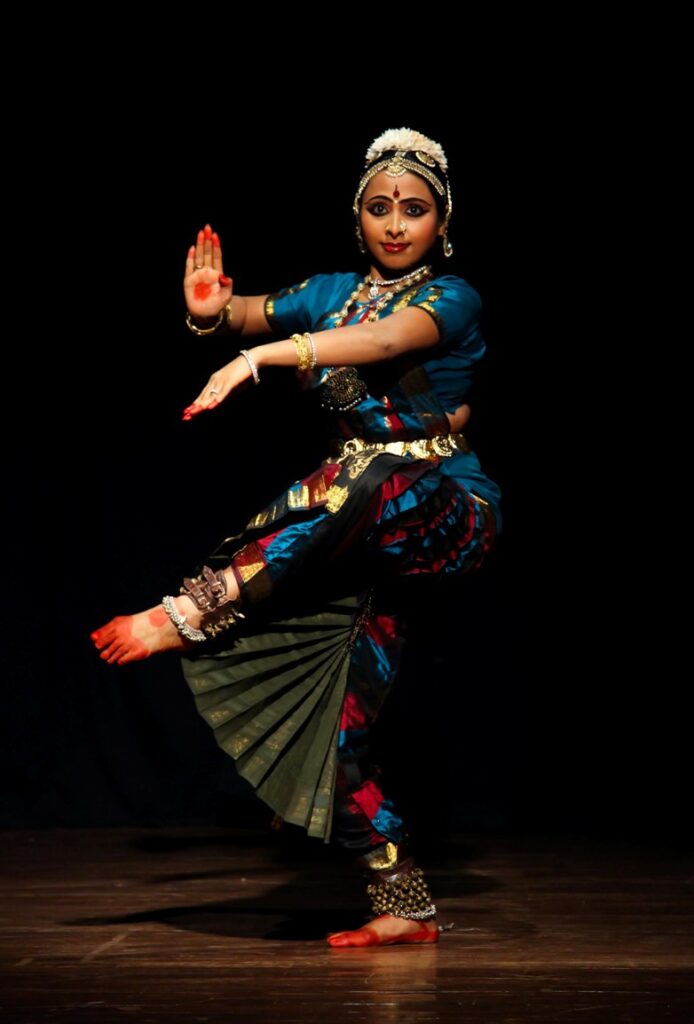
Bharatanatyam is the classical solo dance of Tamil Nadu, traced to temple ritual and the Natya Shastra attributed to sage Bharata. For nearly two millennia it was practised inside Shaiva and Vaishnava temples by hereditary Devadasis under male preceptors called Nattuvanars. The dance survived British-era prohibition through a determined twentieth-century revival, re-emerged on the proscenium stage, and now stands as one of the eight officially recognised classical dance forms of India. Its grammar — geometric lines, half-sit Aramandi, sculpted hand mudras, and the trinity of Nritta, Nritya, and Natya — gives Bharatanatyam its instantly recognisable architecture.
This article covers the historical roots of Bharatanatyam, its near-extinction in the late nineteenth century, the Rukmini Devi Arundale revival, the technique grammar of Adavus and Mudras, the Carnatic margam repertoire, costume and ornamentation, and the leading exponents who carried the form into the present.
Origin and Etymology of Bharatanatyam
The word Bharatanatyam is commonly explained as a syllabic compound — Bha for Bhava (expression), Ra for Raga (melody), Ta for Tala (rhythm), and Natya (drama). A second derivation links the form directly to sage Bharata, author of the Natya Shastra, the Sanskrit treatise composed between 200 BCE and 200 CE that codifies movement, rasa, and theatre.
The dance was historically called Sadir or Dasi Attam when performed by Devadasis in temples and royal courts. The name Bharatanatyam gained currency only in the 1930s when reformers rebranded the form for stage presentation and a respectable middle-class audience.
The Natya Shastra foundation
Bharata’s text divides performance into Tandava (the vigorous masculine mode associated with Shiva) and Lasya (the lyrical feminine mode associated with Parvati). It defines 108 Karanas — basic dance units that combine hand, foot, and body movement — and these Karanas are sculpted on the gopurams of temples like the Chidambaram Nataraja temple and the Brihadeeswara temple at Thanjavur, providing material evidence of the form’s antiquity.
Temple sculpture as living archive
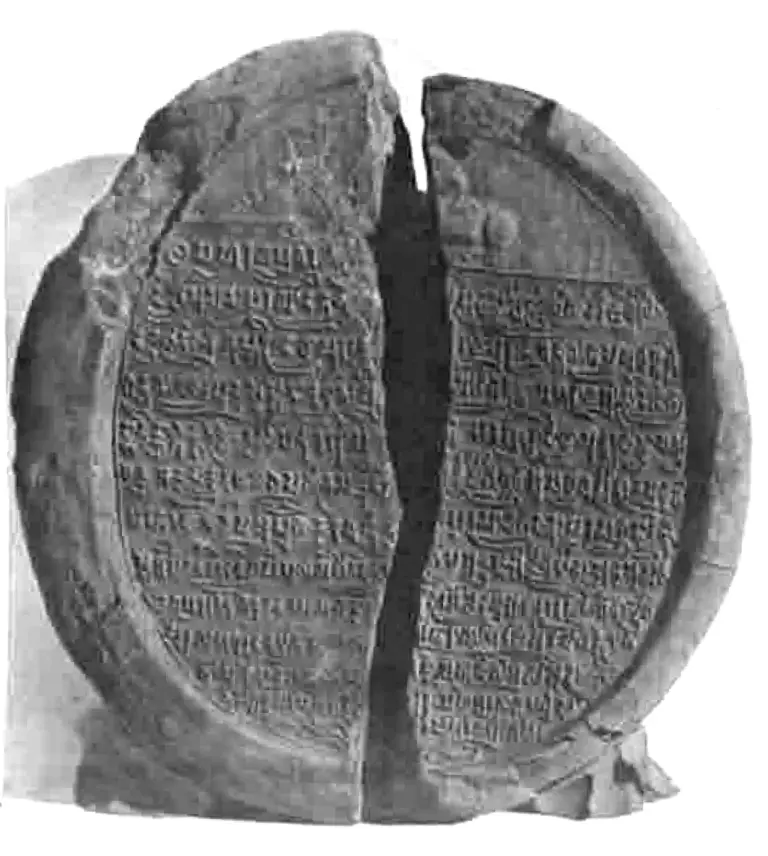
The Tamil Nadu temples are dance archives in stone. Chola-period bronzes of Shiva Nataraja, the dancing god, distil Bharatanatyam grammar — the Ananda Tandava pose with one leg lifted and the other planted on Apasmara is a textbook Karana. Inscriptions at Thanjavur record 400 Devadasis attached to the great temple under Raja Raja Chola I, confirming royal patronage of temple dance in the eleventh century.
The Devadasi Tradition
Devadasis — literally “servants of the deity” — were women dedicated to temple service. They learned music, dance, and Sanskrit, performed during festivals and daily rituals, and held land grants from temple endowments. Their male teachers, the Nattuvanars, came from priestly Isai Vellalar families and held the cymbals (Nattuvangam) that drove the rhythmic recitation of sollukattus.
Devadasi practice produced the Tanjore Quartet of the early nineteenth century — brothers Chinnayya, Ponnayya, Sivanandam, and Vadivelu — who served the court of Maratha king Serfoji II. The Quartet reorganised the temple repertoire into the margam — a structured seven-item recital arc that begins with Alarippu and culminates in Tillana — and this margam remains the canonical Bharatanatyam concert order today.
The colonial prohibition
By the late nineteenth century, the British and Indian social reformers conflated Devadasi service with prostitution. The Madras Devadasi (Prevention of Dedication) Act, 1947, formally banned the dedication of women to temples in the Madras Presidency. Earlier campaigns by reformers like Muthulakshmi Reddy stigmatised the dance itself. Sadir was nearly extinguished. Most hereditary practitioners abandoned performance.
The Twentieth-Century Revival
Bharatanatyam’s resurrection is inseparable from one name — Rukmini Devi Arundale (1904–1986). A Brahmin Theosophist married to George Arundale, she trained under Mylapore Gowri Ammal and the Nattuvanar Meenakshi Sundaram Pillai of Pandanallur. In 1936, she founded Kalakshetra in Madras (now Chennai), a residential institution that taught Bharatanatyam alongside Carnatic music and Sanskrit.
Rukmini Devi made calibrated changes — she lengthened the sari-style costume, removed the most explicit sringara (erotic) repertoire, introduced stage lighting and ensemble choreography, and crucially restored the dance’s spiritual register. She did not invent Bharatanatyam; she repackaged the Pandanallur bani (style) for a new audience and gave the form social legitimacy.
The Pandanallur and Vazhuvoor banis
Parallel to Kalakshetra, the Pandanallur style under Meenakshi Sundaram Pillai retained the angular, terse, geometric grammar associated with the temple tradition. The Vazhuvoor style under Ramaiah Pillai emphasised softer movement and elaborate Abhinaya. Thanjavur and Mysore banis preserved court repertoire. Each bani is identifiable in micro-details — finger position, head tilt, body line — and forms a parallel lineage.
Balasaraswati and the hereditary line
While Rukmini Devi worked from outside the community, T. Balasaraswati (1918–1984) was the towering hereditary exponent. Born into a Devadasi family, granddaughter of Veena Dhanammal, she insisted on the integrity of the temple repertoire including its sringara abhinaya. Her Padam interpretations are considered the gold standard. Balasaraswati received the Padma Bhushan in 1957 and the Padma Vibhushan in 1977.
Technique: Adavus, Mudras, Aramandi
Bharatanatyam is built from Adavus — fundamental units of foot, leg, hip, hand, and head movement. There are roughly 120 Adavus across 12 families, including Tatta Adavu (stamping), Natta Adavu (stretching), Visharu Adavu (whirling), Tirmana Adavu (combinations), and the climactic Tattimitti Adavu. A trained Bharatanatyam dancer can produce thousands of rhythmic phrases by combining these primitives with tala cycles.
Aramandi — the half-seat
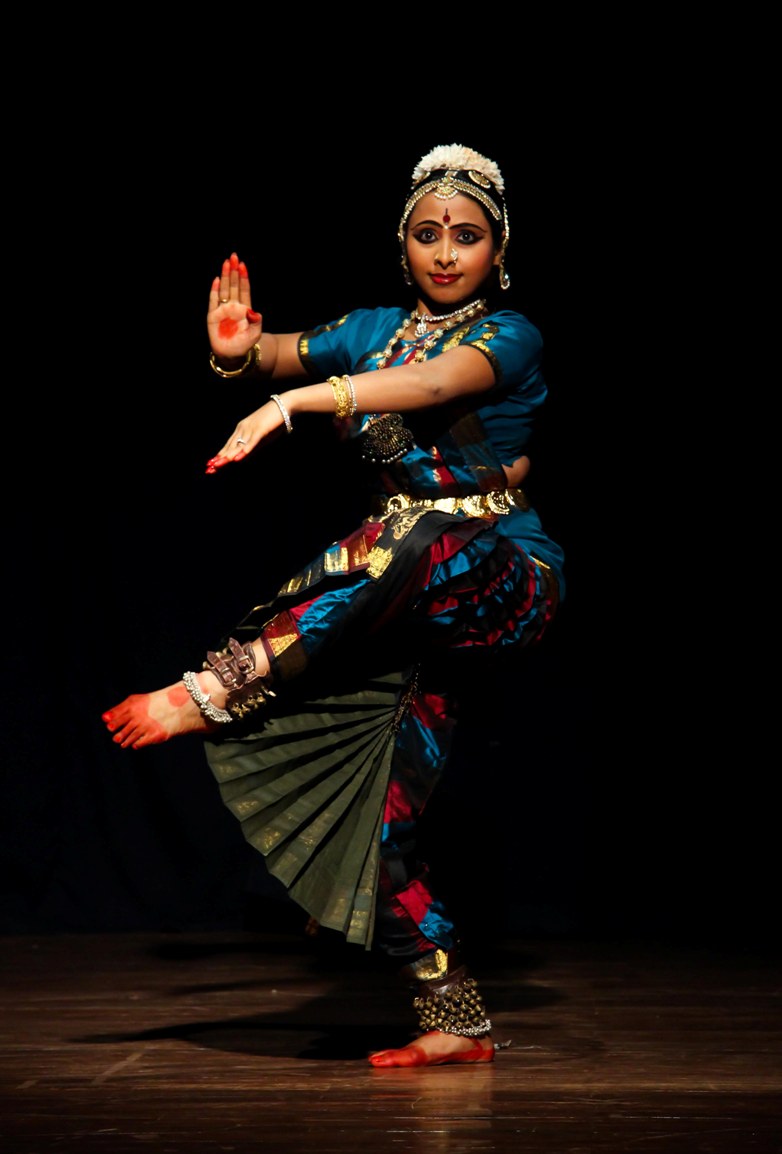
The defining posture of Bharatanatyam is Aramandi, the half-sit. The dancer flexes the knees outward to roughly 90 degrees so that thighs are parallel to the floor, heels touch, and toes splay outward — a turnout that produces the diamond-shaped silhouette visible from the audience. Aramandi must be maintained through most of the recital and demands continuous quadriceps engagement. Muzhumandi is the full-sit, used briefly for impact.
Mudras — hand gestures
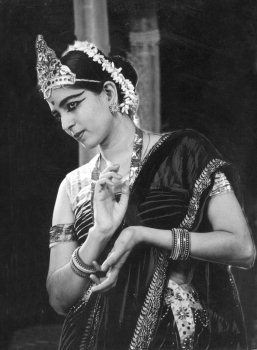
Hand gestures are codified in the Abhinaya Darpana of Nandikeshvara. There are 28 Asamyukta Hastas (single-hand mudras) such as Pataka, Tripataka, Mayura, and Mrigashirsha; and 23 Samyukta Hastas (double-hand mudras) such as Anjali, Pushpaputa, and Garuda. Each mudra has multiple viniyogas (applications) — Pataka alone can signify a cloud, a forest, refusal, a river, or a flag depending on context.
Abhinaya — expressive acting
Abhinaya is fourfold in classical theory — Angika (body), Vachika (speech, applied to the singer in solo dance), Aharya (costume and ornament), and Sattvika (the involuntary bodily signs of emotion such as tears or trembling). The Navarasas — nine emotional flavours — are the palette: Shringara, Hasya, Karuna, Raudra, Veera, Bhayanaka, Bibhatsa, Adbhuta, and Shanta.
The Three Components — Nritta, Nritya, Natya
The classical division of dance is:
- Nritta — pure rhythmic movement without narrative content. The Jatiswaram and Tillana items are dominantly Nritta.
- Nritya — expressive dance that combines movement with narrative meaning. The Padam and Javali items focus on Nritya.
- Natya — full dramatic enactment with character, narrative arc, and dialogue. The Varnam is the densest Natya-leaning item, alternating Nritta and abhinaya across multiple speeds and tala cycles.
The Margam — Concert Structure
The seven-item margam codified by the Tanjore Quartet remains the standard recital sequence:
- Alarippu — invocatory pure-rhythm warm-up.
- Jatiswaram — Nritta to a melodic line in a chosen raga.
- Shabdam — first abhinaya piece, usually in praise of a deity or patron.
- Varnam — the centrepiece, 30–45 minutes long, demanding peak stamina.
- Padam — slow expressive piece on themes of devotional love.
- Tillana — pure-rhythm finale set to a brisk raga.
- Mangalam — closing benediction.
Costume and Aharya
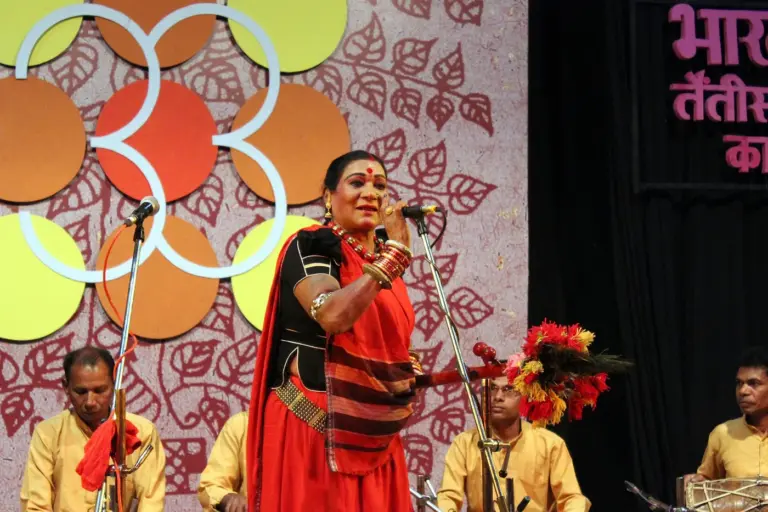
The traditional Bharatanatyam costume is a stitched sari ensemble with a pleated fan that opens at the front when the dancer goes into Aramandi — engineered specifically for the half-sit. The costume is held by a metal belt (ottiyanam), and ornaments include the jada (hair plait piece with sun and moon), netti chutti (forehead ornament), vanki (armlets), heavy mukkuthi nose ornaments, and ankle salangai (bells). Eye makeup is exaggerated for stage visibility; the soles and fingertips are reddened with alta.
Music — The Carnatic Foundation
Bharatanatyam is set to Carnatic music. The orchestra includes the Nattuvanar with cymbals, a vocalist, mridangam, violin, flute, and sometimes veena. Compositions in Tamil, Telugu, Sanskrit, and Kannada by Muthuswami Dikshitar, Tyagaraja, Annamacharya, Kshetrayya, and Purandara Dasa dominate the repertoire. The Tanjore Quartet themselves composed many of the Varnams and Padams still performed today.
Prominent Exponents
Apart from Rukmini Devi and Balasaraswati, the canon includes Yamini Krishnamurthy, Padma Subrahmanyam (who reconstructed Karanas from temple sculpture), Sonal Mansingh, Alarmel Valli (Pandanallur tradition), Malavika Sarukkai, Leela Samson (Kalakshetra), C. V. Chandrashekhar, Priyadarsini Govind, and male exponents such as V. P. Dhananjayan and Narthaki Nataraj. The first male Bharatanatyam practitioners were of course the hereditary Nattuvanars themselves.
Bharatanatyam Today
Bharatanatyam is taught in universities, performed on global stages, and learned by Indian diaspora children as a marker of cultural continuity. The Sangeet Natak Akademi recognises it as one of eight classical forms. Recent debates centre on inclusion — caste critique by hereditary descendants of Devadasis, queer and male practitioners reclaiming space, and choreographers using the form for contemporary themes including environmental crisis, gender, and conflict. Bharatanatyam’s grammar has proven elastic enough to absorb each of these conversations without losing its temple-bred core.
The form is also a sibling within India’s wider classical dance ecosystem — sharing rhythmic vocabulary with Kathakali of Kerala, courtly grace with the Akbar-period miniature traditions that produced Mughal painting, and a stone-archive lineage with the Chola tradition at the Brihadeeswara temple. Folk traditions like Madhubani painting similarly anchor regional cultural identity to ritual practice.
Frequently Asked Questions
What is Bharatanatyam?
Bharatanatyam is the classical solo dance of Tamil Nadu, rooted in temple ritual and codified in the Natya Shastra. It combines Nritta (pure rhythm), Nritya (expressive movement), and Natya (drama), built on the half-sit Aramandi posture and a vocabulary of Adavus and Mudras.
Where did Bharatanatyam originate?
Bharatanatyam originated in the temples of Tamil Nadu, particularly in the Tanjore region. Inscriptions and sculpture from the Chola period — including the Thanjavur Brihadeeswara temple — record its temple practice from at least the eleventh century, while textual roots go back to Bharata’s Natya Shastra.
Who revived Bharatanatyam in the twentieth century?
Rukmini Devi Arundale led the public revival of Bharatanatyam, founding Kalakshetra in 1936. The hereditary line was carried forward simultaneously by T. Balasaraswati, granddaughter of Veena Dhanammal, who insisted on preserving the temple repertoire including its sringara abhinaya.
What are the three components of Bharatanatyam?
The three components are Nritta (pure rhythmic dance without narrative), Nritya (expressive dance combining rhythm with meaning), and Natya (dramatic enactment with character and story). All three appear within a single recital, with the Varnam item drawing on all three.
What are Mudras in Bharatanatyam?
Mudras are codified hand gestures. The Abhinaya Darpana lists 28 single-hand mudras (Asamyukta Hastas) and 23 double-hand mudras (Samyukta Hastas). Each gesture has multiple meanings depending on context — Pataka can mean a cloud, river, refusal, or forest.
What is Aramandi?
Aramandi is the signature half-sit posture of Bharatanatyam. The dancer bends the knees outward with thighs nearly parallel to the floor, heels together, toes splayed — creating the diamond silhouette that defines the form. It must be sustained through most of the recital.
What music accompanies Bharatanatyam?
Bharatanatyam uses Carnatic music. The orchestra includes the Nattuvanar with cymbals, a vocalist, mridangam, violin, and flute. The compositional canon draws on Muthuswami Dikshitar, Tyagaraja, Kshetrayya, and the Tanjore Quartet, in Tamil, Telugu, Sanskrit, and Kannada.
Who are the major exponents of Bharatanatyam?
Major exponents include Rukmini Devi Arundale, T. Balasaraswati, Yamini Krishnamurthy, Padma Subrahmanyam, Alarmel Valli, Malavika Sarukkai, Leela Samson, Sonal Mansingh, Priyadarsini Govind, and V. P. Dhananjayan, among many others across the Pandanallur, Vazhuvoor, Thanjavur, and Kalakshetra banis.
Tell Google you want more of this.
Add Anantam IAS as a preferred sourceOne tap, and this site shows up more often in your own Top Stories, AI Overviews and AI Mode. Remove it any time.