5G Technology in India (UPSC Science & Tech)
UPSC guide to 5G: spectrum, architecture, Indigenous 5G stack, applications, security concerns, and 2024-26 rollout status in India.
5G is the fifth generation of cellular network technology. It is not an incremental upgrade; it is the backbone of Industry 4.0 — promising peak speeds of 2-20 Gbps, ultra-low latency (~1 ms), and connection density of up to a million devices per square kilometre. Commercial 5G services launched in India in October 2022 and crossed 270 million subscriptions by early 2025, making India the second-largest 5G market globally. For UPSC, 5G appears under GS Paper III (Science & Technology, Internal Security, Economy).
From 1G to 5G — a quick orientation
| Generation | Year | Key leap |
|---|---|---|
| 1G | 1979 | Analogue voice |
| 2G | 1991 | Digital voice + SMS |
| 3G | 2001 | Mobile data, video calls |
| 4G LTE | 2009 | Mobile broadband, streaming |
| 5G | 2019 | Ultra-low latency, IoT, industrial use |
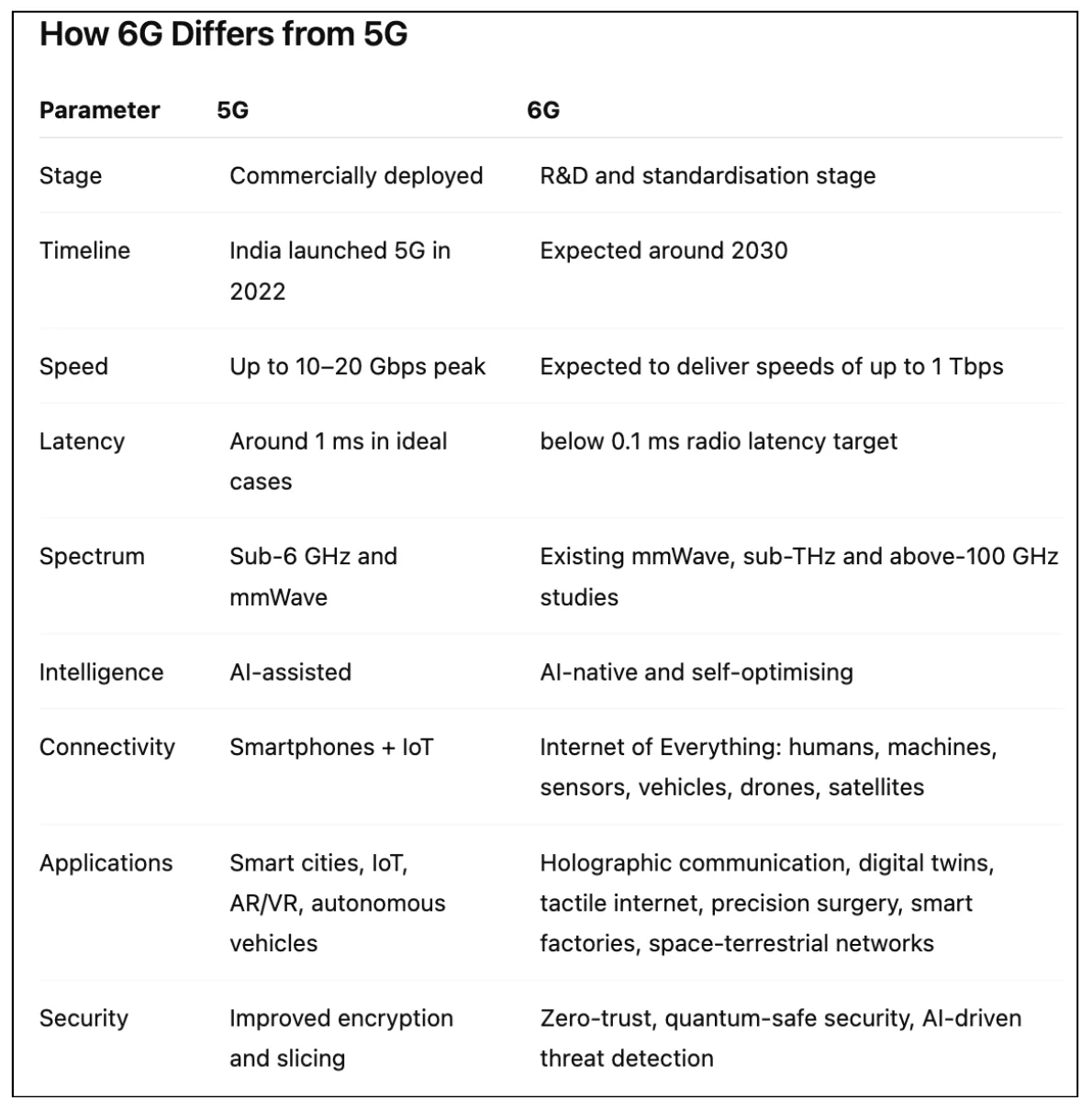
| 6G | ~2030 | AI-native, THz, sensing networks |
How 5G works — the mechanism
5G uses a three-layer spectrum strategy:
| Band | Frequency | Trade-off |
|---|---|---|
| Low-band (sub-1 GHz) | 600-900 MHz | Wide coverage, moderate speed |
| Mid-band | 1-6 GHz (C-band, 3.5 GHz) | Balanced capacity + coverage |
| High-band (mmWave) | 24-100 GHz | Blazing speeds; short range |
Key architectural features:
- Network slicing — one physical network, multiple virtual networks for different use-cases (emergency, gaming, IIoT).
- Massive MIMO — hundreds of antennas per tower beam-forming to specific users.
- Edge computing — processing at the network edge to cut latency.
- Standalone (SA) vs Non-Standalone (NSA) — NSA rides on 4G core; SA is full 5G. Reliance Jio deployed SA; Airtel began with NSA and is migrating.
What 5G enables
- Driverless vehicles and vehicle-to-everything (V2X) communication.
- Tele-surgery and tele-medicine with near-zero lag.
- Smart manufacturing — robotics, predictive maintenance, digital twins.
- Smart grid and smart metering for renewables integration.
- Precision agriculture — drone swarms, sensor-driven irrigation.
- AR/VR/XR immersive media.
- Massive IoT — a million sensors per square km.
A NITI Aayog study estimates 5G could add USD 455 billion to India’s economy by 2035.
India's 5G rollout — status
- Auction (2022): Rs 1,50,173 crore in successful bids; 51 GHz of spectrum auctioned across seven bands.
- Launch (Oct 2022): PM Modi switched on 5G; Jio, Airtel lead; Vi rolled out in 2024.
- Subscriptions: >270 million by Q1 2025; India added over 70 million 5G users in 2024 alone.
- Coverage: all 779 districts covered by Airtel/Jio; ~4.7 lakh 5G base stations operational.
- BharatNet reached ~2.14 lakh gram panchayats with fibre, foundational for 5G backhaul.
Indigenous 5G and Make-in-India
India is among four countries (with USA, China, South Korea) to deploy a fully indigenous 5G stack. Key milestones:
- C-DOT 5Gi — India's homegrown standard, now harmonised with 3GPP Release 17.
- Tejas Networks (Tata group) — home-grown 5G RAN equipment exporting to Africa and USA.
- BSNL 4G/5G native stack — powered by TCS, C-DOT, Tejas; rolled out 100,000 sites in 2024-25.
- Sanchar Saathi + DBT Radio Spectrum — auctioning platform.
- Production Linked Incentive (PLI) for Telecom (2021) — Rs 12,195 crore; over Rs 65,000 crore investment triggered.
Applications — sector view
| Sector | 5G use case |
|---|---|
| Healthcare | Remote surgery, 5G ambulances, AI-powered imaging |
| Agriculture | Precision spraying, livestock monitoring, drone coverage |
| Manufacturing | Private 5G factory networks, digital twins |
| Logistics | Cold-chain tracking, port automation |
| Defence | Secure tactical comms, autonomous systems |
| Education | Immersive AR classrooms, rural tele-teaching |
| Smart cities | Intelligent traffic, surveillance, utilities |
| Energy | Smart grid, distributed renewables, EV charging grid |
Issues and concerns
| Concern | Detail |
|---|---|
| Capex | ~$60-70 billion industry investment needed |
| Spectrum cost & backhaul | High reserve prices; thin fibre-to-tower ratio |
| Device affordability | Median 5G handset price only falling below Rs 10,000 in 2024 |
| Rural coverage | mmWave won't reach villages; low-band and satellite-backhaul critical |
| Energy consumption | 5G towers use 2-3x more power than 4G |
| Health concerns | WHO/ICNIRP consensus: no confirmed risk at compliant RF levels |
| Security | Vendor trust, supply-chain risk, lawful intercept |
| Telecom finances | Vi's debt and AGR dues stress competitive structure |
Security — the trusted-sources regime
The National Security Directive on Telecommunications Sector (2020) mandates telecom operators to procure only from Trusted Sources, with a National Cyber Security Coordinator-led evaluation. Huawei and ZTE have been de facto excluded from Indian 5G trials.
Policy and enabling framework
- National Digital Communications Policy, 2018 — broadband-for-all vision.
- Telecommunications Act, 2023 — replaced the 1885 Telegraph Act; streamlined right-of-way and spectrum management.
- Draft Indian Telecom (Right of Way) Rules, 2024 — uniform RoW charges across states.
- Open RAN push — disaggregated hardware/software; India co-chairs the O-RAN Alliance's emerging-markets group.
- National Broadband Mission 2.0 (2024) — targets 1.7 million km optical fibre and 5G in all villages by 2030.
6G — India's early bet
The Bharat 6G Vision Document (2023) and Bharat 6G Alliance target 2030 deployment, aiming for 10% of global 6G patents. Key research axes: THz communications, AI-native networks, integrated sensing and communication (ISAC), NTN (non-terrestrial networks).
Latest developments (2024-26)
- BSNL 4G/5G rollout (2024-25) — over 100,000 sites live on indigenous stack; nationwide 5G switch-on phased through 2025.
- Satellite 5G/6G integration — Starlink, Jio-SES, OneWeb spectrum allocations pending TRAI's administrative allocation recommendation.
- Telecom Act 2023 rules notified (2024-25) — authorisation regime, public emergency powers, digital Bharat Nidhi.
- Spectrum auction (June 2024) — Rs 11,340 crore realised; limited participation signals maturing market.
- AI Action Summit, Paris (Feb 2025) — India linked 5G to AI compute grid vision.
- India Semiconductor Mission — Tata-PSMC fab will make 5G RF chips domestically.
- DeepTech Policy 2024 — 6G and Open RAN classified as priority.
- National Quantum Mission (2024) — quantum-safe 5G networks research funding.
- Chandrayaan-4 plan & Gaganyaan progress — leverage ISRO's 5G NTN experiments.
- Bharat 6G Alliance MoUs with US Next G Alliance (Nov 2023) and EU 6G-IA (2024).
UPSC Relevance
GS Paper III — Science & Technology
- Principles, spectrum bands, indigenous stack, 6G vision.
GS Paper III — Economy
- Digital economy contribution, PLI outcomes, telecom sector health.
GS Paper III — Internal Security
- Trusted sources, supply-chain risk, lawful interception under Telecom Act 2023.
GS Paper II — Governance
- Digital divide, BharatNet, universal service fund/Digital Bharat Nidhi.
Prelims pointers — mmWave, Network slicing, Massive MIMO, Non-Standalone vs Standalone, PLI for Telecom, Bharat 6G Alliance, Telecommunications Act 2023, 5Gi.
Interview probes — rural 5G economics; 5G and Make-in-India; 6G leadership strategy; 5G cybersecurity; satellite spectrum debate.
5G is not simply faster internet — it is the connective tissue of the fourth industrial revolution. India’s indigenous 5G stack and early 6G vision give it a rare chance to lead rather than follow in the next connectivity era.