6G is the proposed sixth generation of mobile wireless communication, designed from the start as an AI-native, ultra-high-speed, ultra-low-latency network using terahertz spectrum and a layered combination of terrestrial, aerial, and satellite infrastructure. Where 5G is a general-purpose upgrade of 4G LTE, 6G is closer to a reimagining of what a public network does. The targets are ambitious: peak data rates around one terabit per second (about a hundred times 5G’s headline figure), latency in microseconds, and three-dimensional coverage that does not stop at the horizon. Standards are being negotiated under IMT-2030 at the International Telecommunication Union, with commercial deployment expected around 2030.
For UPSC, 6G sits inside GS-III under science and technology, with current-affairs spillover whenever the Department of Telecommunications announces a Bharat 6G milestone, the Bharat 6G Alliance signs a new MoU, or the ITU publishes a draft IMT-2030 framework. The topic also pulls in adjacent themes the syllabus tests regularly: spectrum management, telecom-as-strategic-infrastructure, indigenous technology development, and the digital divide. A candidate who can explain four to five technical features of 6G, list the headline features of the Bharat 6G Vision, and place India in the global standardization landscape has the topic covered at the depth examiners reward.
This guide treats 6G as a coherent network architecture with three interlocking pieces: the radio and spectrum technology, the AI-native software stack, and the space-air-ground delivery model. We cover what 6G is, how it differs from 5G across a dozen parameters, what the Bharat 6G Vision actually commits to, and the prelims-style facts and mains-style debates that surface most often in exam questions.
Quick Facts on 6G
- Definition: Sixth generation of mobile wireless communication, AI-native, with peak data rates approaching 1 Tbps and microsecond latency.
- Standardization: Under the ITU-R IMT-2030 framework, expected commercial deployment around 2030.
- Spectrum: Terahertz (THz) bands, typically 100 GHz to 3 THz, complemented by sub-6 GHz and mmWave for coverage.
- Indian roadmap: Bharat 6G Vision, released by the Department of Telecommunications in March 2023.
- Indian institutions: Bharat 6G Alliance (industry-academia consortium), TSDSI (Telecommunications Standards Development Society of India).
- Key technologies: Terahertz radio, AI-native networking, Reconfigurable Intelligent Surfaces (RIS), Integrated Sensing and Communication (ISAC), SAGIN architecture.
- Expected applications: Holographic communication, tactile internet, digital twins, immersive XR, collective autonomy.
- GS paper relevance: Prelims (Sci-Tech), GS-III (Science and Technology, Communication, Indigenisation).
What 6G Mobile Communication Is
6G is a research-stage telecom standard whose core difference from 5G is architectural rather than incremental. 5G is built on the assumption that AI is added on top of a network designed for human voice, video, and data. 6G assumes AI is the network: machine-learning models manage spectrum allocation, beamforming, handover decisions, and traffic shaping in real time, and the radio interface is co-designed with the AI control loop. This is the meaning of “AI-native” in the IMT-2030 documentation.
The radio side moves into the terahertz range. 5G uses sub-6 GHz bands and millimetre-wave (typically 24-40 GHz). 6G adds terahertz frequencies that allow vastly larger bandwidths but at the cost of much shorter range and worse penetration. The trade-off is managed by Reconfigurable Intelligent Surfaces (programmable reflectors that steer signals around obstacles), by ultra-dense small cells, and by Integrated Sensing and Communication, where the same waveforms double as radar to map the environment.
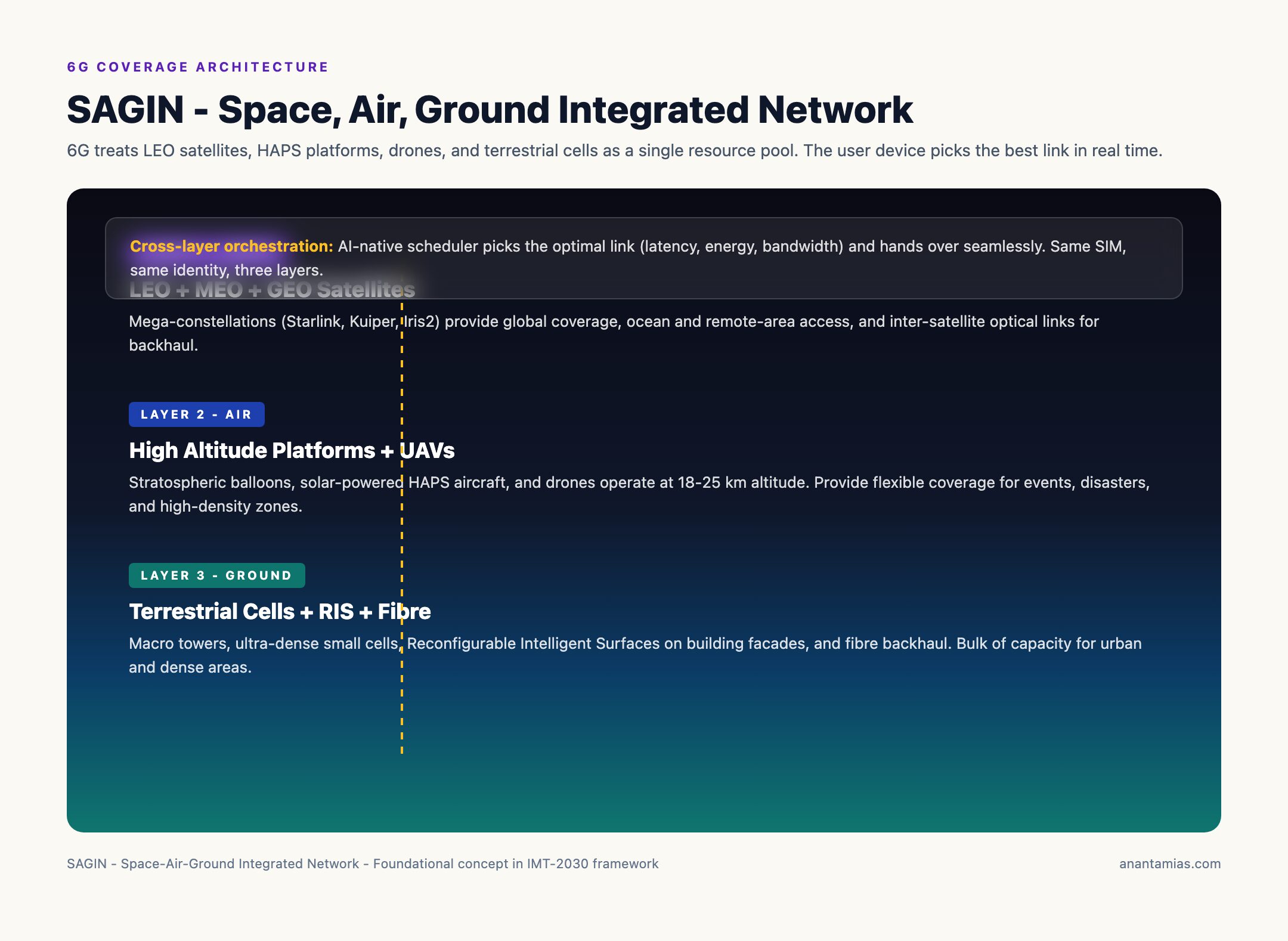
The coverage model goes three-dimensional. 5G is a terrestrial network: cell towers, fibre backhaul, and small cells in dense areas. 6G integrates terrestrial sites with High Altitude Platform Stations (stratospheric aircraft and balloons), uncrewed aerial vehicles, and Low Earth Orbit satellite constellations to form a Space-Air-Ground Integrated Network. The user device picks the best link in real time; the network treats space, air, and ground as a single resource pool.
Background and Historical Context
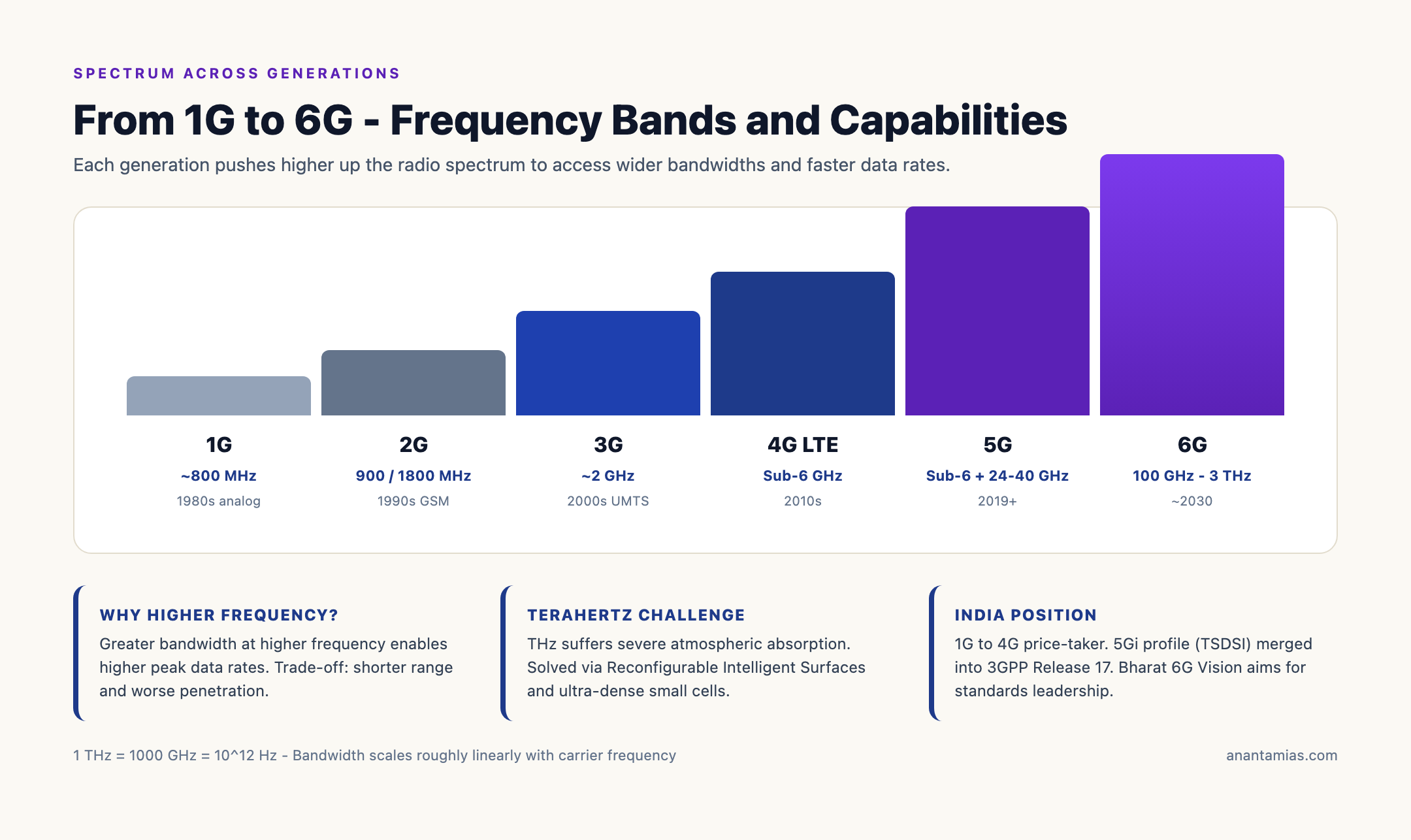
Each generation of mobile communication has been characterized by a single defining capability. 1G (analog, 1980s) made voice mobile. 2G (GSM, early 1990s) added digital voice and SMS. 3G (UMTS/CDMA2000, early 2000s) added mobile internet. 4G LTE (late 2000s) made the internet fast enough to replace fixed broadband for many users. 5G (commercial deployments from 2019) added three explicit use cases: enhanced mobile broadband, ultra-reliable low-latency communication, and massive machine-type communication.
India’s own 5G journey, captured in indigenous 5G, positioned the country as a meaningful contributor for the first time in mobile-standards history. 5G’s commercial roll-out also exposed limits. The mmWave promise of multi-gigabit speeds turned out to be hard to deliver at scale because of propagation losses; most 5G traffic actually moves over sub-6 GHz spectrum at speeds only modestly better than late-stage LTE. Latency improvements landed mostly for industrial use cases, not for consumer phones. AI was bolted on rather than integrated. By 2021, the major standards bodies (ITU, 3GPP, IEEE) had begun shaping 6G research programmes that would address these gaps.
The ITU released its IMT-2030 framework recommendation in late 2023, defining six “usage scenarios” (immersive communication, hyper-reliable low-latency, massive communication, AI integration, ubiquitous connectivity, integrated sensing and communication). 3GPP began 6G study items in Release 21 (2024) with normative work expected in Release 22 (2026-2028). Commercial products and first deployments are targeted for 2030.
India entered the conversation early. The Department of Telecommunications released the Bharat 6G Vision in March 2023, framing 6G as a sovereign-capability priority and announcing the Bharat 6G Alliance to coordinate industry, academia, and government. The Telecommunications Standards Development Society of India (TSDSI) is the recognized national standards body and contributes to ITU and 3GPP processes.
Key Features and Technical Capabilities
A useful way to read the 6G technical roadmap is as four families of capability stitched together.
Spectrum and radio. The defining spectrum range is terahertz, typically the 100 GHz to 3 THz window. Terahertz allows enormous bandwidths (potentially tens of GHz per channel) which is the only physical route to terabit-per-second peak rates. The challenges are short range (atmospheric absorption is severe), poor wall penetration, and tight beamforming requirements. Sub-6 GHz and mmWave continue to provide coverage; terahertz adds capacity in high-density, line-of-sight settings.
AI-native architecture. Every layer of the network, from the physical radio to the application interface, has machine-learning models built in. Channel estimation, beam management, handover, and quality-of-service shaping are all data-driven. The network learns from operational telemetry and updates its models continuously. This is the structural difference from 5G’s “AI-assisted” approach, where AI models sit alongside a network designed without them.
Reconfigurable Intelligent Surfaces (RIS). Large flat panels covered with software-controllable reflecting elements that steer radio waves around obstacles or focus them on specific users. RIS panels are passive (no transmit chain) and cheap to deploy at scale, addressing the line-of-sight problem of terahertz frequencies.
The deeper interplay between communications and quantum technology, including secure key distribution, is captured in the National Quantum Mission framework, which is laying the groundwork for quantum key distribution across long-haul Indian fibre routes. Integrated Sensing and Communication (ISAC). The same waveforms used for data also probe the environment. A 6G base station knows the position, velocity, and approximate shape of objects in its coverage area. Applications include autonomous-vehicle support, indoor mapping, and gesture recognition.
SAGIN coverage. The Space-Air-Ground Integrated Network treats LEO satellite constellations, HAPS platforms, drones, and terrestrial cells as a single resource pool. A user device on a ship at sea, a drone over a forest, or a phone in a remote village all see the same network; the routing layer picks the right path.
Why 6G Matters
For India, 6G matters at three levels. At the consumer level, it promises connectivity that does not break in dense events or in remote geography, and applications (immersive XR, holographic education, telemedicine with haptic feedback) that change what a phone is for. At the industrial level, the ultra-low-latency, ultra-reliable, AI-native combination is what factories, power grids, hospitals, and autonomous fleets actually need to digitize beyond the 5G baseline.
At the strategic level, 6G is a sovereignty issue. Whoever sets the standards (ITU drafts, 3GPP norms, IEEE protocols) embeds their priorities and intellectual property into every device sold globally for the next decade. India was a price-taker in 1G through 4G, started contributing meaningfully in 5G (the 5Gi profile, originated by TSDSI and merged into 3GPP Release 17), and the Bharat 6G Vision aims for India to be a standards-setter in 6G. This is the structural reason for the public investment in research, the Bharat 6G Alliance, and the IIT-led testbeds.
Standards-setting power compounds across adjacent industries; the angstrom-scale chips and semiconductors push, plus India’s semiconductor mission policy push and challenges, determine whether 6G hardware can be fabricated domestically. The economic case is also substantial. The Indian telecom market is the second-largest in the world by subscriber count. Capturing even a small share of the IPR pool around a successful 6G standard generates royalty flows for decades. Equipment manufacturing capacity built around indigenous 6G stacks plays into the broader Make in India electronics push.
India’s Bharat 6G Vision
The Bharat 6G Vision document, released by the Department of Telecommunications on 23 March 2023, lays out three principles and a phased roadmap.
The principles are affordability, sustainability, and ubiquity. Affordability addresses the cost gap that left India underserved in earlier generations; the Vision targets sub-Rs 10,000 6G handsets at launch. Sustainability frames the network around energy-efficient design and reusable infrastructure. Ubiquity emphasizes rural coverage, satellite-based last mile, and digital-public-infrastructure-style integration with services like UPI and Aadhaar.
The phased roadmap has two phases. Phase one (2023-2025) focuses on exploratory ideas, fundamental R&D, and IPR generation. Phase two (2025-2030) moves toward commercial-ready solutions, ITU and 3GPP contributions, and pilot deployments. The Bharat 6G Alliance, launched alongside the Vision, brings together industry players (Reliance Jio, Bharti Airtel, Vi, BSNL, TCS, HCL, Tata Communications, Tata Elxsi, IIT-led research consortia, C-DOT, and DRDO units) for coordinated standards work.
Two test beds anchor the early-stage work. A 6G test bed at IIT Madras and a national 6G research and innovation lab co-led by IISc and IIT Bombay focus on terahertz radio prototypes, AI-native scheduler designs, and ISAC waveforms. The Centre for Development of Telematics (C-DOT) is responsible for indigenous 6G core network software, building on its 5G core work.
Comparative Snapshot: 5G vs 6G Across Parameters
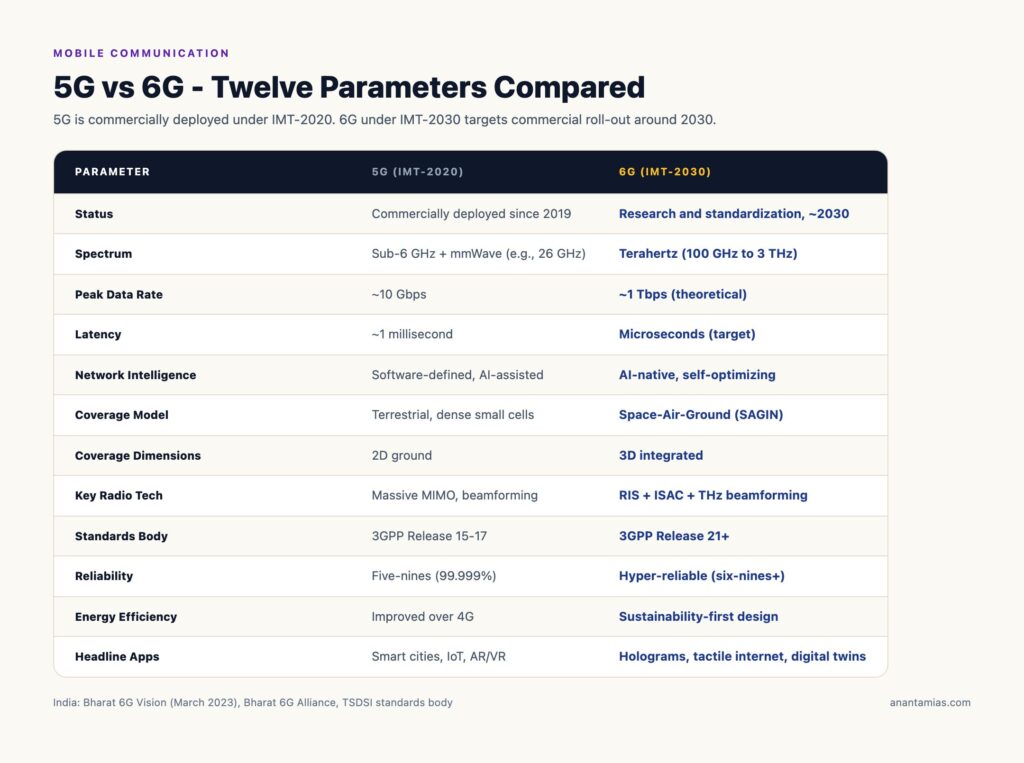
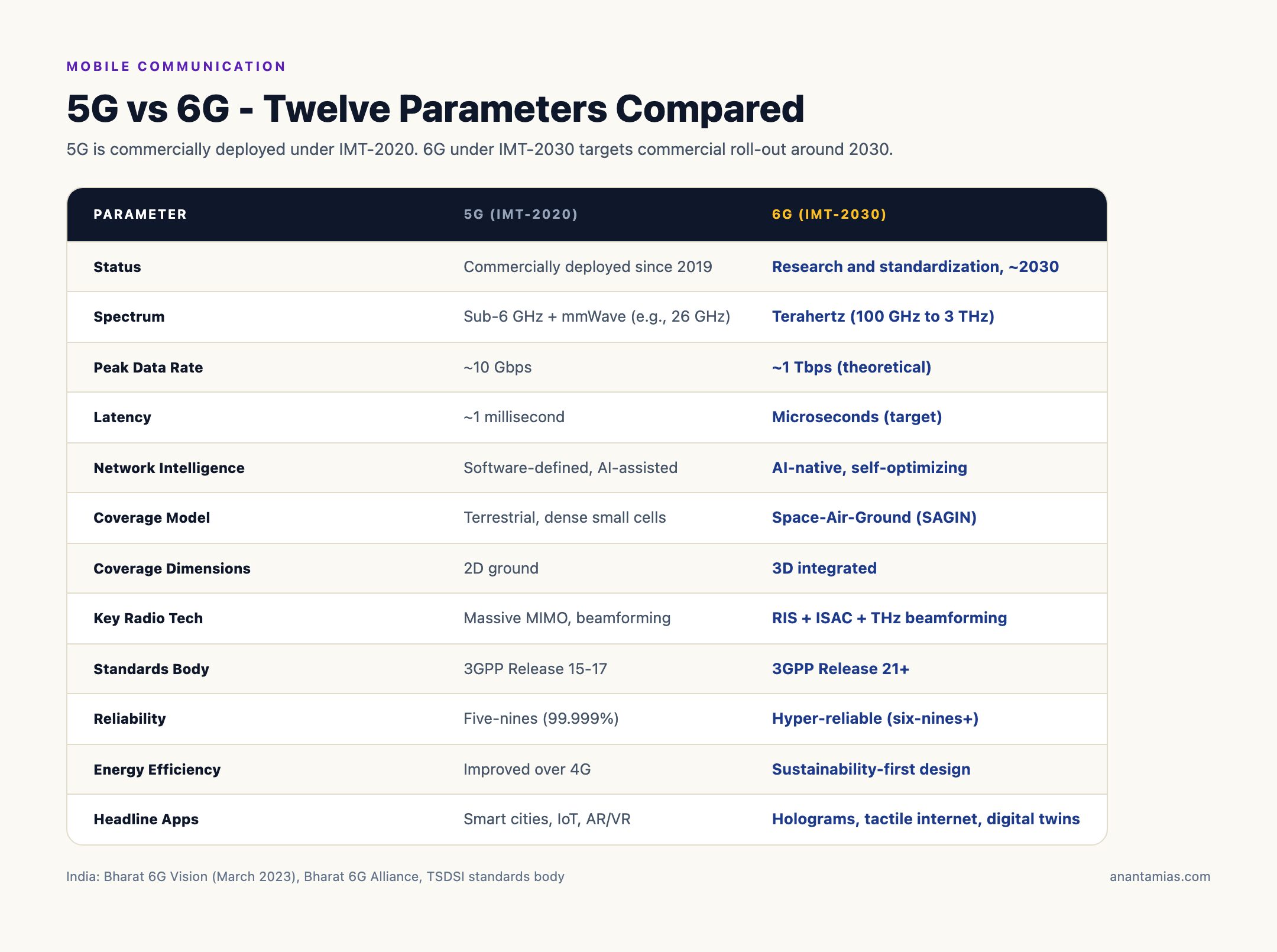
The cleanest way to see the gap is parameter by parameter. 5G operates on sub-6 GHz and mmWave spectrum (up to about 40 GHz); 6G adds terahertz (100 GHz to 3 THz). 5G targets 10 Gbps peak data rates; 6G targets up to 1 Tbps. 5G achieves 1 millisecond air-interface latency in best-case scenarios; 6G targets microseconds, two to three orders of magnitude lower. 5G is software-defined and AI-assisted; 6G is AI-native by design. 5G coverage is essentially terrestrial; 6G is three-dimensional through SAGIN. 5G uses Massive MIMO and beamforming as headline radio technologies; 6G adds RIS and ISAC. 5G applications are smart cities, IoT, industrial automation, and telemedicine; 6G applications are holographic communication, tactile internet with sub-millisecond haptic feedback, digital twins of cities and factories, and collective autonomy among connected machines.
The standards picture: 5G is governed by the IMT-2020 framework at the ITU and the 3GPP Release 15-17 specifications; 6G falls under IMT-2030 and 3GPP Release 21 onward. Commercial 5G is widely deployed (more than 1.5 billion subscribers globally by 2025); commercial 6G is expected from 2030.
Detailed Analysis: The Bharat 6G Stack
A practical view of what India is actually building, beyond the Vision document, shows three layers of work.
The radio layer focuses on indigenous terahertz transceivers, antenna arrays, and RIS panels. IIT Madras and IIT Bombay are building prototype hardware; private sector partners (Tejas Networks, VVDN, and others) are scaling toward foundry-grade production. The bet is that India can transition from a near-zero share of 5G radio hardware (most of which is supplied by Ericsson, Nokia, Samsung, and Huawei globally) to a meaningful manufacturing base by 2030.
The core network layer is led by C-DOT, which already supplies the indigenous 4G core for BSNL and is delivering the indigenous 5G core. The 6G core extends the same software stack with AI-native scheduling, network function virtualization, and intent-based networking.
The standards layer runs through TSDSI and through Indian member contributions to 3GPP and IEEE working groups. India’s 5G contribution (the 5Gi technical profile addressing Indian deployment scenarios) was a useful template; the Bharat 6G Alliance is structured to produce a much larger and earlier set of contributions on terahertz waveform design, coverage in low-density areas, and SAGIN integration.
Challenges Ahead
Several constraints temper the optimism. Terahertz radio remains hard. Atmospheric absorption is high, the components are expensive, and indoor penetration is poor. Most 6G traffic, like most 5G traffic, will likely move over sub-6 GHz bands; terahertz will be a niche capability for ultra-dense, ultra-high-bandwidth scenarios.
AI-native networks raise questions of privacy, explainability, and security that are not yet fully addressed in standards drafts. A network whose decisions are taken in real time by machine-learning models has to be auditable and contestable; the current research base in regulatory tech for AI-native telecom is thin.
Spectrum auctions for terahertz have not begun anywhere globally. India’s regulatory framework will need to evolve, and the trade-off between sovereign spectrum allocation and regional harmonization (with neighbors and trade partners) will be a recurring policy theme.
The ecosystem gap is also real. Building competitive radio chip design, foundry-grade fabrication, and large-scale device manufacturing requires sustained investment over the 2025-2032 window. The Production-Linked Incentive scheme for telecom equipment provides one lever; whether it scales to true competitiveness is an open question.
Prelims Pointers
- The Bharat 6G Vision was released by the Department of Telecommunications on 23 March 2023.
- The IMT-2030 framework is the ITU-R recommendation governing 6G standardization.
- 6G targets peak data rates around 1 Tbps and latency in microseconds.
- The Bharat 6G Alliance is the industry-academia consortium for 6G research and standards.
- TSDSI is the Indian standards body that contributes to ITU and 3GPP.
- The 5Gi profile, originated by TSDSI, was merged into 3GPP Release 17.
- SAGIN stands for Space-Air-Ground Integrated Network.
- Reconfigurable Intelligent Surfaces (RIS) and Integrated Sensing and Communication (ISAC) are key 6G radio technologies.
Mains Practice Questions
- “6G is not merely the next iteration of mobile communication but a reimagining of what a public network does.” Discuss with reference to AI-native architecture, SAGIN, and the Bharat 6G Vision. (250 words, GS-III)
- Examine India’s transition from a price-taker to a contributor in mobile communication standards, with reference to the Bharat 6G Vision and TSDSI’s role. (250 words, GS-III)
- Discuss the spectrum, infrastructure, and privacy challenges that will shape India’s 6G roll-out. (150 words, GS-III)
Way Forward
Three priorities define the Indian 6G push to 2030. First, sustained investment in terahertz radio research, RIS, and AI-native software through coordinated funding across DST, MeitY, DoT, and the Bharat 6G Alliance, so that Indian patents enter ITU and 3GPP submissions in numbers that match the country’s scale. Second, manufacturing and supply-chain build-out, leveraging the PLI scheme for telecom equipment, semiconductor incentives under the India Semiconductor Mission, and rural-coverage targets that drive demand for indigenous SAGIN hardware. Third, regulatory readiness, including spectrum policy for terahertz, AI governance norms for autonomous network operations, and security standards that anticipate state-level threats to a critical national asset.
Done well, 6G is the moment India shifts from buying global standards to writing them. Done poorly, the 1G-to-4G price-taker pattern repeats. The intermediate work between now and 2030 is what decides which way that goes.
Frequently Asked Questions
What is 6G in simple terms?
6G is the proposed sixth generation of mobile wireless communication. It is designed to be much faster than 5G (peak data rates approaching one terabit per second), to have far lower latency (microseconds rather than milliseconds), to use AI as the core of the network rather than as an add-on, and to combine ground, air, and satellite infrastructure into a single network. Commercial deployment is expected around 2030.
When will 6G be commercially available?
The current ITU and 3GPP roadmap targets 2030 for commercial roll-out. The standards work runs through IMT-2030 and 3GPP Release 21 onwards, with normative specifications expected in 2026-2028 and first network deployments in 2030-2032.
What is the Bharat 6G Vision?
The Bharat 6G Vision is a roadmap released by India’s Department of Telecommunications on 23 March 2023. It commits India to becoming a leader in 6G design, development, and deployment. Its three guiding principles are affordability, sustainability, and ubiquity. It also established the Bharat 6G Alliance as the industry-academia coordinating body and set up test beds at IIT Madras and IIT Bombay.
How is 6G different from 5G?
6G differs from 5G across every major parameter: spectrum (terahertz versus sub-6 GHz and mmWave), peak data rate (1 Tbps versus 10 Gbps), latency (microseconds versus 1 millisecond), AI integration (native versus assisted), coverage model (3D space-air-ground versus 2D terrestrial), and applications (holograms and tactile internet versus IoT and industrial automation).
What is terahertz spectrum?
Terahertz spectrum refers to electromagnetic frequencies roughly between 100 GHz and 3000 GHz (3 THz). It sits between mmWave radio and infrared light. Terahertz bands offer huge bandwidths and very high data rates but suffer from atmospheric absorption, short range, and poor wall penetration. They are the defining radio frequencies for 6G.
What is SAGIN?
SAGIN stands for Space-Air-Ground Integrated Network. It is the 6G coverage architecture that combines low-earth-orbit satellite constellations, high-altitude platform stations, drones, and traditional terrestrial cell sites into a single integrated network. The user device picks the best link in real time, and the network treats space, air, and ground as one resource pool.
What is an AI-native network?
An AI-native network is one where machine-learning models are integrated into every layer of the network from the start, not added on top of a non-AI design. Channel estimation, beamforming, handover decisions, traffic shaping, and security are all driven by AI in real time. 6G is the first generation of mobile networks designed AI-native by default.
What are Reconfigurable Intelligent Surfaces?
Reconfigurable Intelligent Surfaces, or RIS, are flat panels covered with electronically controllable reflecting elements that can steer radio waves around obstacles or focus them on specific users. They are passive (they do not transmit or amplify) and cheap to deploy at scale, helping address the short-range and obstruction problems of terahertz frequencies.
What is the Bharat 6G Alliance?
The Bharat 6G Alliance is an industry-academia consortium launched alongside the Bharat 6G Vision in 2023. It brings together major Indian telecom operators, equipment manufacturers, IT services companies, IITs, IISc, C-DOT, and DRDO units to coordinate 6G research, IPR generation, and standards contributions to the ITU and 3GPP.
Will 6G replace 5G?
Eventually yes, but slowly. 5G networks will continue to operate alongside 6G well into the 2030s, the way 4G LTE still carries most traffic in many countries with active 5G deployments. 6G adds terahertz capacity and AI-native operation on top of the sub-6 GHz coverage that 5G already provides; full replacement would require a complete device upgrade across the entire user base, which takes years.
Tell Google you want more of this.
Add Anantam IAS as a preferred sourceOne tap, and this site shows up more often in your own Top Stories, AI Overviews and AI Mode. Remove it any time.