The Industrial Revolution is one of the most transformative processes in human history, fundamentally altering how goods are produced, how societies are organised, and how nations relate to each other. Beginning in Britain in the mid-18th century, it progressed through multiple phases — each defined by breakthrough technologies — and continues to reshape the world today. For UPSC aspirants, the Industrial Revolution is essential for World History (GS Paper I) and for understanding colonialism, economic development, and technological change.
The First Industrial Revolution (c. 1760-1840)
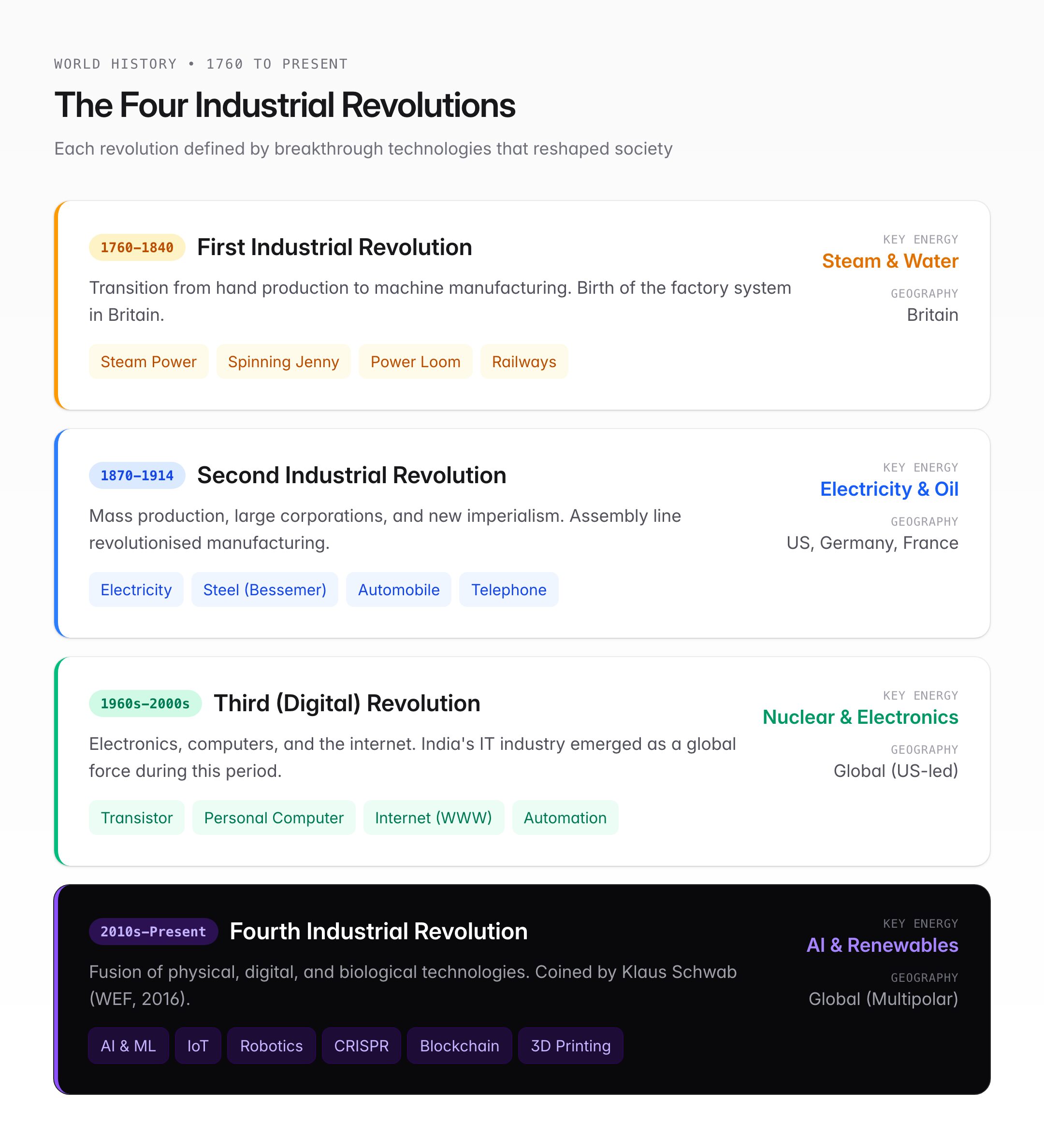
The First Industrial Revolution began in Britain and was characterised by the transition from hand production to machine manufacturing, the rise of the factory system, and the use of steam power and water power.
Why Britain?
- Capital accumulation from colonial trade and the slave economy
- Natural resources: Abundant coal and iron deposits
- Agricultural Revolution: Enclosure movement freed labour for factories
- Political stability and a supportive legal framework (patent laws, property rights)
- Geographic advantage: Island nation with ports and navigable rivers
- Scientific temperament fostered by the Enlightenment
Key Inventions
| Invention | Inventor | Year | Significance |
|---|---|---|---|
| Spinning Jenny | James Hargreaves | 1764 | Multiplied yarn output per worker |
| Water Frame | Richard Arkwright | 1769 | Water-powered spinning; enabled factory system |
| Steam Engine (improved) | James Watt | 1769 | Revolutionised power generation for factories and transport |
| Power Loom | Edmund Cartwright | 1785 | Mechanised weaving |
| Cotton Gin | Eli Whitney | 1793 | Mechanised cotton processing (primarily in the US) |
The textile industry was the leading sector, followed by iron and coal. The development of railways (George Stephenson's Rocket, 1829) and steamships expanded the revolution's reach.
The Second Industrial Revolution (c. 1870-1914)
The Second Industrial Revolution saw the rise of steel, electricity, chemicals, and petroleum as driving forces. It was geographically broader, spreading to Germany, the United States, France, and Japan.
Key Developments
- Bessemer Process (1856) enabled mass steel production
- Electricity: Thomas Edison (light bulb, 1879), Nikola Tesla (AC power)
- Internal combustion engine: Karl Benz and Gottlieb Daimler developed the automobile (1880s)
- Telecommunications: Alexander Graham Bell (telephone, 1876), Guglielmo Marconi (radio)
- Assembly line: Henry Ford revolutionised mass production (1913)
- Chemical industry: Synthetic dyes, fertilisers, and pharmaceuticals
This phase also saw the rise of large corporations, monopolies (trusts), and labour unions. It fuelled a new wave of imperialism as industrialised nations sought raw materials and markets.
The Third Industrial Revolution (c. 1960s-2000s)
Also called the Digital Revolution, this phase was driven by electronics, computers, and information technology.
Key Milestones
- Transistor (1947) and integrated circuit (1958) — foundation of modern electronics
- Personal computers (1970s-80s) — IBM, Apple
- Internet — ARPANET (1969), World Wide Web (Tim Berners-Lee, 1989)
- Mobile telephony and the semiconductor industry
- Automation in manufacturing using programmable logic controllers
The Third Revolution globalised production through supply chains, enabled the rise of the services sector, and created the modern knowledge economy. India's IT industry emerged as a global force during this period.
The Fourth Industrial Revolution (c. 2010s-present)
Coined by Klaus Schwab (founder of the World Economic Forum) in 2016, the Fourth Industrial Revolution is characterised by the fusion of physical, digital, and biological technologies.
Defining Technologies
- Artificial Intelligence (AI) and machine learning
- Internet of Things (IoT)
- Robotics and autonomous vehicles
- 3D printing (additive manufacturing)
- Blockchain and distributed ledger technology
- Biotechnology: Gene editing (CRISPR), synthetic biology
- Quantum computing
This revolution blurs the boundaries between industries and raises profound questions about employment, privacy, inequality, and governance — topics increasingly relevant for UPSC essays and ethics papers.
Social and Economic Impact
Urbanisation and Class Formation
The Industrial Revolution drove massive rural-to-urban migration. Cities like Manchester, Birmingham, and Pittsburgh grew rapidly. A new industrial working class emerged, often living in squalid conditions. The bourgeoisie (factory-owning middle class) became politically powerful.
Labour Conditions and Reform
Early industrialisation was marked by child labour, 16-hour workdays, and hazardous conditions. This gave rise to:
- The trade union movement
- Marxism — Karl Marx and Friedrich Engels published The Communist Manifesto (1848) and Das Kapital (1867), analysing capitalism's contradictions
- Factory Acts in Britain (1833, 1844, 1847) gradually improved conditions
- The Chartist Movement demanded political rights for workers
Environmental Impact
Industrialisation initiated the large-scale burning of fossil fuels, deforestation, and pollution. The Anthropocene — the geological epoch defined by human impact on Earth's systems — is closely linked to the Industrial Revolution.
Impact on India and Colonialism
The Industrial Revolution had a devastating and paradoxical impact on India:
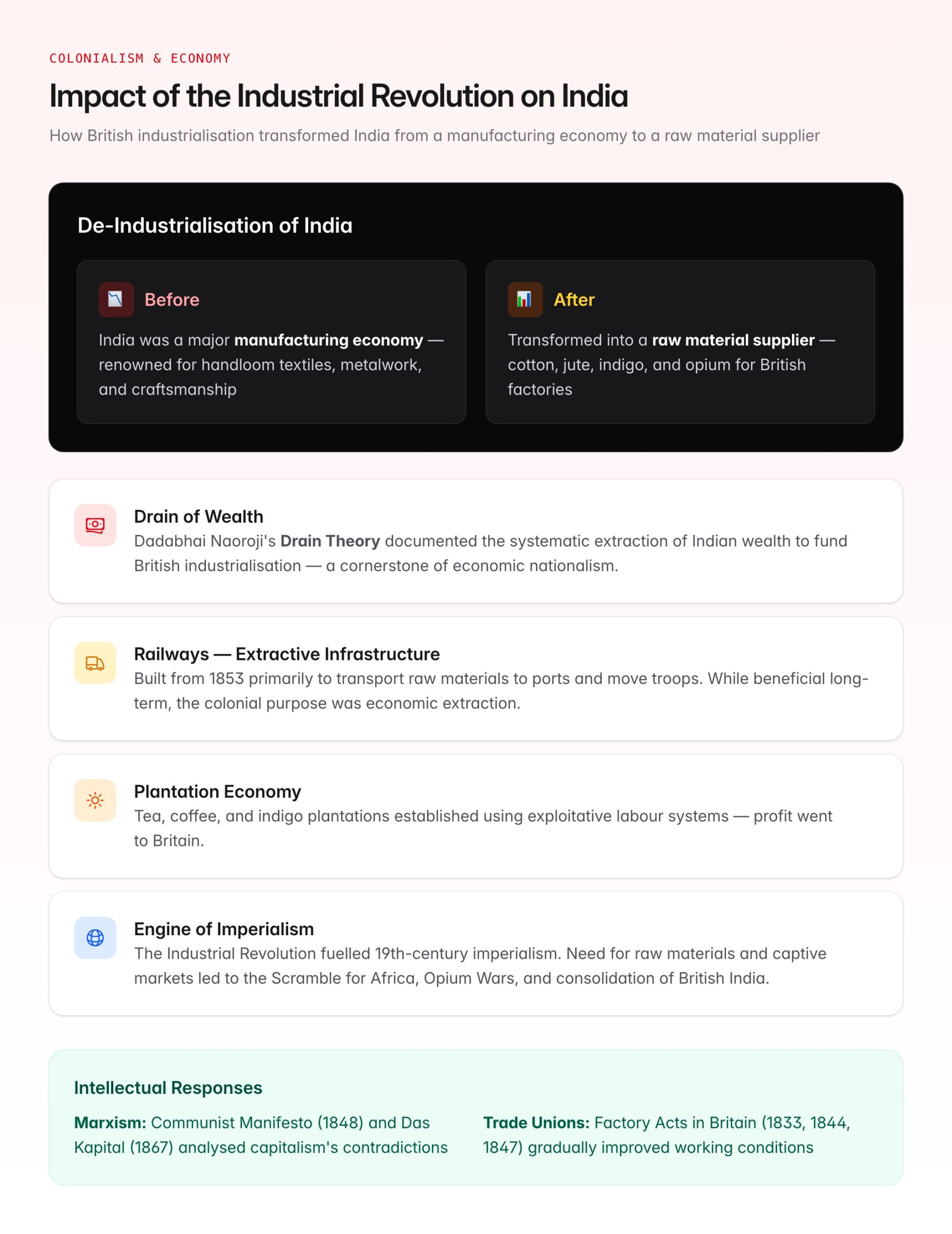
De-industrialisation of India
- British-manufactured goods (especially textiles) flooded Indian markets, destroying India's renowned handloom and handicraft industries.
- India was transformed from a manufacturing economy into a supplier of raw materials (cotton, jute, indigo, opium) for British factories.
- Dadabhai Naoroji‘s Drain Theory documented the systematic extraction of Indian wealth to fund British industrialisation.
Railways and Infrastructure
- The British built an extensive railway network in India (beginning 1853), primarily to transport raw materials to ports and to move troops. While this infrastructure had long-term benefits, its purpose during colonial rule was extractive.
- Plantations (tea, coffee, indigo) were established using exploitative labour systems.
Broader Colonial Impact
The Industrial Revolution was the engine of 19th-century imperialism. Industrialised nations needed raw materials and captive markets, leading to the Scramble for Africa, the Opium Wars in China, and the consolidation of British control over India.
Comparison of All Four Revolutions
| Feature | First | Second | Third | Fourth |
|---|---|---|---|---|
| Period | 1760-1840 | 1870-1914 | 1960s-2000s | 2010s-present |
| Key energy | Steam, water | Electricity, oil | Nuclear, electronics | AI, renewable, fusion |
| Key sector | Textiles, iron | Steel, chemicals, autos | IT, services | AI, biotech, IoT |
| Geography | Britain | US, Germany, France, Japan | Global (US-led) | Global (multipolar) |
| Social impact | Urbanisation, class | Labour rights, unions | Globalisation, outsourcing | Automation, inequality debates |
UPSC Relevance
GS Paper I: World History — Industrial Revolution and its impact; Social changes in modern world. GS Paper III: Indian economy, industrialisation, science and technology. Essay: Frequently tested themes around technology, inequality, and development.
Key Prelims facts:
- The First Industrial Revolution began in Britain around 1760, driven by steam power and the textile industry.
- James Watt improved the steam engine (1769); the Spinning Jenny (Hargreaves, 1764) mechanised spinning.
- The Second Industrial Revolution (1870-1914) was defined by steel, electricity, and the internal combustion engine.
- The Third Revolution centred on computers and the internet (1960s onward).
- The Fourth Industrial Revolution (Klaus Schwab, 2016) involves AI, IoT, robotics, and biotechnology.
- The Industrial Revolution caused de-industrialisation of India, destroying the handloom sector.
- Dadabhai Naoroji's Drain Theory linked British industrialisation to Indian economic exploitation.
- Marxism emerged as a response to industrial capitalism (Communist Manifesto, 1848).
Tell Google you want more of this.
Add Anantam IAS as a preferred sourceOne tap, and this site shows up more often in your own Top Stories, AI Overviews and AI Mode. Remove it any time.